Written by: Matthew Timmins, Founder and Managing Director, Leva Sleep | Last updated: August 6, 2026
Key Takeaways for Canadian Couples
- An integrated sleep system with an adjustable base, zoned hybrid mattress, and cervical accessories works best for couples managing both snoring and back pain.
- Head elevation of 10–30 degrees on an adjustable base opens the airway more effectively than pillow stacking, and the zero-gravity preset also decompresses the lumbar spine to ease back pain.
- Medium-firm mattresses (6–7/10) deliver better outcomes for back pain in clinical studies, and zoned pocket-coil construction helps maintain spinal alignment across different body weights.
- Leva Sleep’s forthcoming spring 2026 anti-snore mode uses sensor detection to raise the head when snoring occurs, and split configurations ensure only the affected partner is adjusted.
- Explore Leva Sleep’s integrated systems designed for Canadian couples managing snoring and back pain.
How Head Elevation Reduces Snoring
The MSD Manual recommends sleeping with the head elevated as a general measure for primary snoring, best accomplished by inclining the entire upper body rather than raising only the head with pillows. Elevating only the head creates a neck-forward angle that can worsen airway restriction instead of relieving it.
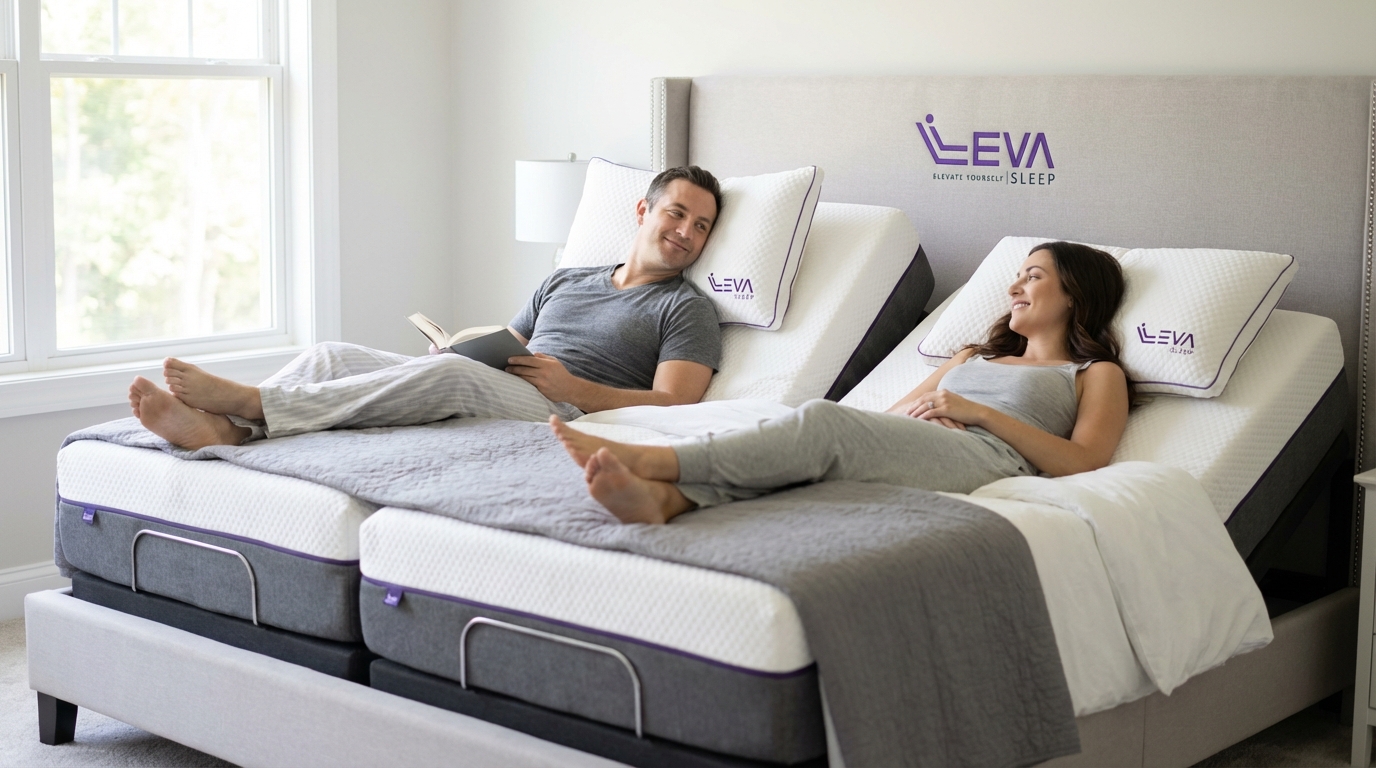
An adjustable base inclines the whole upper body in a controlled way. Elevating the head of an adjustable base by 10–30 degrees can reduce positional snoring by keeping the airway more open, though it is not a medical treatment for obstructive sleep apnea. The zero-gravity preset raises the head about 20–30 degrees and the knees to a similar height, and users report less snoring, lower back pressure, and fewer acid reflux symptoms.
This preset is now standard on most adjustable bases, including Leva Sleep’s lineup. Leva’s bases offer precise head elevation to support airway openness, and the forthcoming anti-snore mode, arriving spring 2026, adds automated detection and micro-adjustment. The base raises the head incrementally when snoring is detected, aiming to avoid waking the sleeper.
Mattress Firmness Levels That Support Back Pain Relief
A randomized, double-blind controlled trial of 313 adults with chronic low-back pain published in The Lancet found that medium-firm mattresses produced less pain in bed, less pain on rising, and less disability at 90 days compared with firm mattresses. A 2021 literature review in the Journal of Orthopaedics and Traumatology reached the same conclusion, linking medium-firm mattresses with reduced nonspecific low back pain and better sleep quality.
Body weight shapes the ideal firmness range. Lighter sleepers under 130 lbs with back pain often do well on medium firmness (5–6/10). Average-weight sleepers (130–220 lbs) usually benefit from medium-firm (6–7/10). Heavier sleepers over 220 lbs tend to need firm (7–8/10) support to prevent midsection sinkage and spinal misalignment.
The connection between back pain and snoring is closer than many couples expect. A 2026 cross-sectional study in Molecular Pain found that individuals with intermediate or high OSA risk reported significantly higher chronic low back pain severity (mean 49.11 vs. 25.48) and pain interference (mean 40.04 vs. 16.84) than those with low OSA risk (p < 0.001), with biological aging pace mediating the relationship. Treating both issues through a single integrated sleep system aligns with this evidence.
NCOA testing of over 130 mattresses, using pressure mapping and input from sleep specialists, doctors, occupational therapists, and physical therapists, highlights zoned support, a medium to medium-firm feel (typically 6–6.5/10), and targeted pressure relief as key features for back sleepers and people with chronic back pain. Leva Sleep’s zoned pocket-coil hybrid options follow this pattern, with distinct wire gauges across body zones and foam comfort layers dense enough to resist premature compression.
How Anti-Snore Technology Works in 2026
Sensor-based anti-snore technology in 2026 relies on real-time detection and automated positional response. These systems analyze breath rate and snoring patterns, then raise the head incrementally, often by about 10–12 degrees, when snoring occurs.
Leva Sleep’s forthcoming spring 2026 anti-snore mode uses this same detection-and-adjustment model. The key distinction is integration. Leva builds the mode into a vertically integrated system where the base, mattress, and accessories are engineered together rather than added to a third-party mattress. Whisper-quiet German motors help ensure the adjustment itself does not become a new disturbance for the non-snoring partner.
For couples where only one partner snores, a split configuration keeps the automated head elevation on the affected side only. The other partner’s position remains unchanged.
Key Buying Factors for a Snoring and Back Pain Sleep System
Several technical details matter when you want relief from both snoring and back pain. Each factor below ties directly to comfort, noise control, or long-term support.
- Motor noise: Quiet motors keep the adjustment mechanism from becoming its own sleep disturbance. Ask for decibel ratings or request a live demonstration so you can hear the motor in action.
- Independent controls: Split configurations with separate remotes or app zones let each partner adjust their side without affecting the other. This matters most when only one partner snores or has back pain.
- Mattress zoning: Zoned coils or foams support different body regions appropriately. Confirm that the mattress uses varied coil gauges or foam densities across zones instead of a single uniform construction.
- Mattress-base compatibility: Some mattresses do not flex cleanly on adjustable bases and can buckle or wear out faster. Verify that the mattress is rated for articulation before pairing it with a base.
- Delivery and setup: Large adjustable systems are heavy and complex. Check whether white-glove delivery is available in your province and what services it includes, such as assembly and old bed removal.
- Warranty coverage: Look for separate, clear warranties for the base and mattress. Coverage should address motor failure, foam compression, and structural components.
- Canadian pricing and availability: Confirm that the retailer ships to your province and that prices are in Canadian dollars with no surprise cross-border duties.
- Split Queen availability: Split Queen suits smaller rooms but is less common than Split King. If you need a Queen footprint, verify that the retailer offers a true Split Queen option.
Split vs. Non-Split Adjustable Bases for Couples
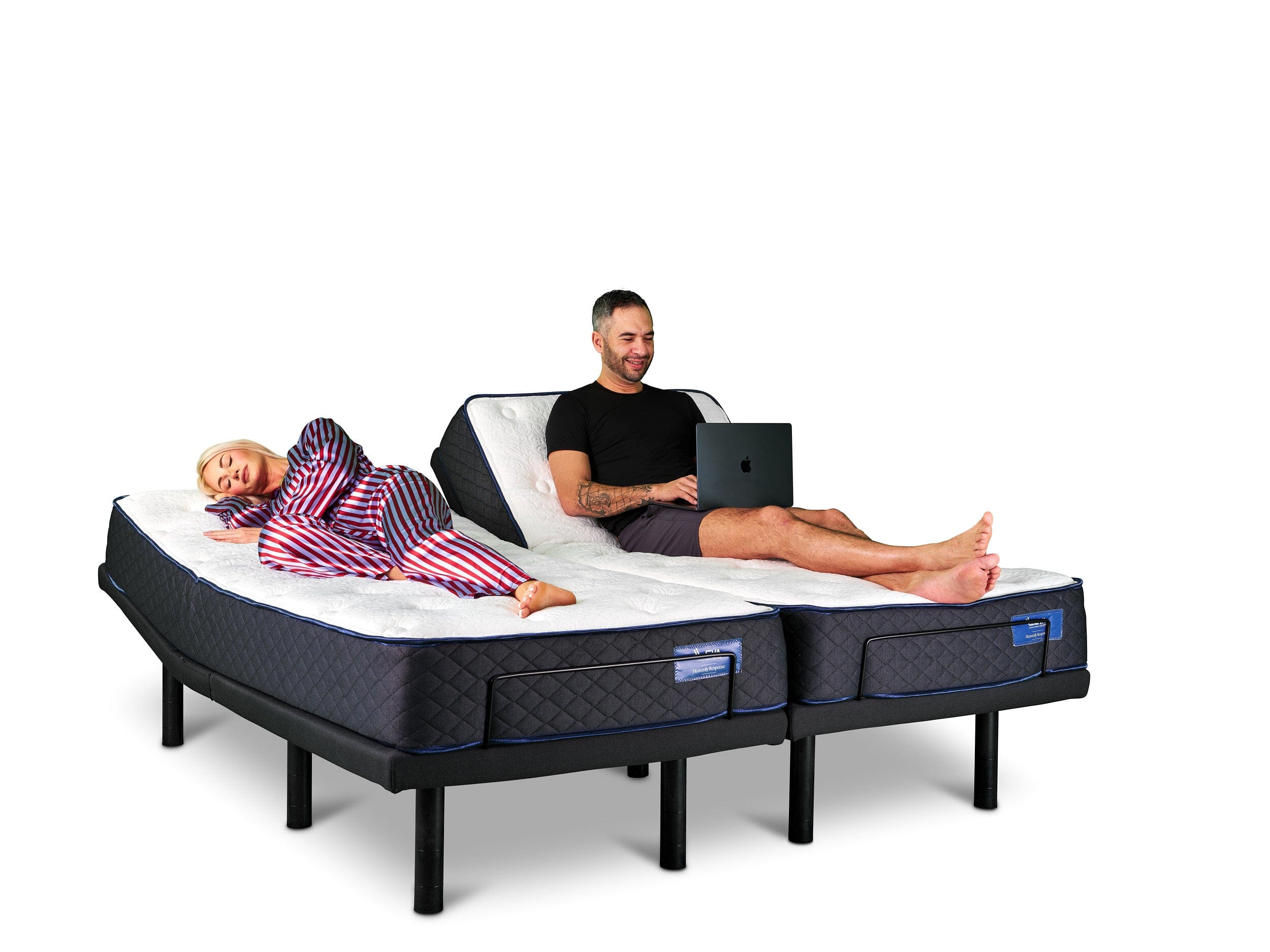
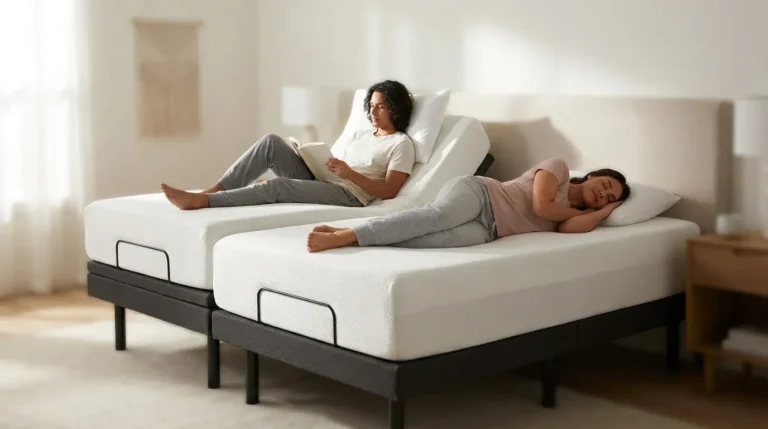
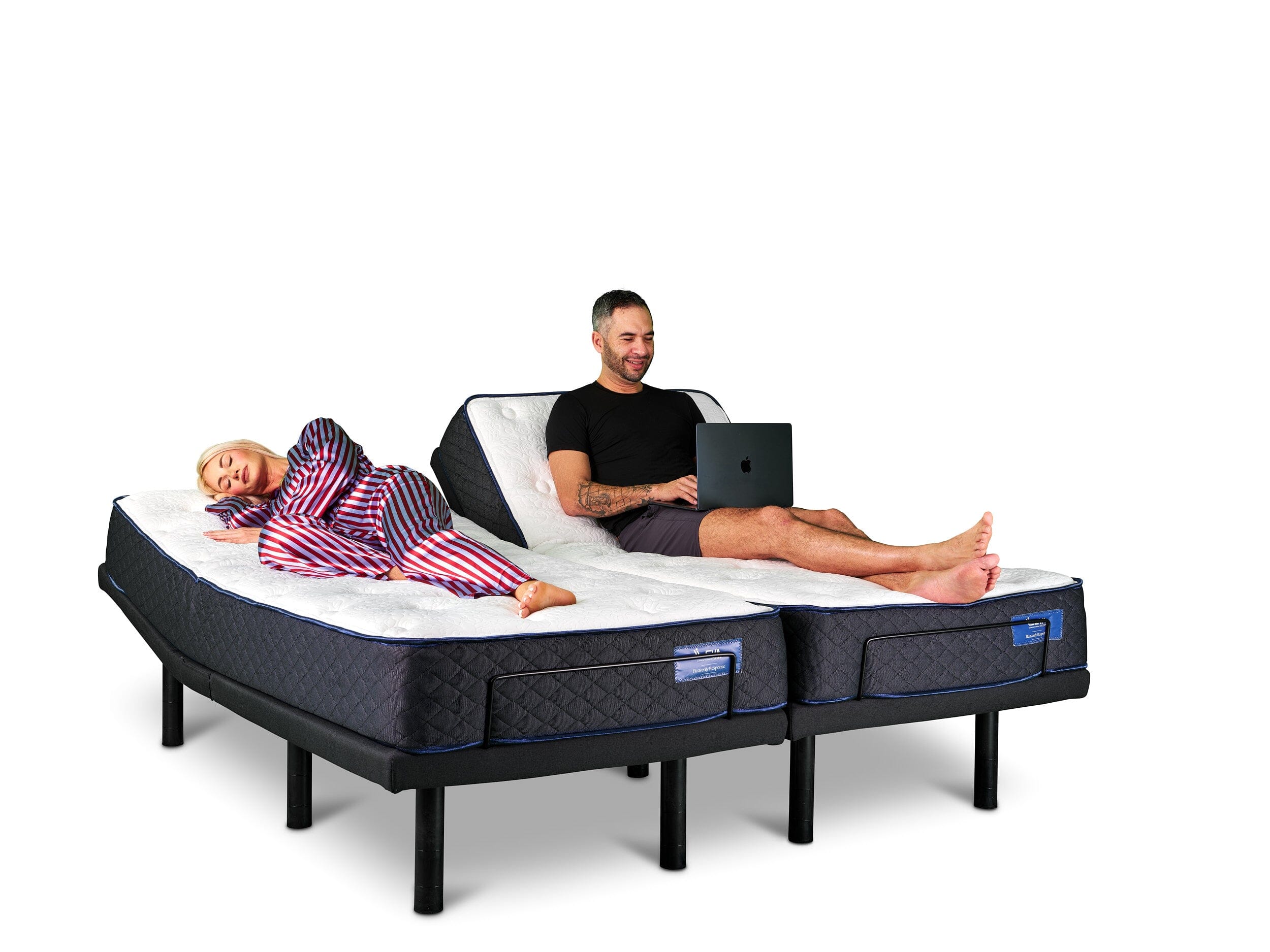
Split king adjustable beds use two twin XL mattresses side by side on an adjustable base, giving each partner independent head and foot control while motion isolation keeps position changes from transferring across the seam.
The table below compares four main configurations a Canadian couple may consider. Pricing reflects approximate Canadian market ranges as of 2026.
| Feature | Split Adjustable Base (Leva Sleep) | Non-Split Adjustable Base | Luxury Split Base (e.g., Tempur-Pedic Ergo Smart) |
|---|---|---|---|
| Independent head/foot control per partner | Yes, each side fully independent | No, both partners adjust together | Yes, Split King pairs two Twin XL bases |
| Motion isolation between partners | Yes, position changes do not transfer across the seam | No, any adjustment affects both sides | Yes, same motion isolation benefit |
| Anti-snore capability | Forthcoming spring 2026 automated mode; manual elevation available now | Manual elevation only; affects both partners simultaneously | Sleeptracker-AI Snore Response™ raises head about 12° automatically |
| Approximate Canadian price premium vs. Leva | Baseline | Lower upfront; limited long-term utility for couples | 30–50% higher than Leva equivalent configurations |
Potential drawbacks of split configurations include a seam between the two mattresses that may feel uneven if the mattresses are not properly secured, and the need for two separate fitted sheet sets. Leva Sleep addresses both with purpose-built bedding accessories that have deep pockets and extra elastic for split adjustable setups.
Why Leva Sleep’s Vertical Integration Helps Canadian Buyers
Leva Sleep has operated for over 8 years and has generated more than $50M in lifetime sales across 25,000+ Canadian customers. This track record comes from a focused model built around adjustable sleep systems rather than general bedding.
Vertical integration covers every stage of the product lifecycle. Leva designs bases and mattresses together so mattress flex characteristics match the base’s articulation range. Whisper-quiet German motors power the adjustments. Local Ontario and Alberta assembly removes the manufacturing markup that often appears in traditional wholesale and retail chains. In-house white-glove delivery, available for a fee, includes bedroom delivery, full assembly, leg-height adjustment, a product tutorial, and removal of the old bed.
This structure produces a significant cost advantage compared with luxury competitors offering similar features. Leva also offers a distinctive option in the Canadian market: the Split Queen adjustable base, built for couples who want independent control in a Queen-sized footprint rather than a King.
Frequently Asked Questions
What is the best anti-snore device in Canada?
Effective anti-snore solutions for Canadian couples in 2026 fall into three main categories: CPAP machines prescribed for diagnosed obstructive sleep apnea, mandibular advancement devices fitted by a dentist, and positional therapy through head-of-bed elevation. For couples where snoring is positional rather than tied to a diagnosed apnea condition, an adjustable base with automated anti-snore capability targets airway collapse during back sleeping without a mask or mouthpiece.
Leva Sleep’s forthcoming spring 2026 anti-snore mode detects snoring and makes micro-adjustments to the head of the bed automatically. For couples with one snoring partner, a split adjustable base keeps the elevation on the affected side only, leaving the other partner’s position unchanged. Canadians in Ontario and Alberta can access Leva Sleep’s full system with in-house white-glove delivery.
What is the Japanese trick for sleep apnea?
The “Japanese trick” mentioned in sleep forums usually refers to positional therapy. This includes sleeping on one’s side instead of the back or elevating the upper body to prevent the tongue and soft palate from collapsing into the airway during sleep. The name is informal, but the mechanism is well established. Supine sleeping increases airway obstruction in positional sleep apnea, and lateral or elevated positioning can reduce it.
An adjustable base handles the elevation component more effectively than a wedge pillow because it inclines the entire upper body rather than only the head, which matches the method recommended by the MSD Manual for snoring relief. For diagnosed obstructive sleep apnea, positional therapy supports but does not replace medically supervised treatment. A physician or sleep specialist should guide diagnosis and care.
Does the pillow trick work against sleep apnea?
The “pillow trick,” which involves stacking pillows under the head, is a common home remedy for snoring and mild positional sleep apnea. Its benefit is limited because raising only the head creates a neck-forward angle that can increase airway restriction instead of opening it. The MSD Manual advises against using pillows to raise only the head for snoring relief and recommends inclining the entire upper body.
A cervical support pillow designed for adjustable bases can improve head and neck alignment once the base is elevated. The pillow alone, however, does not match the effect of full upper-body inclination. Couples seeking a durable, adjustable solution often do better with an adjustable base that provides appropriate head elevation, paired with a compatible cervical pillow.
Conclusion: Choosing the Right Sleep System in 2026
Canadian couples managing snoring and back pain together benefit from a system where every component works in sync. Key criteria include independent per-partner control, full upper-body elevation instead of head-only pillow stacking, a zoned hybrid mattress in the medium-firm range, and a retailer with the expertise and logistics to deliver and set up the system correctly.
Evidence from 2026 links OSA risk directly to chronic low back pain severity, so addressing both conditions through a single integrated sleep system reflects a coherent clinical approach. Automated anti-snore technology, now available from luxury brands and arriving in Leva Sleep’s lineup this spring, removes the need for manual nighttime adjustments.
For buyers in Ontario and Alberta, Leva Sleep’s vertically integrated model, with 8 years of experience, 25,000+ customers, 15–20 adjustable base models, and Split Queen availability, offers a comprehensive Canadian-focused option. Compare motor noise, independent controls, mattress zoning, and delivery logistics across any systems you consider, and confirm that the mattress and base are engineered to work together before you purchase.