
Written by: Matthew Timmins, Founder and Managing Director, Leva Sleep | Last updated: June 23, 2026
Key Takeaways
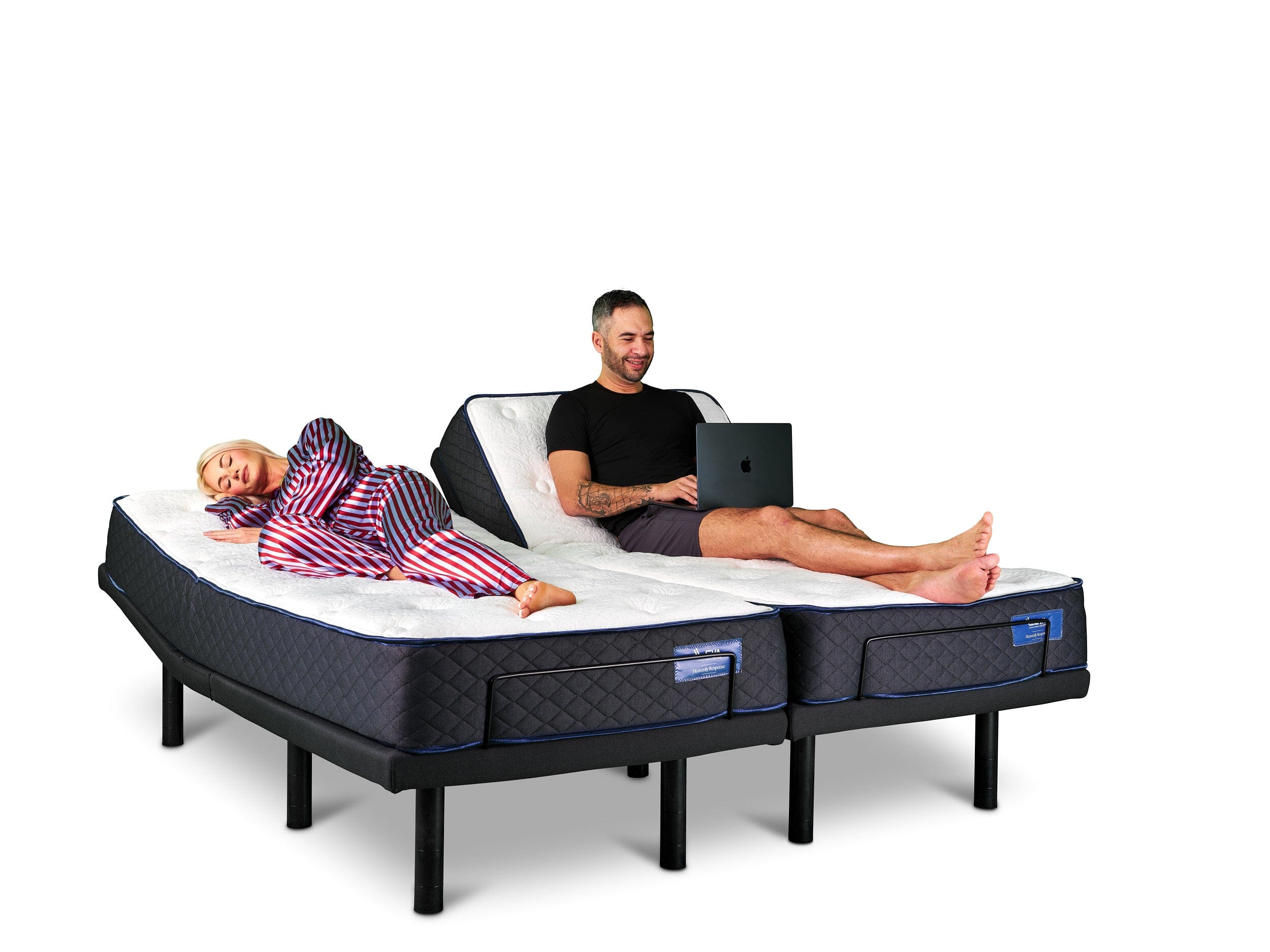
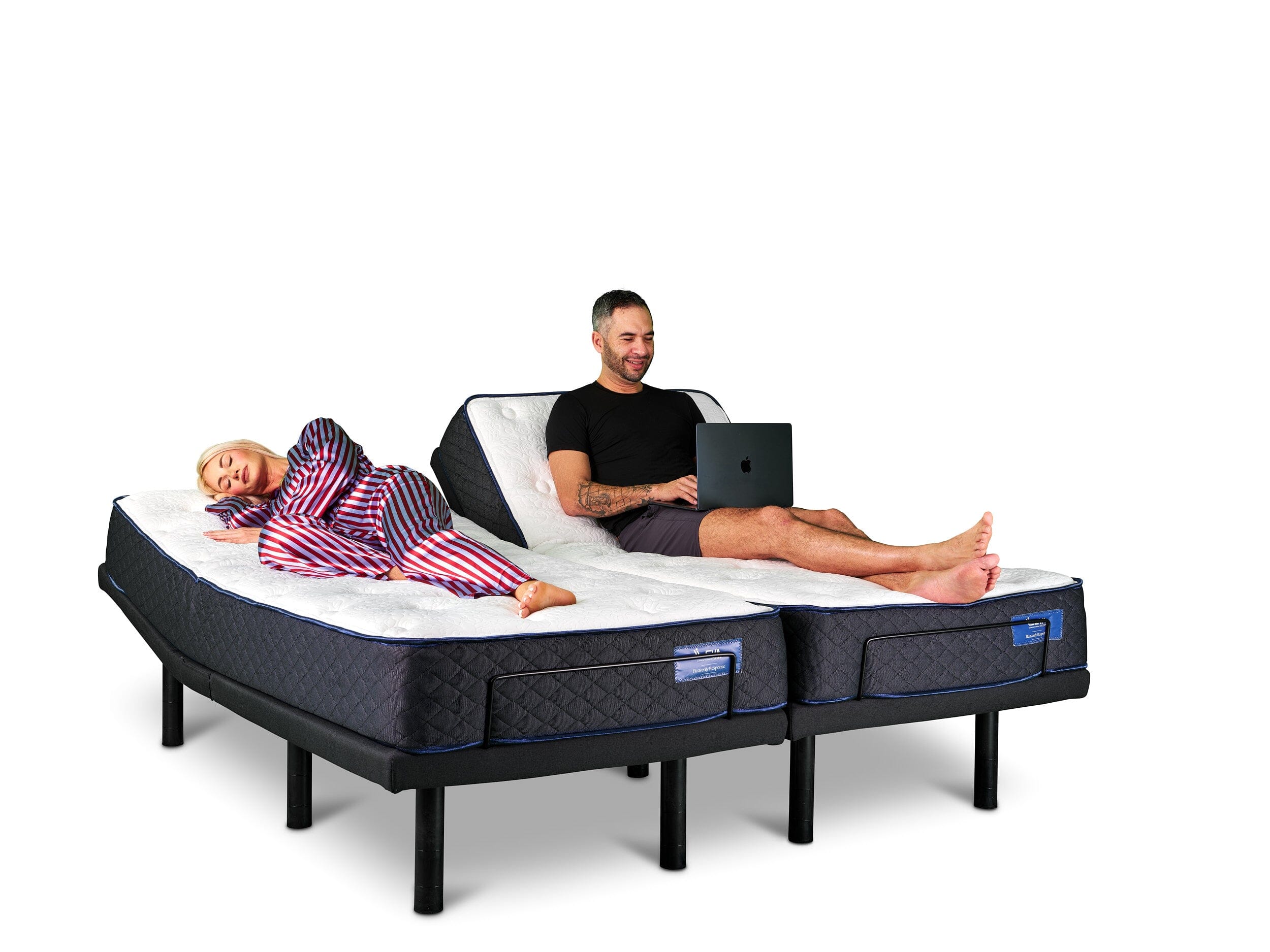
- A split queen adjustable bed uses two independent 30×80-inch bases so each partner can adjust elevation and contouring separately within a standard queen footprint.
- Side sleepers benefit most from bases that offer lumbar support and pillowtilt motors, which target shoulder and hip pressure points while maintaining spinal alignment.
- Key evaluation criteria include true 30×80 dimensions, motor noise levels, white-glove delivery availability, and compatibility with flex-rated mattresses.
- Leva Sleep provides whisper-quiet German motors, in-home white-glove delivery in Ontario and Alberta, and purpose-built sheets designed for elevation without slippage.
- Explore Leva Sleep’s full range of adjustable bed packages designed for Canadian couples here.
Quick-Read Overview for Canadian Side Sleepers
Side sleepers in Canada comparing split queen adjustable beds should focus on four priorities. Look for true 30×80 independent sides rather than twin-XL workarounds, pressure-relief zoning at the shoulder and hip, motor noise measured at one metre from the bed, and white-glove delivery that includes in-room setup and height adjustment. Pillowtilt and lumbar motors sit in a secondary tier of features yet still make a clear difference for spinal alignment, especially for side sleepers. Anti-snore mode, available on Leva Sleep's platform from spring 2026, adds a fifth consideration for couples where one partner snores.
Why a True 30×80 Split Queen Fits Ontario and Alberta Bedrooms
A standard queen mattress measures 60×80 inches. A split queen divides that width into two 30-inch sides rather than two 38-inch twin-XL sides. The 30×80 configuration preserves the familiar queen footprint, fits standard queen bed frames, and suits the bedroom dimensions common to Ontario and Alberta homes without a frame upgrade or a larger room. Twin-XL workarounds, by contrast, produce a 76×80-inch surface, which is four inches narrower than a queen, and require a king-sized frame, king-sized bedding, and a visible centre gap that standard queen sheets cannot bridge.
Leva Sleep builds its Split Queen bases to the 30×79.5 specification and designs its fitted sheets with deep pockets and reinforced elastic to accommodate elevation without the sheet pulling free, a persistent complaint with standard bedding on adjustable bases. Beyond the physical dimensions and bedding compatibility, understanding how the base's motors and features work together helps you decide whether it will solve your specific sleep issues.
How Leva’s Split Queen Supports Firmness, Contouring, and Quiet Operation
Side sleepers need a mattress that allows the shoulder and hip to sink slightly while keeping the lumbar spine level. On a flat base, this balance depends entirely on mattress firmness. On an adjustable base with a lumbar motor, the base itself can provide targeted lift beneath the lower back. This reduces the firmness burden on the mattress and allows a softer surface that better relieves shoulder and hip pressure.
Pillowtilt, a secondary motor that adjusts only the head zone of the mattress, lets side sleepers fine-tune neck angle without raising the entire upper body. This feature matters for side sleepers who experience neck stiffness from stacking pillows or from fixed head positions. Independent pillowtilt also helps couples where one partner prefers a steeper head angle than the other.
Motor noise affects comfort in shared bedrooms, especially when one partner adjusts their side while the other sleeps. To evaluate this, ask the retailer for the decibel rating at one metre during movement. Leva Sleep uses whisper-quiet German motors across its adjustable base range to reduce disruption at night. Beyond noise, the base's zero-gravity presets distribute body weight across the surface to reduce pressure at any single point, and on Leva's app-controlled platform, each partner can save these positions independently for quick access.
Who Benefits Most from a Split Queen in Ontario and Alberta
This configuration suits couples in Ontario and Alberta where one or both partners are side sleepers with shoulder or hip discomfort on a flat mattress. It also helps couples with meaningfully different firmness preferences, couples where one partner snores or has been advised to sleep with the head elevated for airway management, and couples whose previous adjustable bases were too loud or lacked fine-tuned adjustability.
Leva Sleep's customers often include couples who have already tried softer mattresses or basic adjustable bases and still wake with pressure or alignment issues. The split queen format directly addresses the space constraint that leads many couples to dismiss split configurations because they assume a king-sized room is required.
Key Buying Checks Before You Choose a Split Queen
- Firmness: Side sleepers typically sleep better on medium to medium-soft surfaces, roughly 4 to 6 on a 10-point scale, which allow shoulder and hip contouring. Confirm the mattress options available with any adjustable base and whether they are designed to flex with the base without voiding the warranty.
- Spinal alignment: Choose bases that offer both head elevation and lumbar support as independent motors. A base with only head elevation cannot correct lower-back curvature for side sleepers.
- Motor noise: Request a decibel specification or an in-store demonstration before purchasing. Motors that exceed 45 dB at one metre are loud enough to wake a light sleeper in a quiet room.
- True 30×80 availability: Confirm the base ships as two separate 30-inch units rather than a single queen unit with a cosmetic split.
Trade-offs and Limitations to Confirm in Advance
Several practical limitations deserve attention before you place an order.
- Sheet slippage: Standard queen fitted sheets are not designed for elevation beyond 30 degrees. Confirm whether the retailer offers purpose-built sheets with deep pockets and reinforced elastic.
- Remote reach: Wireless remotes and app control remove cable clutter but rely on Bluetooth proximity. Confirm the app's range and whether it functions without a persistent internet connection.
- Centre gap: Two independent 30-inch bases create a small gap at the centre seam. A mattress bridge or purpose-built split queen mattress reduces this. Ask the retailer what gap management solution is included.
- Decibel level at one metre: Verify this figure directly with the manufacturer or retailer. Avoid relying on subjective descriptors like "quiet" without a measurable reference.
- Weight capacity per side: Confirm the per-side weight rating, not just the combined rating, so the base supports both partners safely.
Setup, Ownership Experience, and Canadian White-Glove Delivery
Adjustable bed bases are heavy, multi-component systems that can be difficult to move and assemble. Curbside delivery leaves the full assembly burden with the customer and increases the risk of incorrect setup, especially for leg height adjustment, which determines whether the base sits flush with an existing bed frame.
Leva Sleep offers in-house white-glove delivery to Ontario and Alberta for a fee. The service includes delivery to the bedroom, full assembly, leg height adjustment to the customer's specification, old bed removal with donation or recycling where available, and a product tutorial covering app setup, preset positions, and accessory use. Trained Leva staff, not third-party couriers, perform this service.
First-time split queen buyers gain particular value from the tutorial component. Clear guidance on saving independent positions for each side, activating zero-gravity or anti-snore presets, and pairing the app correctly reduces the friction that often causes people to underuse an adjustable base's features.
Common Split Queen Mistakes to Avoid
- Choosing twin-XL workarounds: A split configuration built from two twin-XL bases produces a 76-inch-wide surface in a king-sized frame. This setup requires new bedding, a larger frame, and often a larger room, and retailers rarely highlight these trade-offs clearly.
- Ignoring motor noise: A base that sounds acceptable in a busy showroom can feel disruptive at 2 a.m. in a quiet bedroom. Always request a decibel specification.
- Overlooking specialized bedding: Standard fitted sheets pull free at moderate elevation angles. Purchasing a base without confirming compatible bedding availability often leads to frustration within the first week of use.
- Assuming all adjustable bases flex safely with all mattresses: Foam and hybrid pocket-coil mattresses respond differently to articulation. Confirm that the mattress is rated for use with an adjustable base before purchase.
FAQ
Which adjustable bed works best for side sleepers?
Side sleepers benefit most from an adjustable base that offers independent lumbar support and pillowtilt motors in addition to standard head and foot elevation. These features provide targeted support beneath the lower back and independent neck-angle adjustment, both relevant to the shoulder and hip pressure points common in side sleeping. A base with only head elevation can help with snoring and acid reflux but does not directly improve spinal alignment for side sleepers. Look for a base paired with a medium to medium-soft mattress designed to flex with the base without warranty restrictions.
What firmness does a side sleeper need?
Side sleepers generally sleep better on medium to medium-soft mattresses, typically a 4 to 6 on a 10-point firmness scale, because these surfaces allow the shoulder and hip to sink enough to keep the spine level. A mattress that is too firm creates a pressure gap at the waist and forces the spine into lateral curvature. A mattress that is too soft allows the hip to sink excessively, which creates the opposite curvature. On an adjustable base with lumbar support, the base can partially compensate for a firmer mattress by providing lift beneath the lower back, which gives couples with different firmness preferences more flexibility when choosing a shared mattress.
What are the common problems with split queen adjustable beds?
The most frequently reported problems include a centre gap between the two independent bases that creates an uneven sleeping surface near the middle of the bed, standard fitted sheets pulling free during elevation, motor noise disrupting the non-adjusting partner, and confusion between true 30×80 split queen configurations and twin-XL workarounds sold under the "split queen" label. Purpose-built split queen mattresses, deep-pocket fitted sheets with reinforced elastic, whisper-quiet motors, and clear dimensional confirmation from the retailer address these issues before purchase.
Are any adjustable beds made in Canada?
Leva Sleep designs its adjustable bed systems in-house and assembles them in the Canadian regions it serves, Ontario and Alberta, while overseeing international component manufacturing. This local assembly model allows Leva to maintain quality control, reduce the markup associated with third-party manufacturing, and offer direct-to-consumer pricing that is 30 to 50 percent lower than comparable luxury competitors. Most adjustable bed bases sold in Canada are manufactured by Leggett & Platt (USA) or Ergomotion, with some brands private-labeling from them or building their own in Canada.
How does white-glove delivery work for a split queen adjustable bed in Canada?
Leva Sleep's white-glove delivery service, available in Ontario and Alberta for a fee, covers delivery directly to the bedroom, full assembly of the base and accessories, leg height adjustment, old bed removal, and a hands-on product tutorial. Trained Leva staff, rather than third-party couriers, complete the visit. For a split queen specifically, the setup includes pairing both 30-inch bases, confirming the centre gap management, and walking both partners through independent app control and preset configuration. Scheduling is handled directly with Leva, not through a logistics intermediary.
Conclusion: A Space-Efficient Path to Independent Comfort
Evaluating a split queen adjustable bed for side sleeping in Canada comes down to three verifiable criteria. Confirm true 30×80 independent adjustability instead of a twin-XL workaround, pressure-relief features including lumbar and pillowtilt motors suited to shoulder and hip contact points, and a delivery model that includes in-room setup and product training. Couples in Ontario and Alberta who have already tried softer mattresses and basic adjustable bases without resolving differing firmness needs or snoring disruption often find the split queen format the most space-efficient path to independent comfort in a shared bed.