Written by: Matthew Timmins, Founder and Managing Director, Leva Sleep | Last updated: July 16, 2026
Key Takeaways for Sleep-Incompatible Couples
- Sleep incompatibility from snoring, temperature differences, and mild OSA often pushes couples toward sleep divorce, which harms rest and relationship quality.
- Common fixes like earplugs, separate duvets, and wedge pillows treat isolated symptoms and leave core sleep issues unresolved.
- Split adjustable sleep systems give each partner independent head and foot positioning, clinically supported elevation, and quiet motors so couples can stay in one bed.
- Key evaluation criteria include independent adjustability, elevation range for medical needs, whisper-quiet motors, temperature compatibility, and professional white-glove delivery.
- Leva Sleep offers Split King and Split Queen systems purpose-built for Canadian couples—shop Leva Sleep’s adjustable bed packages to restore shared, restorative sleep.
Why Everyday Sleep Fixes Rarely Solve the Problem
Most couples try a predictable series of fixes before they seriously consider sleeping in separate rooms. Each fix targets one symptom and leaves the underlying incompatibility in place.
Earplugs and white-noise machines can soften sound but do nothing for motion transfer, temperature clashes, or the snoring partner’s own disrupted sleep from apnea events. Standard foam earplugs alone recovered 72% of deep sleep lost to environmental noise and outperformed pink noise, which showed only minor dose-dependent benefits and could reduce REM sleep, yet earplugs still function as a coping tool rather than a true solution.
The Scandinavian method, where each partner uses a separate duvet, eases temperature and blanket-stealing conflicts. It does not address snoring, motion transfer, or elevation needs.
Wedge pillows lock sleepers into a fixed elevation angle that cannot be fine-tuned, often shift during the night, and apply the same incline to both partners on a shared mattress. An adjustable bed frame elevating the head 15–20 degrees offers consistent positional therapy for snoring reduction without wedge pillows that can shift during sleep.
Beyond these temporary accessories, the bed itself often becomes the limiting factor. Traditional flat beds, even premium ones, cannot accommodate independent positioning. One partner’s elevation need forces the other into the same angle. Basic adjustable bases sold as add-ons at general furniture retailers often make things worse. They may use loud motors that wake a light sleeper, offer limited independent control on a shared surface, and pair with mattresses not engineered to articulate properly. Split-king adjustable base configurations allow each partner to independently adjust their head and foot positions without affecting the other, a capability missing from single-surface bases at any price.
None of these workarounds address the full cluster of issues that often appear together in couples aged 35–70. These include snoring, apnea, GERD, hip or knee pain, temperature regulation, and firmness preference.
How Split Adjustable Sleep Systems Resolve Incompatibility
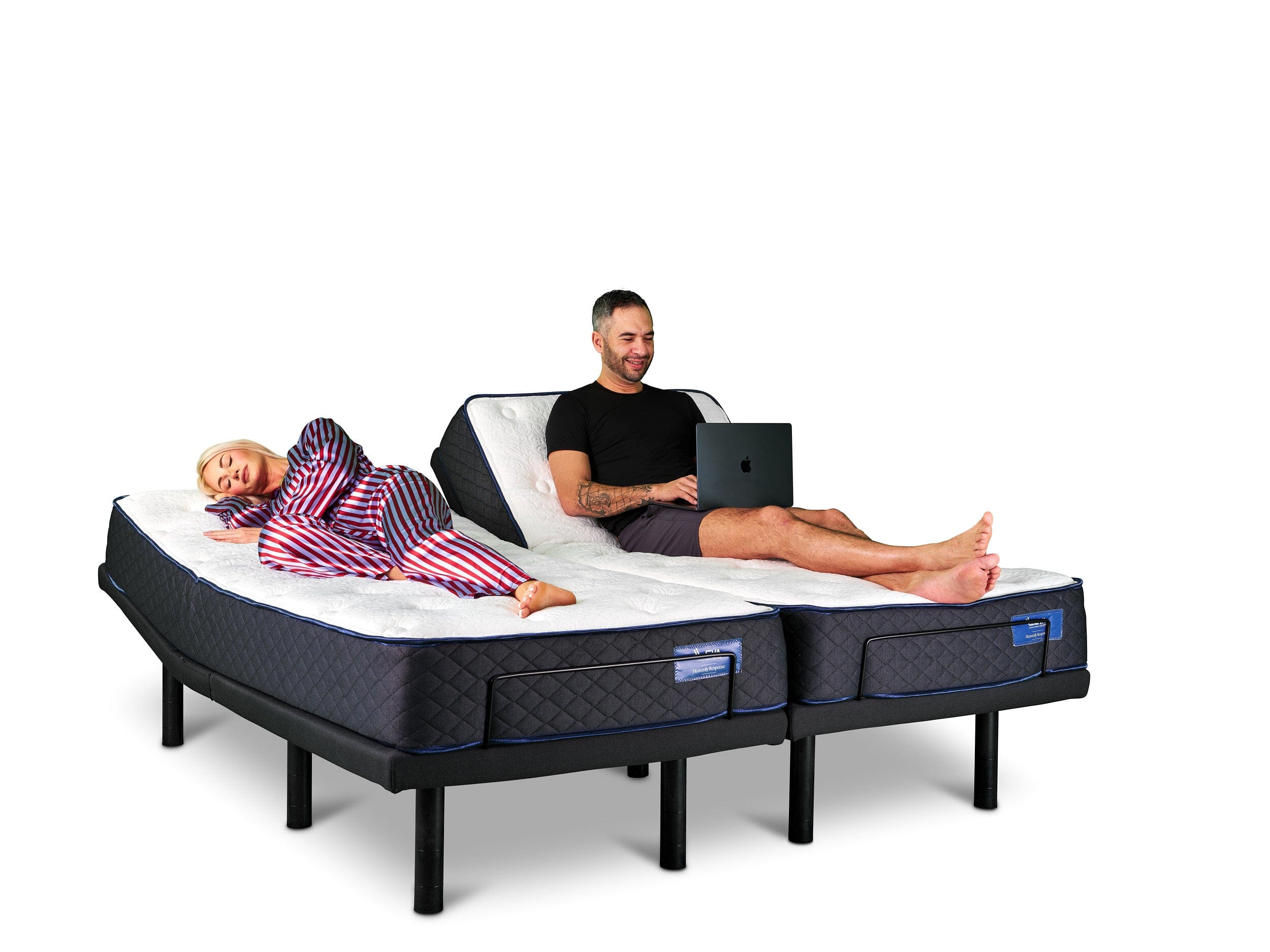
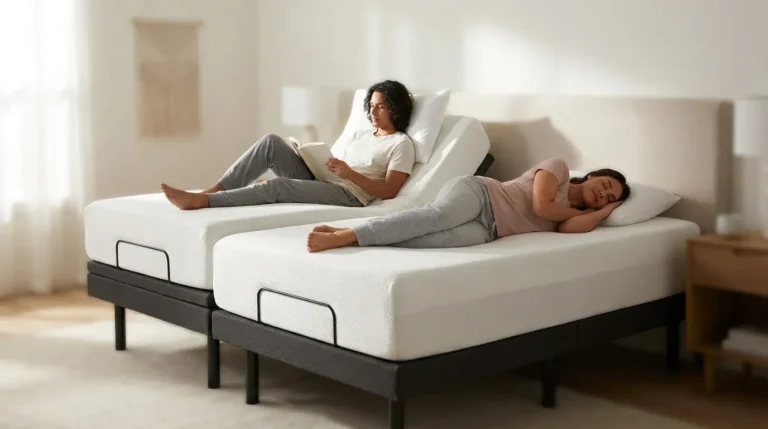
Split adjustable sleep systems directly target the root causes of sleep incompatibility while keeping couples in the same bed. Unlike single-surface adjustable bases or flat beds, split configurations give each partner a fully independent sleep surface with separate motors, separate controls, and separate elevation profiles.
A 2017 study of 52 patients with mild to moderate OSA found that 7.5-degree head-of-bed elevation can decrease the apnea-hypopnea index (AHI) and improve oxygen saturation. At 30° head-of-bed elevation in a 2022 POSA study, mean AHI fell from 23.8 to 17.7 events/h. The 2017 study instead tested 7.5° elevation. On a split system, only the affected partner’s side elevates while the other side remains flat.
Leva Sleep has spent over eight years and $50M in lifetime sales developing split adjustable systems specifically for Canadian couples. The product line includes both Split King, which uses two Twin XL bases, and the uniquely available Split Queen, a configuration built for couples who want independent adjustability in a more space-conscious footprint. Whisper-quiet German motors, Bluetooth app control, anti-snore presets, and integrated heating and cooling compatibility come standard across the lineup. White-glove delivery to Ontario and Alberta includes old bed removal, full setup, leg-height adjustment, and a product tutorial, so couples avoid the typical “bed in a box” burden.
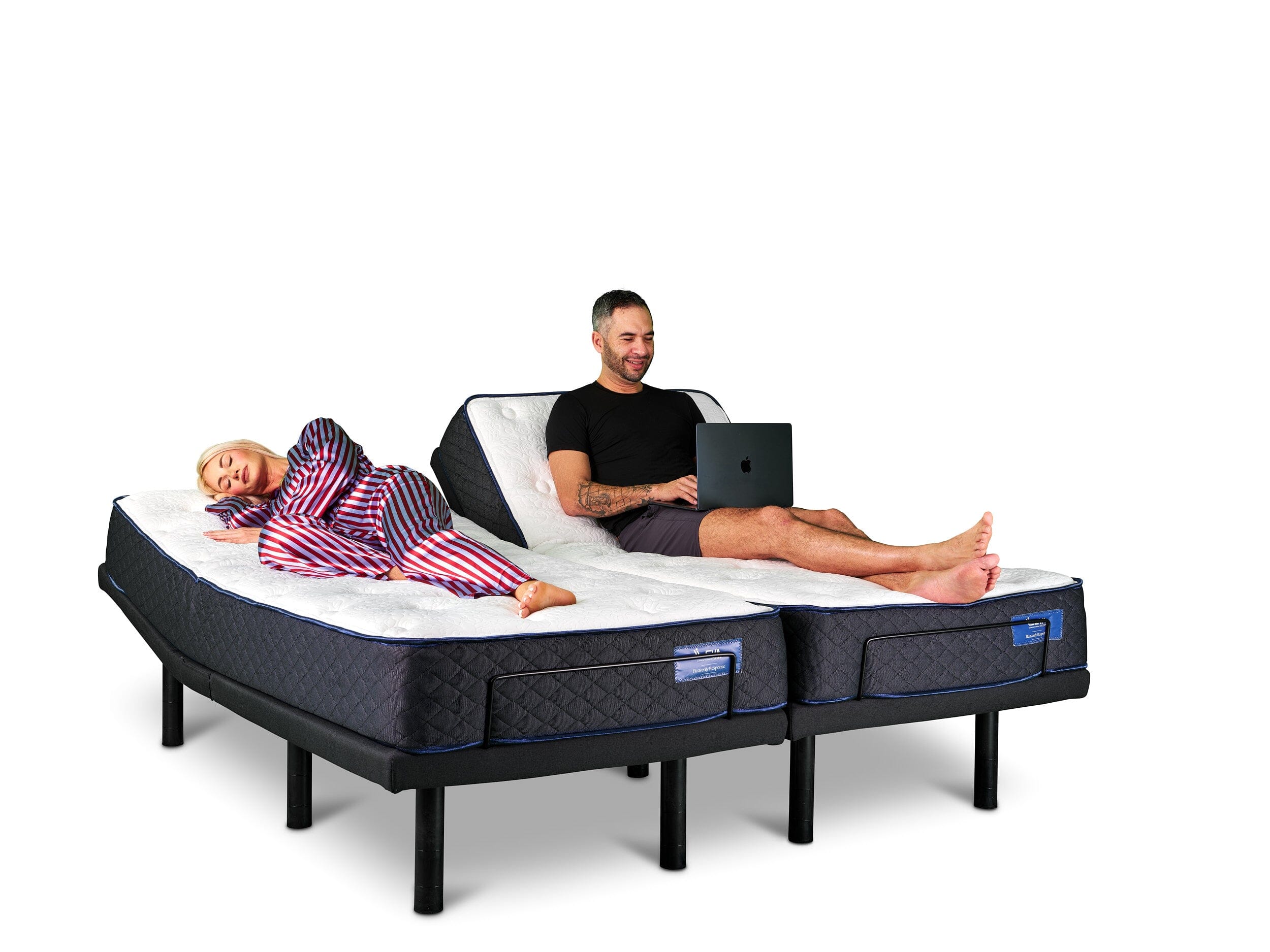
Leva Sleep’s direct-to-consumer model keeps pricing 30–50% below comparable luxury competitors. This approach makes a medical-grade sleep solution financially reachable for many households.
Explore Split King and Split Queen configurations with white-glove delivery to Ontario and Alberta.
What to Look For in a Split Adjustable Sleep System
Couples comparing split adjustable systems can use the following criteria to guide a purchase.
- Independent adjustability for each partner. Confirm that the system uses two fully separate bases with independent motors and remotes, not a single base with a split surface. This distinction matters because only true dual-base systems eliminate motion transfer and allow full independence. Split King configurations carry a price premium over standard King bases in Canada, and that premium buys complete positional freedom for both partners. For couples who need that independence but cannot fit a King, Leva Sleep’s Split Queen delivers the same dual-base architecture in a smaller footprint.
- Head and foot elevation range for medical needs. Head elevation can help reduce snoring, per research in the Journal of Clinical Sleep Medicine. Clinical guidelines from the Canadian Sleep Society’s 2022 Clinical Practice Guidelines note that positional therapy including head elevation is an effective complementary approach for positional snoring and mild sleep apnea. For GERD, elevating the head is a recommended intervention. Confirm that the base offers the clinically supported elevation ranges discussed earlier and includes a zero-gravity preset for back pain and circulation.
- Whisper-quiet motors and app control. Motor noise is a primary complaint with basic adjustable bases. Leva Sleep’s systems use German-engineered quiet motors to minimize disturbance. Bluetooth app control supports custom sleep position memory, vibrating alarms, and anti-snore preset activation without waking a partner.
- Temperature regulation compatibility. Couples with thermal mismatches should confirm that the base works with integrated heating and cooling pads that operate independently on each side. Leva Sleep’s systems support this integration so one partner can sleep cool while the other uses gentle warmth.
- Mattress and bedding compatibility. All-foam, latex, and flexible foam-coil hybrid mattresses are compatible with adjustable bases, while traditional continuous-coil innerspring mattresses and those thicker than 14 inches are typically incompatible and may void warranties. Leva Sleep designs its own all-foam and hybrid pocket-coil mattresses specifically for articulation. Bedding accessories such as deep-pocket fitted sheets with extra elastic, duvet clips, and remote pockets are engineered to stay in place through elevation cycles.
- White-glove delivery and setup in Ontario and Alberta. Large adjustable systems benefit from professional installation. Leva Sleep’s in-house delivery team manages bedroom delivery, full assembly, leg-height customization, old bed removal, and a hands-on product tutorial. This team is not a third-party courier and works only with models they know in detail.
Benefits Couples See When They Restore Shared Sleep
Addressing root causes of sleep incompatibility creates benefits that extend far beyond quieter nights.
Reduced conflict and improved relationship quality. A 2024 meta-analysis of more than 40,000 participants found a consistent association between higher relationship quality and better sleep outcomes, including longer sleep duration and improved sleep quality. The relationship between sleep and marital satisfaction runs in both directions, so gains in one area support the other.
Health support for apnea and pain without relying only on masks. Head elevation on a split adjustable base provides a non-invasive complement to medical treatment. For mild to moderate obstructive sleep apnea, head-of-bed elevation reduces gravitational pull on soft tissue in the airway, decreasing obstruction frequency; it serves as a meaningful complement to CPAP therapy but is not a replacement, according to clinical guidelines recommending 15–20° elevation. For hip, knee, and lower back pain, research in the Journal of Physical Therapy Science (2015) found that a back care pillow improved outcomes as an adjuvant therapy for chronic non-specific low back pain.
Maintained sleep-wake alignment and intimacy. A 2020 study published in Frontiers in Psychiatry found that couples sleeping together showed increased REM sleep and greater synchronization of sleep stages compared to sleeping individually. Staying in the same bed, even on independent surfaces, preserves the neurobiological and relational benefits of co-sleeping that separate rooms remove.
Restore shared sleep with a Leva Sleep split system and support both health and relationship satisfaction.
Comparing Basic Hacks, Flat Beds, and Split Systems
Couples usually move through three tiers of solutions as they search for relief. The comparison below outlines how each tier performs on the criteria that matter most for sleep-incompatible couples.
When assessing basic hacks such as earplugs, white noise, separate duvets, and wedge pillows, remember that these tools address single symptoms in isolation. They provide no independent positioning, create no motor noise risk, offer no proven medical efficacy for apnea or GERD, require minimal investment, and include no delivery support. They work as a first step but rarely meet the needs of couples with multiple or medically driven incompatibilities.
Traditional flat beds and single-surface adjustable bases maintain a shared sleep surface but cannot provide independent positioning. Single-surface adjustable bases introduce motor noise as a new risk, offer limited medical benefit because both partners must accept the same angle, and usually come through general retailers without specialized setup support. Mattress compatibility varies widely and often goes undisclosed at the point of sale.
Split adjustable sleep systems, particularly Split King and Leva Sleep’s Split Queen, provide fully independent head and foot positioning for each partner, whisper-quiet motor operation, clinically supported elevation ranges for snoring, OSA, GERD, and pain, and long-term value through durable engineering. White-glove delivery with professional setup in Ontario and Alberta further reduces friction. Mattress compatibility is built in when couples purchase an integrated package. The main tradeoff is a centre gap between the two bases, which connector straps and a unified top pad help minimize.
Frequently Asked Questions About Split Adjustable Beds
How do split adjustable systems work when only one partner needs elevation?
Split adjustable systems are built for this kind of asymmetry. Each base runs on its own motor and remote, so one partner can elevate their head to 20–30 degrees for snoring or apnea relief while the other remains completely flat. There is no mechanical linkage between the two sides. The non-elevating partner feels no movement, hears no extra noise from the other motor, and experiences no change to their sleep surface. This independence is the key advantage of a true split configuration over a single-surface adjustable base, where any elevation change affects both sleepers. Leva Sleep’s Split Queen and Split King systems both support fully independent operation, and the Leva Sleep app lets each partner save preferred positions separately.
Are split adjustable systems suitable for diagnosed sleep apnea with CPAP?
Head-of-bed elevation on a split adjustable base works as a recognized complementary intervention for obstructive sleep apnea, not a replacement for CPAP in diagnosed cases. Clinical guidelines recommend 15–20 degrees of elevation as a first-line positional strategy for mild to moderate OSA, and research has shown meaningful reductions in apnea-hypopnea index at elevations between 7.5 and 30 degrees. For patients already using CPAP, head elevation can improve comfort and adherence by reducing the pressure needed to keep the airway open. Leva Sleep’s adjustable bases are compatible with CPAP use, and the elevated head position can make mask fit more comfortable for some users. Anyone with a diagnosed sleep disorder should discuss positional therapy with a sleep physician before changing a treatment plan. Sleep apnea clinics in Ontario and Alberta have referred patients to Leva Sleep because the elevation capability complements prescribed treatment.
What maintenance do the motors and specialized bedding require?
Leva Sleep’s adjustable bases use German-engineered whisper-quiet motors designed for many years of daily use. Routine maintenance stays simple. Couples can periodically check the power cable and remote connection, keep the underbed area clear of objects that might stress the lift mechanism, and confirm that the mattress remains centred on the base. The motors do not need lubrication or scheduled servicing under normal residential use. Specialized bedding such as deep-pocket fitted sheets with extra elastic, duvet clips, and mattress protectors is machine washable and built to withstand repeated articulation cycles without losing elasticity or fit. Leva Sleep designs all bedding accessories in-house for adjustable base use, so materials are chosen for durability under bending stress rather than adapted from flat-bed products.
How long do split adjustable beds usually last with daily use?
A well-built split adjustable base used daily by a couple can provide reliable performance for eight to twelve years or longer, depending on build quality, weight load, and usage patterns. Leva Sleep supports its systems with an eight-year track record of engineering and more than 25,000 customers, and its direct-to-consumer model keeps accountability with the company rather than a retail intermediary. When evaluating any adjustable base, confirm the total load rating. A range between 650 and 850 lb usually accommodates the combined weight of mattress, bedding, and sleepers without overworking the motor system. Leva Sleep’s bases are rated for sustained daily use within these loads. The mattresses paired with the bases, including all-foam and hybrid pocket-coil designs engineered for articulation, carry their own warranties and are expected to maintain support and comfort for the full service life of the base when used as an integrated system.
Conclusion: Choosing Technology Instead of Sleep Divorce
Sleep divorce does not have to follow sleep incompatibility. Snoring, mild obstructive sleep apnea, GERD, hip and knee pain, temperature mismatches, and firmness disagreements can be addressed at the source by replacing a shared flat surface with a system built for two independent sleepers sharing one bed.
Split adjustable sleep systems, evaluated on independent positioning, clinically supported elevation ranges, quiet motor operation, temperature regulation, and mattress compatibility, offer the strongest evidence base and the most complete feature set for couples in this situation. For Canadian couples in Ontario and Alberta, Leva Sleep adds a Split Queen configuration that most competitors do not offer, direct-to-consumer pricing 30–50% below luxury retail, and in-house white-glove delivery that covers everything from old bed removal to personalized setup.
Investing in a split adjustable sleep system means treating the root causes of sleep incompatibility instead of accepting separation as the only option. With over eight years of expertise, $50M in lifetime sales, and 25,000 customers, Leva Sleep brings a proven track record to that decision.
Find the Split King or Split Queen package that fits your sleep needs and keep shared sleep part of your relationship.