
Written by: Matthew Timmins, Founder and Managing Director, Leva Sleep | Last updated: June 22, 2026
Key Takeaways for Split Queen Adjustable Beds
- A split queen adjustable bed uses two independent 30-inch motorized bases inside a standard queen footprint. Each partner controls their own head and foot elevation.
- Independent motion isolation keeps movement on one side from disturbing the other. Connector straps and non-skid surfaces keep both bases aligned and stable.
- Modern controls let partners sync both sides when they want the same position or keep them separate. Advanced models add features such as anti-snore mode.
- Standard queen sheets usually slip on split adjustable beds. Deep-pocket split queen sheets or two Twin XL sheets keep a secure fit during elevation.
- Leva Sleep offers split queen packages with quiet motors, local white-glove delivery, and adjustable bed solutions designed for Canadian couples.
How Two Independent Bases Share One Queen Footprint
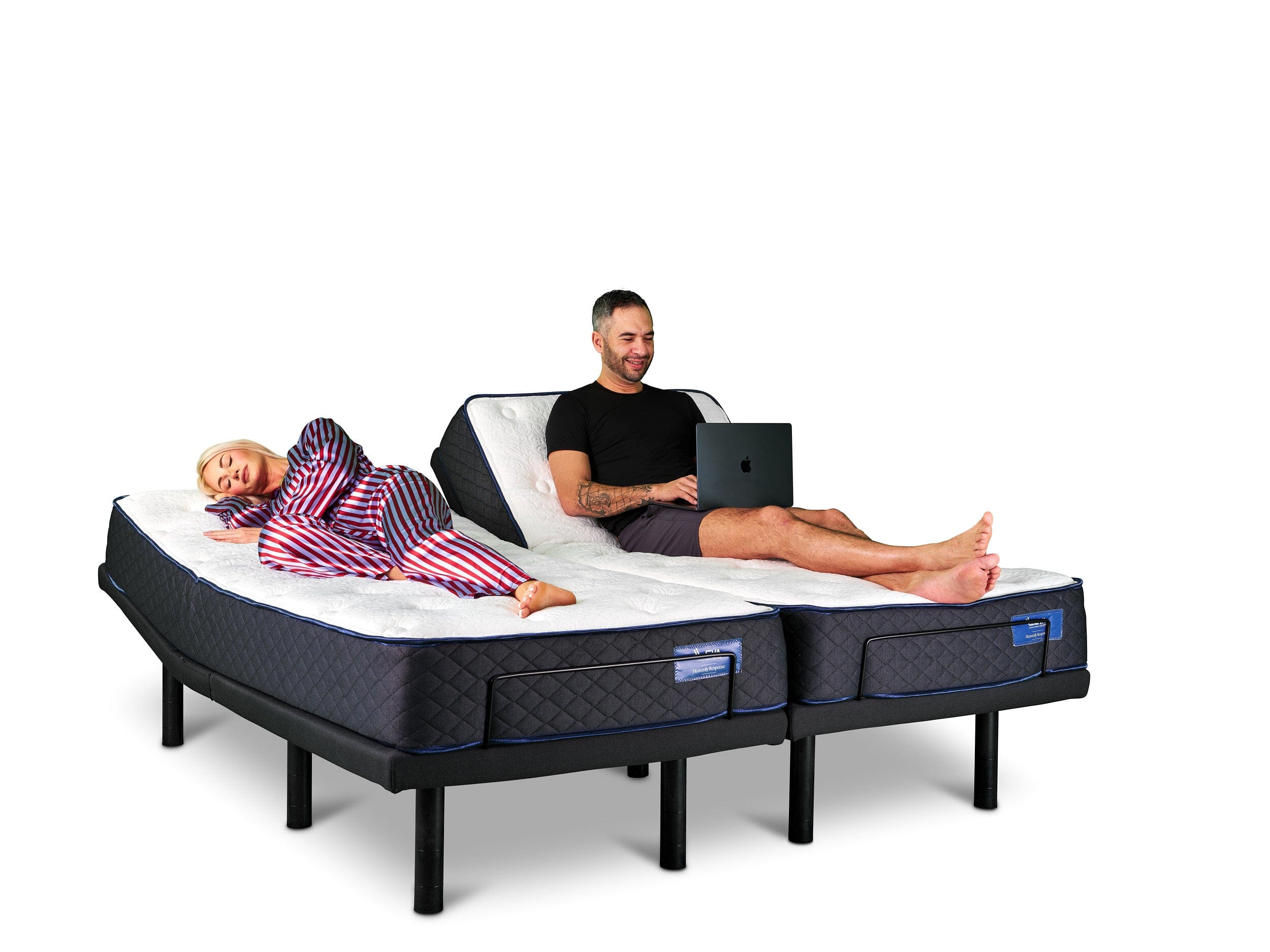
A split queen adjustable bed places two 30-inch × 80-inch motorized bases side by side. Together they occupy the same 60-inch × 80-inch footprint as a standard queen bed. Each base works as a self-contained unit with its own motor, control system, and articulating frame.
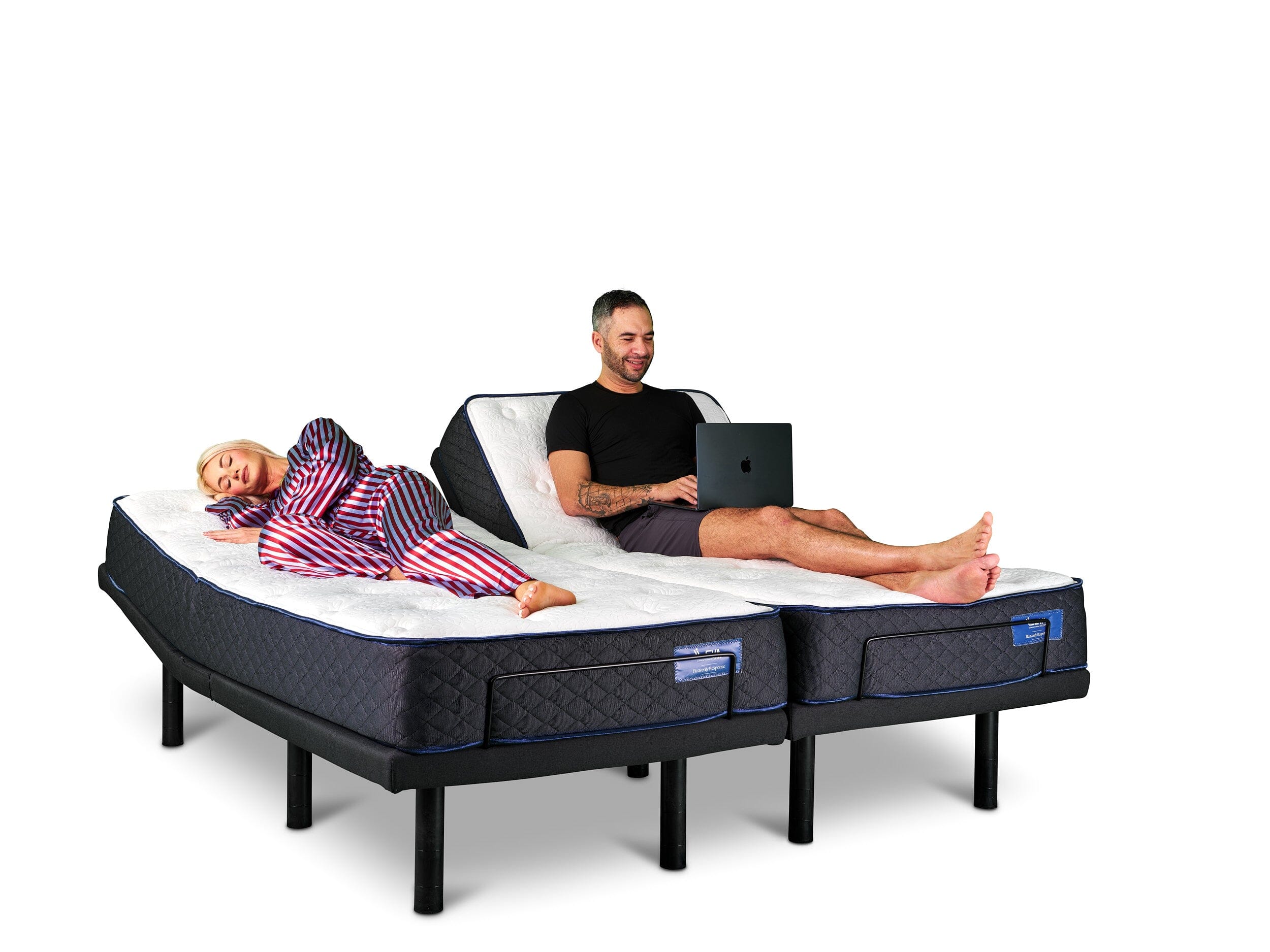
The core components that create independent head and foot elevation on each side include:
- Dedicated drive motors, one per base, that control head and foot articulation independently
- Articulating deck sections, which use hinged panels to raise and lower the head zone, lumbar zone, and foot zone
- Connector straps or alignment brackets, which keep both bases flush against each other
- Non-skid surface materials, applied to the deck to prevent mattress movement during elevation changes
- Individual remote or app interface, one controller per side, with optional sync capability
Queen-sized adjustable bases typically support 750 pounds or more across the full platform. This capacity covers the combined weight of the mattress, both occupants, and bedding. Because each half of a split queen has its own motor and support structure, uneven weight distribution between partners does not affect performance on the other side.
Expert Tip — Evaluating Motor Quality: Compare split queen bases by listening for motor noise during a live demonstration or by requesting decibel ratings from the retailer. Whisper-quiet motors, such as the German-engineered motors used in Leva Sleep bases, complete elevation cycles with little to no audible mechanical sound. Avoid bases when the motor specification is missing from product documentation.
Explore Leva Sleep’s whisper-quiet adjustable bases
How Motion Isolation Protects Each Partner’s Sleep
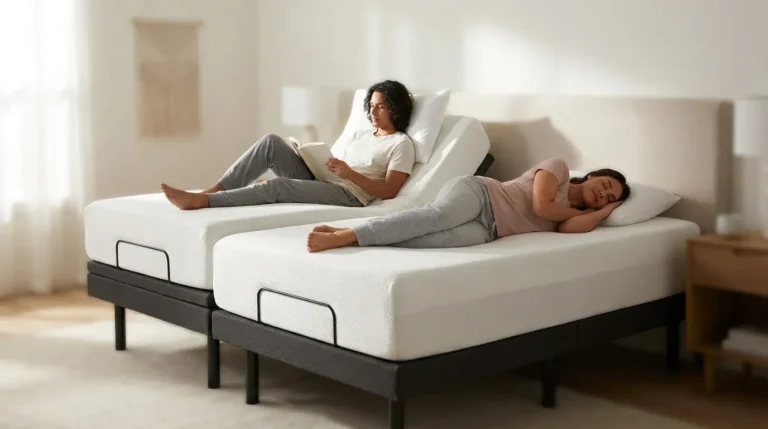
The split construction lets couples use different positions at the same time. A standard adjustable base moves the entire mattress as one unit, while each 30-inch base in a split queen articulates independently. When one partner raises their head section, the other side stays mechanically still.
Most split adjustable bases use connector straps or non-skid surfaces to keep the two bases aligned and stable. This design prevents gaps or sliding that could disturb partners. High-quality adjustable bases also rely on quiet motors so mechanical sounds do not wake a partner during independent adjustments.
Troubleshooting — Motor Noise: If a base produces grinding or clicking sounds during adjustment, first check that the connector straps are properly tensioned and that no bedding is caught in the articulating joints. Persistent noise after these checks usually indicates a worn drive motor and calls for a warranty claim or service call.
How Controls Work Together or Stay Independent
Each base has its own dedicated motor, so each side also uses its own control system. Modern adjustable bases include sync functions that let the two sides move together when desired while still allowing independent movement.
In everyday use, each partner holds or uses a dedicated remote or app interface. A sync button or in-app toggle temporarily links both sides so they rise and lower in unison. Couples often use this synced mode when they want the same position or when they make the bed.
Leva Sleep’s anti-snore mode shows how independent controls extend beyond simple elevation. The system detects snoring through vibration or audio sensing and applies a small adjustment to the snoring partner’s head section. This change happens without waking them or disturbing the other side. Per-side automation of this kind works because each base has its own motor and control circuit.
How Sheets and Bedding Behave on Split Queen Beds
Standard queen fitted sheets are cut for a flat, stationary mattress. When one or both sides elevate, the sheet corners pull away from the mattress edges, especially at the foot of the bed. On a split queen, the two separate mattresses also create a centre seam that standard sheets must bridge, which often causes bunching or corners popping loose overnight.
Practical solutions include:
- Specialized split queen fitted sheets with deep pockets, typically 18–21 inches, and reinforced elastic around the full perimeter. Choose this option when you want the cleanest look and can match the sheet depth to your mattress.
- Two Twin XL fitted sheets, one per mattress, which follow each mattress independently through elevation changes and are usually easier to find than specialty split queen sheets.
- Sheet straps or suspenders clipped diagonally under the mattress corners to maintain tension at full elevation. Use these when your current sheets fit reasonably well but slip at the corners.
Leva Sleep designs fitted sheets with extra-deep elastic and side remote pockets specifically for adjustable bases. This type of purpose-built bedding helps eliminate sheet slippage on split systems.
Troubleshooting — Sheet Slippage: If sheets pull free during the night, measure your mattress depth at full elevation before buying replacement sheets. A mattress that is 12 inches thick at rest may require a 20-inch pocket depth when the head section is raised 45 degrees. Standard 14-inch pocket sheets will not stay in place.
Common Split Queen Issues and Simple Fixes
Troubleshooting — Centre Gap: Two independent bases can drift apart over time and create a gap at the centre of the bed. Tighten connector straps monthly and place a non-skid mat beneath each base to keep them aligned. Some couples add a mattress bridge pad, a foam insert that sits in the gap, to maintain a more seamless sleeping surface.
Expert Tip — Mattress Compatibility: Memory foam and latex mattresses flex easily on adjustable bases. Traditional innerspring mattresses with interconnected coils are too rigid and can be damaged by repeated articulation. Confirm that any mattress you pair with a split queen base is clearly rated as adjustable-base compatible by the manufacturer.
Expert Tip — Delivery Logistics: Split queen bases ship as two separate 30-inch-wide units, which move through standard Canadian doorways and stairwells more easily than a single king-sized base. In Ontario and Alberta, Leva Sleep’s white-glove delivery team handles room placement, assembly, leg-height adjustment, and old-bed removal in one appointment, typically scheduled within a defined delivery window after purchase.
How to Choose Between Split Queen and Split King
| Feature | Split Queen | Split King |
|---|---|---|
| Total dimensions | 60″ × 80″ (two ~30″ × 80″ bases) | 76″ × 80″ (two Twin XL bases, each ~38″ × 80″) |
| Typical weight capacity | 750 lbs or more (full platform) | 800 lbs or more (full platform) |
| Sheet requirement | See bedding section above for detailed sheet options | Two Twin XL sheets (standard workaround) |
| Room suitability | Standard Canadian master bedrooms, 10′ × 10′ minimum recommended | Larger rooms required, 16″ wider than split queen |
Couples in typical Ontario or Alberta homes with master bedrooms under 12 feet wide usually find the split queen footprint easier to accommodate while still enjoying full independent control. Couples who want maximum personal sleeping width per side, or who have combined weights above 700 pounds, should consider a split king instead.
Compare split queen and split king packages at Leva Sleep
What a Successful Split Queen Setup Looks Like
A properly installed split queen adjustable bed delivers noticeable changes within the first week. Each partner adjusts their side independently without waking the other. Snoring-related disruptions drop as anti-snore mode or manual head elevation opens airways. Fitted sheets stay in place through the night, and the centre gap remains closed.
Both partners fall asleep in their preferred position instead of negotiating a shared compromise. For couples who had moved to separate rooms, comfortably sharing a bed again becomes the clearest sign that the system works as intended.
Frequently Asked Questions
Is a split queen adjustable bed suitable for sleep apnea?
Yes. Elevating the head of the bed between 30 and 45 degrees helps keep airways open by reducing the gravitational collapse of soft tissue at the back of the throat, which contributes to obstructive sleep apnea. A split queen base lets the partner with sleep apnea maintain this elevation throughout the night while the other partner sleeps flat or at a different angle.
Leva Sleep’s anti-snore mode, anticipated on select 2026 models, adds automated micro-adjustments that respond to detected snoring without requiring the user to wake and reposition. For diagnosed sleep apnea, consult a physician before replacing CPAP therapy with positional adjustment alone. Many patients use both approaches together.
What room size works for a split queen in Canadian homes?
A split queen base occupies the same 60-inch × 80-inch floor space as a standard queen mattress. Canadian building codes historically produced master bedrooms around 10 feet × 12 feet in homes built before 2000, and a queen-sized bed fits comfortably in these rooms with clearance on three sides.
A split king is 76 inches wide, which is 16 inches wider than a split queen, and usually requires a room at least 12 feet wide to maintain comfortable access on both sides. Couples in condominiums, townhouses, or older detached homes in Ontario and Alberta often find the split queen the more practical choice based on room size alone.
How often do adjustable bed motors need maintenance?
Quality adjustable bed motors are sealed units built for years of daily use without routine maintenance. The main user task involves keeping the articulating joints clear of bedding and debris, which can create resistance and speed up wear. Connector straps should be checked for tension every one to three months.
If a motor begins to make unusual sounds or slows noticeably during elevation cycles, contact the manufacturer or retailer under warranty instead of attempting self-repair. Leva Sleep bases carry manufacturer warranties and are supported by in-house service, so a technician familiar with the specific motor system handles any issues.
What delivery timelines apply in Ontario and Alberta?
Delivery timelines vary by retailer and inventory location. Leva Sleep assembles its systems locally in the regions it serves, which shortens transit time compared with international shipping and supports scheduled white-glove delivery appointments. Customers in Ontario and Alberta typically receive a confirmed delivery window after purchase, with full setup completed in a single visit.
The setup appointment usually includes room placement, leg-height adjustment, app pairing, and old-bed removal. Customers should confirm current lead times directly with Leva Sleep at the time of purchase, because inventory levels and seasonal demand can affect scheduling.
Conclusion: When a Split Queen Makes Sense
A split queen adjustable bed uses two independent 30-inch × 80-inch motorized bases inside a standard queen footprint. This design gives each partner full control over head and foot elevation, massage, and, on advanced models, automated anti-snore adjustments. Motion isolation comes from the physical separation of the two bases, supported by connector straps and non-skid surfaces.
Bedding compatibility usually calls for purpose-built sheets with deep elastic pockets or a two-sheet Twin XL setup. The split queen suits most Canadian master bedrooms and couples with combined weights under 750 pounds. The split king suits couples who need more individual width or higher weight capacity.
For couples in Ontario and Alberta, the decision process stays simple. Measure the room, confirm mattress compatibility, and choose a retailer with adjustable-bed expertise, local assembly, and white-glove setup. View Leva Sleep’s complete split queen packages to explore options built and delivered by Canada’s adjustable-bed specialists.