Written by: Matthew Timmins, Founder and Managing Director, Leva Sleep | Last updated: July 16, 2026
Key Takeaways for Couples Losing Sleep to Snoring
- A premium split adjustable bed system with independent head elevation and automatic anti-snore technology gives couples a practical way to avoid sleep divorce caused by snoring.
- Snoring leads to significant sleep loss for partners, averaging one hour per night and up to 360 hours annually, which contributes to relationship strain and higher rates of sleep divorce.
- Unlike earplugs, white-noise machines, or separate bedrooms, split adjustable beds address the root mechanical cause of snoring while allowing both partners to remain in the same bed with independent controls.
- Leva Sleep’s Split Queen and Split King configurations offer whisper-quiet motors, app control, automatic anti-snore adjustments, and white-glove delivery at 30–50% less than comparable luxury brands.
- Explore split adjustable beds with automatic anti-snore technology and keep both partners sleeping comfortably together.
The Hidden Cost of Snoring on Canadian Relationships
Snoring consistently disrupts sleep for most partners who share a bed with a snorer. Seventy-five percent of people with snoring partners report that it impacts their sleep quality. This disruption is measurable: bed partners of snorers lose approximately one hour of sleep every night and wake at least partially an average of 21 times per hour. Over a full year, partners of heavy snorers lose roughly 360 hours of sleep (about 15 days), which helps explain the higher rates of anxiety, depression, morning headaches, and work absences seen in this group.
Snoring negatively affects the well-being of 77% of those sharing a bed with someone who snores. Partners report daytime sleepiness, mood challenges, and decreased energy that spill into work and family life. In couples where one partner has obstructive sleep apnea, researchers found that snoring loudness predicted relationship strain more reliably than the number of apnea events per hour. The pattern is clear: 19% of couples with habitual loud snorers report relationship strain, compared with 9% of couples with light snorers.
Sleep separation is becoming more common as couples try to protect their rest. Surveys showed the sleep divorce rate among U.S. adults was more than one-third in 2023 and nearly 31% in 2025, with adults aged 35–44 most likely to sleep separately at 39%. The trend extends globally: the ResMed 2025 Global Sleep Survey of 30,026 respondents found that 18% of couples reported sleeping in separate rooms due to snoring and restlessness. The stakes are high for long-term relationships. A poll of 2,000 recently divorced Britons found that 47% said their partner’s snoring contributed to their break-up, and half of recently divorced respondents described snoring as a deal-breaker when entering new relationships.
Explore split adjustable beds that address snoring at the source and keep both partners in the same bed.
Comparing Root-Cause Elevation to Symptom-Only Fixes
Anti-snore products fall into two clear groups. Some mask the problem for the non-snoring partner, while others reduce or eliminate the snoring itself. The table below compares common options by how they work and how well they help couples keep sharing a bed over time. Use these criteria as a checklist before you commit to any solution.
| Option | Mechanism | Addresses Root Cause? | Couples Stay in Same Bed? |
|---|---|---|---|
| Split adjustable bed with anti-snore elevation | Elevates head and torso 10–30°, using gravity to prevent soft-tissue airway collapse | Yes, through mechanical airway opening | Yes, independent bases allow one partner to elevate while the other remains flat |
| CPAP machine | Delivers pressurized air through a mask to keep the airway open | Yes, for obstructive sleep apnea | Partially, patients with engaged partners are 1.5× more likely to be adherent, but mask discomfort reduces compliance |
| White-noise machine | Masks sudden noise spikes for the bed partner by filling the room with consistent sound | No, snoring continues unaffected | Temporarily, does not reduce snoring or sleep disruption for the non-snoring partner |
| Earplugs | Reduces sound reaching the non-snoring partner’s ears | No, snoring continues unaffected | Temporarily, discomfort and incomplete noise blocking limit long-term use |
| Wedge pillow | Raises the upper body at a fixed angle to reduce airway collapse | Partially, fixed angle limits personalization | Yes, but wedge pillows lack the adjustability of adjustable bases, affecting long-term compliance |
| Mandibular advancement device (MAD) | Gently pushes the lower jaw forward to keep the airway open | Yes, for mild to moderate snoring | Yes, wearable device does not affect sleeping arrangement, but requires dental fitting and nightly compliance |
Why CPAP, Earplugs, and White Noise Fall Short for Couples
CPAP remains the clinical gold standard for obstructive sleep apnea, yet its benefits for shared-bed harmony depend on consistent use. CPAP is less commonly used to treat snoring without an underlying sleep disorder, because many people find the adjustment period too demanding without full-blown apnea and its health risks. The mask, tubing, and machine noise introduce new bedroom disruptions, and compliance rates remain a persistent clinical challenge even when the therapy is medically necessary.
As the comparison above shows, earplugs and white-noise machines address only the non-snoring partner’s perception of sound. They do nothing to reduce airway collapse, improve the snorer’s oxygen saturation, or prevent the micro-arousals that fragment both partners’ sleep. White-noise machines mask sudden noise spikes for the bed partner by filling the room with consistent sound, but a partner who wakes 21 times per hour due to snoring will not achieve restorative sleep through sound masking alone.
Separate bedrooms remove the noise but introduce a different cost. Couples who share a bed often rate their sex life more positively than those who sleep separately, and many sleep-separated couples worry that the arrangement could contribute to relationship breakdown. Most couples want better sleep and preserved intimacy. They do not want to choose between the two.
How Split Adjustable Beds with Anti-Snore Technology Help Couples
A split adjustable bed system tackles the core tension for couples. It reduces snoring at the source through head elevation while preserving independent comfort for each partner. A 2017 study of 52 patients with mild to moderate obstructive sleep apnea found that 7.5-degree head-of-bed elevation reduced the apnea-hypopnea index from 15.7 to 10.7 events per hour, a 32% reduction. A peer-reviewed in-home study published in PMC comparing four weeks of flat sleep to four weeks at a 12° incline found a 7% relative reduction in objective snoring duration.
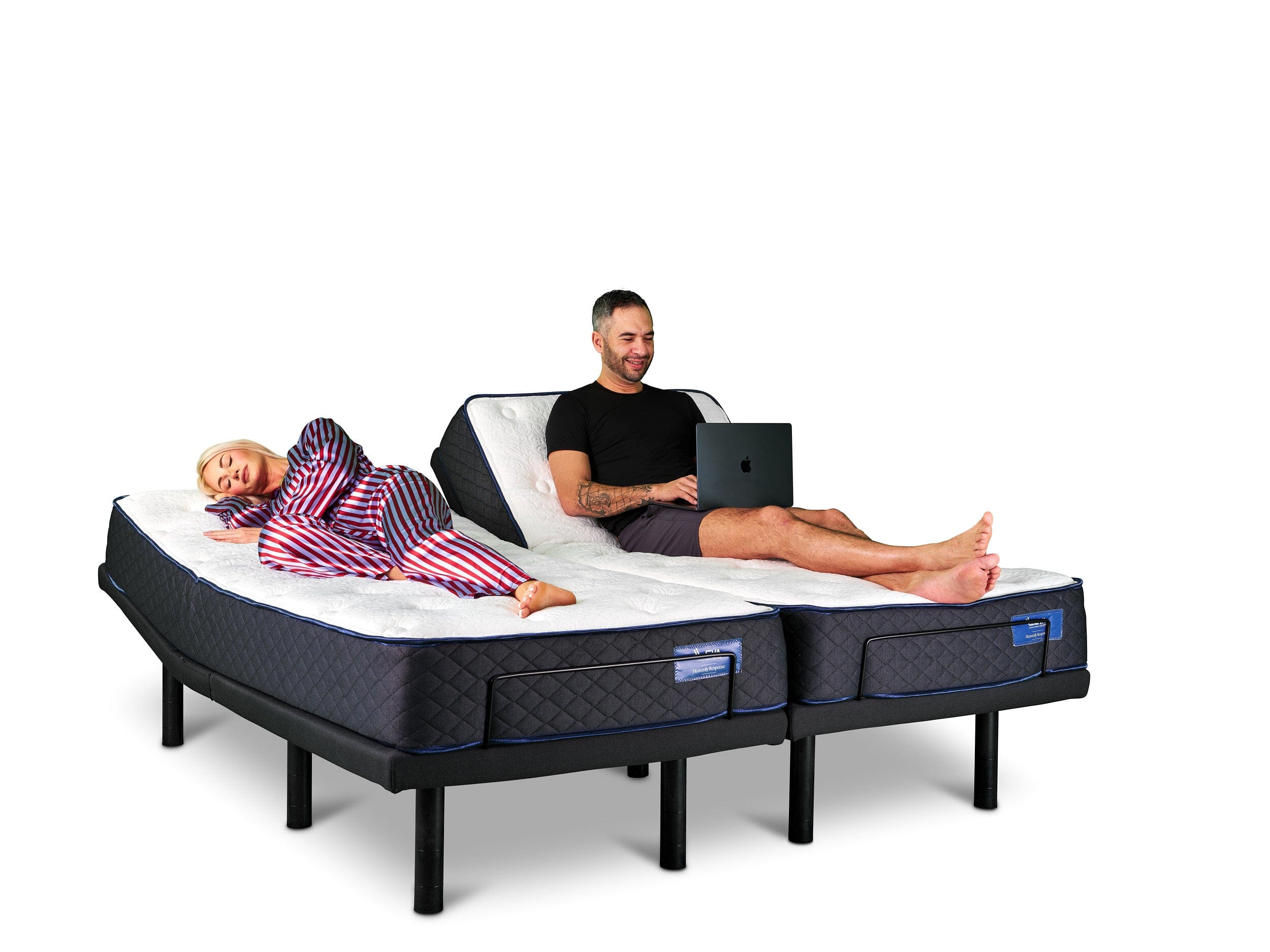
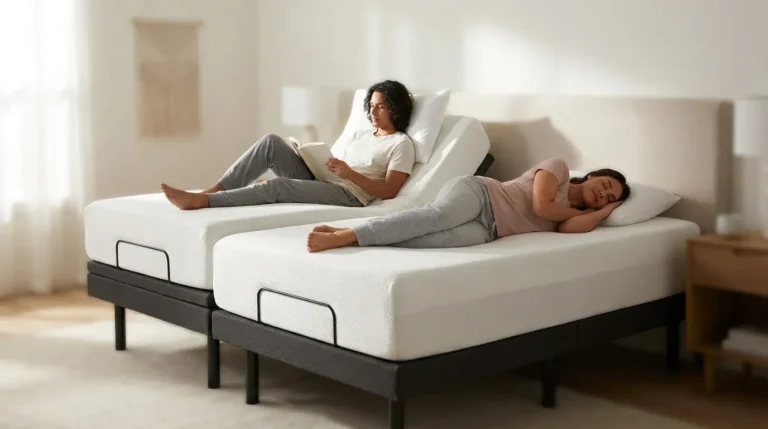
Leva Sleep’s Split Queen and Split King configurations give each partner a fully independent adjustable base powered by whisper-quiet German motors. One partner can sleep at a 10–20° anti-snore incline while the other remains completely flat, with zero motion transfer between sides. Full app control via Bluetooth allows custom sleep positions, vibrating alarms, and real-time adjustments without waking the other partner. Integrated heating and cooling pads manage temperature independently on each side, which solves the common problem of one partner sleeping hot while the other sleeps cold.
Leva Sleep’s automatic anti-snore mode detects snoring and makes micro-adjustments to the head of the bed in real time. These small changes reduce or eliminate snoring events without requiring the snoring partner to wake or manually reposition. This feature turns the system from a passive elevation tool into an active, responsive sleep technology and represents a major step forward in couple-focused adjustable bed design.
For Ontario and Alberta couples, Leva Sleep provides in-house white-glove delivery. Trained professionals bring the system to the bedroom, assemble it, adjust leg heights, provide a full product tutorial, and remove the old bed. Leva’s direct-to-consumer model, which covers design, assembly, and delivery without retail middlemen, creates a 30–50% price advantage over comparable luxury competitors. The Split Queen configuration is a particularly rare option that delivers independent adjustability in a more space-conscious footprint than a Split King.
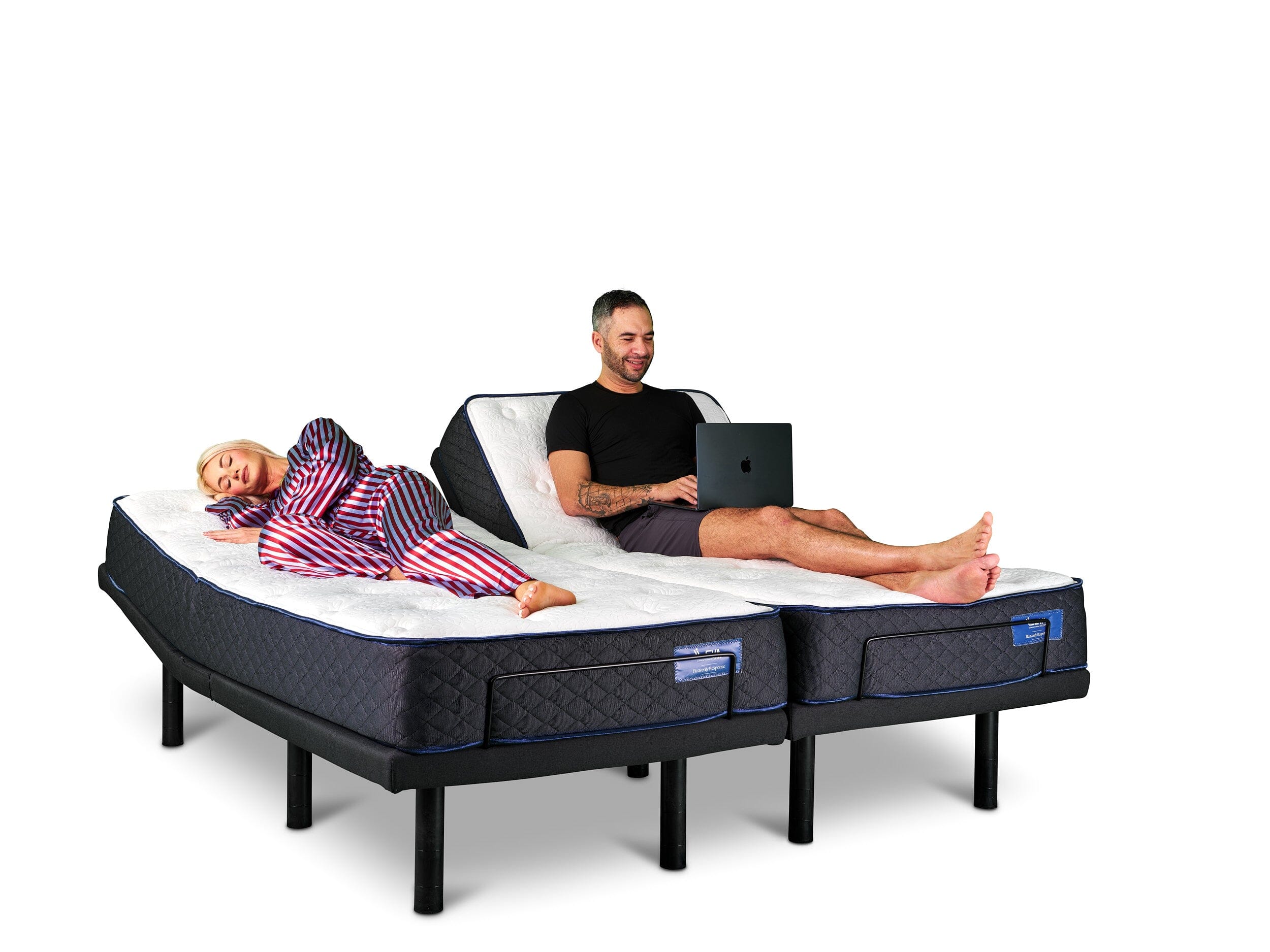
See Split Queen and Split King beds with automatic anti-snore detection and experience real-time adjustments that reduce snoring before it disrupts your partner.
Real Cost Comparison: Symptom Fixes vs Split Adjustable Systems
Symptom-fix products accumulate costs over time without solving the underlying problem. Earplugs require ongoing replacement, which creates a small but constant expense. White-noise machines add a larger upfront cost and a permanent device in the bedroom, yet they do not reduce snoring frequency. Separate bedrooms escalate both financial and emotional costs, whether that means buying a second mattress or investing in a full dual-master renovation, and they carry the highest relational burden of all.
A premium split adjustable base system functions as a one-time capital investment with a multi-decade lifespan. A complete split king adjustable bed setup in Canada ranges from $2,000 to $6,000 CAD, including two Twin XL mattresses and two independent adjustable bases. Leva Sleep’s direct-to-consumer pricing places its premium configurations well below the upper end of that range.
Hidden costs in any adjustable base purchase include motor quality and longevity, accessory compatibility, and delivery setup. Motor replacement parts on an adjustable base typically cost $30–$125, and cheaper motors tend to run louder, wear faster, and fail sooner than premium units. Leva Sleep’s whisper-quiet German motors and purpose-designed bedding accessories, including fitted sheets with deep pockets and extra elastic, duvet clips, and mattress protectors, are engineered specifically for adjustable bases. This design approach removes the ongoing frustration and replacement cost of standard bedding that fails under elevation.
Medical Red Flags and Pairing Elevation with the Scandinavian Sleep Method
Head elevation on an adjustable base works well for positional and mild-to-moderate snoring, but it does not replace medical evaluation when snoring is severe or accompanied by gasping, choking, or witnessed apnea events. For apnea-related snoring, an adjustable base helps but does not replace CPAP treatment, which remains the gold standard prescribed after a sleep study. Couples who suspect obstructive sleep apnea should pursue a formal sleep study before relying on elevation alone.
For couples already using CPAP, an adjustable base complements rather than replaces the therapy. Many people find that an adjustable bed and CPAP machine work better together than either does alone, because elevation often makes the mask more tolerable and improves consistency of use.
The Scandinavian sleep method, where each partner uses a separate duvet on a shared bed, pairs naturally with a split adjustable system. When one partner elevates their head section, a shared duvet bunches and pulls. Separate duvets, held in place with Leva Sleep’s purpose-designed duvet clips, prevent this tug-of-war. The result is a shared bed where both partners have independent elevation, independent temperature regulation, and independent bedding while still sleeping in the same room.
Browse complete adjustable bed systems with purpose-designed bedding that works with the Scandinavian sleep method.
Frequently Asked Questions
Is snoring actually a deal-breaker in relationships?
Snoring becomes a deal-breaker for a significant share of couples. As noted earlier, nearly half of divorced respondents in one UK survey cited snoring as a relationship contributor, and 50% called it a deal-breaker for future relationships. These figures show how untreated snoring can escalate from a nightly annoyance to a structural relationship problem over months and years. The encouraging news is that snoring is treatable. Couples who address the root cause, whether through head elevation, medical treatment, or a combination, often report measurable improvements in relationship satisfaction and, in many cases, a return to shared sleeping.
How angry do partners of snorers typically get, and is that anger justified?
Anger among partners of snorers reflects a documented physiological response rather than simple irritability. Losing one hour or more of sleep per night produces measurable increases in cortisol, reduced empathy, and impaired conflict resolution, which makes anger more likely and harder to manage. Research from the University of California, Berkeley found that chronic sleep deprivation caused by a partner’s snoring generated subconscious negative emotional associations with the partner’s presence at bedtime, including increased startle responses and cortisol spikes. Over 50% of bed partners of chronic snorers reported anxiety symptoms before the snoring partner received treatment. Recognizing that the anger has a biological driver, not a character flaw, helps couples focus on addressing the snoring itself.
Do split adjustable beds actually keep couples together, or do they just delay sleep divorce?
Evidence points toward genuine long-term bed sharing when couples address snoring at the root cause. Many couples who had adopted sleep divorce resumed sleeping together after the snoring partner received treatment. A split adjustable bed system targets the same root cause, airway collapse during sleep, through a non-invasive, non-medical mechanism that both partners can use indefinitely. Because each partner controls their own side independently, the system removes the compromise dynamic that often drives sleep divorce. One partner’s therapeutic need no longer forces the other into an uncomfortable position. Automatic anti-snore technology, such as Leva Sleep’s mode, further reduces the chance that snoring events will continue unchecked during the night.
What size split adjustable bed is right for couples in smaller Canadian homes?
The Split Queen offers the most space-efficient option for couples who want independent adjustability without the footprint of a Split King. A Split King uses two Twin XL bases side by side and requires a room that comfortably fits a standard king-size bed. A Split Queen provides the same independent elevation and control in a queen-size footprint, which suits many older Ontario and Alberta homes with standard-sized bedrooms. Leva Sleep is one of the few Canadian providers offering a Split Queen configuration built to customer specifications. For couples with larger rooms or who prioritize maximum motion isolation, the Split King remains the premium choice. Both configurations are available with Leva Sleep’s white-glove delivery and setup service.
How does Leva Sleep’s pricing compare to other adjustable bed brands in Canada?
As mentioned earlier, Leva’s direct-to-consumer approach delivers 30–50% savings versus luxury brands like Tempur-Pedic, with complete split systems available well below the $9,000-plus price points common at retail. Premium split adjustable bed packages from major luxury brands in Canada can exceed $9,000 for a complete setup. Leva Sleep delivers comparable engineering, whisper-quiet German motors, app control, anti-snore technology, and white-glove setup at a significantly lower price point. The company also offers 15–20 adjustable bed models, compared with the 3–5 typically found at general mattress retailers, which gives couples in Ontario and Alberta a deeper level of selection and specialist expertise than general furniture stores can provide.
Decision Guide for Choosing a Split Adjustable Bed
For couples aged 40–60 in Ontario and Alberta facing snoring-driven sleep divorce, the investment hierarchy is clear. Symptom fixes such as earplugs, white noise, and separate bedrooms address how the problem feels without resolving it and carry ongoing relational costs. Medical interventions like CPAP are essential for diagnosed obstructive sleep apnea but introduce their own compliance and comfort barriers for shared-bed life. A split adjustable bed system with automatic anti-snore technology stands out as the only option that reduces snoring at the mechanical source, preserves independent comfort for both partners, and keeps the couple in the same bed over the long term.
When evaluating any split adjustable system, start with motor noise levels, because a loud motor undermines the goal of reducing sleep disruption. Next, confirm whether a Split Queen option exists if your bedroom cannot accommodate a king footprint. Then review the control experience. App control granularity and anti-snore preset functionality determine how easily each partner can fine-tune their side. Finally, check mattress and bedding compatibility along with the quality of the delivery and setup service, since poor execution in either area can weaken an otherwise strong system. Leva Sleep’s direct-to-consumer model, lifetime sales volume, Canadian customer base, and 30–50% price advantage over luxury competitors position it as a specialist authority for couples ready to invest in a permanent solution.
Find your split adjustable bed configuration and invest in the permanent solution that keeps you and your partner sleeping together.