Written by: Matthew Timmins, Founder and Managing Director, Leva Sleep | Last updated: July 11, 2026
Key Takeaways for Couples
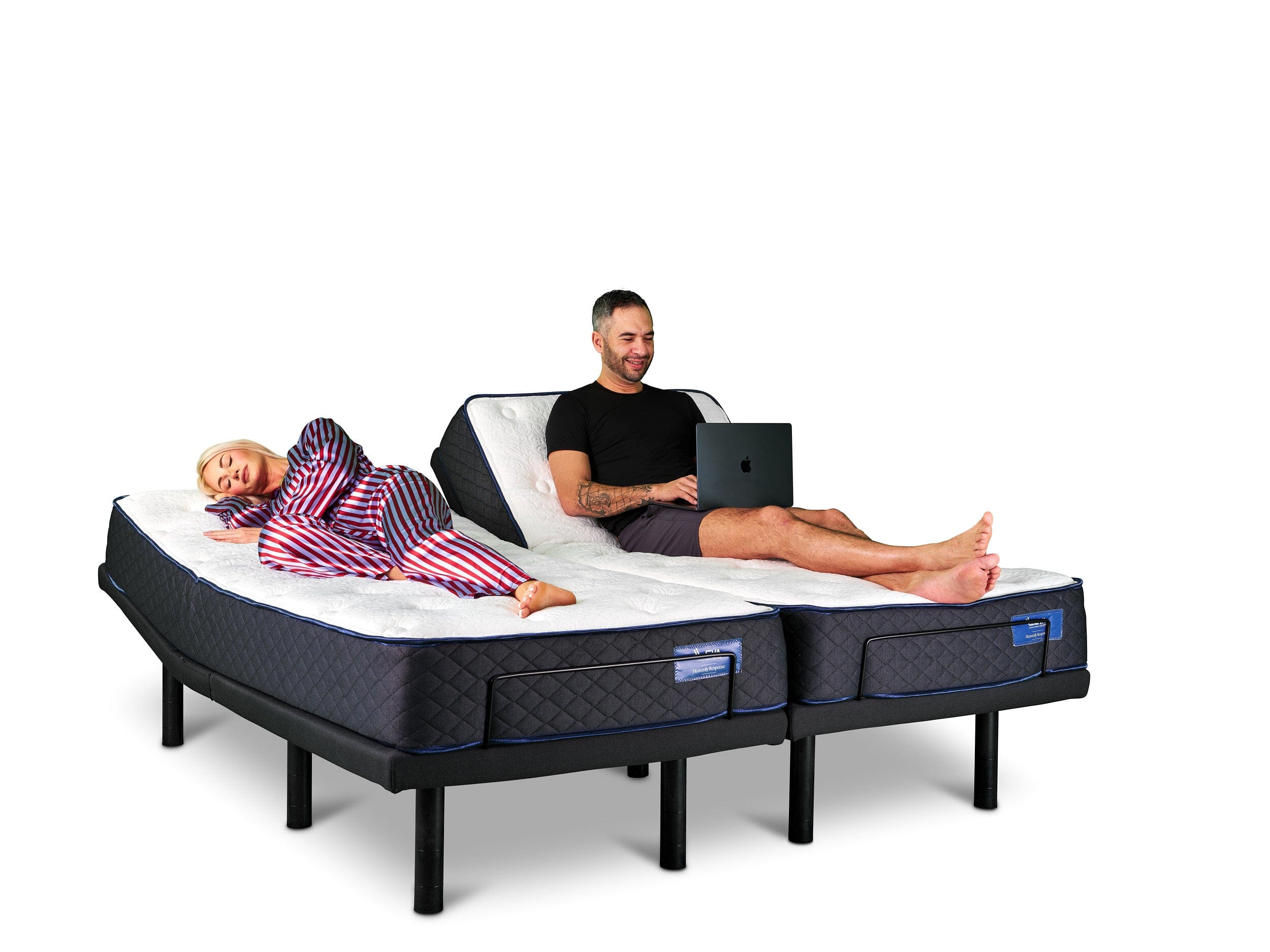
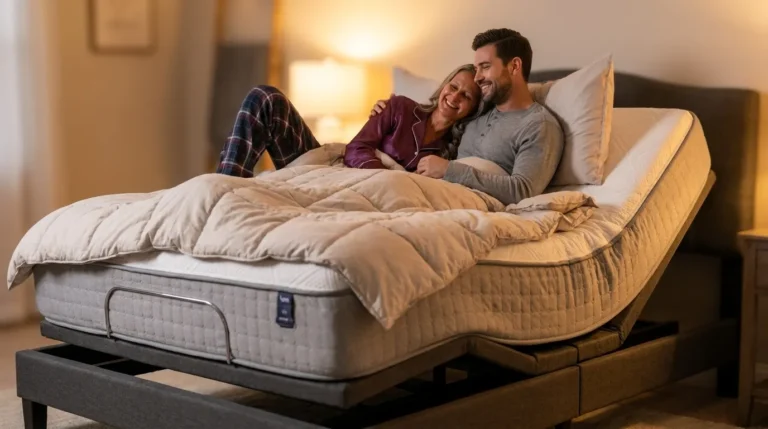
- Unified adjustable bases force both partners to share the same elevation angle, which often pushes couples toward separate sleeping arrangements.
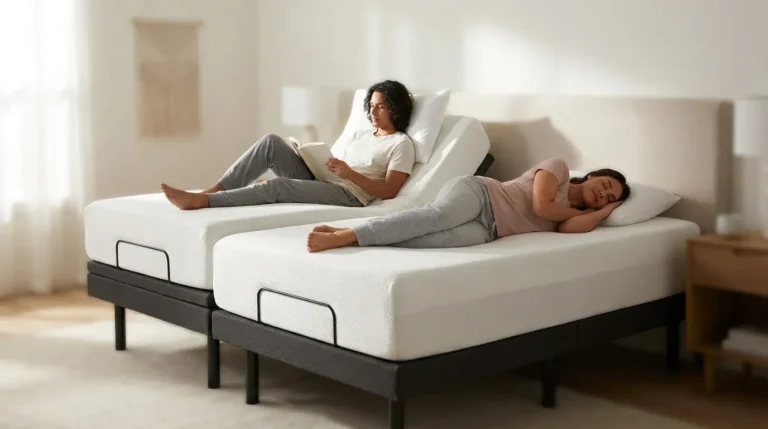
- Independent split-control systems let each partner adjust head, foot, massage, and temperature settings without affecting the other side of the bed.
- Split configurations deliver 74–82% better motion isolation than unified bases, which cuts down on wakeups from a restless partner.
- Leva Sleep offers a rare Split Queen option in Canada plus whisper-quiet motors, lumbar support, pillow tilt, and an anti-snore mode arriving spring 2026.
- Leva Sleep’s adjustable beds give couples independent split-control systems that remove many of these nightly compromises.
The Problem: Unified Bases Force Constant Compromise
Unified adjustable bases create a structural compromise problem. When one partner needs head elevation for snoring or acid reflux, the other must accept the same angle or sleep flat while their partner remains elevated. This is not a minor inconvenience. A 2025 AASM Sleep Prioritization Survey of 2,007 U.S. adults found that 31% have tried a sleep divorce, and ResMed’s fifth annual Global Sleep Survey (30,026 respondents, fielded Dec 2024) reported that 18% of couples sleep in separate rooms due to snoring and restlessness.
The medical stakes are measurable. A Mayo Clinic study found that bed partners of people with sleep apnea lose roughly one hour of sleep per night, and that treating the snorer significantly improved the partner’s sleep quantity and quality. In Canada specifically, a 2024 study of 51,337 Canadians aged 45–85 found that 28.1% had moderate-to-severe obstructive sleep apnea. 6.4% of Canadian adults now report a diagnosis of sleep apnea, double the rate recorded in 2009, so the partner-impact problem documented by Mayo Clinic is affecting more Canadian couples every year.
Other conditions add to the strain. Ninety-five percent of adults lose at least one hour of sleep to pain in a given week, and 75% of adults with nighttime heartburn report that symptoms affect their sleep. A unified base cannot address these conditions independently for each partner. Motion transfer compounds the problem, as research on bed-sharing couples shows that a partner can cause awakenings in the other.
Temperature differences create another fault line. The ideal bedroom temperature for restorative sleep is cool, and temperatures outside the recommended range increase sleep fragmentation. A unified base with a single temperature zone forces one partner to overheat or under-heat. Leva Sleep’s split systems solve this with independent temperature controls per side, so you can explore models with dual-zone climate regulation.
How Independent Controls Protect Each Partner’s Sleep
Split King systems deliver 74–82% better motion isolation than unified bases because vibration cannot transfer between physically separate mattresses. This separation sharply reduces wake events for partners who toss and turn. Each partner adjusts elevation, firmness, massage intensity, and temperature without affecting the other side of the bed.
Firmness preferences become independent decisions in split systems. This matters because 90% of couples have opposing mattress preferences. For couples where one partner requires medical elevation for sleep apnea, acid reflux, or post-surgical recovery, the other partner can remain flat or choose a different angle without compromise.
Leva Sleep has built its entire product line around independent control. With over eight years of expertise, $50M in lifetime sales, and 25,000+ customers, Leva offers 15–20 adjustable base models, compared to the 3–5 typically found at general mattress retailers. The company uses a direct-to-consumer, vertically integrated model to reduce distributor and retailer markups, which keeps pricing significantly lower than many luxury competitors. Leva also offers a Split Queen configuration, a rare option in Canada that delivers independent control in a smaller footprint suited to typical Canadian bedroom dimensions.
You can use Leva’s catalog to compare Split Queen and Split King configurations side by side and see which layout fits your space and sleep habits.
Feature Details That Matter for Couples
Several specific features determine whether an adjustable base truly solves partner-specific sleep problems or simply adds elevation to a shared surface.
- Motor noise: Leva Sleep uses whisper-quiet German motors. Loud or jerky motors defeat the purpose of independent adjustment by waking the other partner during position changes.
- Lumbar and pillow tilt: Leva bases include lumbar control for precise lower back support and a pillow tilt motor for head and pillow adjustment independent of full head elevation. This detail is critical for side sleepers managing neck alignment.
- Anti-snore mode: Leva’s anti-snore mode (arriving spring 2026) detects snoring and makes micro-adjustments to the head of the bed automatically, without requiring the snorer or their partner to wake up and operate a remote.
- Temperature regulation: Leva integrates a heating and cooling pad per side, so each partner sets an independent thermal environment. This directly addresses the temperature mismatch that research identifies as a driver of sleep fragmentation.
- App control: The Leva Sleep app provides Bluetooth control of elevation, massage, custom sleep positions, and vibrating alarms per side, with AI-powered sleep tracking for real-time micro-adjustments.
Leva pairs its independent bases with mattresses from Serta, Tempur-Pedic, Simmons, and Beautyrest, as well as its own all-foam and hybrid pocket coil models, all selected for adjustable base compatibility.
Mattress and Bedding Fit for Adjustable Bases
Foam mattresses and hybrid mattresses with individually wrapped pocket coils are compatible with adjustable bases, while traditional innerspring mattresses with connected coils are generally not compatible because the coil system resists bending. Rigid innersprings adapt poorly because they barely follow the flexing of the upper body and legs and may damage the base.
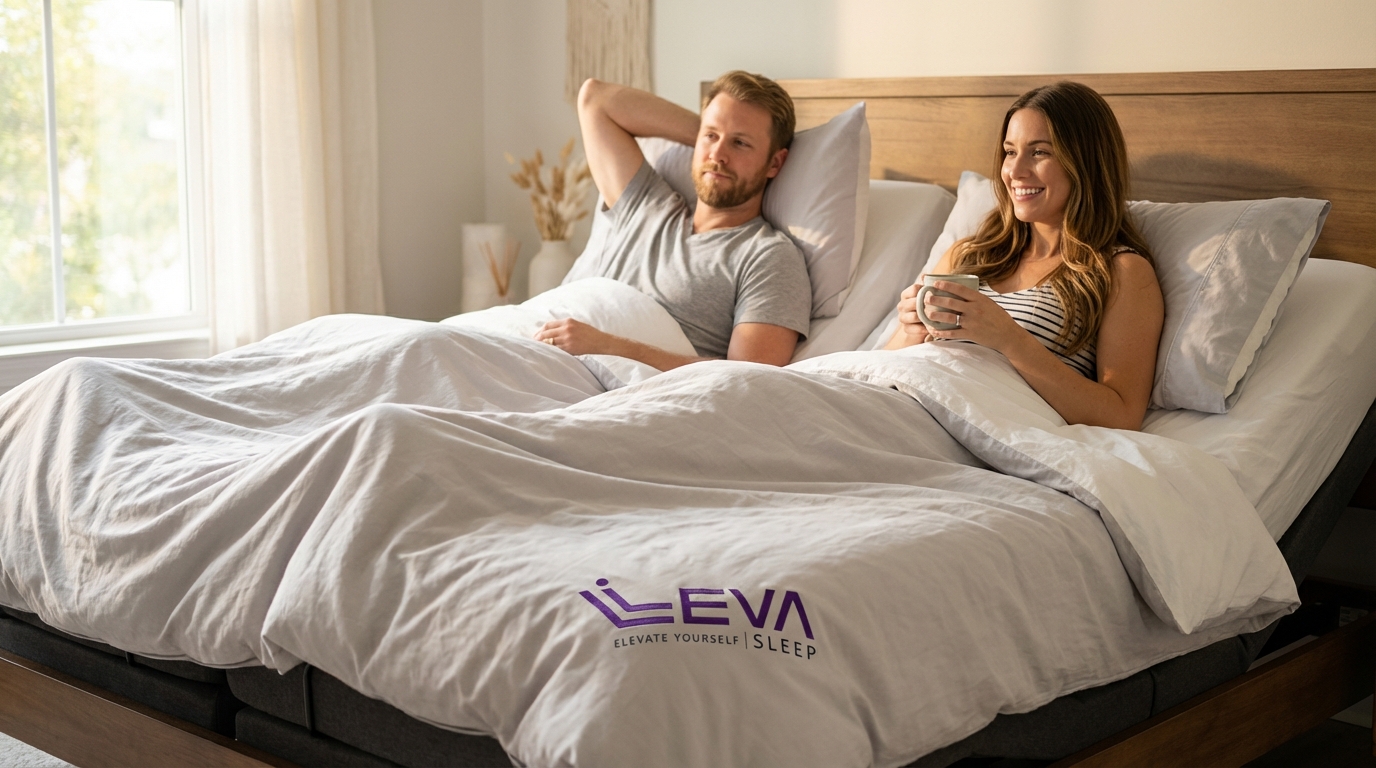
Standard bedding creates a secondary problem on split configurations. Fitted sheets can pop off elevated corners, and duvets bunch when partners are at different angles. Leva designs its own bedding line specifically for adjustable bases, including fitted sheets with deep pockets and extra elastic, duvets with clips to maintain separation when positions differ, and remote pockets built into the side panels. These products are engineered alongside the bases rather than added as generic accessories.
Split Queen vs Split King for Canadian Bedrooms
Split Queen adjustable bases consist of two independent 30″ × 80″ platforms that together fit a standard queen frame. This layout provides independent firmness and adjustability in a smaller footprint than a King. For Canadian couples in condos, older homes, or rooms where a King-size footprint is impractical, the Split Queen often becomes the only configuration that delivers full independent control without a renovation.
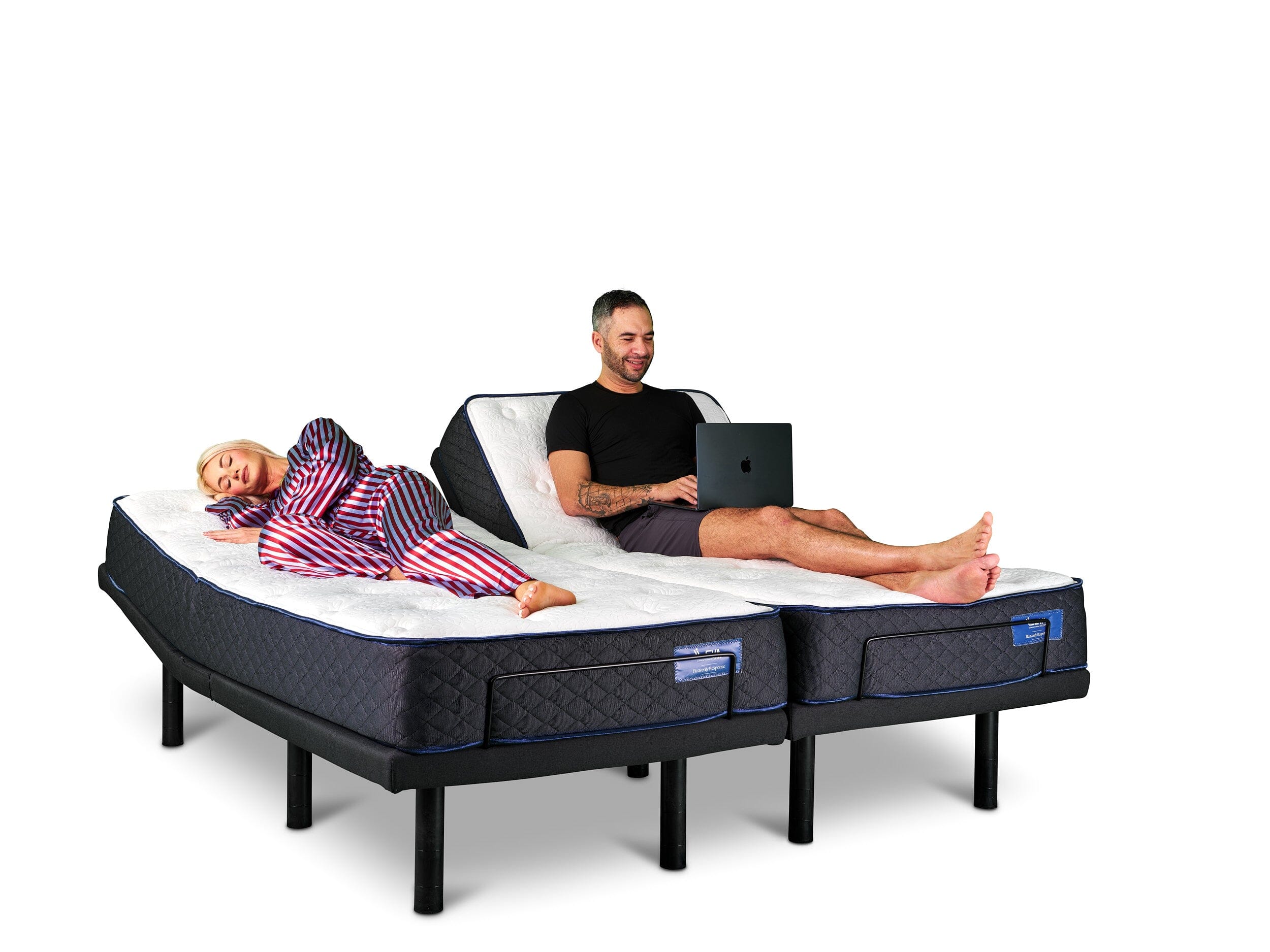
In Canada, Split Queen mattresses are less commonly stocked at chain retailers and are often under-represented on showroom floors. Leva Sleep builds Split Queen bases to customer specifications, which makes it one of the few Canadian sources for this configuration.
The centre gap between split mattresses, typically 2–4 inches, is the primary intimacy concern couples raise. Sixty percent of couples find this gap intolerable for maintaining physical closeness. Mattress connector straps and a shared flat sheet or duvet on top of two separate fitted sheets are the standard solutions. Leva’s duvet clip system addresses this concern directly by keeping bedding aligned when partners choose different positions.
Medical Elevation Needs for Each Partner
A head elevation of 10–30 degrees on adjustable beds can help with snoring relief. Positional therapy via head elevation is considered one of the most effective non-invasive treatments for habitual snoring by sleep experts and clinical research.
For acid reflux and GERD, clinical guidelines recommend elevating the head of the bed, as gravity keeps stomach acid down and decreases acid exposure time in the esophagus. A 2020 systematic review and meta-analysis by Khan and Singh found that head-of-bed elevation reduces esophageal acid exposure in patients with gastroesophageal reflux disease.
For back pain, orthopedic physical therapist Karena Wu, P.T., D.P.T., recommends the zero-gravity position, which creates a 120-degree angle between thighs and torso, along with leg elevation to reduce pressure on the pelvis and backbone. Elevating both the head (roughly 30°) and knees (15–20°) distributes spinal pressure across the entire back rather than concentrating it in the lumbar region, providing decompression for those with chronic back pain, arthritis, or sciatica.
In a unified base, one partner’s medical elevation requirement overrides the other’s comfort. In a split system, each partner sets the clinically appropriate angle for their own condition independently.
Canadian Pricing and Overall Value
Split King setups from luxury brands typically cost $4,800–$14,000+ total for two mattresses plus two adjustable bases. Leva Sleep’s direct-to-consumer, vertically integrated model, which includes local design and assembly with oversight of international manufacturing, removes distributor and retailer markups. This structure delivers comparable or superior feature sets at meaningfully lower prices than many top-tier competitors. Sleep apnea clinics in Canada refer patients to Leva, which reflects clinical confidence in the product line beyond standard retail positioning.
Delivery and Setup for Real Homes
White glove delivery is recommended for heavy or complex adjustable beds in Canada because it simplifies installation, assembly, and removal of the old bed or box spring. Leva Sleep’s in-house white-glove service, available in Ontario and Alberta, goes beyond basic scheduling. Trained Leva professionals deliver to the bedroom, assemble the base and accessories, adjust leg heights for comfort, provide a full product tutorial, and remove the old bed for donation or recycling. This service is handled by Leva staff rather than a third-party courier.
“Bed in a box” alternatives leave assembly, height adjustment, and bedding configuration to the customer. That approach can feel overwhelming for a system with independent motors, app pairing, and specialized bedding requirements.
Decision Framework for Your Bedroom
The table below compares the three primary configurations on attributes that matter most to Canadian couples. All pricing data is drawn from cited sources.
| Attribute | Unified Adjustable Base | Generic Split King/Queen | Leva Sleep Split System |
|---|---|---|---|
| Independent elevation per partner | No, shared angle only | Yes | Yes |
| Motion isolation | Low, single continuous surface | 74–82% better than unified | 74–82% better than unified |
| Split Queen availability in Canada | Not offered | Rare in retail | Yes, built to customer specifications |
| White-glove delivery available | Varies by retailer | Varies by retailer | Yes (Ontario and Alberta) |
| Anti-snore mode available | Rarely | Select models only | Planned spring 2026 |
| Price range (split king, total system) | Not typical | $4,800–$14,000+ at luxury brands | Lower than many luxury competitors |
Leva Sleep’s white-glove service is in-house rather than third-party and covers Ontario and Alberta with full assembly, product tutorial, and old-bed removal included.
Couples can use a simple checklist before purchasing. Key questions include whether either partner requires medically specific elevation, whether firmness preferences differ, how the bedroom footprint fits a Queen or King configuration, whether professional assembly and old-bed removal matter, and whether the current mattress is compatible or needs replacement.
Frequently Asked Questions
Can a split adjustable bed help with snoring without waking my partner?
Yes. On a split adjustable base, the snoring partner can elevate their head independently to 10–30 degrees, which uses gravity to keep airways open and reduce soft tissue collapse in the throat. This adjustment has no effect on the other side of the bed. Leva Sleep’s upcoming anti-snore mode (spring 2026) automates this further by detecting snoring and making micro-adjustments to the head position without either partner needing to wake up or operate a remote. This setup differs from a unified base, where any elevation change affects both partners simultaneously.
What are the downsides of adjustable beds for couples?
The primary downsides are the centre gap between split mattresses, typically 2–4 inches, which some couples feel reduces physical closeness, the requirement for compatible mattresses such as foam or flexible hybrids instead of traditional innerspring, and the higher upfront cost compared to a standard flat bed. Unified adjustable bases eliminate the gap but reintroduce the compromise problem discussed earlier, where any elevation change affects both partners simultaneously. Split systems address the compromise but require purpose-built bedding, such as Leva’s fitted sheets with extra elastic and duvet clips, to prevent sheets from slipping during elevation changes.
Is a Split Queen adjustable bed available in Canada?
Split Queen adjustable beds are available in Canada but are rarely stocked at mainstream chain retailers. Most Canadian showrooms carry Split King configurations at best. Leva Sleep is one of the few Canadian providers that builds Split Queen bases to customer specifications, which makes it a practical option for couples who need independent controls but cannot accommodate a King-size footprint. The Split Queen consists of two 30″ × 80″ independent platforms that fit within a standard queen frame, delivering full per-side control in a smaller room.
Do I need to replace my mattress to use a split adjustable base?
If the current mattress is a traditional innerspring with connected coils, replacement is necessary because it will resist the bending required by an adjustable base and may damage the motor system over time. Foam mattresses and hybrids with individually wrapped pocket coils flex correctly with adjustable bases and are the recommended mattress types. Leva Sleep designs its own all-foam and hybrid pocket coil mattresses specifically for use with its adjustable bases and also pairs its bases with compatible mattresses from Serta, Tempur-Pedic, Simmons, and Beautyrest.
What elevation is recommended for acid reflux and back pain on an adjustable bed?
For acid reflux and GERD, clinical guidelines recommend elevating the head of the bed, which uses gravity to keep stomach acid below the esophagus during sleep. A 15–20 degree incline is generally considered the effective range for full-torso elevation without causing midsection compression. For back pain, the zero-gravity position, with the head raised approximately 10–15 degrees and knees elevated slightly above heart level, decompresses the lumbar spine and distributes pressure across the full back. On a split adjustable base, each partner sets the angle appropriate for their own condition without affecting the other side.
Conclusion: Matching Your Bed to Both Partners’ Needs
Unified adjustable bases work for couples whose sleep needs are genuinely identical, including elevation preference, firmness, temperature, and schedule. For most Canadian couples aged 35–70, that description does not fit. Snoring, acid reflux, chronic pain, sleep apnea, and temperature mismatches are common in this group, and each condition benefits from a different positional response per partner.
Independent split-control systems, particularly Split Queen and Split King configurations, remove this compromise. The core decision factors include medical elevation needs, firmness disagreements, room dimensions, mattress compatibility, and delivery requirements. Leva Sleep’s vertically integrated model addresses each of these with a Canadian-specific product line and in-house white-glove delivery in Ontario and Alberta. You can find your Split Queen or Split King configuration based on bedroom size, budget, and both partners’ sleep needs.