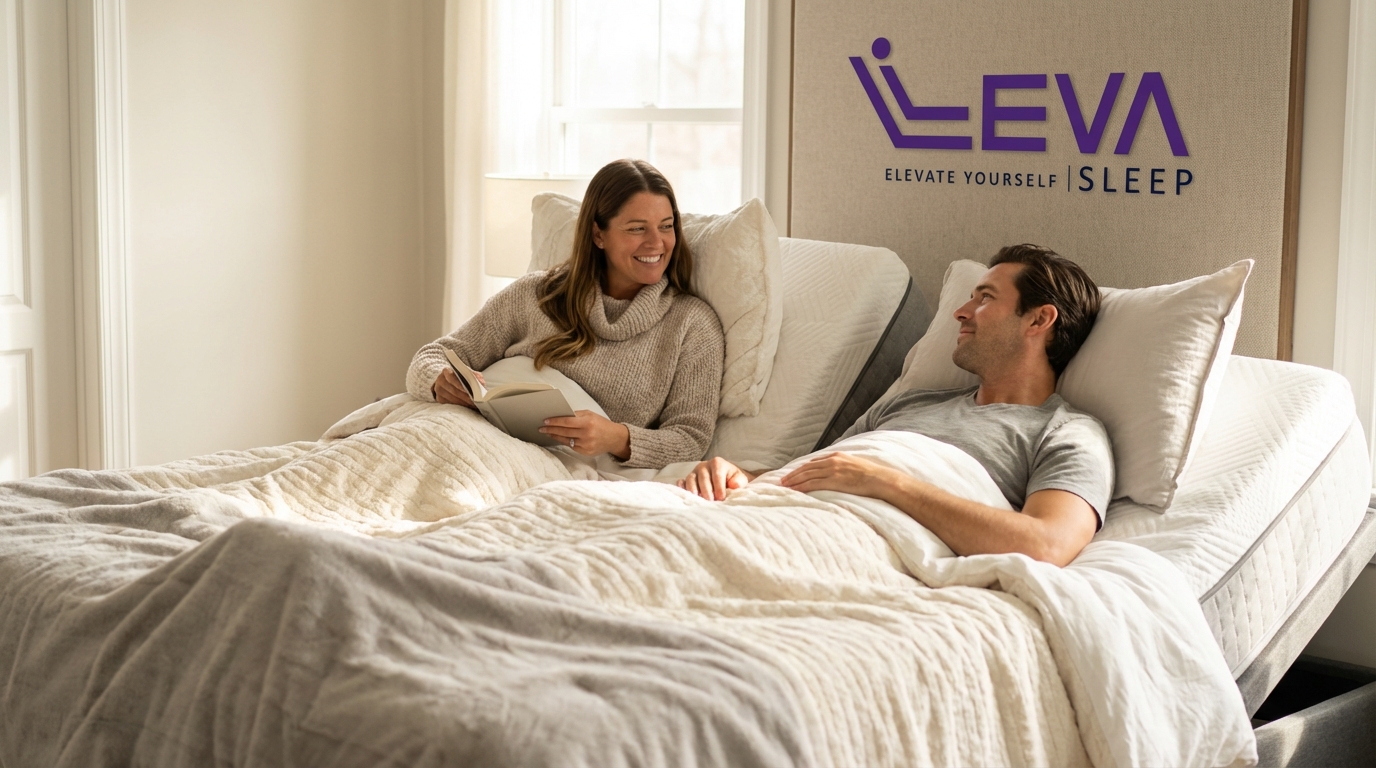
Written by: Matthew Timmins, Founder and Managing Director, Leva Sleep | Last updated: July 3, 2026
Key Takeaways
- Shared flat mattresses often fail couples when one partner’s snoring, hip pain, or medical needs disrupt the other’s sleep through pressure points and motion transfer.
- Memory foam excels at pressure relief and motion isolation, and it works best when paired with an independently controlled split adjustable base.
- Split adjustable bases let each partner customize head elevation, lumbar support, and temperature settings without affecting the other side, which solves issues a single-unit base cannot.
- Key evaluation criteria include independent motors per side, quiet operation, mattress flexibility for elevation, per-side temperature regulation, and a meaningful trial period with clear return terms.
- Leva Sleep’s vertically integrated Split Queen and Split King systems deliver these features at 30–50% lower cost than premium competitors. Explore Leva Sleep’s split adjustable bed packages to find the right configuration for your relationship.
Why Couples Stop Sharing a Bed
Many couples move to separate bedrooms because a shared flat mattress forces both partners into the same position and firmness. One partner may need head elevation for snoring or acid reflux, while the other sleeps best on a flat surface. Temperature differences, hip or back pain, and restless movement add more strain. Over time, these conflicting needs turn bedtime into a nightly compromise that leaves both people tired and frustrated.
Couples who want to sleep together again need a setup that treats each side of the bed as its own sleep environment. That means separate control over elevation, support, and temperature without sacrificing closeness. The solution lies in combining memory foam with a truly independent split adjustable base.
How Split Adjustable Memory Foam Systems Solve These Problems
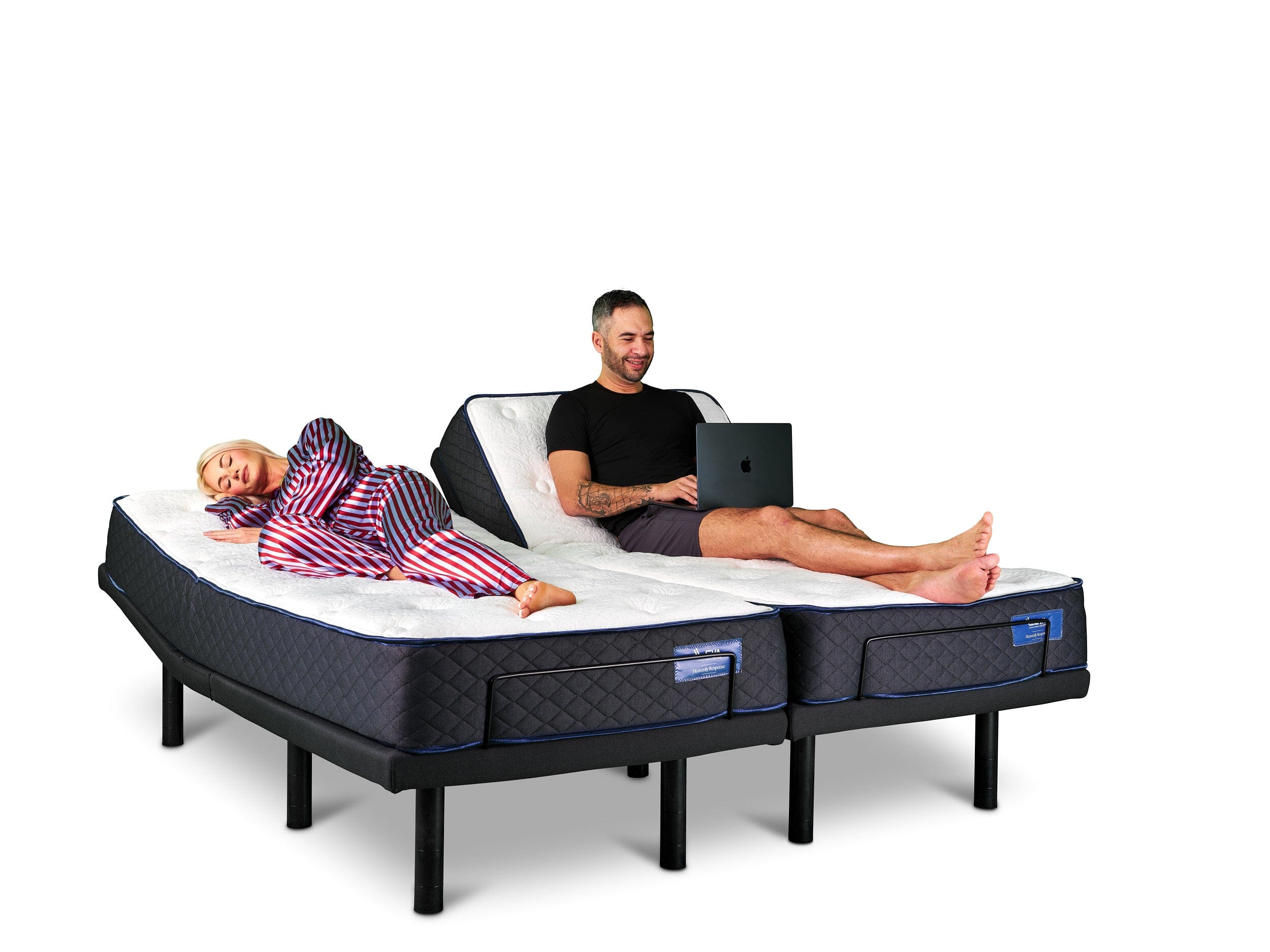
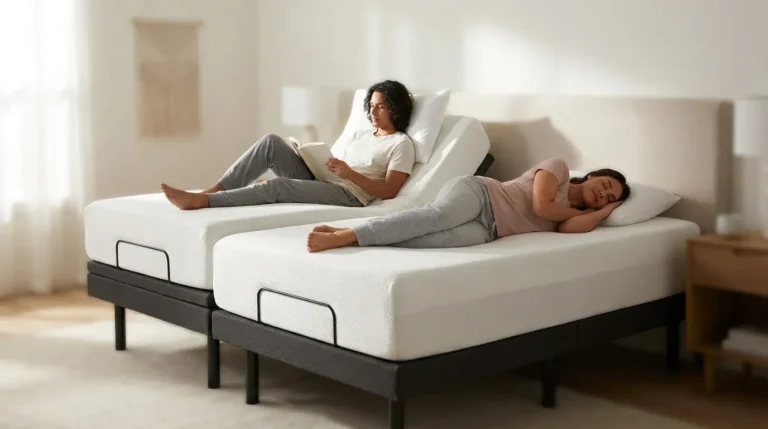
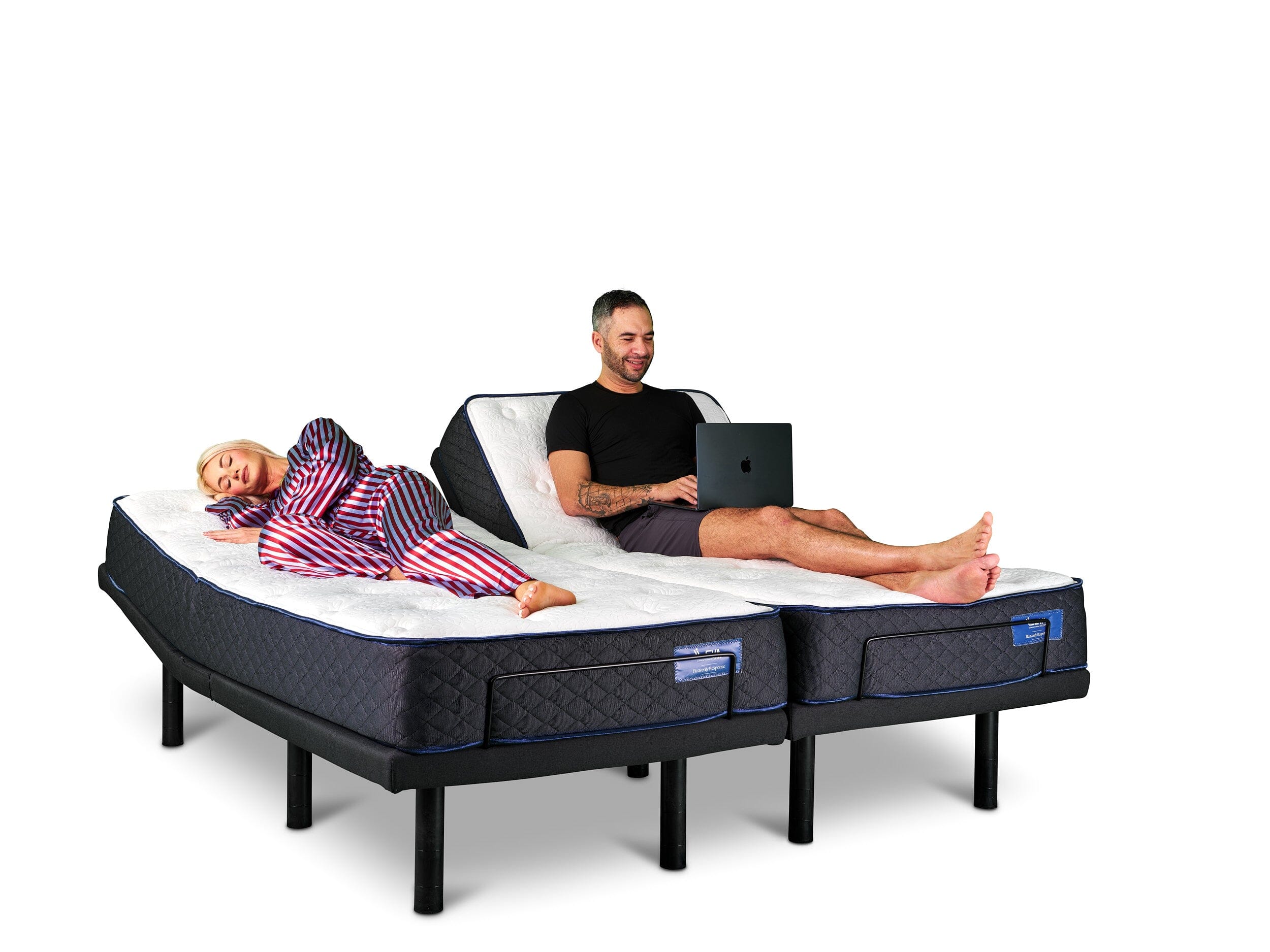
A split adjustable base divides the bed down the centre and gives each partner an independently controlled sleep surface. Each side can be elevated or lowered and set to a different massage intensity. On advanced systems, each side can also adjust lumbar support and pillow tilt without affecting the other side.
When a Tempur-Pedic-style memory foam mattress sits on this type of base, the system delivers pressure relief, motion isolation, and medical-grade positioning at the same time. One partner can raise their head to reduce snoring while the other stays flat. Movement on one side stays contained, which protects light sleepers.
Leva Sleep offers Split Queen and Split King configurations, and Split Queen is especially helpful in Canada because it is rare. Most Canadian adjustable bed specialists stock Twin XL, Queen, and King sizes. Split King (two Twin XL) is also widely available but needs a larger room footprint. Leva’s Split Queen option brings independent adjustability to couples who cannot or do not want to upsize their bedroom.
Typical Canadian Pricing for Memory Foam and Adjustable Base Packages
The table below outlines general Queen-size pricing ranges for memory foam mattress and adjustable base packages in Canada. Verify current pricing directly with each retailer before purchasing, as prices change frequently.
| Category | Approx. Queen Package Price (CAD) | Split Base Available | White-Glove Delivery |
|---|---|---|---|
| Tempur-Pedic (premium brand, retailer-sold) | about $2,650 to $4,700 | Split King and Split CA King | Varies by retailer |
| General mattress retailer adjustable package | about $1,400 to $5,000 | Limited models | Varies |
| Leva Sleep Split Queen/King system | Approx. 30–50% less than top-tier competitors (see cost advantage explanation below) | Split Queen & Split King | In-house white-glove (fee) |
Pricing ranges above are approximate and for general orientation only. Confirm current figures at point of purchase. Because these systems represent a significant investment, it helps to understand which features truly justify price differences. The criteria below separate marketing extras from features that actually improve sleep for couples.
Evaluation Criteria That Actually Matter for Couples
These criteria determine whether a memory foam system for couples solves the real problems or simply replaces one compromise with another.
Independent adjustability per side. Each side of the base should operate on a completely separate motor and controller. Some bases marketed as “split” share a single motor for head elevation, which means one partner’s adjustment still affects the other. True independence keeps each person’s settings stable.
Motor noise. Quiet motors protect the sleeping partner when the other person changes position. Even with independent motors, loud operation can wake the other person and cancel out the benefit of separate control. Look for systems that specify whisper-quiet or low-decibel motors.
Lumbar support and pillow tilt. Head elevation alone does not address lower back pain. A lumbar zone that inflates or adjusts independently provides targeted support for the lumbar curve, which shifts when the upper body rises. Pillow tilt, which uses a separate motor at the top of the head zone, prevents the neck from hyperextending when the head is raised for anti-snore positioning.
Temperature regulation. Memory foam retains heat more than innerspring mattresses. Couples who sleep at different temperatures should look for systems that include a heating and cooling pad per side. A single-zone system averages both partners’ needs and usually leaves one person uncomfortable.
Mattress compatibility with elevation. Not all memory foam mattresses flex adequately at the head and foot zones required by an adjustable base. A mattress that is too rigid will resist bending, which stresses the foam layers and reduces the base’s range of motion. Confirm that the mattress is rated for adjustable base use before purchasing.
Specialized bedding. Standard fitted sheets often pull off when a base elevates. Sheets designed for adjustable bases use deeper pockets and reinforced elastic so they stay in place through full range-of-motion cycles.
App and remote control. Couples who adjust positions during the night benefit from app-based control that does not require turning on a light. Bluetooth-connected apps allow custom position presets, vibrating alarms, and automated micro-adjustments triggered by snoring detection.
Find a Leva Sleep system that meets these criteria
Practical Buying Considerations for Canadian Couples
Warranty and trial period. Memory foam mattresses typically carry 10-year warranties, and the terms vary significantly. This variation matters because some warranties cover only manufacturing defects above a defined sag threshold, often 1.5 inches. That level may not cover the gradual softening that reduces pressure relief over time. Since pressure relief is a main reason to buy memory foam, reading the full warranty document, not just the headline number, helps you understand real protection. Trial periods in Canada range from 100 to 365 nights. Confirm whether the trial applies to the base, the mattress, or both, and whether return shipping costs are covered.
Delivery logistics in Ontario and Alberta. Large adjustable bases require two-person delivery teams and clear access to the bedroom. Measure staircase and doorway clearance before ordering. White-glove delivery services, such as those offered by Leva Sleep for a fee, handle old bed removal, full assembly, leg-height adjustment, and a product walkthrough. This service removes the logistical burden that standard courier delivery places on the customer.
Return policies. Some retailers exclude adjustable bases from standard return policies or charge restocking fees. Clarify the return process for each component of the system separately before committing, so you know exactly what happens if the setup does not work for you.
People Also Ask
What is the best mattress comparable to Tempur-Pedic?
Tempur-Pedic’s primary advantage is its proprietary viscoelastic foam, which contours closely to the body and absorbs motion effectively. Mattresses that use high-density memory foam with similar slow-response characteristics offer comparable pressure relief at lower price points. The key specifications to compare are foam density, measured in kg/m³ or lb/ft³, ILD (Indentation Load Deflection) rating for firmness, and the number of distinct foam layers. Hybrid mattresses that combine a memory foam comfort layer with a pocket coil support core can also replicate the contouring feel while improving airflow and edge support.
What are the disadvantages of memory foam?
Memory foam retains body heat more than latex or innerspring alternatives, which can cause discomfort for people who sleep warm. It also has a slower response time than latex, so it takes longer to adjust when a sleeper changes position, and some people feel “stuck” in the surface. Memory foam can off-gas a chemical odour when new, which typically dissipates within a few days to two weeks. Lower-density memory foam also degrades faster than high-density formulations and can lose its pressure-relieving properties within a few years.
What mattress do most 5-star hotels use?
Five-star hotels in Canada and internationally tend to use medium-firm hybrid mattresses from brands such as Simmons Beautyrest, Serta, and Sealy. These options prioritize durability and broad comfort appeal across diverse guests. Some luxury properties use custom pillow-top innerspring mattresses. Memory foam is less common in hotel settings because of heat retention concerns and the difficulty of accommodating guests with very different firmness preferences on a single mattress. For couples with specific needs, a customizable home system with independent firmness and elevation per side offers a more targeted solution than any hotel standard.
Why Leva Sleep Delivers Luxury Features at a Lower Price
Leva Sleep operates a vertically integrated model. The company designs its systems in-house, oversees manufacturing, assembles locally in the regions it serves, and delivers through its own white-glove team rather than third-party couriers. Removing the retail markup, the distributor margin, and outsourced delivery costs creates a clear cost advantage compared with comparable top-tier competitors while maintaining premium materials and engineering standards.
Leva Sleep has accumulated the scale to negotiate on materials and the operational depth to maintain quality control at each stage. The company stocks 15–20 adjustable base models compared to the 3–5 typically found at general mattress retailers. This broader range means customers are matched to a system based on their actual needs rather than the retailer’s inventory constraints.
The Split Queen configuration, which is rare in the Canadian market, grew directly from customer demand. Couples in smaller bedrooms wanted independent adjustability without the larger footprint of a Split King. Leva builds Split Queen systems to customer specifications, which general retailers typically do not offer.
Start your search with Leva Sleep’s adjustable bed collection
Conclusion: Matching Your System to Your Relationship
The decision to invest in a split adjustable memory foam system comes down to five practical checks. Each side of the base must operate independently. The motors need to run quietly enough to avoid waking a sleeping partner. The mattress should flex properly for adjustable base use. The system should include temperature regulation per side. The retailer should offer a meaningful trial period with transparent return terms.
For Canadian couples in Ontario and Alberta who now sleep in separate rooms, or who manage snoring, hip pain, or sleep apnea, a split adjustable system with a Tempur-Pedic-style memory foam mattress addresses root causes rather than symptoms. Compare current pricing, confirm delivery logistics for your address, and read warranty terms in full before purchasing.
Compare Leva’s split adjustable systems for your home
Frequently Asked Questions
Can a memory foam mattress be used on a split adjustable base?
Yes, as long as the mattress is specifically rated for adjustable base use. Memory foam is generally more flexible than innerspring mattresses, which makes it well-suited to the bending required at the head and foot zones of an adjustable base. Not all memory foam mattresses are constructed to handle repeated flexion without delaminating or cracking the foam layers, so construction quality matters. When purchasing, confirm with the retailer that the mattress carries an explicit adjustable-base compatibility rating. Leva Sleep designs its mattresses, including all-foam and hybrid pocket coil options, to work with its adjustable bases and maintain full range of motion without compromising foam integrity.
What is a Split Queen adjustable bed and why is it hard to find in Canada?
A Split Queen adjustable bed divides a standard Queen-size sleep surface into two independently controlled halves, each with its own motor, remote, and elevation settings. This layout allows each partner to raise or lower their side without affecting the other. Split Queen systems are uncommon in Canada because most adjustable bed manufacturers and retailers focus on Split King configurations, which are easier to produce using two standard Twin XL bases. A true Split Queen requires custom fabrication to fit the narrower Queen dimensions. Leva Sleep is one of the few Canadian retailers that builds Split Queen systems to order, which makes it a practical option for couples who want independent adjustability without the larger footprint of a Split King.
How does head elevation on an adjustable base help with snoring and sleep apnea?
Elevating the head of the bed by 7 to 15 degrees shifts the position of the airway and reduces the tendency of soft tissue in the throat to collapse. This change helps prevent obstruction of breathing during sleep. Positional therapy of this kind is commonly recommended for mild to moderate obstructive sleep apnea and snoring as a complement to, or sometimes an alternative to, CPAP therapy. On a split adjustable base, only the snoring partner’s side needs elevation, which lets the other partner keep a flat surface.
Is white-glove delivery worth the additional cost for an adjustable bed?
For most couples purchasing a split adjustable base, white-glove delivery functions as a practical necessity rather than a luxury. Adjustable bases are heavy, require precise assembly, and must be connected to power and tested before use. A standard courier delivery leaves the customer responsible for moving components to the bedroom, assembling the frame, connecting the motors, and calibrating the remote or app. That process can take several hours and carries a risk of damage if done incorrectly. Leva Sleep’s white-glove service, described in the purchasing considerations section, eliminates this logistical burden and helps ensure the system is set up correctly from the first night.
How do I evaluate whether a memory foam mattress will hold up over time on an adjustable base?
Longevity on an adjustable base depends primarily on foam density and construction quality. High-density memory foam, generally 50 kg/m³ or higher, resists compression and delamination better than lower-density alternatives. Look for mattresses with clearly stated foam density specifications rather than vague descriptors such as “premium” or “high-quality.” The number of foam layers and how they are bonded also matters. Mattresses with glued or heat-bonded layers are more resistant to separation under repeated flexion than those relying solely on compression fit. Warranty terms provide a useful proxy. A manufacturer confident in long-term durability will cover sagging above a defined threshold for 10 or more years. Read the full warranty document and confirm it applies when the mattress is used on an adjustable base, because some warranties are voided by non-flat surfaces.