Written by: Matthew Timmins, Founder and Managing Director, Leva Sleep | Last updated: July 18, 2026
Key Takeaways for Canadian Couples
- Hybrid memory foam mattresses built for split adjustable bases give Canadian couples strong pressure relief, motion isolation, and cooling at 30–50% lower cost than comparable Tempur-Pedic systems.
- Side sleepers sleep more comfortably on 4–5 lb density foam with a 3–4 inch comfort layer that cushions shoulders and hips while keeping the spine aligned.
- Hybrid constructions with pocketed coils move air through the mattress more effectively than all-foam designs, which helps during hot Ontario and Alberta summers.
- Medium-firm zoned support combined with an adjustable base can ease back pain by pairing contouring at the surface with precise body positioning.
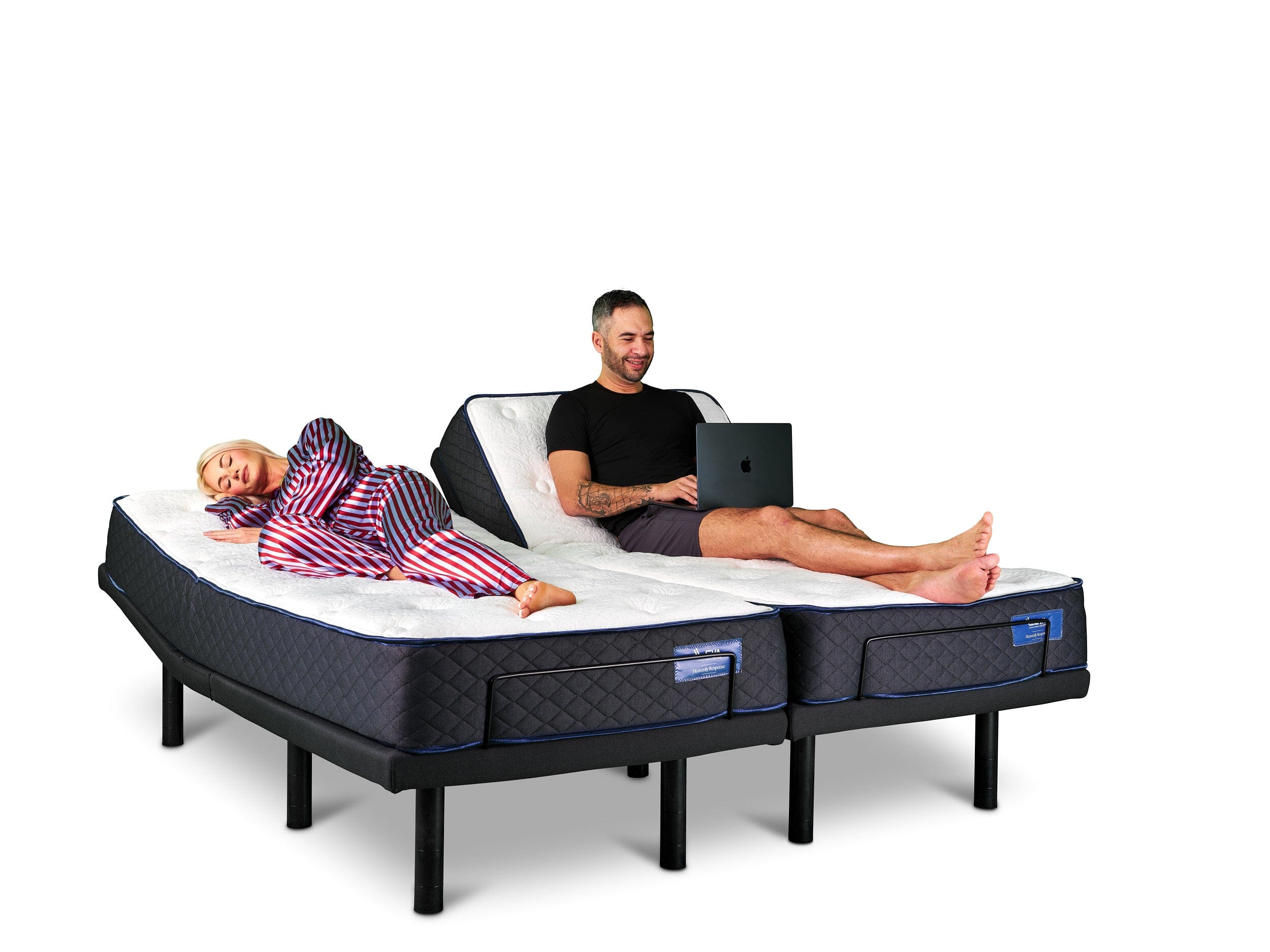
- Leva Sleep offers purpose-built split adjustable bed packages that address snoring, different firmness needs, and partner movement. Explore split bed solutions tailored for couples.
Side Sleeper Memory Foam Picks for Canadians
Side sleepers place concentrated pressure on the shoulders and hips, so contouring depth becomes the main decision point. Side sleepers benefit most from memory foam with 4–5 lb density, ILD 14–22, and a 3–4 inch comfort layer. This combination spreads weight evenly and keeps the spine aligned at the waist.
These specifications translate side sleeper needs into measurable mattress features. When evaluating options, look for:
- Comfort layer density of 4 lb/ft³ or higher for durability that typically lasts 7–10 years
- ILD (Indentation Load Deflection) between 14 and 22 to cushion shoulders and hips without collapsing
- A comfort layer of at least 3 inches so you do not bottom out on the support core
- A breathable Tencel, bamboo rayon, or knit cover to offset the heat-retention tendency of dense foam
Side sleepers with pressure-point issues at the shoulders and hips often prefer memory foam over latex for its deep contouring and pressure relief. Alberta buyers should also note that memory foam can feel firmer in Calgary’s dry climate, where relative humidity often sits at 30–40%. Experts therefore recommend choosing one firmness level softer than what felt right in a humid Ontario showroom.
Cooling Memory Foam Options for Hot Canadian Summers
Many side sleepers also struggle with heat retention, which often comes from the same dense foam that provides pressure relief. Cooling mattresses in Canada in 2026 are available from around $300 to over $1,500 CAD, with options for hot sleepers. Traditional memory foam is the category’s primary heat-retention offender. Memory foam is an inherently insulating material that restricts airflow and retains heat against the body even when gel-infused or open-cell.
Cooling technologies rank by sustained effectiveness, meaning how long they keep working through the night rather than just during the first hour:
- Phase-change material (PCM) covers: absorb and release heat to smooth out surface temperature swings over several hours
- Copper-infused foam: conducts heat away from the body on an ongoing basis
- Open-cell memory foam: lets air move through interconnected cells for more consistent cooling than gel alone
- Gel-infused foam: absorbs heat effectively at first but reaches thermal equilibrium after 30–90 minutes, after which it provides no further cooling
Hybrid mattresses promote passive ventilation through the open space created by the pocketed coil support layer, preventing the heat trapping that occurs in all-foam constructions. This airflow advantage matters during Ontario and Alberta summers when bedroom temperatures often exceed 25°C.
Memory Foam Choices for Back Pain Relief
The Canadian Chiropractic Association notes that pressure relief from memory foam is beneficial for side sleepers and those with joint issues when density (4–5 lbs/ft³) and ILD are appropriate. A 2021 systematic review in the Journal of Orthopaedics and Traumatology concludes that medium-firm mattresses with good spinal alignment are best for most adults with chronic non-specific low back pain.
For back-pain sufferers, these criteria matter most:
- Medium-firm feel (around 6–7 on a 10-point scale) to support lumbar curvature without letting the hips sink too far
- Zoned support or adjustable lumbar features that focus on the lower back separately from the rest of the body
- Adjustable base compatibility so the head and foot can be elevated to reduce spinal loading. Adjustable bases paired with compatible mattresses are popular for sleepers with sleep apnea or acid reflux because they allow the head to be elevated.
Leva Sleep’s adjustable bases add lumbar control and pillow-tilt articulation on top of the mattress’s pressure relief. This combination addresses back pain through both surface contouring and precise body positioning.
Best Memory Foam Setups for Canadian Couples
A 2025 Sleep Foundation comparison and 2025 NapLab side-by-side testing both conclude that memory foam outperforms hybrids on motion isolation while hybrids outperform on temperature regulation and edge support. Couples therefore need to balance sensitivity to partner movement against a tendency to sleep hot when choosing between all-foam and hybrid designs.
Couples evaluating mattresses together can focus on:
- Motion isolation: memory foam reduces motion transfer by up to 90% compared to traditional innerspring mattresses
- Firmness compatibility: split configurations let each partner choose a different feel entirely
- Temperature: heat sharing occurs faster in queen memory foam mattresses with two bodies; king size reduces this by providing more surface area per person
- Split-base readiness: the mattress must flex repeatedly without delaminating at the hinge point
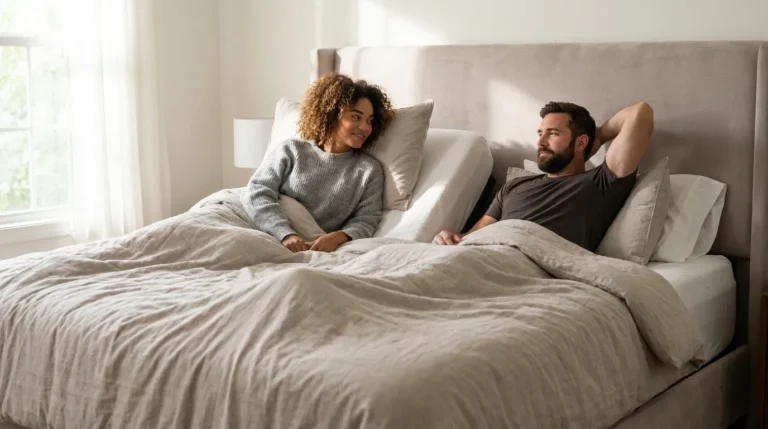
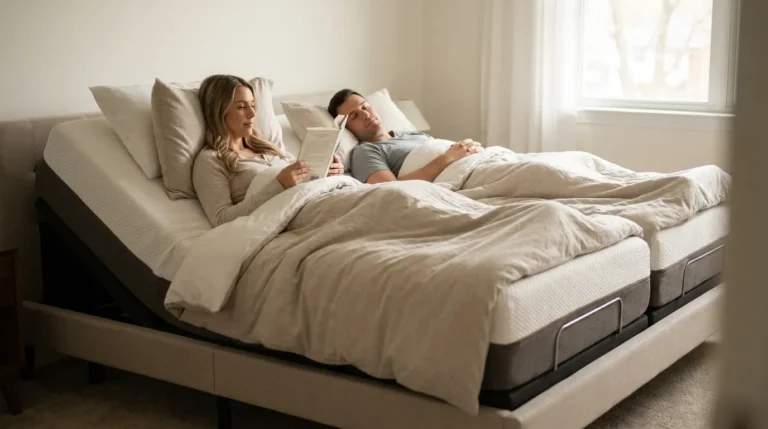
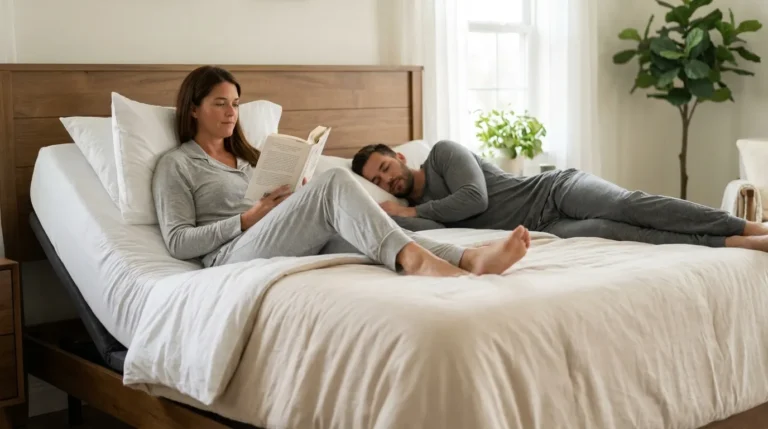
When differing firmness preferences, snoring, or partner movement push couples toward separate sleeping arrangements, often called a “sleep divorce,” a split adjustable base with purpose-built memory foam hybrids can resolve the conflict while keeping both partners in the same bed.
Memory Foam vs Hybrid on Adjustable Bases
Memory foam mattresses provide superior motion isolation compared to hybrids because the foam absorbs movement locally under direct pressure without transmitting energy laterally across the surface. Hybrids, by contrast, deliver good but not complete motion isolation. Individually wrapped pocketed coils reduce transfer, yet some vibration still moves through the coil system.
For adjustable base use, both constructions work well when the coils are individually wrapped rather than Bonnell-connected. Traditional innerspring mattresses with interconnected Bonnell coils are not compatible with adjustable bases, as the connected coil system resists bending and can be damaged by repeated flexing.
The practical trade-off for Canadian couples on an adjustable base looks like this:
- All-foam memory foam: maximum motion isolation, maximum contouring, higher heat retention, best for light sleepers who run cool
- Memory foam hybrid (pocketed coils): excellent motion isolation, strong contouring, superior airflow, best for couples where at least one partner sleeps hot or weighs over 230 lbs
Hybrid mattresses generally last 7–10 years compared with 5–7 years for all-foam memory foam mattresses because the coils resist sagging better than high-density foam alone. For most Canadian couples on a split adjustable base, a memory foam hybrid offers the best mix of longevity, cooling, and motion isolation.
Choosing the Right Memory Foam Thickness
Many memory foam mattresses sold in Canada range between 10 and 14 inches in height. Thickness affects both feel and how smoothly the mattress works on an adjustable base.
Most adjustable base manufacturers specify a maximum mattress height between 12 and 14 inches for full articulation warranty coverage, as thicker mattresses risk exceeding weight ratings and straining the bending radius. Mattresses with a 10–12 inch profile flex best on adjustable bases, while very thick mattresses (14 inches or more) flex less and are heavy to move.
General thickness guidelines for adjustable base use:
- 10–12 inches: optimal flex, lightest weight, easiest articulation, ideal for most adjustable base pairings
- 12–14 inches: acceptable with most modern bases, but confirm the base’s maximum supported thickness before purchasing
- 14 inches or more: mattresses thicker than 14 inches or featuring thick pillow tops can bind against the retainer bar during incline adjustments and should be avoided
Within the comfort layer itself, the 3–4 inch depth recommended for side sleepers delivers enough pressure relief without letting you bottom out on the support core.
Best Systems for Split Adjustable Bases
Leva Sleep’s vertical integration creates a clear advantage for couples who want split adjustable bases. General mattress retailers usually stock 3–5 adjustable base models as an add-on, while Leva Sleep offers 15–20 purpose-engineered adjustable models designed to pair with its own memory foam hybrid mattresses.
Leva Sleep’s split adjustable system includes:
- Whisper-quiet German motors that articulate without waking a sleeping partner
- Anti-snore mode (spring 2026) that detects snoring and makes small head-of-bed adjustments
- Lumbar control for targeted lower-back support that works independently from head and foot positions
- Pillow-tilt motor for fine-tuned head and neck adjustment
- Full app control via Bluetooth, including custom sleep positions, vibrating alarms, and real-time adjustments
- Extra-elastic fitted sheets and duvet clips designed to stay in place while the base moves
- In-house white-glove delivery that covers bedroom setup, old-bed removal, leg-height adjustment, and a full product walkthrough
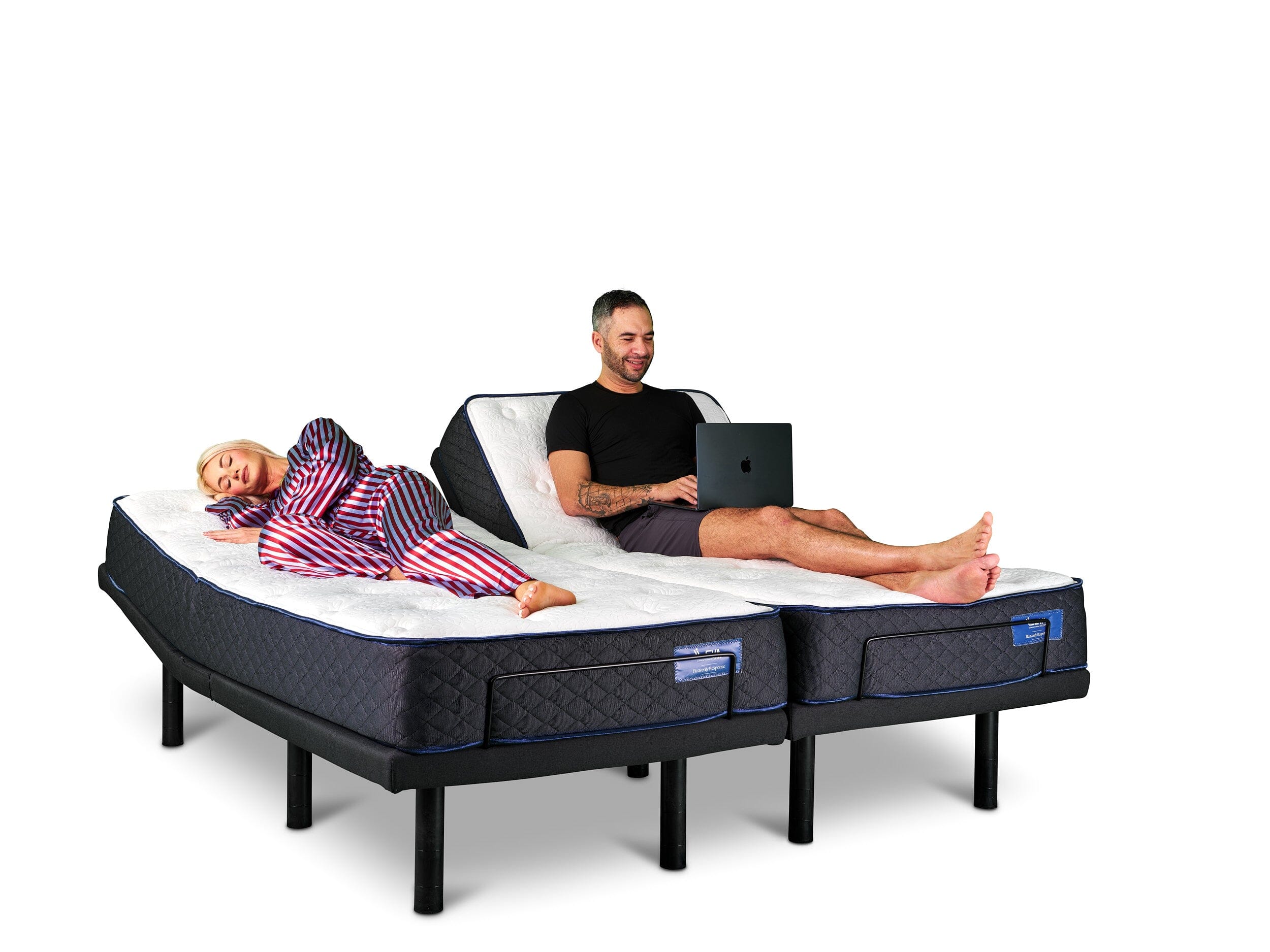
Split king adjustable beds consist of two independent Twin XL platforms, each with its own motor system and remote, allowing each side to articulate independently without affecting the other sleeper. Leva Sleep extends this idea to Split Queen configurations, which remain rare. These systems deliver independent adjustment in a smaller footprint and are built to customer specifications.
With over 25,000 Canadian customers, $50M in lifetime sales, and 8 years of adjustable-bed specialization, Leva Sleep delivers Tempur-Pedic-level performance at significantly lower cost by cutting out middlemen. See the cost savings and configure your split system today.
Comparison Table for Canadian Adjustable-Base Shoppers
The table below compares eight mattresses relevant to Canadian couples considering memory foam options for adjustable bases. Canadian pricing reflects publicly listed queen-size figures as of mid-2026. Leva Sleep pricing reflects its typical savings versus Tempur-Pedic on a comparable hybrid system; contact Leva Sleep directly for current package pricing.
| Mattress | Canadian Price (Queen) / Trial / Warranty | Firmness & Cooling Technology | Split Adjustable-Base Compatible |
|---|---|---|---|
| Leva Sleep Memory Foam Hybrid | 30–50% below Tempur-Pedic comparables; trial and warranty details at levasleep.com | Multiple firmness options, open-cell hybrid construction with pocketed coils for passive airflow | Yes, purpose-built for Leva’s 15–20 split Queen and split King bases; white-glove delivery included for a fee |
| Tempur-Pedic TEMPUR-Adapt | roughly C$2,800–C$3,900 for a queen size with a 10-year full replacement limited warranty | Medium or medium-hybrid, proprietary NASA-derived TEMPUR foam, 5–7 lb/ft³ density | Yes, compatible with Tempur-Pedic power bases in split queen and split king |
| Endy Mattress | $399–$895 CAD depending on size; 365-night trial; 15-year warranty | Three firmness options (Firm, Medium-Firm, Plush); standard memory foam without an advanced cooling layer | Memory foam is compatible with adjustable bases; split-base pairing requires third-party base verification |
| Douglas Alpine | $999 CAD; 365-night trial; 15-year warranty | Temperature-balancing gel foam and phase-changing cover | All-foam construction is adjustable-base compatible; split-base pairing requires third-party base verification |
| Silk & Snow Hybrid | Prices vary by size; 365-night trial; 15-year warranty | 1,200 pocketed coils | Hybrid is adjustable-base compatible; split-base pairing requires third-party base verification |
| Octave Mirage | $1,299 CAD; 365-night trial; 15-year warranty | Cooling-thread cover and copper-infused gel foam | All-foam construction is adjustable-base compatible; split-base pairing requires third-party base verification |
| Casper Original | $1,499 CAD; 100-night trial; 10-year warranty | Medium-firm feel with zoned support foam layers and no advanced cooling layer listed | All-foam construction is adjustable-base compatible; split-base pairing requires third-party base verification |
| Endy Hybrid | Prices vary by size; 365-night trial; 15-year warranty | 13.5-inch hybrid with three firmness options | Hybrid is adjustable-base compatible; split-base pairing requires third-party base verification |
Common Buyer Mistakes to Avoid
Canadian couples often repeat a few avoidable mistakes when buying a memory foam mattress for an adjustable base.
- Ignoring foam density: foam under 1.5 lb/ft³ will develop body impressions within two years; look for 1.8 lb/ft³ or higher in the support core and 3.0 lb/ft³ or higher in the memory foam comfort layer
- Choosing a mattress over 14 inches thick: thicker mattresses risk exceeding weight ratings and straining the bending radius of adjustable bases
- Buying a mattress without confirming split-base compatibility: not all memory foam mattresses are rated for repeated split-base articulation cycles, so always look for explicit manufacturer certification
- Assuming gel foam solves heat retention permanently: as noted earlier, gel foam’s cooling effect is temporary, lasting only 30–90 minutes before thermal equilibrium. A hybrid with pocketed coils offers more sustained passive ventilation.
- Skipping a mattress protector: mattress warranties in Canada are voided by stains, and an unprotected mattress absorbs moisture that speeds up foam breakdown
- Purchasing a general adjustable base instead of a specialist system: standard retailers stock 3–5 base models with limited split options, while a specialist like Leva Sleep offers 15–20 models with purpose-matched mattresses, accessories, and in-house delivery
Frequently Asked Questions
How thick should memory foam be for adjustable bases?
For most adjustable bases, a mattress between 10 and 13 inches thick gives the best balance of comfort and articulation. Mattresses in the 10–12 inch range flex most easily and place the least strain on the base’s motor and hinge system. Mattresses at 13–14 inches are usually still compatible but should be checked against the base manufacturer’s maximum height specification before purchase. Anything above 14 inches can bind against the retainer bar during incline adjustments and may exceed the base’s weight rating. Inside the mattress, the memory foam comfort layer should be at least 3 inches deep for meaningful pressure relief, with a support core of at least 1.8 lb/ft³ base foam density to resist sagging.
Do memory foam mattresses work with split Queen bases?
Memory foam mattresses work well with split Queen bases when the manufacturer explicitly rates them for adjustable base use. Memory foam is the most consistently compatible mattress type for split adjustable bases because its flexible, non-rigid construction bends smoothly with base articulation and returns to shape without damage. A split Queen configuration uses two separate narrow mattresses placed side by side, each on its own independent base. Each partner can adjust head elevation, foot elevation, lumbar support, and massage settings without affecting the other side. Leva Sleep is one of the few Canadian specialists offering purpose-built Split Queen adjustable systems, with mattresses designed for repeated articulation cycles and accessories, including extra-elastic fitted sheets and duvet clips, engineered to stay in place when the base moves.
How long does cooling technology actually last in Canadian summers?
Cooling performance depends on the specific technology. Gel-infused memory foam provides active cooling for approximately 30–90 minutes before reaching thermal equilibrium, after which it no longer draws heat away from the body. Phase-change material covers and copper-infused foams offer more sustained heat dissipation because they work through conduction and absorption rather than a one-time thermal exchange. Open-cell memory foam architecture provides passive airflow through interconnected cells and maintains cooling more consistently than gel alone, especially when paired with a breathable Tencel or knit cover. Hybrid mattresses with pocketed coil support layers add a structural airflow advantage that foam-only cooling cannot fully match. For Ontario and Alberta couples facing summer bedroom temperatures above 25°C, a memory foam hybrid with open-cell foam, a PCM or copper-infused comfort layer, and a breathable knit cover delivers the most reliable all-night cooling performance.
Are mattress warranties transferable across provinces?
Most major mattress warranties in Canada apply to the original purchaser rather than a specific address, so coverage usually continues if the owner moves between provinces. Tempur-Pedic’s 10-year warranty, for example, is nationwide in Canada and transfers with the owner across provincial moves. Warranty validity still depends on following the manufacturer’s care requirements, including a compatible foundation with slats no more than 3–4 inches apart, no stains, and no use of an incompatible base type. Prorated warranties reduce coverage value over time, so non-prorated terms offer stronger protection. When evaluating any mattress purchase, confirm in writing whether the warranty is non-prorated, what the sagging threshold is for a valid claim (typically 1–1.5 inches), and whether adjustable base use is explicitly allowed.
Conclusion: A Split-Bed Path to Better Sleep
Many Canadians now choose mattresses based on comfort and function rather than brand name. For couples, the features that matter most, such as independent positioning, motion isolation, cooling, and lumbar support, work best when the mattress and base are engineered as a single system.
Leva Sleep has spent 8 years serving more than 25,000 customers and generating $50M in sales by designing memory foam hybrid mattresses, whisper-quiet German-motor bases, and purpose-made bedding accessories as one integrated package. These systems are assembled locally, delivered with white-glove service, and typically cost 30–50% less than comparable Tempur-Pedic setups.
Find your split bed solution and discover the split Queen or split King configuration that lets both of you sleep the way you need to in the same bed.