Written by: Matthew Timmins, Founder and Managing Director, Leva Sleep | Last updated: June 22, 2026
Key Takeaways for Couples Sharing a Bed
- Tempur-Pedic mattresses excel at motion isolation and pressure relief but often sleep warm when two people share the bed.
- All-foam construction locks both partners into one firmness and one flat position, even when their needs differ.
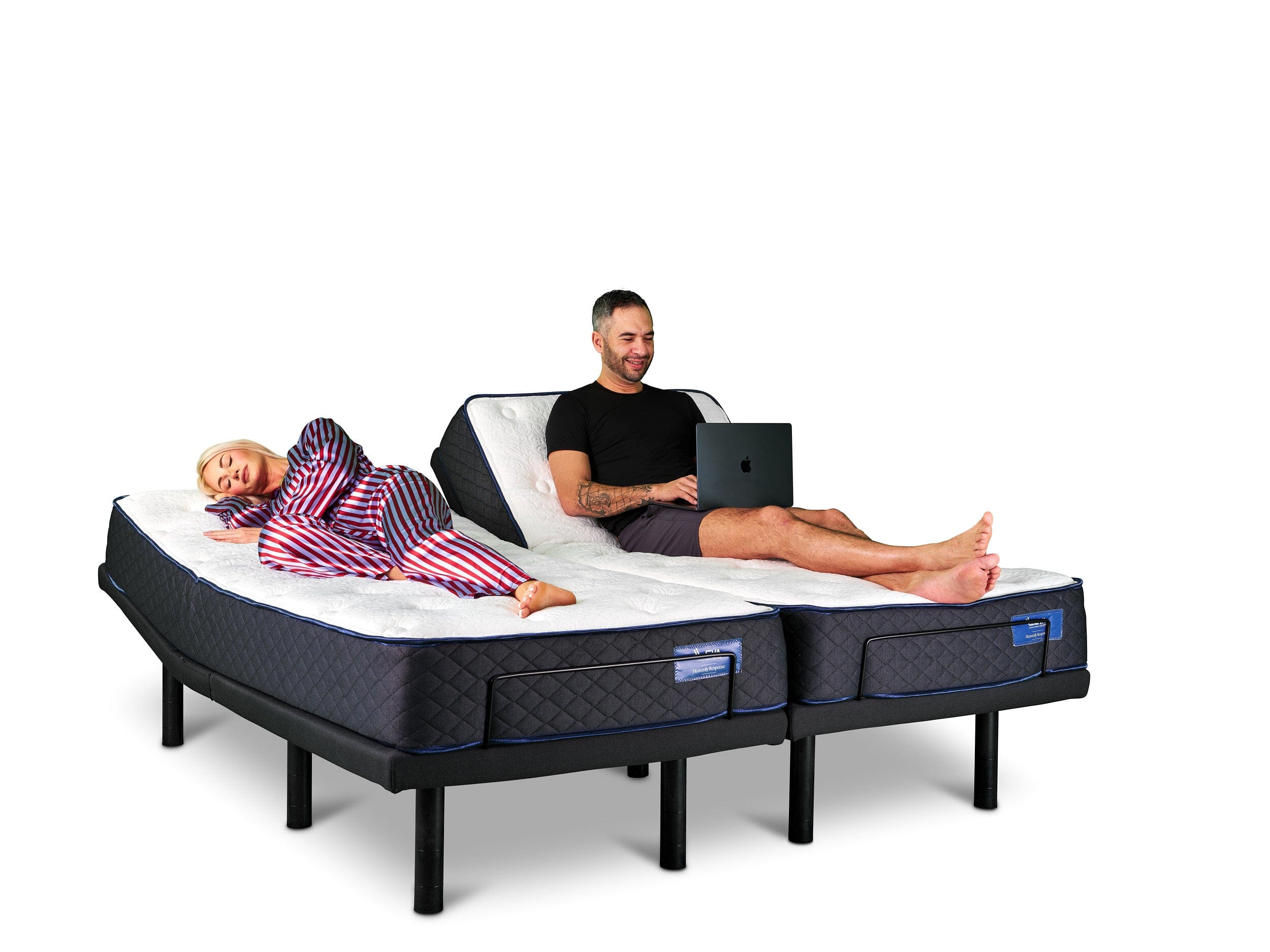
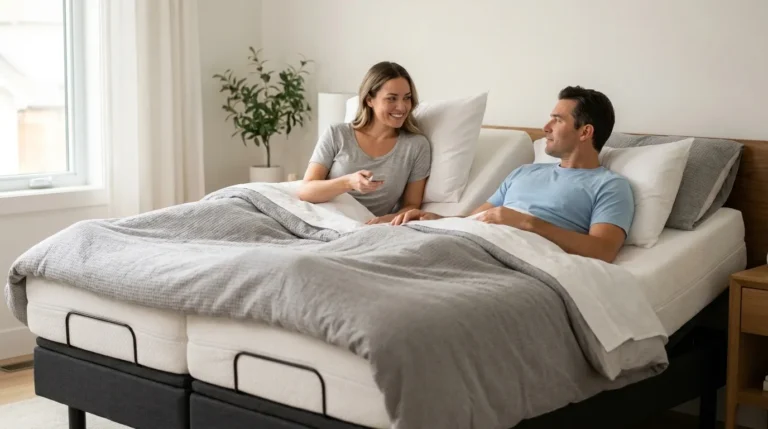
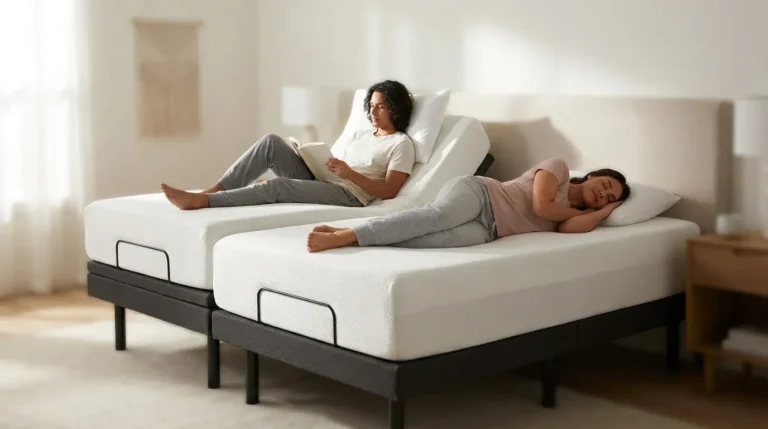
- Split adjustable systems separate each side at the base, improving motion isolation and giving each partner true control.
- Hybrid mattresses with coil airflow plus optional per-side temperature controls handle hot and cold sleepers in the same bed.
- For Canadian couples who want independent customization, explore Leva Sleep’s adjustable bed packages to find a split system that fits your needs.
The Problem: Shared Mattresses, Conflicting Needs
A 2024 OnePoll survey found that 82% of people in relationships report their partner’s sleeping habits consistently wake them up, with 25% specifically citing tossing and turning. Studies show adults typically change sleep position 11–13 times per night on average (range roughly 3–45), and some awakenings in shared beds are caused by a partner’s movement.
Three common Canadian couple scenarios highlight the gap. One partner snores and needs head elevation, while the other sleeps flat. A single flat mattress cannot meet both needs. A post-surgery patient requires a specific incline for recovery, while their partner needs a firm, flat surface. Again, one shared surface cannot adapt. One partner overheats every night while the other runs cold. A single mattress material cannot hold two different temperatures at once. Tempur-Pedic’s all-foam construction does not offer independent solutions for any of these situations. Over 31% of U.S. adults have engaged in a “sleep divorce”, sleeping in separate rooms to preserve sleep quality, which shows how often couples fail to solve shared-sleep incompatibility. The following table compares how all-foam and split adjustable systems handle these couple-specific challenges across key features.
All-Foam vs Split Adjustable Systems: Side-by-Side Comparison
| Feature | Tempur-Pedic All-Foam | Split Adjustable System (e.g., Leva Sleep) |
|---|---|---|
| Motion Isolation | Strong, dense viscoelastic foam absorbs movement effectively | Strong, independent bases physically separate each side |
| Temperature Regulation | All-foam models generally score lower on cooling than hybrids in NapLab testing, and top-performing all-foam models reach about 7.5/10 for temperature control | Hybrid mattresses with coil airflow plus optional per-side cooling pads handle conflicting temperature needs independently |
| Independent Customization | None, single firmness and flat profile for both partners | Full, each side controls elevation, firmness, massage, and temperature independently |
| Edge Support | Tempur-Pedic Supreme scored 6.5/10 for edge support in NapLab testing | Adjustable hybrid bases with reinforced perimeters provide stable edge support for easier entry and exit |
Leva Sleep’s Split Adjustable Systems for Canadian Couples
Leva Sleep focuses on adjustable sleep systems for Canadian couples, with over 8 years of expertise, $50M in lifetime sales, and 25,000+ customers across Ontario and Alberta. Where a standard mattress retailer carries 3–5 adjustable base models, Leva Sleep offers 15–20 configurations, including the Split Queen, a size most Canadian retailers do not stock.
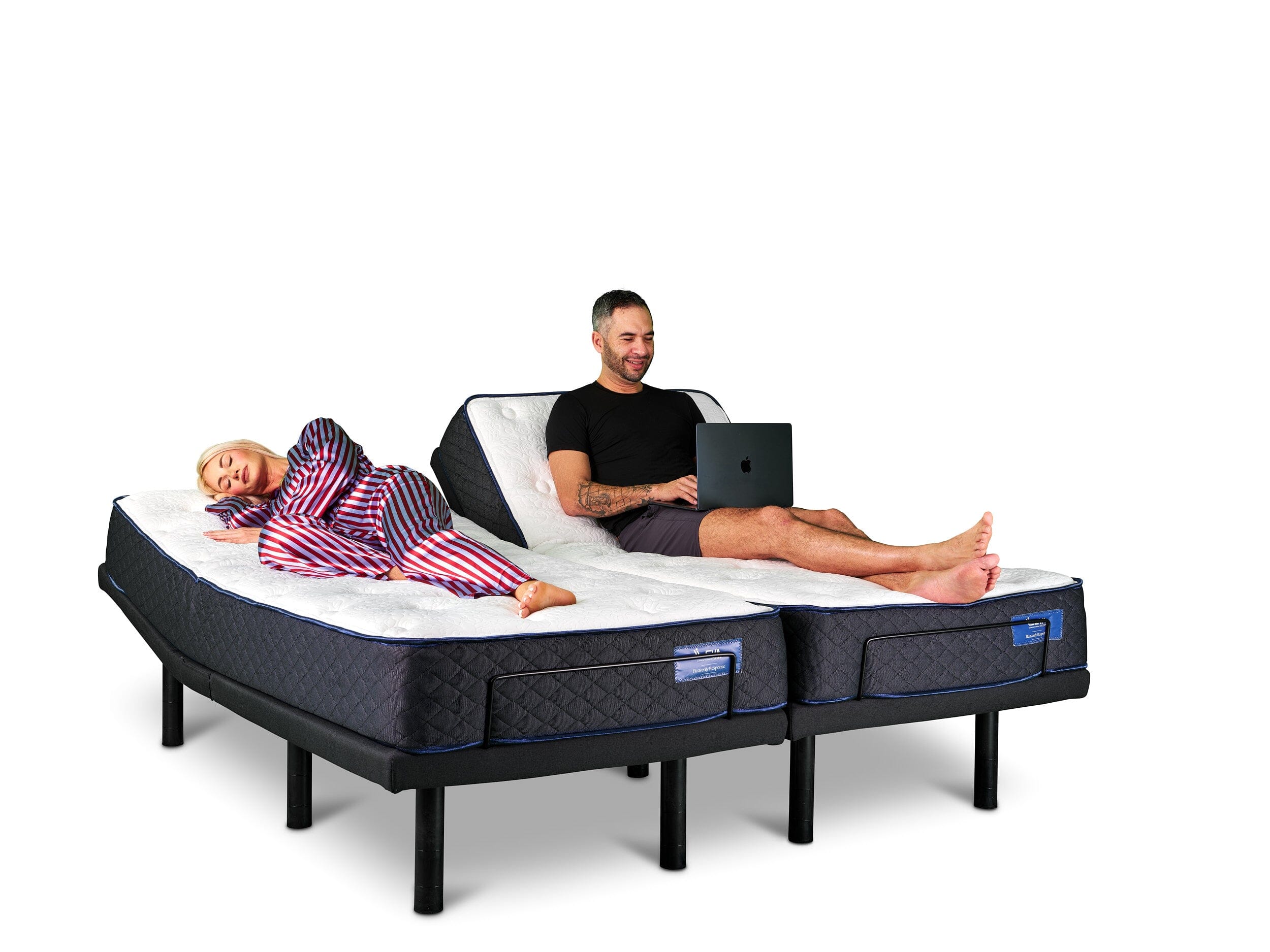
Split Queen and Split King bases from Leva Sleep give each partner independent control over head and foot elevation, massage intensity, and temperature through the Leva Sleep app. These adjustments stay quiet because whisper-quiet German motors remove the mechanical noise that made older adjustable bases disruptive for light sleepers. For couples where snoring drives most disturbances, an anti-snore mode arriving in spring 2026 will detect snoring and make small head-of-bed adjustments automatically, which addresses the issue without waking either partner. Leva Sleep delivers this level of functionality at 30–50% less than comparable luxury competitors by using a direct-to-consumer, vertically integrated model with local design, local assembly, and in-house white-glove delivery. For couples in Ontario and Alberta who have been considering Tempur-Pedic but need independent customization, Leva Sleep offers a structural alternative.
Compare Leva Sleep split adjustable packages
Motion Isolation Performance in Real Bedrooms
Tempur-Pedic’s dense viscoelastic foam absorbs motion effectively and reduces partner disturbance. Given that partner movement causes measurable sleep disruption, as noted earlier, mattress-level motion isolation becomes a meaningful health factor rather than a simple marketing claim.
All-foam motion isolation still has a ceiling because both partners share the same surface and frame. Every movement travels through that shared structure. A split adjustable system separates each side at the base level, so a partner who shifts position or changes elevation at 3 a.m. creates almost no mechanical disturbance on the other side. For couples where one partner has restless legs, gets up frequently, or needs positional changes for a medical condition, physical separation at the base level offers more reliable protection than foam absorption alone.
Explore split bases with independent motion isolation
Heat Retention When Two Bodies Share an All-Foam Bed
Heat retention often becomes Tempur-Pedic’s most noticeable limitation for couples. Traditional memory foam traps warm air in viscoelastic poly foam layers that release heat slowly, and NapLab tests show all-foam models usually score lower on cooling than hybrids. Even open-cell foam, gel infusions, and phase-change materials only reduce warmth, with tested all-foam models topping out around 7.5/10 for temperature control.
A mattress that holds body heat can block the normal 1–2°C drop in core body temperature needed to fall asleep, which delays sleep and fragments sleep continuity. Two bodies increase this effect. When one partner sleeps hot and the other sleeps cold, mattress material alone cannot solve both temperature needs. Leva Sleep’s split systems pair hybrid mattresses, which benefit from coil-layer airflow, with optional per-side heating and cooling pads. Each partner sets a separate thermal environment without affecting the other side.
Intimacy, Bounce, and Edge Support for Couples
All-foam construction creates two intimacy challenges for many couples: low bounce and weak edge support. NapLab testing found the Tempur-Pedic Supreme has very low bounce, and combined with weaker edge support, it earns a 6.7/10 sex performance score. Low bounce and limited edge stability restrict comfortable positions and usable surface area.
The Tempur-Pedic Supreme also shows extremely slow material response, which creates a “stuck” sensation during movement. The TEMPUR-Adapt scores 5.5/10 for ease of movement. Hybrid mattresses with pocket coils restore a more responsive surface that supports repositioning, while reinforced perimeter construction on adjustable bases addresses edge sinkage and makes the full width of the bed more usable.
See hybrid and split options designed for comfort and intimacy
Long-Term Sagging and Fixed Firmness for Couples
Tempur mattresses use a one-sided foam construction, which prevents flipping to spread wear and can allow body impressions to form faster on the single usable surface. Sleep Foundation gives the TEMPUR-Adapt a durability rating of 6.5/10. A 2026 Mattress Clarity review by Certified Sleep Science Coaches notes Tempur-Pedic’s durability and edge support, describing strong overall performance but also structural limits tied to all-foam design.
Permanent lack of flexibility creates a larger issue for couples. All-foam mattresses cannot be reconfigured once needs change. If one partner develops a medical need for elevation or if firmness preferences drift apart over time, the mattress stays fixed. Tempur does not publish ILD ratings or foam density specifications, so couples cannot easily compare firmness or long-term support with competitors when they shop for differing needs. A split adjustable system lets each side be repositioned, reconfigured, and updated independently as circumstances evolve.
Decision Guide: When a Split Adjustable System Makes Sense
A Tempur-Pedic mattress suits couples who share similar firmness preferences, have no temperature conflicts, do not need medical positioning, and experience little snoring. In that situation, its motion isolation and pressure relief work well.
A split adjustable system deserves close attention when one or more specific conditions apply. One partner snores or has been advised to sleep elevated for sleep apnea, acid reflux, or post-surgery recovery. Partners prefer clearly different firmness levels. One partner overheats while the other sleeps cold. Either partner has hip, knee, or back pain that responds to positional changes. The Global Wellness Institute’s 2026 Sleep Initiative Trends report highlights intelligent sleep systems as a major trend, reflecting how often fixed, shared surfaces fail couples with divergent needs.
For Canadian couples in Ontario and Alberta, Leva Sleep offers Split Queen and Split King configurations with independent controls, hybrid mattress options, per-side temperature regulation, quiet motors, and in-house white-glove delivery. These systems typically cost 30–50% less than comparable luxury competitors because of Leva Sleep’s direct-to-consumer model. Tempur-Pedic builds quality products, yet a single fixed surface often cannot meet two different sleep profiles. Many couples benefit more from a split adjustable configuration that treats each side as its own sleep environment.
Find your split adjustable setup with Leva Sleep
Frequently Asked Questions
Can a Tempur-Pedic mattress be used on an adjustable base?
Most Tempur-Pedic mattresses work with adjustable bases, and Tempur-Pedic sells its own Power Base line. Using a Tempur-Pedic mattress on a standard adjustable base still leaves the main couple-specific limits in place. Both partners share one mattress with one firmness, and neither partner can independently control elevation, temperature, or support on their own side. A split adjustable system, where each side has its own base and mattress, delivers genuine per-side independence. Leva Sleep pairs its split bases with both all-foam and hybrid mattress options, including models from established brands, so couples do not have to choose between mattress quality and adjustability.
Is heat retention really a significant problem with Tempur-Pedic for couples?
Heat retention often becomes a real issue with all-foam mattresses, and the effect grows when two people share the bed. Dense viscoelastic foam restricts airflow and traps body warmth, and even Tempur-Pedic’s SmartCool covers and gel-infused layers only reduce this tendency. Couples who sleep at similar temperatures may find this manageable. Couples where one partner sleeps hot and the other sleeps cold rarely solve the problem with a single mattress material. Separate bedding, zoned hybrid mattresses, and per-side cooling pads, which are available through Leva Sleep’s split systems, offer practical ways to handle conflicting temperature needs.
What is a Split Queen adjustable bed, and why is it relevant for Canadian couples?
A Split Queen adjustable bed uses two narrow twin-XL-equivalent bases placed side by side inside a queen-size frame, each with its own motor controls. Each partner can adjust head elevation, foot elevation, massage, and temperature settings without affecting the other side. The Split Queen suits couples in smaller Canadian bedrooms where a Split King, which uses two full twin XL bases, will not fit. Leva Sleep is one of the few Canadian retailers that builds Split Queen configurations to order, giving couples room-friendly access to independent customization.
How does Leva Sleep’s pricing compare to Tempur-Pedic for couples seeking adjustable solutions?
Tempur-Pedic’s adjustable base packages sit at the premium end of the Canadian market. Leva Sleep uses a direct-to-consumer, vertically integrated model that designs and assembles systems locally and removes retail markup. This structure delivers comparable or greater adjustability at 30–50% less than top-tier competitors. The price gap reflects fewer intermediaries and savings passed directly to customers. Couples drawn to Tempur-Pedic’s reputation but limited by budget, or couples who need split-base functionality that standard Tempur-Pedic packages do not include, often find Leva Sleep’s pricing model more accessible.
What should couples evaluate when comparing adjustable bed systems?
Couples comparing adjustable bed systems can start by assessing five criteria for each partner. First, preferred sleep position and whether elevation would help, such as back, side, or stomach. Second, firmness preference on a soft-to-firm scale. Third, temperature tendency, whether hot sleeper, cold sleeper, or neutral. Fourth, any medical or positional requirements, including sleep apnea, acid reflux, or post-surgery recovery. Fifth, sensitivity to partner movement during the night.
Once both partners define their needs, they can decide whether a shared mattress can satisfy both profiles at the same time. If the answer is no on two or more criteria, a split adjustable system with independent controls becomes the configuration to prioritize. Couples should also review motor noise, warranty terms, delivery and setup experience, and whether the retailer specializes in adjustable bases or treats them as a secondary product.