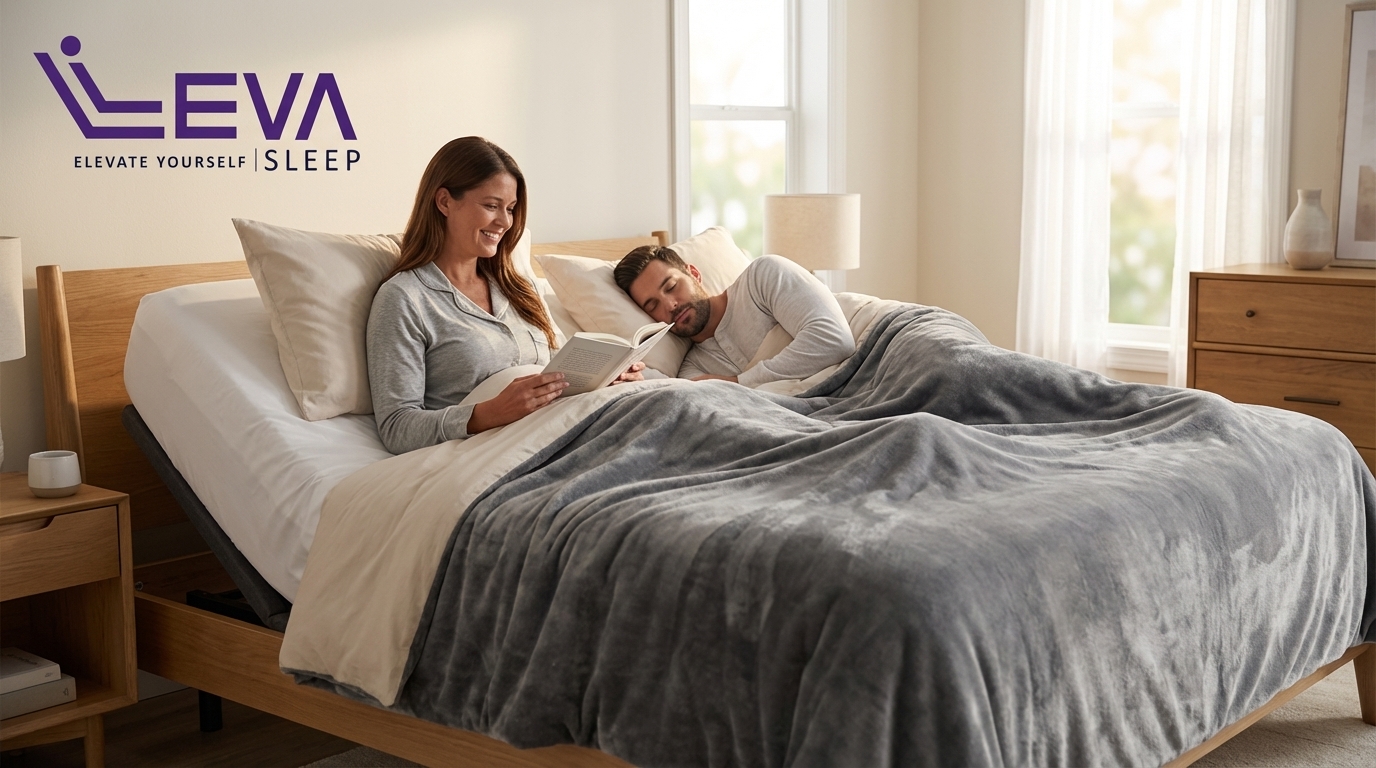
Written by: Matthew Timmins, Founder and Managing Director, Leva Sleep | Last updated: July 16, 2026
Key Sleep Divorce Insights for Canadian Couples
- Sleep divorce, where partners sleep separately to protect sleep quality, is rising in Canada due to snoring, temperature mismatches, movement, and medical conditions that flat beds cannot resolve.
- Canadian data is limited, but surveys suggest 30–40% of couples sleep apart, with similar U.S. figures showing 35% sleeping separately at least sometimes.
- Traditional fixes like separate bedrooms or single adjustable bases often fall short because they either reduce intimacy or fail to give each partner independent control.
- Split adjustable sleep systems let couples stay in the same bed by offering per-side head elevation, temperature control, and quiet motors that address the root causes of sleep disruption.
- Leva Sleep offers Split Queen and Split King adjustable bed packages with independent controls and white-glove delivery; find an adjustable bed configuration that fits your needs.
The Problem: Why Sleep Divorce Is Rising in Canada
More Canadian couples are moving toward separate sleeping arrangements in 2026 because nightly disruptions feel harder to ignore. Snoring is the most frequently cited driver, with many couples reporting that a partner’s snoring, loud breathing, or gasping disrupts their sleep.
Women report snoring-related disruptions far more often than men. Temperature mismatches affect a significant share of couples, and sharing a bed can increase sleep disturbances when one partner runs hot and the other runs cold.
Beyond these everyday incompatibilities, medical conditions add a more serious layer of disruption. Bed partners of people with untreated obstructive sleep apnea lose about an hour of sleep per night. Restless legs syndrome, frequent bathroom visits, and chronotype incompatibility, where one partner is a natural early riser and the other a night owl, add further pressure that no flat mattress can resolve.
Post-COVID health priorities also shape attitudes. Sleep now sits beside nutrition and exercise as a non-negotiable wellness pillar, so couples feel less willing to accept chronic disruption. Among Canadians aged 50 and older, grey divorce rates rose 26% between 1991 and 2006 before stabilizing, a demographic that overlaps heavily with couples managing age-related sleep conditions. No Canadian data directly links grey divorce to sleep divorce, but the age overlap is notable.
Explore split adjustable systems that address snoring, temperature mismatches, and movement before separate bedrooms become the default.
What Do Current Sleep Divorce Statistics Show?
Canadian-specific longitudinal data on sleep divorce remains limited. The most relevant domestic benchmark is the 2013 report citing Ryerson University clinical observations and recent surveys estimating that 30-40% of couples sleep in separate beds. Statistics Canada does not publish a dedicated sleep-arrangement metric.
Comparable U.S. data provides useful context for Canadian trends:
- The American Academy of Sleep Medicine’s 2023 national survey of 2,005 adults found that 35% sleep separately from their partner sometimes or always, with 15% doing so consistently.
- Adults aged 35–44 reported the highest rates of sleeping apart at 39%, while adults aged 65 and older reported the lowest at roughly 18%.
- A February 2026 Sleep Foundation survey of 3,200 U.S. adults found that couples who proactively framed sleep separation as a wellness decision reported significantly better outcomes on relationship satisfaction, sexual frequency, and communication quality than couples who reactively separated due to snoring-related conflict.
- A January 2023 survey found that 52.9% of adults who opted for separate bedrooms reported improved sleep, gaining an average of 37 extra minutes of rest per night.
Canadian sleep experts echo these patterns. Sleep expert Amanda Jewson notes that the most common complaint from clients is that their partner moves frequently during the night, and that snoring, apnea, restless leg syndrome, and shift-work schedules are the primary drivers she encounters in practice.
Why Common Sleep Divorce Solutions Often Fail
Most couples cycle through three options before discovering split adjustable systems, and each option has clear limits.
| Solution | Snoring / Airway | Temperature Regulation | Independent Positioning |
|---|---|---|---|
| Traditional flat bed | No adjustment possible | Shared surface, no zoning | None |
| Basic adjustable base (single) | Head elevation helps one partner, disrupts the other | Shared surface, no zoning | Linked, one setting for both sides |
| Separate bedrooms | Removes noise but leaves apnea untreated, introduces reduced intimacy and a sense of disconnection | Each partner controls their room | Full independence, but at the cost of shared space |
| Split adjustable system | Per-side head elevation opens airways independently | Per-side temperature regulation available | Full independent control for each partner |
A study in the European Respiratory Journal found little objective improvement in sleep quality for female partners of snorers who slept apart for one night, which suggests that physical separation alone does not reliably solve the underlying problem.
The Solution: How Split Adjustable Sleep Systems Help Couples Stay Together
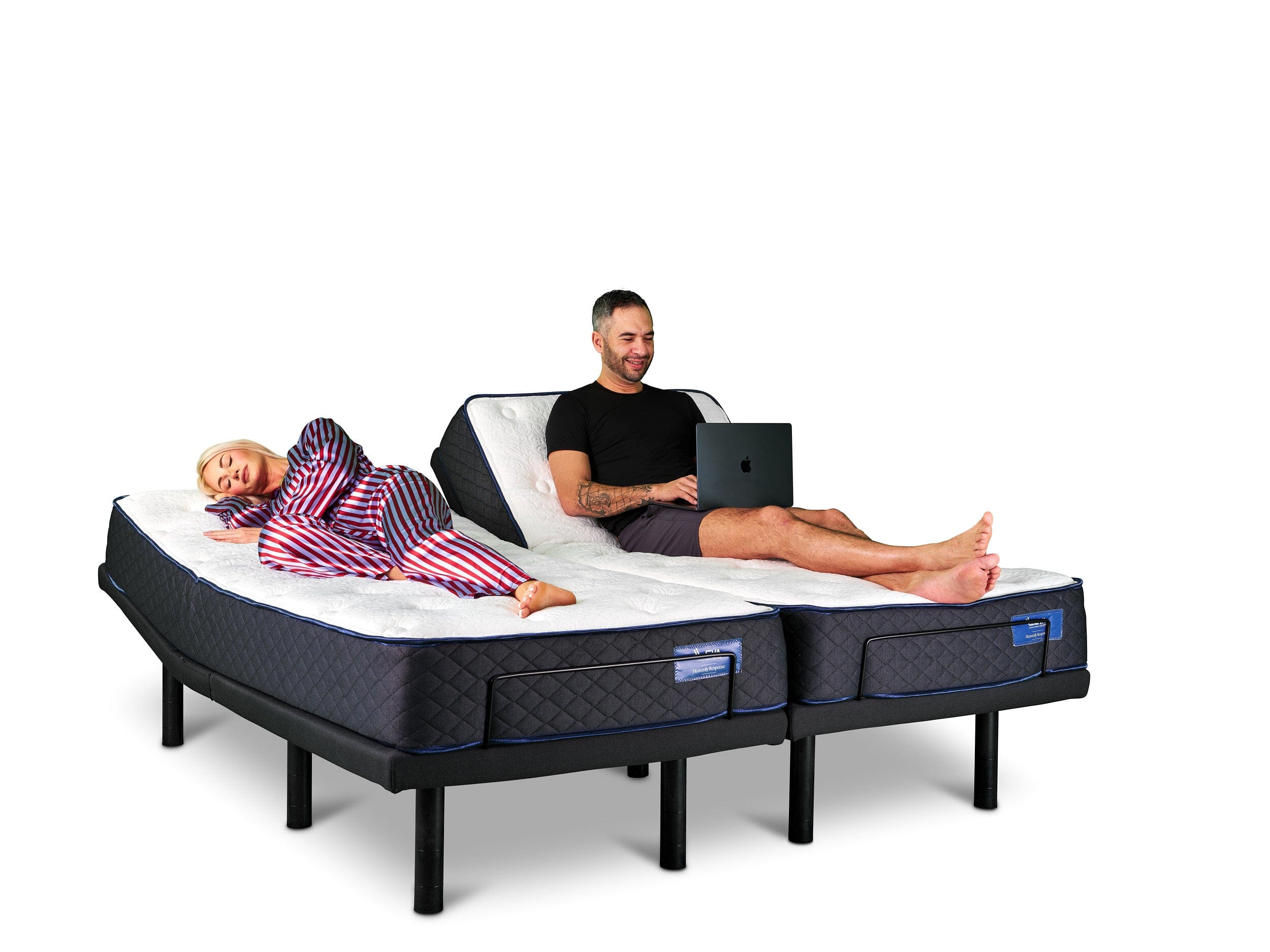
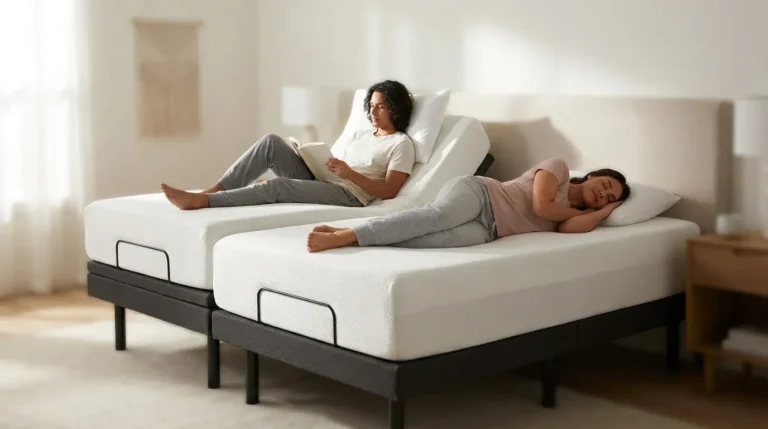
A split adjustable sleep system pairs two independently controlled bases under a shared mattress or two matched mattresses side by side. Each partner adjusts head elevation, foot elevation, lumbar support, massage intensity, and temperature without affecting the other side.
Leva Sleep offers Split Queen and Split King configurations, with the Split Queen as a rare format in the Canadian market, assembled locally and delivered with in-house white-glove service across Ontario and Alberta. These key functional elements work together to address the core disruptions couples face.
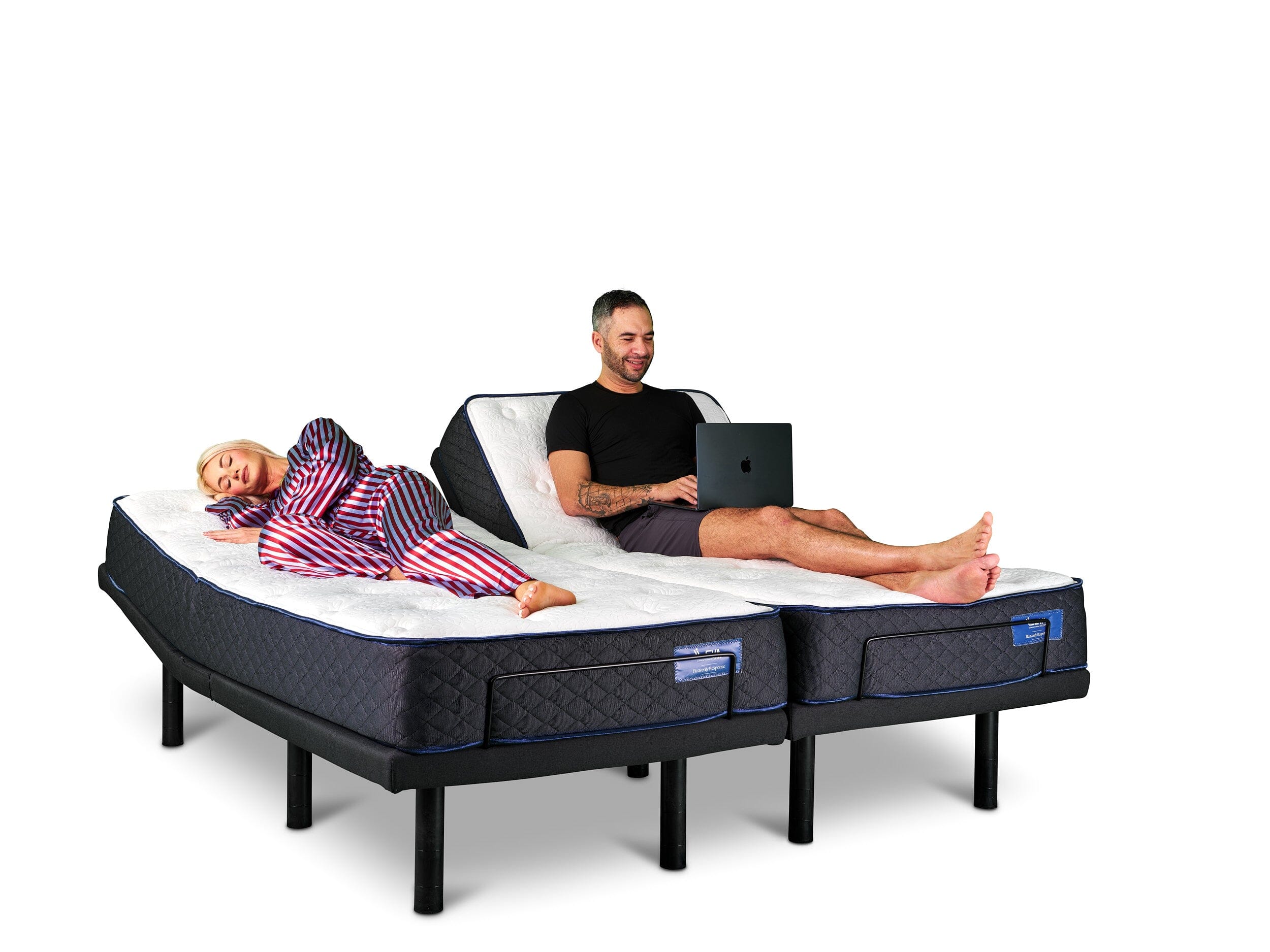
Independent head elevation gently raises the airway to reduce snoring and address mild sleep apnea without a CPAP mask. This positioning pairs with lumbar and pillow tilt control, which supports hip, knee, and lower-back conditions that worsen on a flat surface.
Whisper-quiet German motors keep adjustments smooth and quiet so one partner’s movement does not wake the other. Per-side heating and cooling resolve temperature mismatches that affect 58% of couples, allowing one partner to sleep cool while the other sleeps warm.
App control with anti-snore mode detects snoring and makes micro-adjustments to head position automatically, creating a responsive system that adapts through the night. Because Leva Sleep designs, assembles, and delivers its systems directly, it prices its packages 30–50% below comparable luxury competitors while maintaining premium materials and engineering.
Configure your Split Queen or Split King system to match your specific needs.
How to Evaluate Split Adjustable Systems as a Couple
Couples can use a few clear criteria to compare split adjustable systems beyond brand marketing.
Independent Adjustability
Each side should operate on a fully separate motor and controller. A single-motor base marketed as adjustable cannot serve two partners with different needs at the same time.
Elevation Range and Lumbar Support
Head elevation should reach at least 60 degrees to meaningfully open airways. Lumbar support should adjust through the mid-zone, not just head and foot, so it can address lower-back and hip conditions.
Motor Noise
Ask for decibel specifications or test the base in person. Research summarized in a 2026 systematic review found that healthy sleepers sharing a bed wake each other an average of six times per night, and a loud motor adds unnecessary disturbances on top of that baseline.
Mattress and Bedding Compatibility
Adjustable bases work best with mattresses that flex easily, typically all-foam or hybrid pocket-coil designs. Standard fitted sheets often pop off elevated corners, so deep-pocket sheets with reinforced elastic designed for adjustable bases are a better fit.
Temperature Regulation
Per-side heating and cooling pads should operate independently. Confirm that the system allows one partner to run cool while the other runs warm at the same time.
White-Glove Canadian Delivery
Large adjustable bases benefit from professional setup. Delivery should include in-room placement, assembly, leg-height adjustment, a product tutorial, and old-bed removal. Leva Sleep’s in-house delivery team handles all of these steps for Ontario and Alberta customers.
Long-Term Usability and Cost
Vertical integration, where the manufacturer also manages delivery and after-sale support, can reduce the total cost of ownership. Leva Sleep’s direct-to-consumer model removes retail markups, delivering a 30–50% price advantage over comparable luxury brands while offering 15–20 adjustable models versus the 3–5 typically found at general mattress retailers.
Does Sleep Divorce Lead to Divorce?
Current evidence does not support the idea that sleeping separately automatically damages relationships. Research does not support the assumption that sleeping separately damages relationships; many couples report improved satisfaction when separation improves sleep for both partners.
A 2024 study published in Sleep Medicine Reviews tracking 1,400 U.S. couples found that chronic sleep deprivation from shared-bed disruptions was a stronger predictor of relationship conflict than the sleeping arrangement itself. In other words, a shared bed that causes poor sleep poses a greater risk to the relationship than sleeping apart.
Couples who sleep apart and sleep well often report higher relationship satisfaction than couples who share a bed but sleep poorly. The primary risk factor is not the arrangement but the absence of intentional connection during waking hours. Couples who sleep apart while maintaining nightly rituals such as reading, talking, and goodnight routines often report that separation sharpens their appreciation for intimate moments rather than diminishing them.
A split adjustable system removes the need to choose between sleep quality and shared space. It addresses the root causes while keeping partners in the same bed.
New Sleep Divorce Trends in 2026
The defining shift in 2026 is the reframing of sleep separation from a relationship failure to a deliberate wellness strategy. As noted earlier, the Sleep Foundation’s 2026 survey showed that proactive framing leads to better outcomes, which helps explain why more couples now discuss sleep openly.
A parallel trend is the return to shared beds through technology. Split adjustable systems with per-side temperature control, app-managed positioning, and AI-powered snore detection allow couples who previously moved to separate rooms to reunite in a single sleep environment. The stigma against sleep divorce is not well-supported by evidence; the arrangement is not a reliable marker of relationship problems. As that stigma fades, couples more openly discuss sleep needs and invest in technology-driven solutions rather than defaulting to separate bedrooms.
Benefits: Restored Shared Sleep and Reduced Tension
When both partners sleep adequately, measurable relationship benefits follow. No research published in Sleep Medicine Reviews or the sources examined supports the claim that couples with adequate sleep have 67% higher relationship satisfaction than sleep-deprived couples, so that figure should not be treated as established.
Specific documented benefits of resolving sleep disruption include:
- Reduced daytime irritability and fewer resentment-driven arguments
- Better management of sleep apnea, hip and knee pain, and acid reflux through positional adjustment
- Improved sexual frequency, as earlier research shows that resolving sleep disorders can reverse the doubled risk of sexual dysfunction
- Maintained nightly rituals that sustain emotional connection
- Lower stress hormone levels associated with improved individual health markers
RAND Corporation sleep researcher Wendy Troxel states that chronic sleep deprivation erodes mood, empathy, and patience, the very things a relationship runs on. Restoring adequate sleep for both partners addresses that erosion at its source.
Decision-Support Framework for Choosing a Sleep Setup
Couples can work through the following five steps in sequence to identify the most appropriate path.
- Identify the primary disruptor: Start by naming the main issue, such as snoring, temperature, movement, or schedule mismatch, because each points toward different solutions. Snoring and temperature mismatches are directly addressable with split adjustable technology.
- Assess medical involvement: If you suspect sleep apnea, schedule a sleep study before choosing equipment. Leva Sleep’s adjustable bases are used as a complementary tool by sleep apnea clinics, but clinical diagnosis should come first.
- Evaluate the cost of inaction: Documented costs of chronic sleep disruption include increased daytime irritability, more resentment-driven arguments, and worse individual health markers such as higher stress hormone levels. Clarifying these costs helps you decide how urgent a change feels.
- Compare total cost of ownership: Weigh the expense of furnishing a second bedroom against investing in a shared solution. A split adjustable system from Leva Sleep costs 30–50% less than comparable luxury alternatives and consolidates the solution into one shared space.
- Prioritize communication: The conversation about a sleeping arrangement, whether honest or avoided, may be a more meaningful signal for relationship health than the arrangement itself. Plan how you will talk about changes and how you will maintain connection.
Compare Split Queen and Split King configurations to find the right fit for your space and needs.
Frequently Asked Questions
Does sleep divorce lead to divorce?
Current research does not establish a causal link between sleeping separately and relationship breakdown. Studies consistently show that the quality of sleep, not the location of sleep, is the stronger predictor of relationship satisfaction.
Couples who sleep apart and sleep well frequently report higher satisfaction than couples who share a bed but sleep poorly. The arrangement becomes problematic mainly when partners avoid honest conversation or use separation to sidestep underlying relationship issues rather than sleep issues.
Maintaining intentional connection during waking hours, such as shared meals, nightly rituals, and planned intimacy, is the factor most associated with positive outcomes for couples who sleep separately.
What is the new trend in sleep divorce in 2026?
The dominant 2026 trend is intentional wellness framing, where couples treat sleep as a shared health goal rather than a relationship concession. This shift aligns with the Sleep Foundation’s 2026 findings that proactive framing leads to better outcomes.
Adoption of split adjustable sleep technology is growing at the same time. These systems allow partners to return to a shared bed with independent control over elevation, temperature, and firmness.
Couples who frame the decision proactively as a wellness investment report better outcomes on relationship satisfaction and communication than those who arrive at separation reactively after prolonged conflict. The stigma around sleep divorce continues to decline as sleep health becomes a mainstream wellness topic.
What are the statistics for sleep divorce in Canada?
Canada-specific longitudinal data remains limited. The most cited domestic figure comes from a 2013 report citing Ryerson University clinical observations and recent surveys estimating that 30-40% of couples sleep in separate beds. Statistics Canada does not publish a dedicated sleep-arrangement metric.
The closest comparable data comes from the United States, where the American Academy of Sleep Medicine’s 2023 survey of 2,005 adults found that 35% sleep separately sometimes or always. Canadian sleep experts report similar patterns in clinical practice, with snoring, movement, and shift-work schedules as the primary drivers.
Adults aged 35–44 report the highest rates of sleeping apart in U.S. surveys at 39%, a demographic that maps closely to Leva Sleep’s core customer base.
Is there an overlap between grey divorce and sleep divorce in Canada?
No published Canadian research directly links grey divorce, which refers to divorce among adults aged 50 and older, to sleep divorce or living-apart-together arrangements. Grey divorce rates among Canadians aged 50 and older rose 26% between 1991 and 2006 before stabilizing.
The age group most affected by grey divorce overlaps with the age group most likely to manage sleep apnea, chronic pain, and other conditions that drive sleep separation. The causal or correlational relationship between these patterns has not been studied in a Canadian context.
Couples in this demographic who experience sleep-related strain can consider split adjustable sleep systems as a practical intervention that improves sleep quality without requiring physical separation.
Conclusion: Sleeping Better Together Without Separate Bedrooms
Sleep divorce has become a widespread response to real physiological incompatibilities such as snoring, temperature mismatches, and medical conditions that flat beds and basic adjustable bases cannot resolve. As the 30–40% figure from Ryerson University suggests, Canadian couples are not alone in facing this challenge, and U.S. data points in the same direction.
Evidence also shows that sleeping separately does not inherently damage relationships. Sleep quality, open communication, and maintained connection during waking hours matter more than whether partners share a mattress.
Split adjustable sleep systems from Leva Sleep address the root causes directly, giving each partner independent control over their sleep environment while keeping both in the same bed. These systems cost 30–50% less than comparable luxury alternatives and include in-house white-glove delivery across Ontario and Alberta.
Find the split configuration that lets you both sleep better together without separate bedrooms.