Written by: Matthew Timmins, Founder and Managing Director, Leva Sleep | Last updated: July 20, 2026
Key Takeaways
- Mild positional snoring that occurs mainly on the back often improves when the head is elevated 10–30 degrees without medical devices.
- Traditional options like wedge pillows, side-sleeping aids, and basic adjustable bases each create trade-offs in comfort, consistency, and couple compatibility.
- Clinical studies show that adjustable-bed elevation between 7.5° and 30° can reduce snoring duration and AHI in mild-to-moderate positional cases.
- Manual anti-snore presets on well-built adjustable bases currently provide more reliable results than automatic detection systems, which are prone to false triggers.
- Leva Sleep offers Split Queen and Split King adjustable bed packages designed for Canadian couples who want quiet, independent anti-snore elevation at 30–50% less than comparable competitors.
The Problem: Why Traditional Snoring Fixes Fall Short
Most couples start with simple snoring fixes, yet each common option comes with real drawbacks over time.
Wedge pillows are widely available for $20–$100 and provide a fixed incline, typically 7°, 10°, or 12°. They hold position through the night, but an adjustable bed base supports the angle across the whole body and maintains consistent elevation more comfortably for nightly use. Wedge pillows also create a separate, raised surface that can feel isolating for couples.
Side sleeping often reduces snoring compared with back sleeping. Wedge and body pillows can encourage a lateral position but do not reliably prevent rolling onto the back the way wearable positional therapy devices can.
Basic adjustable bases raise the head but often use loud motors, offer limited angle precision, and lack a dedicated anti-snore preset. These issues can turn a potential solution into another source of disruption.
CPAP therapy remains the clinical gold standard for obstructive sleep apnea. Using CPAP for 4 hours per night reduces AHI by 33–48% in moderate OSA, and higher nightly use is needed for larger reductions. Mask discomfort, noise, and compliance challenges make CPAP a difficult long-term choice for mild positional snoring when OSA has not been diagnosed.
How Adjustable-Bed Elevation Reduces Snoring
Head and torso elevation with an adjustable bed helps keep the airway more open and reduces soft-tissue collapse that creates snoring sounds. The benefit generally increases with angle up to a practical limit, where neck strain and discomfort start to outweigh gains.
The table below summarizes key clinical findings on elevation angle, snoring or AHI reduction, detection method, and study source.
| Elevation Angle | Snoring / AHI Reduction Range | Detection Method | Study Source |
|---|---|---|---|
| 12° | 7% reduction in objective snoring duration | Adjustable bed base (in-home crossover trial) | PMC9021938 (2022) |
| 7.5° | AHI reduction in mild-to-moderate OSA patients; improved minimum O₂ saturation | Polysomnography (52 mild-to-moderate OSA patients) | Souza et al. 2017, JCSM (PMID 28647854) |
| 30° | AHI reduction in 45 patients; velum and oropharyngeal lateral wall collapse visibly decreased | Drug-induced sleep endoscopy (45 patients) | Iannella et al. 2022 (PMID 36233488) |
| 7°–15° | 7°–15° elevation produces up to 28% snoring reduction | Adjustable base / torso elevation | Does Sleeping Elevated Help With Snoring? |
These results apply mainly to positional and mild-to-moderate OSA cases. Elevation reduces hypopneas more effectively than complete apneas, so benefits appear smaller in severe OSA.
Clinical Evidence: Do Anti-Snore Adjustable Beds Work?
For mild positional snoring, clinical research supports head elevation as a meaningful intervention. Polysomnography studies show AHI reductions with head elevation alone in mild positional OSA patients. The 2022 PMC crossover trial (PMC9021938) reported that 12° incline over 4 weeks produced a 7% relative reduction in objective snoring duration, 4% fewer awakenings, and a 5% increase in deep sleep compared with flat sleeping.
Souza et al. (2017) in the Journal of Clinical Sleep Medicine studied 7.5-degree head-of-bed elevation in obstructive sleep apnea patients and found improvements, although this approach still falls short as a replacement for CPAP in moderate-to-severe cases.
Anti-snore modes on adjustable bases appear in two main forms: manual presets and automatic detection. In 2026, manual anti-snore presets provide more consistent value for most Canadians because false triggers and inconsistent timing limit automatic systems. Leva Sleep’s upcoming spring-2026 AI micro-adjustment mode aims to solve these issues with more precise, lower-disruption responses for couples who want automation without frequent false alarms.
Automatic Detection: Can Adjustable Beds Detect Snoring?
Some adjustable bases now include automatic snore detection, although reliability varies widely between models. The TEMPUR-Ergo Smart Base uses integrated Sleeptracker-AI piezoelectric sensors under the mattress to detect snoring vibrations and automatically raises the head of the bed 12 degrees without waking the sleeper or sleepers. When you compare automatic systems, look at sensor quality, how accurately they distinguish snoring from other noises, and whether the added cost matches your needs.
Automatic snore detection also increases base cost and introduces another potential failure point, and many users disable the feature within months because of false triggers from coughing, heavy breathing, traffic noise, or partner movement.
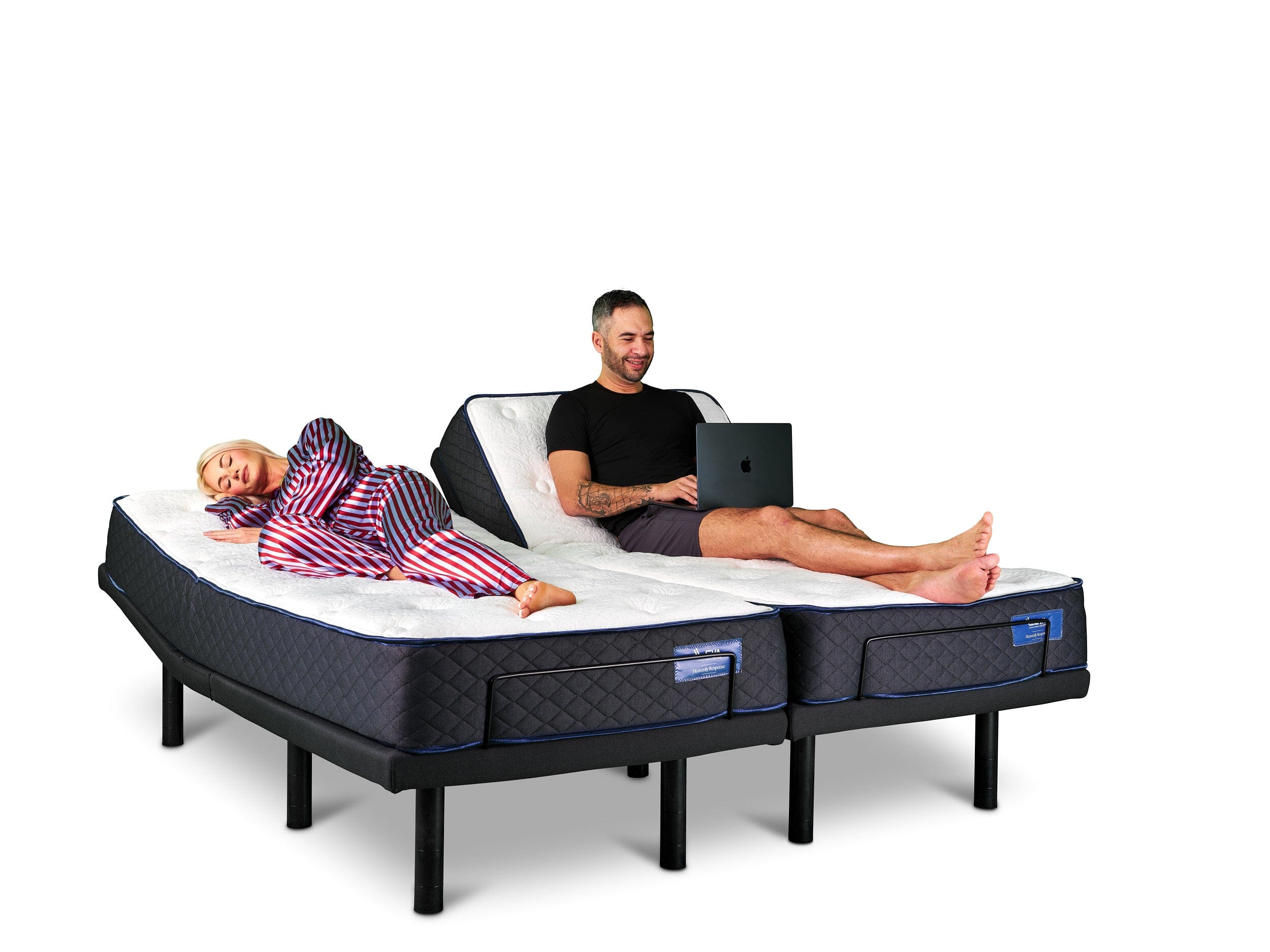
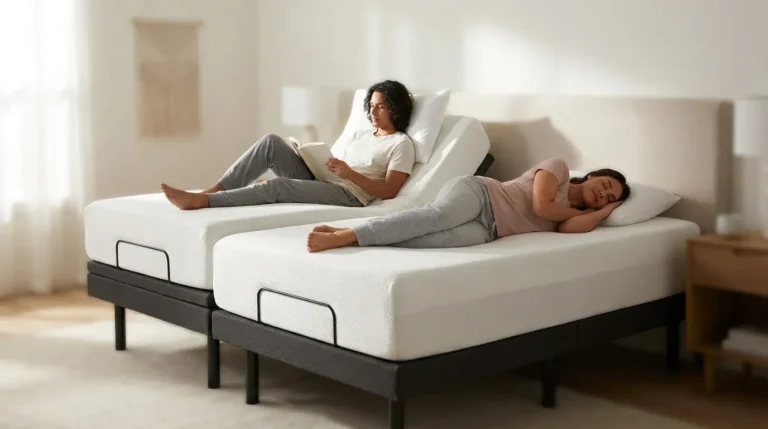
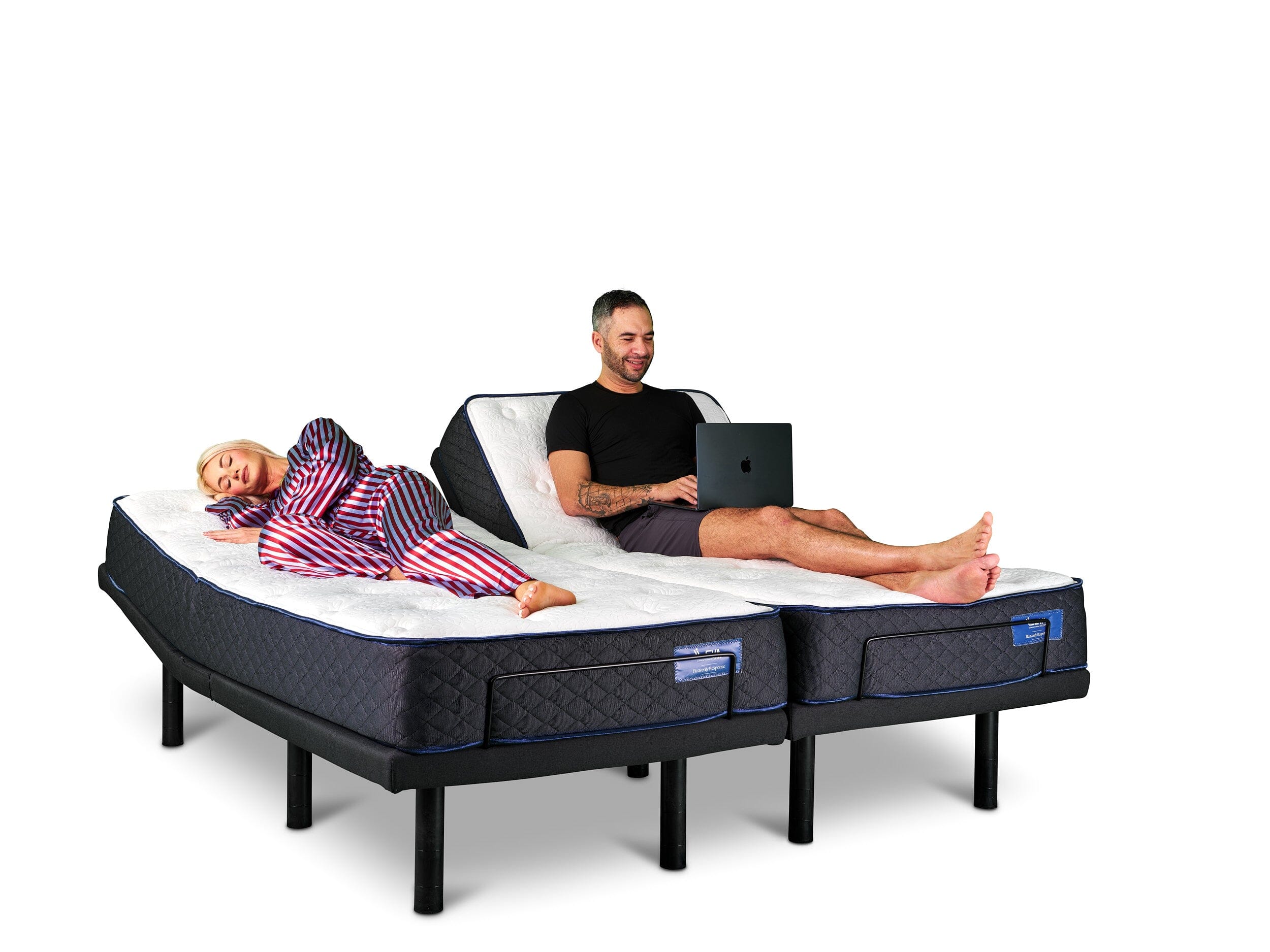
Split Queen and Split King configurations give couples an extra layer of control. Each partner manages their own side’s elevation, massage, and position settings without affecting the other. The non-snoring partner stays undisturbed by adjustments for the snorer, which no wedge pillow or single-zone base can match.
Limitations: What Are the Downsides of Adjustable Beds?
Adjustable beds do not fit every snoring profile, and both clinical and practical limits matter.
- Bed elevation does not adequately treat severe OSA (AHI above 30); CPAP remains the clinical standard.
- Non-positional snorers, who snore in every position, often have anatomical causes such as enlarged tonsils or a deviated septum, so head elevation helps less.
- Head-of-bed elevation may be contraindicated for people with lower limb edema and venous insufficiency.
- Head elevation does not resolve central sleep apnea, which occurs when the brain fails to signal breathing muscles.
- Excessive head elevation can strain the neck and disrupt breathing, so small adjustments and proper cervical support work better.
When you evaluate an adjustable bed for anti-snore use, consider how each feature affects both partners and the overall sleep experience.
Motor noise affects whether adjustments wake the non-snoring partner, so whisper-quiet motors protect both people from extra disruption. Mattress compatibility matters because only foam and pocket-coil mattresses designed for adjustable bases flex safely, while standard innerspring models can wear or crack. Once you elevate the bed, standard fitted sheets often pop off, so deep-pocket sheets with reinforced elastic keep bedding in place through the night.
Temperature regulation also changes with elevation because airflow around the body shifts, and integrated heating or cooling pads can keep both partners comfortable. Delivery and setup can feel overwhelming with large bases, so professional, white-glove service removes that burden. Finally, split configurations such as Split Queen or Split King give each partner independent control, which is crucial when only one person snores.
Why Leva Sleep’s Approach Fits Canadian Couples
Leva Sleep focuses on the real-world friction points Canadian couples face when they shop for anti-snore adjustable beds. The company brings over 8 years of experience, $50M in lifetime sales, and 25,000+ customers, and it operates as a vertically integrated specialist that designs, assembles, and delivers its own systems.
Several advantages stand out for couples comparing anti-snore options.
- 30–50% price advantage over comparable luxury competitors, achieved through a direct-to-consumer model that removes middlemen.
- Split Queen availability, a rare configuration that offers independent elevation and massage controls for each partner in a space-conscious footprint.
- Whisper-quiet German motors that avoid adding motor noise to existing snoring disruption.
- Spring-2026 AI anti-snore mode, an upcoming feature designed to detect snoring and deliver micro-adjustments with fewer false triggers than many current automatic systems.
- In-house white-glove delivery across Ontario and Alberta, including bedroom setup, old bed removal, product tutorials, and real-time height adjustments.
- Mattresses and bedding built for adjustable bases, including fitted sheets with extra elastic and duvet clips that prevent the slippage common with standard bedding on elevated bases.
Sleep apnea clinics refer patients to Leva Sleep, and many couples who had moved to separate rooms because of snoring have returned to sharing a bed after adopting Leva’s split adjustable systems. For Canadian couples in Ontario and Alberta who want a non-invasive, evidence-backed anti-snore option before medical intervention, Leva Sleep’s Split Queen and Split King adjustable beds, quiet engineering, upcoming AI anti-snore mode, and white-glove delivery align closely with these needs at a clear price advantage over many luxury brands.
Frequently Asked Questions
Do anti-snore adjustable beds work?
For mild positional snoring, which appears mainly when someone sleeps on their back, adjustable bed anti-snore modes can deliver measurable improvements. Clinical studies show reductions in AHI and snoring that vary with elevation angle and patient profile, with the strongest gains in positional and mild-to-moderate OSA cases. A 2022 in-home crossover trial found measurable improvements at 12° elevation, and the 7% snoring reduction and sleep quality gains discussed earlier show that even modest angles can produce objective results. At steeper angles between 20° and 30°, researchers have recorded AHI reductions in positional OSA patients.
Anti-snore adjustable beds do not replace CPAP in moderate-to-severe OSA and offer limited benefit for non-positional snorers whose snoring persists in every position. Anyone who experiences witnessed apneas, gasping, or excessive daytime sleepiness should seek a sleep study before relying on elevation alone.
Is there an adjustable bed that can detect snoring?
Several adjustable bases now include automatic snore detection. The TEMPUR-Ergo Smart Base, mentioned earlier, uses under-mattress sensors to detect snoring and adjust automatically. Sleep Number’s FlexFit 2 Smart Base includes a Partner Snore feature that lets one partner manually raise the other side of the bed with a single button press. Leva Sleep’s spring-2026 AI anti-snore mode is being developed to detect snoring and deliver micro-adjustments with improved precision over many current automatic systems.
Automatic detection always involves a trade-off between convenience and reliability. Current systems can trigger on coughing, traffic noise, or partner movement, and sensors increase the cost of the base. When you compare these systems, look at sensor quality, response consistency, and whether the extra cost makes sense for your household. For most couples in 2026, a manual anti-snore preset on a well-built adjustable base provides the core benefit without extra cost or frequent false triggers. Leva Sleep’s Split Queen and Split King configurations let each partner control their own side independently, so adjustments for the snoring partner do not disturb the other.
What are the downsides of adjustable beds?
Adjustable beds come with several clinical and practical limitations that deserve attention before purchase. Clinically, head elevation does not treat severe OSA with AHI above 30, does not resolve central sleep apnea, and offers limited benefit for non-positional snorers with anatomical causes such as enlarged tonsils or a deviated septum. Elevation may also be inappropriate for people with lower limb edema or venous insufficiency.
On the practical side, standard innerspring mattresses usually do not work well with adjustable bases, standard fitted sheets often slip off elevated positions, and basic adjustable bases can use loud motors that disturb sleep. Automatic snore-detection systems add cost and can misfire. Delivery and setup of large adjustable bases can also feel challenging without professional help. Leva Sleep addresses most of these practical issues with whisper-quiet motors, mattresses and bedding engineered for adjustable bases, and in-house white-glove delivery and setup across Ontario and Alberta.
Conclusion: Choosing the Right Path for Better Sleep Together
Evidence for adjustable-bed head elevation as a mild positional snoring intervention remains consistent across study designs and elevation angles. Researchers have documented reductions in snoring duration and AHI for positional snorers at angles between 7.5° and 30°, with the strongest results in people whose snoring worsens on their back. Wedge pillows provide a low-cost starting point but lack the angle precision, whole-body support, and couple-compatibility of a purpose-built adjustable base. CPAP remains the standard for confirmed moderate-to-severe OSA and should not be replaced with positional therapy without medical guidance.
For Canadian couples, the key questions involve whether snoring is positional, whether both partners need independent control, whether local delivery and setup support exist, and whether pricing reflects real value instead of brand markup. Leva Sleep’s Split Queen and Split King adjustable beds, quiet engineering, upcoming AI anti-snore mode, and white-glove delivery across Ontario and Alberta address these priorities at a price point that reflects genuine value.
Find your split adjustable bed solution and start sleeping together again.