Written by: Matthew Timmins, Founder and Managing Director, Leva Sleep | Last updated: July 24, 2026
Key Takeaways for Canadian Couples
- High-density foam mattresses use polyurethane support layers at 1.8 lb/ft³ or higher and memory-foam comfort layers at 3.0 lb/ft³ or higher. This construction improves spinal support, motion isolation, and resistance to sagging compared to lower-density foam.
- Before buying, confirm published density and ILD ratings, CertiPUR-US certification, and a 10–12 inch profile to keep the mattress compatible with adjustable bases.
- High-density memory foam at 5+ lb/ft³ can last 12–25 years, while high-density polyfoam at 1.8+ lb/ft³ typically lasts 6–10 years. The longer lifespan helps justify the higher upfront cost.
- Hybrid designs with pocketed coils or open-cell foam improve airflow and reduce heat build-up, which helps couples who sleep warm on split adjustable bases.
- Leva Sleep offers adjustable bed packages with high-density mattresses built for split bases. Explore Leva Sleep’s complete adjustable bed packages with white-glove delivery across Ontario and Alberta.
Quick Density-Verification Checklist
Use this checklist to confirm that a mattress meets high-density standards before you buy.
- Support core polyfoam density is at least 1.8 lb/ft³ (29 kg/m³).
- Memory foam comfort layer density of 3.0+ lb/ft³ is a solid quality baseline, with 4–5 lb/ft³ considered high-density for better longevity.
- CertiPUR-US certification appears on the product page or label, confirming low VOC emissions and the absence of harmful chemicals.
- ILD (Indentation Load Deflection) rating is published. Side sleepers need soft Talalay (14–22 ILD), back sleepers need medium Talalay or Dunlop (24–28 ILD), and stomach sleepers need medium-firm Dunlop (28–32 ILD).
- The sweet spot for adjustable bases is 10–12 inches thick.
- No interconnected Bonnell coil system. Only all-foam or individually pocketed coil hybrid constructions work well on adjustable bases.
- Both density and ILD figures are published. Vague “high density” marketing language without numbers is not enough.
Density and ILD Comparison Table
| Foam Type | Minimum Density | Typical ILD | Expected Lifespan |
|---|---|---|---|
| Low-density polyfoam | 1.2–1.5 lb/ft³ | typically starting around 14–20 (with some grades higher) | 1–2 years |
| Mid-density polyfoam | Approximately 1.5–1.8 lb/ft³ | 20–30 | 2–5 years |
| High-density polyfoam | varies (commonly 1.8+ or 2.5+ lb/ft³) | ranges widely (e.g. ~19–86) | typically ~6 years or 8–10+ years depending on exact density |
| High-density memory foam | 5+ lb/ft³ | around 12 (comfort layer) | 12–25 years |
Benefits of High-Density Foam Mattresses
High-density foam mattresses deliver clear advantages over low-density options in durability, support, and motion isolation. A 4 lb/ft³ foam block weighs twice as much as a 2 lb/ft³ block of the same size and holds up longer under pressure. High-density polyurethane foam at 1.8+ lb/ft³ resists compression fatigue and body impressions because it contains more polymer material and stronger cell walls per unit volume.
Memory foam’s closed-cell structure also provides excellent motion isolation, so movement on one side does not transfer across the mattress. This feature directly benefits couples who wake easily. A 2006 study in the Journal of Chiropractic Medicine found that switching to new medium-firm mattresses improved sleep quality and reduced back pain, and noted that foam breakdown in older mattresses contributed to poor spinal alignment.
Drawbacks of High-Density Foam Mattresses
High-density foam has two main drawbacks: heat retention and higher price. Higher-density memory foam can trap more heat, which makes it uncomfortable for hot sleepers without added cooling features. Standard memory foam retains body heat because air does not move easily through the internal structure.
On cost, premium high-density memory foam queen mattresses in Canada range from C$1,200 to C$2,500+ (or higher for ultra-premium brands), compared to C$500–C$800 for budget low-density models. These trade-offs remain manageable when you choose modern open-cell foams, gel infusions, or hybrid constructions with pocketed coils, which all reduce heat retention. The extended lifespan of 8–10+ years also helps balance the higher upfront cost over time.
Memory Foam vs High-Density Polyfoam and Hybrids
Memory foam and high-density polyfoam overlap, because memory foam is a type of foam that can also be high-density. For mattress shoppers, the real comparison is between all-foam high-density memory foam designs and high-density polyfoam or hybrid constructions.
On durability, high-density memory foam at 5+ lb/ft³ offers an expected lifespan of 12–25 years. On cooling, polyfoam mattresses often perform as well as or slightly better than memory foam in objective temperature tests. Hybrid mattresses that pair memory foam comfort layers with pocket springs improve airflow and sleep cooler than all-foam memory foam designs while still providing strong pressure relief.
On adjustable-base performance, memory foam mattresses work very well because their flexible structure returns to shape quickly and contains no rigid internal systems. Pocketed-coil hybrids also perform well on adjustable bases. For couples on split adjustable bases, both constructions provide strong motion isolation. The better choice depends on whether you value cooler sleep or deeper contouring more.
Cooling Features in All-Foam and Hybrid High-Density Mattresses
The table below compares common cooling technologies in all-foam and hybrid high-density mattresses so you can match features to your temperature needs.
| Feature | All-Foam HD | Hybrid HD | Benefit for Couples |
|---|---|---|---|
| Base airflow | Limited, closed-cell structure restricts circulation | Better, pocket coil layer allows vertical airflow | Reduces overheating for both partners |
| Open-cell foam | Increases airflow ~30–50% vs. closed-cell | Increases airflow ~30–50% vs. closed-cell | Reduces heat build-up in the comfort layer |
| Gel or graphite infusion | Reduces heat build-up by ~1–3°C vs. traditional foam | Reduces heat build-up by ~1–3°C vs. traditional foam | Helps partners who consistently sleep warm |
| Motion isolation | Very strong, movement does not transfer across mattress | Strong, pocketed coils compress independently | Limits partner disturbance on split bases |
Compare Leva Sleep’s all-foam and hybrid mattresses for split bases to see how different cooling features pair with adjustable systems.
Use Cases for Couples on Split Adjustable Bases
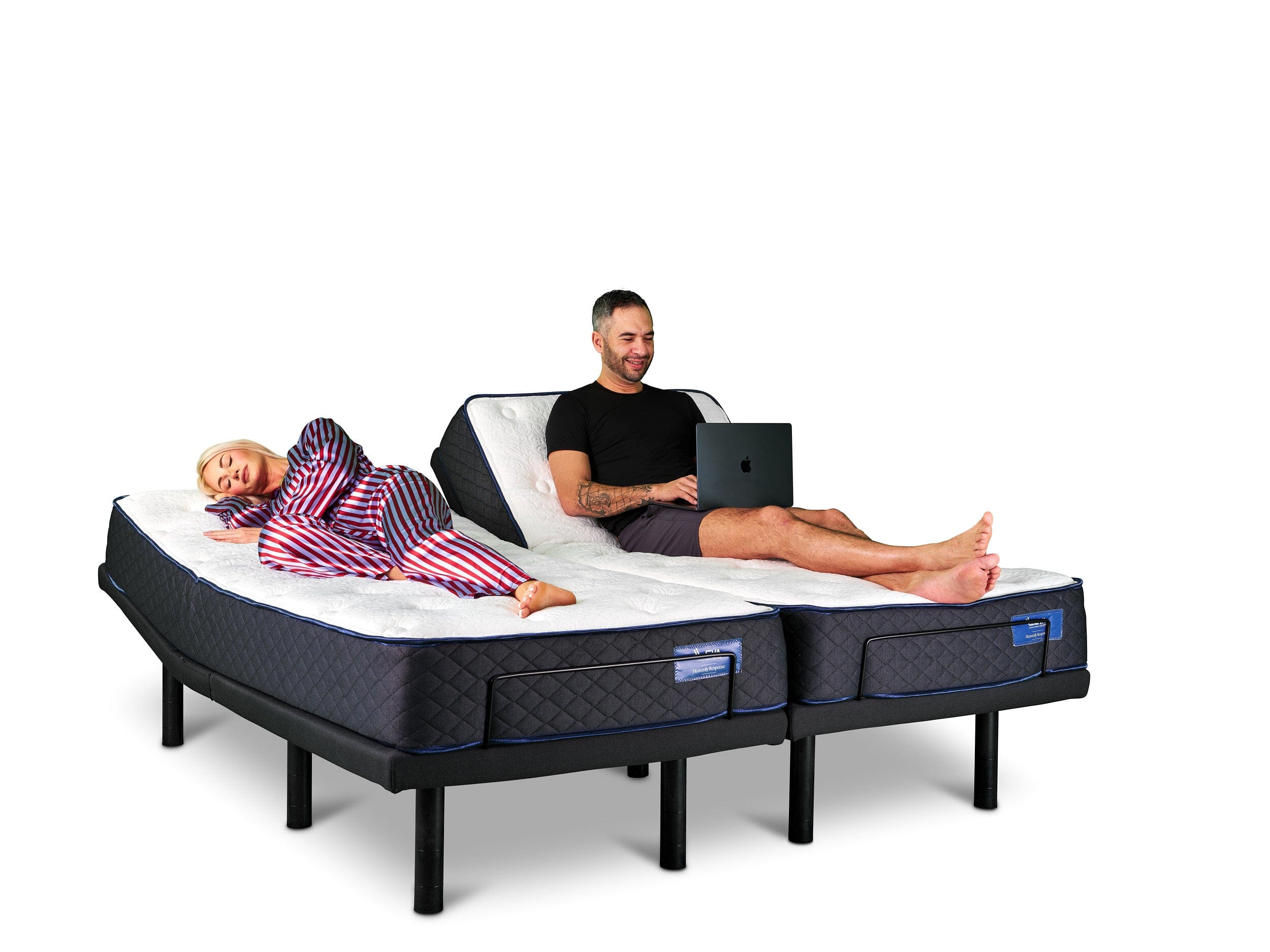
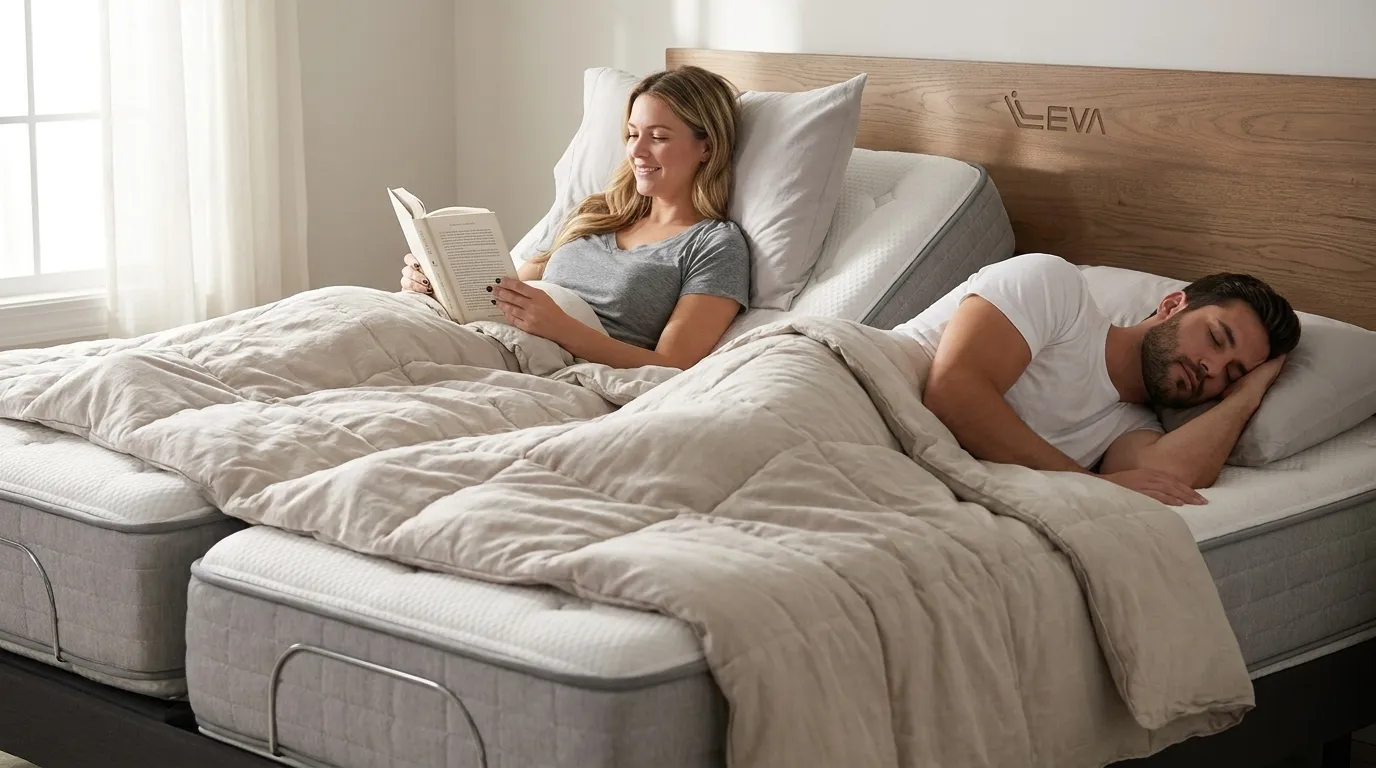
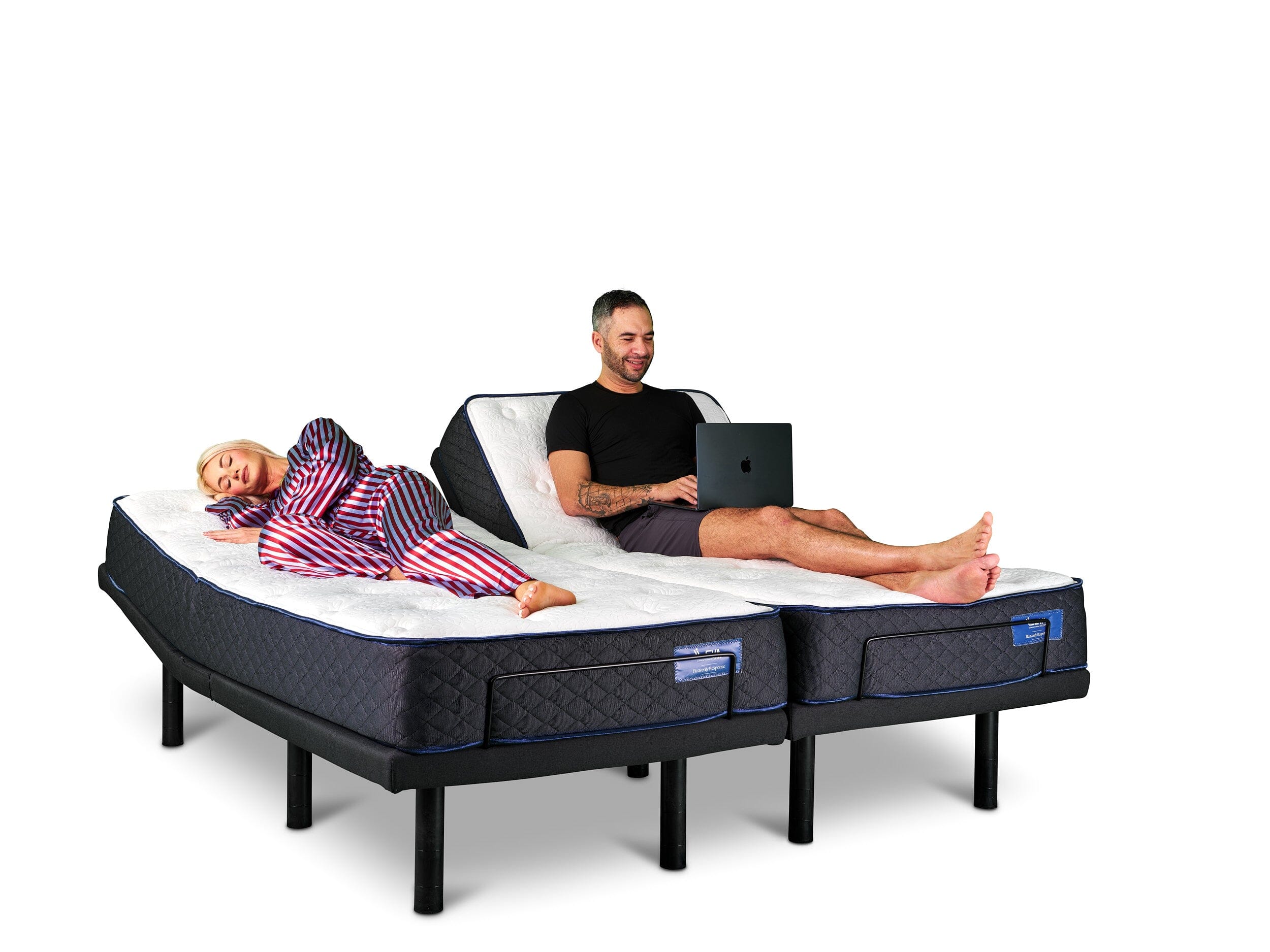
Split adjustable bases let each partner control head and foot elevation independently, so each side can use a different firmness. The firmness guide below applies to each side of a split queen or split king setup.
- Soft (14–22 ILD): Side sleepers need soft Talalay in this range because it allows enough shoulder and hip compression for proper spinal alignment.
- Medium (24–28 ILD): Combination sleepers and couples with different preferences benefit from medium Talalay or Dunlop in this range, which balances support and pressure relief.
- Firm (28–32 ILD): Stomach sleepers, back sleepers who prefer firmer support, and heavier individuals should choose medium-firm Dunlop in this range to prevent excessive sinkage and maintain a neutral spine.
Couples experiencing sleep divorce, where one partner moves to another room due to snoring, movement, or firmness conflicts, gain the most from split configurations with independent elevation. Partner movement on a shared flat mattress often drives sleep disruption. High-quality memory foam offers excellent motion isolation on split adjustable bases, absorbing vibrations from position changes so one partner’s movements do not wake the other.
For adjustable-base compatibility, the mattress must meet the thickness requirements outlined earlier, avoid interconnected innerspring systems, and use materials such as memory foam, latex, or pocketed-coil hybrids that flex without damage. Segmented core designs with three to five pre-cut flex zones at common adjustment points allow controlled bending without stress concentrations or loss of support. Sleepers with hip or knee pain often benefit from head and foot elevation that reduces joint pressure, while those managing sleep apnea benefit from gentle head elevation that opens the airway without a CPAP mask.
Configure your split queen or split king system with independent controls and pair it with a high-density mattress designed for adjustable bases.
2026 Canadian Pricing and Certification Guide
Queen foam mattresses in Canada typically cost between C$400 and C$1,200 in 2026, depending on foam density, brand, and construction. The ranges below focus on queen-size high-density foam and hybrid options.
- C$500–C$800: Budget or low-density memory foam at 1.2–1.5 lb/ft³, with a lifespan of 1–2 years, not recommended for adjustable bases or heavier sleepers.
- C$800–C$1,500: Mid-range all-foam or quality hybrid with pocketed coils, lifespan of 5–8 years, suitable for adjustable bases.
- C$1,200–C$2,000: High-density memory foam at 5+ lb/ft³ or well-built foam hybrid, lifespan of 8–12 years, recommended for split adjustable base systems.
- C$1,500–C$2,500+: Premium high-density memory foam at 5+ lb/ft³, lifespan of 12–25 years, offering the strongest durability and deepest contouring.
At these price points, confirm the following certifications and specifications before purchase.
- CertiPUR-US certification for low VOC emissions and safe foam chemistry.
- Published density figures in lb/ft³ or kg/m³ for both support and comfort layers.
- Published ILD rating for each foam layer.
- Adjustable-base compatibility stated clearly by the manufacturer.
- Minimum 10-year warranty for mattresses in the C$1,000+ range.
Frequently Asked Questions
How long does a high-density foam mattress last in Canada?
Lifespan ties directly to foam density. Polyfoam support cores at 1.8+ lb/ft³ can maintain their shape for 6–10 years under average use, with higher densities used in premium models that last longer. Memory foam comfort layers at 5+ lb/ft³ can last 12–25 years. By contrast, foam below 1.5 lb/ft³ can develop body impressions within 1–2 years. Heavier sleepers should choose higher densities to achieve better durability.
Is a high-density foam mattress compatible with a split adjustable base?
All-foam and pocketed-coil hybrid mattresses work well on split adjustable bases when they follow specific construction rules. The mattress needs to fall within the recommended thickness range, since very thick models over 14 inches can become too rigid and strain the base motor. The internal construction must use flexible materials such as memory foam, latex, or individually pocketed coils, because interconnected Bonnell or offset coil systems can snap under repeated articulation.
Mattresses with segmented or pre-cut flex zones at common adjustment points bend more cleanly and maintain support longer. High-density foam perimeter rails of at least 1.8 lb/ft³ that extend 4–6 inches inward help resist edge sagging when the base is raised.
What density foam mattress works for couples with different firmness preferences?
For couples with different firmness needs, a split configuration works best, since each side can use a separate mattress at the preferred ILD. On a shared mattress, a medium density and firmness, with a support core at 1.8–2.0 lb/ft³ polyfoam and a comfort layer at 5+ lb/ft³ memory foam, and an ILD in the mid range, suits the widest mix of sleep positions and body types. Refer to the firmness guide in the Use Cases section above for specific ILD suggestions by sleep position.
High-density memory foam across these firmness levels delivers strong motion isolation, so one partner’s adjustments or movements do not transfer as easily to the other side. This feature matters most for light sleepers and couples using independent elevation controls.
Conclusion: Matching High-Density Mattresses to Your Adjustable System
A high-density foam mattress, whether polyfoam at 1.8+ lb/ft³ or memory foam at 5+ lb/ft³, suits Canadian couples who want a mattress that resists sagging, isolates partner movement, and stays compatible with a split adjustable base over many years. The verification process stays simple when you confirm published density and ILD figures, CertiPUR-US certification, the thickness criteria discussed above, and clear adjustable-base compatibility from the manufacturer.
For cooler sleep, focus on open-cell structures, gel or graphite infusions, or hybrid builds with pocketed coils. Couples dealing with sleep divorce, different firmness needs, or conditions such as sleep apnea or hip and knee pain often resolve these issues by pairing a split adjustable base with a carefully chosen high-density mattress.
Leva Sleep designs all-foam and hybrid mattresses that meet every criterion in this guide, including published density, CertiPUR-US certification, flex-zone construction, and explicit split adjustable base compatibility. The company delivers these as complete systems with white-glove setup across Ontario and Alberta at 30–50% below comparable luxury competitors.
Shop Leva Sleep’s adjustable bed packages with high-density mattresses and in-home white-glove delivery to build a split queen or split king system tailored to both partners.