Visit One Of Our 6 Showrooms Located Across Canada!
No Payments, No Interest Until 2027
Free Delivery & In-Home Set Up
How to Position Your Bed for Acid Reflux Relief
Content
Written by: Matthew Timmins, Founder and Managing Director, Leva Sleep | Last updated: July 22, 2026
Key Takeaways for Nighttime Reflux Relief
Stacked pillows fail for acid reflux because they only raise the head and neck, not the full upper body, and can actually worsen symptoms.
Left-side sleeping combined with 6–8 inches of torso elevation is the evidence-based method shown to reduce nighttime GERD episodes.
Back, right-side, and stomach sleeping positions allow acid to flow more easily into the esophagus and should be avoided.
Adjustable bases with independent controls outperform wedges and risers for couples, providing precise elevation without disturbing a partner.
Leva Sleep offers split adjustable bed packages with whisper-quiet motors and white-glove delivery. Explore Leva Sleep’s split adjustable bed packages to find the right configuration for lasting reflux relief.
Left-side sleeping places the junction between the stomach and esophagus above the level of stomach contents, creating a gravity-assisted barrier that reduces the frequency and severity of reflux episodes during sleep, according to sleep medicine physician Dustin Cotliar, MD, MPH.
Studies have shown that left lateral sleeping can reduce oesophageal acid exposure time compared to right lateral sleeping in GERD patients. Research cited by Putnams indicates that maintaining a left lateral recumbent position can reduce oesophageal acid exposure.
Left-side sleeping works best when it becomes your default position every night. Habitual back or right-side sleepers often need a few weeks of practice. Place a body pillow behind your back to prevent rolling during the night. Keep your spine neutral by using a pillow that fills the gap between your ear and shoulder without pushing your head forward.
Start by measuring 6–8 inches at the head end of your bed frame or mattress. Smaller elevations may have limited clinical effect.
Once you know your target height, choose an elevation method that raises the entire upper body as a unit (see the comparison table below).
Whichever method you select, combine the elevation with left-side sleeping for maximum benefit, since the two strategies reinforce each other.
Finally, if sharing a bed, evaluate whether your chosen method forces your partner onto the same incline. If so, a split adjustable base may be a better fit.
When evaluating adjustable bases, focus on motor noise, independent controls for each side, app-based micro-adjustment capability, and compatibility with your existing mattress. Whisper-quiet motors reduce partner disturbance, while split controls allow each person to fine-tune their own angle.
Browse Leva Sleep’s adjustable base lineup to compare 15–20 models with independent split controls, whisper-quiet German motors, and white-glove delivery across Ontario and Alberta.
Bed risers placed under the head-end legs of the frame are a low-cost entry point. They tilt the entire bed frame at a fixed angle, which achieves full-torso elevation. However, they carry significant limitations for couples.
Fixed bed risers or under-leg risers at the head end tilt the entire bed, forcing both partners in a shared bed to sleep on the same incline regardless of individual GERD needs. For couples where only one partner has reflux, this is a meaningful drawback.
Pregnancy-Specific Tips for Acid Reflux Bed Position
Acid reflux is especially common during pregnancy as the growing uterus places upward pressure on the stomach and hormonal changes relax the lower esophageal sphincter. Left-side sleeping is the position most consistently recommended during pregnancy for both reflux relief and optimal circulation. The left-side position recommended earlier becomes even more important during pregnancy, as it addresses both reflux and circulation needs simultaneously.
For elevation, a wedge pillow placed under the upper body from the chest upward is a practical option during pregnancy because it can be repositioned easily and does not require modifying the bed frame. An adjustable base with independent head elevation is a longer-term investment that remains useful postpartum. Pregnant individuals should confirm any positional or elevation strategy with their obstetric care provider.
Comparison of Elevation Methods for GERD
Left-side sleeping and proper elevation form the core strategy, and pregnancy adds a few special considerations. With those principles in mind, the next step is choosing how to create that incline in your own bedroom. The table below compares wedges, risers, and split adjustable bases so you can match the method to your space, budget, and whether you share a bed.
Tilts the entire bed, forcing both partners onto the same incline, fixed angle, no adjustment
Low for couples, no independent control, angle cannot be changed without physically moving risers
Split Adjustable Base
Allows each partner independent head elevation; precise, stable incline control; more comfortable for long-term nightly use than wedge pillows or risers
Higher upfront cost, requires compatible mattress
High, app-controlled micro-adjustments, durable motors, no repositioning required nightly
When to See a Doctor About Acid Reflux
Positional strategies are a complement to medical care, not a replacement. Consult a physician or gastroenterologist if you experience any of the following:
Reflux symptoms occurring more than twice per week despite positional changes
Difficulty swallowing or a sensation of food sticking in the throat
Unintended weight loss
Persistent nausea or vomiting
Chest pain (always rule out cardiac causes first)
Symptoms that do not improve after 4–6 weeks of consistent positional management
The Canadian Society of Intestinal Research provides patient-facing resources on GERD diagnosis and management for Canadians seeking guidance from a Canadian clinical perspective.
What Success Looks Like with a Split Adjustable Base
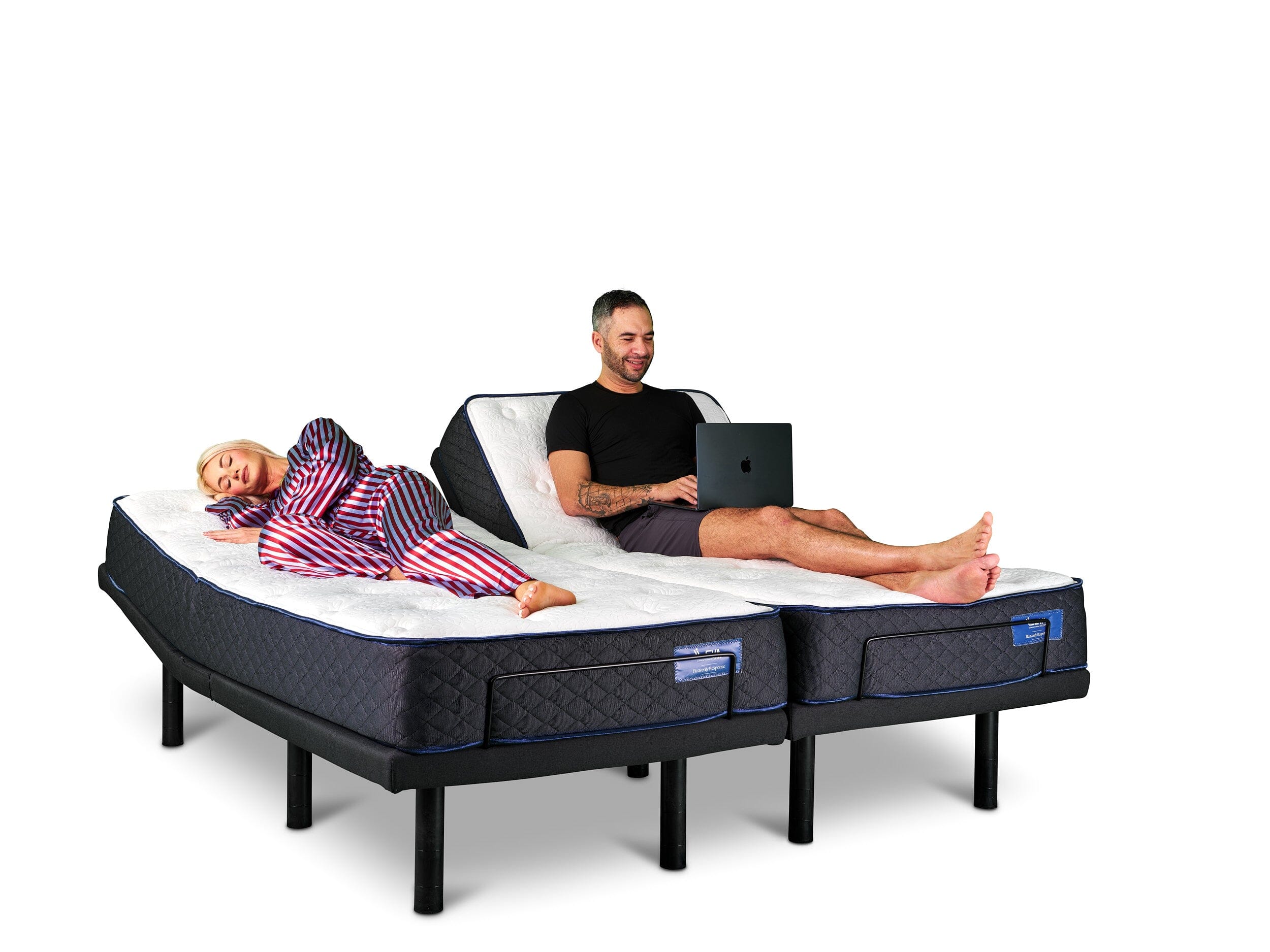
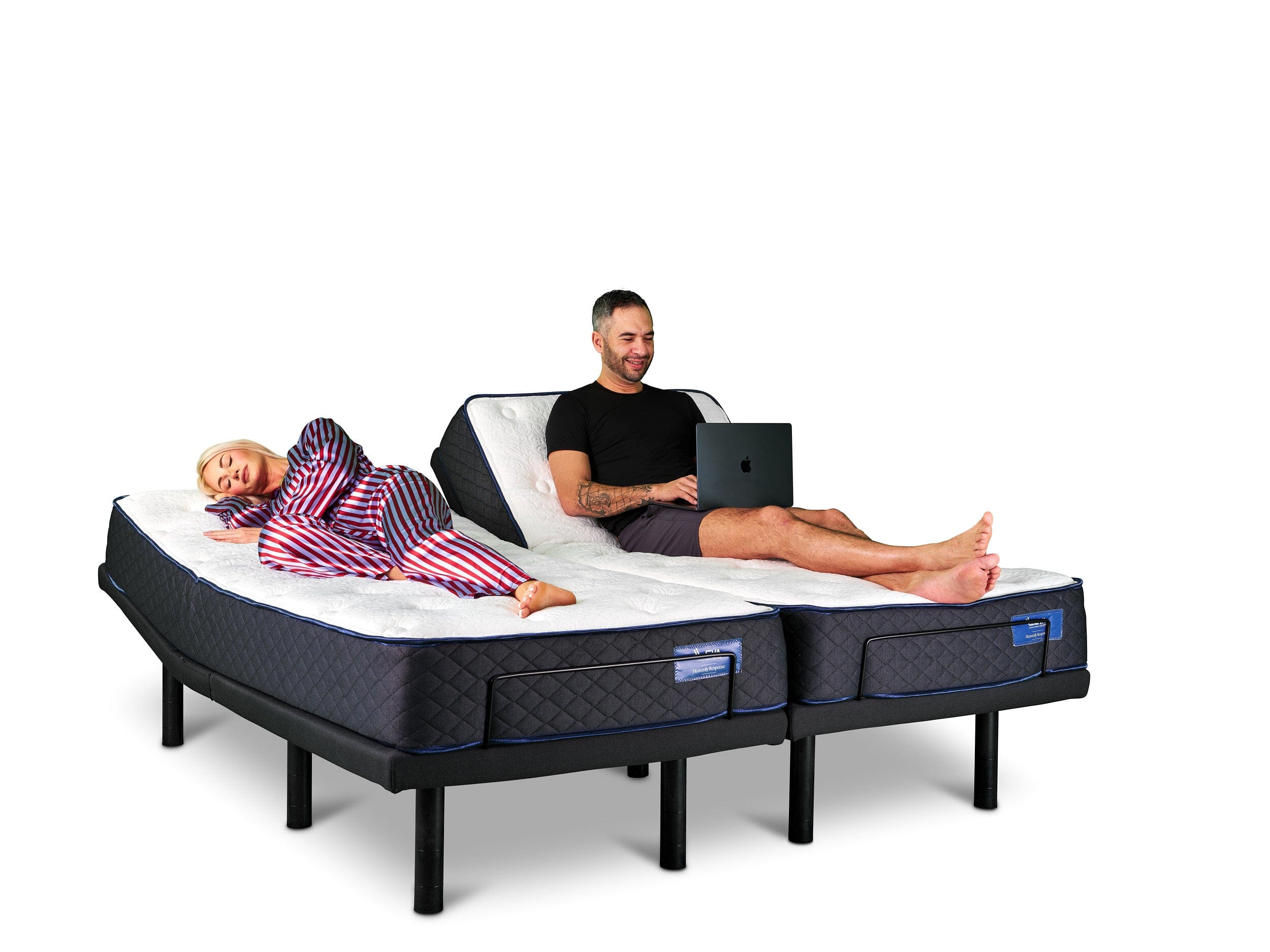
For couples where one partner has reflux and the other does not, a split adjustable base resolves the core tension. One side elevates to the therapeutic range while the other remains flat, so both partners stay in the same bed comfortably. A split adjustable base allows one partner with GERD to use independent head elevation while the other sleeps flat, avoiding forcing an unnecessary incline on the non-GERD partner.
Leva Sleep’s Split Queen and Split King adjustable bases are built specifically for this scenario. Each side is controlled independently through the Leva Sleep app, which enables custom sleep positions, vibrating alarms, and subtle micro-adjustments. Whisper-quiet German motors mean position changes do not wake a sleeping partner. An anti-snore mode, arriving spring 2026, will detect snoring and make automatic head adjustments, addressing a condition that frequently co-occurs with acid reflux.
Leva Sleep Split Queen Bed
Leva Sleep offers 15–20 adjustable base models, compared to the 3–5 typically found at general mattress retailers, and prices run 30–50% below comparable luxury competitors through a direct-to-consumer model with local assembly. View Leva Sleep’s Split Queen and Split King bases with in-house white-glove delivery across Ontario and Alberta.
Advanced Setup: Bedding and Mattress Choices for Elevated Sleep
Significant upper-body elevation causes standard fitted sheets to pull away from the mattress corners. Leva Sleep designs its bedding accessories specifically for adjustable bases, including fitted sheets with deep pockets and extra elastic that maintain a secure fit through the full range of elevation. Duvet clips keep bedding separated when partners use different angles.
For couples with temperature regulation differences, another common source of sleep disruption, Leva’s heating and cooling pad integrates with the adjustable base system to provide individual thermal control on each side. Pairing the right mattress, either all-foam or hybrid pocket coil designed to flex with the base, with purpose-built bedding completes a sleep system that functions as a unit rather than a collection of mismatched components.
Frequently Asked Questions
How long does delivery take in Ontario and Alberta?
Leva Sleep offers in-house white-glove delivery in Ontario and Alberta. Delivery timelines vary by location and current scheduling, so the most accurate estimate comes from contacting Leva Sleep directly at the time of purchase. White-glove service includes delivery to the bedroom, full assembly, leg-height adjustment, a product tutorial, and removal of your old bed, which is donated or recycled where possible.
What warranty comes with Leva Sleep adjustable bases?
Warranty terms vary by model. Because Leva Sleep designs and assembles its systems locally and operates a direct-to-consumer model, warranty support is handled in-house rather than through a third-party retailer. Specific warranty details for each model are available on the Leva Sleep website or by speaking with their sleep specialists directly.
Will my existing mattress work with a split adjustable base?
Most all-foam and hybrid pocket-coil mattresses are compatible with adjustable bases, provided they are flexible enough to bend with the base through its elevation range. Traditional innerspring mattresses with rigid border wires are generally not compatible. Leva Sleep’s specialists can assess compatibility during the pre-purchase consultation, and Leva also offers its own line of mattresses engineered specifically to work with their adjustable bases.
Can both partners use different elevations on the same bed?
Yes. This feature defines a split adjustable base. On a Leva Sleep Split Queen or Split King, each side has its own independent motor and controls accessible through the Leva Sleep app. One partner can sleep at a therapeutic 6–8 inch elevation for acid reflux while the other remains completely flat. Positions can be changed quietly at any time without disturbing the other side.
Conclusion and Your Next Step
The evidence on acid reflux bed position is consistent across multiple clinical sources. Left-side sleeping combined with proper upper-body elevation is the most effective non-pharmacological positional strategy for reducing nighttime reflux. Stacked pillows and fixed bed risers are partial solutions at best. For couples with differing sleep needs, a split adjustable base is the only method that delivers therapeutic elevation to one partner without compromising the other’s comfort.
Leva Sleep has spent over 8 years and served more than 25,000 Canadian customers building adjustable sleep systems designed for exactly this situation, with white-glove delivery, quiet engineering, and pricing 30–50% below luxury competitors.