Written by: Matthew Timmins, Founder and Managing Director, Leva Sleep | Last updated: July 20, 2026
Key Takeaways for Canadian Couples
- Adjustable beds can reduce snoring and mild obstructive sleep apnea by elevating the head 7–30 degrees, lowering AHI by about 31% and improving oxygen saturation without disrupting sleep architecture.
- Many Canadian couples face relationship strain and health impacts from undiagnosed sleep apnea, and flat beds or CPAP alone often do not solve positional snoring.
- Head-of-bed elevation between 20–30 degrees is clinically supported for positional OSA and can also reduce nighttime reflux and nasal congestion common in Canadian winters.
- Leva Sleep’s split adjustable systems provide independent controls, anti-snore presets, and quiet motors so each partner can customize elevation without compromise.
- Explore Leva’s split adjustable systems to keep couples together while addressing snoring and mild sleep apnea.
The Problem: Snoring, Sleep Apnea, and Strain on Relationships
One partner snores. The other lies awake, nudging, sighing, and eventually retreating to the couch. Over weeks and months, this pattern erodes sleep quality, strains relationships, and creates measurable health consequences for both people. Statistics Canada reports that about 6% of Canadian adults aged 18–79 have been diagnosed with sleep apnea, while a 2024 analysis from the Canadian Longitudinal Study on Aging found that a large proportion of participants at high risk for OSA were unrecognized and undiagnosed. The true burden on Canadian households is therefore substantially larger than diagnosed figures suggest.
Traditional flat beds offer no mechanical solution to positional snoring. Basic CPAP machines address the airway directly but introduce their own friction, including mask discomfort, hose management, and noise that can disturb the non-CPAP partner. Many couples reach a breaking point, known in sleep research as “sleep divorce,” where separate rooms feel like the only option. Leva Sleep’s split adjustable systems aim to remove that compromise so couples can stay in the same bed.
Explore Leva’s split adjustable systems and keep both partners in the same bedroom.
How Head Elevation on Adjustable Beds Helps Breathing
Positional therapy reduces the gravitational pull that collapses soft tissue such as the soft palate, tongue base, and pharyngeal walls into the airway during supine sleep. Elevating the head and upper trunk shifts these structures forward and downward relative to the airway opening. This position helps keep the airway open without relying solely on mechanical air pressure.
Head-of-bed elevation has been found to reduce AHI and was described by researchers as a low-cost, well-tolerated positional therapy and non-CPAP alternative for selected positional OSA phenotypes. Research consistently identifies 20–30 degrees of head elevation as the effective range for snoring reduction. Below 15 degrees the gravitational effect is usually insufficient, while above 35–40 degrees many people find the position uncomfortable for sustained sleep.
Head elevation also provides benefits beyond the airway. The American College of Gastroenterology recommends head elevation of approximately 15–20 degrees as a non-pharmacological intervention for nighttime reflux in its 2022 Clinical Guideline on Diagnosis and Management of GERD. Head elevation of 15–30 degrees on an adjustable base can also reduce acid reflux episodes and improve nasal drainage, addressing common CPAP side effects including GERD and winter congestion in Canadian climates.
Compare Leva’s elevation settings and anti-snore presets to see which ranges match your needs.
Clinical Evidence: Do Adjustable Beds Reduce Snoring?
Souza et al. (2017, PMID 28647854) found that 7.5-degree head-of-bed elevation in 52 patients with mild-to-moderate OSA reduced AHI and improved minimum oxygen saturation without negatively affecting sleep architecture. Approximately 60% of patients in that study were classified as responders, and many saw their apnea event count cut by half or more, with a stronger effect on hypopneas than apneas.
A separate study at a steeper angle reinforces these findings. Iannella et al. (2022, PMID 36233488) reported that at 30-degree head-of-bed elevation, AHI in 45 patients was reduced, representing a clinically meaningful but partial improvement. A 7.5-degree head elevation can also reduce snoring frequency.
The evidence is strongest for mild positional OSA, where apnea events occur far more often in the supine position than in lateral positions. For non-positional snoring or OSA that persists equally in all sleep positions, head elevation provides only marginal benefit. Non-positional snorers often have anatomical causes such as enlarged tonsils, deviated septum, or nasal polyps, where head elevation helps less.
Medical Guidance on Adjustable Beds and Positional Therapy
According to the Canadian Sleep Society, positional therapy is a recognized non-drug approach for conditions where sleeping flat worsens symptoms, and changing the angle of the upper body during sleep can ease pressure on the airway. The 2021 European Respiratory Society guideline provides a conditional recommendation for positional therapy as an alternative to CPAP specifically in position-dependent OSA.
Expert consensus is clear on one boundary: adjustable beds are not a replacement for CPAP in moderate-to-severe cases. Sleep Specialist Dorothy Balicki states: “Snoring can be a sign of obstructive sleep apnea, which has serious cardiovascular implications. An adjustable bed can help with the symptom, but if there is an underlying condition, it needs proper medical attention first.” For moderate to severe OSA, CPAP remains the standard treatment because it mechanically holds the airway open with air pressure regardless of body position. Adjustable bases are not medical devices and provide only mechanical position change, so they do not treat diagnosed sleep apnea conditions.
Any Canadian adult experiencing regular snoring or suspected apnea events should obtain a sleep study before relying on elevation alone as a management strategy.
Why Snoring Can Persist Even When You Use CPAP
CPAP delivers continuous positive airway pressure that mechanically prevents airway collapse, but it does not fully address positional factors that increase the pressure required to keep the airway open. When a CPAP user sleeps flat and supine, gravity still pulls soft tissue toward the airway, so the machine must work harder and mask seal, hose routing, and overall comfort can suffer.
Adjustable beds can work with CPAP by allowing users to lower required pressure settings and improving mask tolerance, comfort, and long-term adherence. Adjustable bases with a flat platform behind the headboard section allow CPAP machines to sit at mattress level, simplifying hose routing and reducing mask tugging during position changes.
Residual snoring on CPAP can also stem from pressure settings that have not been adjusted correctly, mask fit issues, or mouth breathing, which elevation alone does not resolve. A sleep specialist should be consulted before changing prescribed CPAP settings.
The Product: Leva Sleep Split Adjustable Systems for Couples
Leva Sleep is a Canadian adjustable bed specialist with over 8 years of experience, $50M in lifetime sales, and 25,000+ customers across Ontario and Alberta. This focus on adjustable beds, rather than treating them as an add-on category, allows Leva to offer 15–20 models designed around couples’ needs. Among these is the Split Queen configuration, a rare format in the Canadian market that delivers split adjustability without requiring a King-sized footprint.
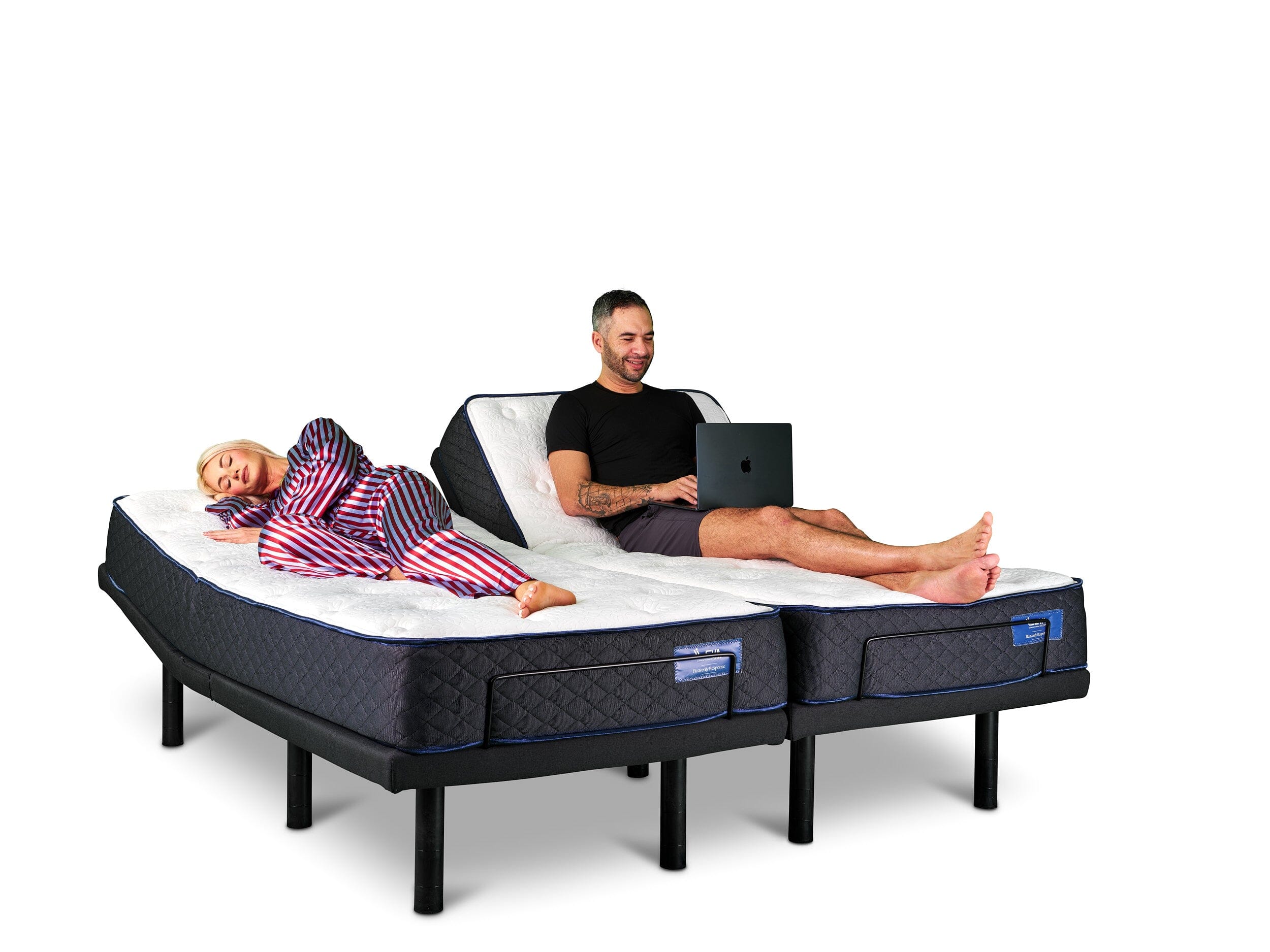
Leva’s split adjustable bases include the following features:
- Anti-snore mode with micro-adjustment presets for positional snoring
- App-controlled Bluetooth with custom sleep position memory
- Whisper-quiet German motors engineered for minimal sleep disruption
- Independent lumbar support per side
- Pillow tilt motor for head and neck alignment
- Integrated heating and cooling pads for individual temperature regulation
- AI-powered sleep tracking for real-time micro-adjustments
Leva’s vertically integrated, direct-to-consumer model, which combines local design, regional assembly, and no retail middlemen, delivers these features at 30–50% less than comparable luxury competitors such as Ghostbed or Sleep Country’s premium tier.
Browse Leva’s Split Queen and Split King packages with independent controls.
Couple-Specific Benefits and Buying Considerations
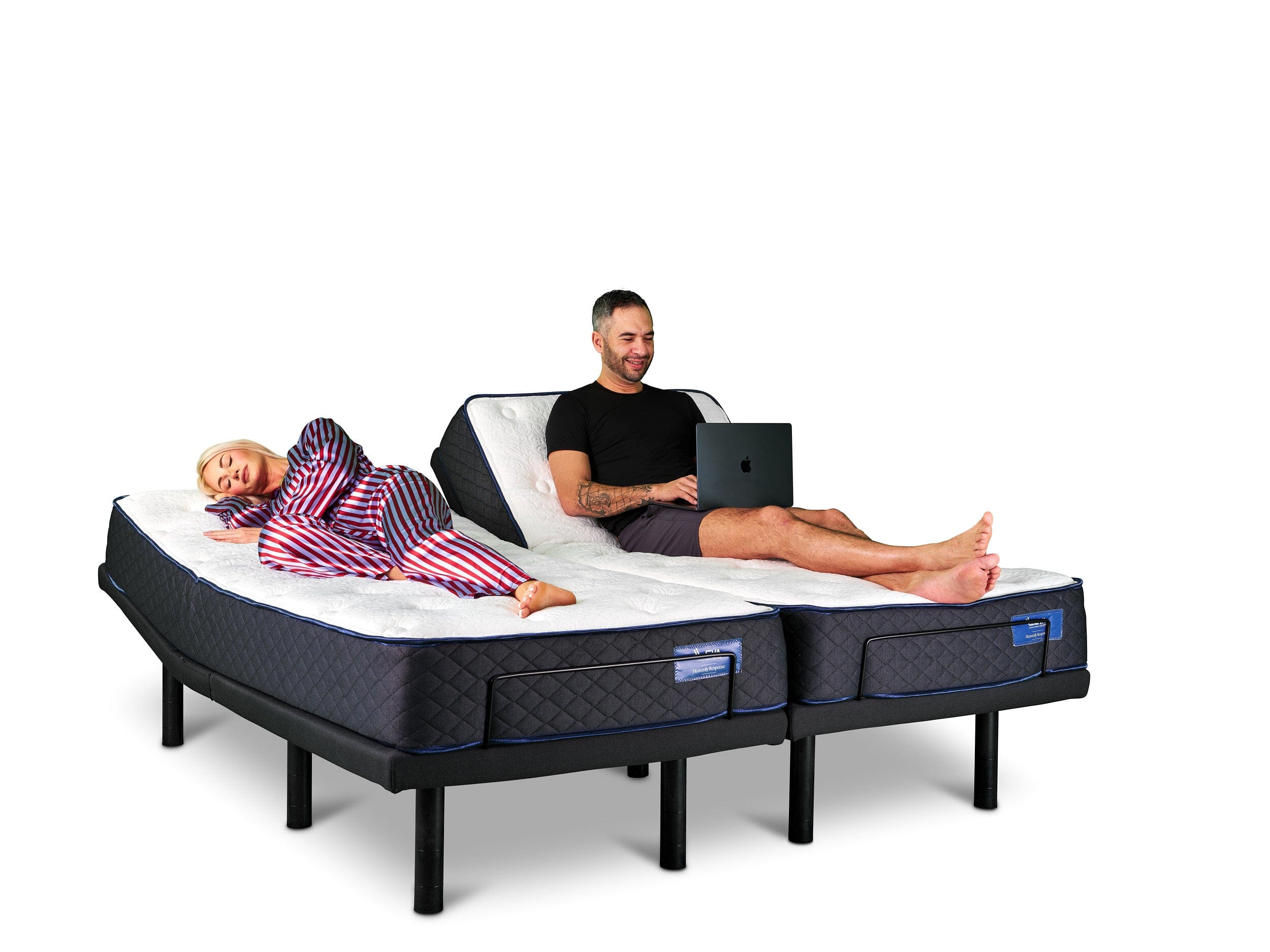
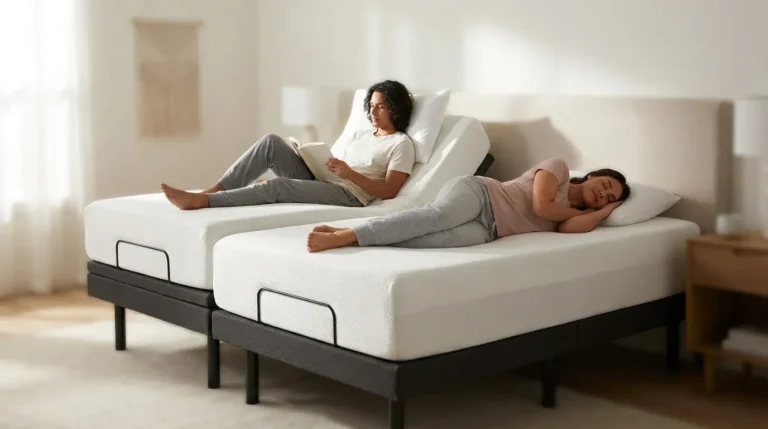
The defining advantage of a split adjustable system for couples is independent control. One partner can elevate to 20 degrees for positional snoring management while the other sleeps flat. Massage zones, temperature settings, and firmness preferences operate separately, which removes the compromise that often drives sleep divorce.
Leva Sleep’s white-glove delivery service, available in Ontario and Alberta, includes bedroom delivery, full assembly, leg-height adjustment, a product tutorial, and removal of the existing bed. These services handle the heavy lifting and setup details that often deter couples from upgrading.
When evaluating any split adjustable system, the following criteria are worth assessing:
- Independent adjustability: Confirm each side operates on a fully separate motor and control system.
- Noise level: Whisper-quiet motors matter for couples, particularly CPAP users whose sleep is already sensitive to sound.
- Mattress compatibility: Memory foam, latex, and hybrid pocket-coil mattresses flex well with adjustable bases, while traditional innerspring mattresses with connected coils are generally not compatible. Leva designs its own all-foam and hybrid mattresses specifically for its bases.
- Bedding retention: Standard fitted sheets often pull off at elevation. Leva’s purpose-built bedding uses deep pockets, extra elastic, and duvet clips designed for adjustable use.
- Temperature regulation: Integrated heating and cooling pads allow each partner to set an independent sleep temperature.
- Delivery and setup experience: White-glove in-home setup provides a smoother experience than a boxed delivery that requires self-assembly.
Frequently Asked Questions
How long does setup take and what maintenance is required?
Leva Sleep’s white-glove delivery team handles full assembly in the bedroom, including leg-height adjustment and a product walkthrough. Most installations are completed in a single appointment. Ongoing maintenance is minimal because the German motors are engineered for long-term quiet operation, and the app provides firmware updates. Leva’s direct-to-consumer model means customers contact the company directly for any service needs rather than navigating a third-party retailer.
Are Leva Sleep beds suitable for couples with differing medical needs?
Yes. The Split Queen and Split King configurations give each partner a fully independent base with separate elevation, massage, lumbar support, and temperature controls. One partner can use therapeutic head elevation for positional snoring or mild sleep apnea while the other sleeps flat. If one partner uses a CPAP machine and the other does not, the split system accommodates both without compromise. Couples with differing firmness preferences can also pair different mattress types on each side.
When should I consult a sleep specialist before trying elevation?
A sleep study is recommended before using head elevation as a primary management strategy for suspected sleep apnea. Positional therapy is most appropriate for mild positional OSA, where apnea events are significantly more frequent in the supine position, and this pattern should be confirmed by polysomnography rather than self-diagnosis. Individuals with moderate-to-severe OSA, central sleep apnea, high BMI, or apnea that occurs in all sleep positions should prioritize medical evaluation and not rely on elevation alone. Anyone currently prescribed CPAP should consult their sleep specialist before changing their treatment approach.
Can I use my existing CPAP machine with an adjustable base?
Yes. Adjustable bases are compatible with CPAP therapy and can improve the overall CPAP experience by reducing gravitational airway collapse that increases required pressure, simplifying hose routing when the base includes a flat platform behind the head section, and improving positional comfort for better long-term adherence. As noted earlier, the base complements but does not replace prescribed CPAP therapy for moderate-to-severe OSA. CPAP users should confirm that their mask and hose setup can accommodate the elevated head position before committing to a specific elevation angle for nightly use.
Conclusion: Choosing a Split Adjustable Bed to Sleep Better Together
Shared sleep disruption from snoring and mild positional sleep apnea can be addressed with the right setup. Clinical evidence supports head-of-bed elevation between 7 and 30 degrees as a meaningful, well-tolerated intervention for positional OSA, reducing AHI by approximately 31% on average and improving oxygen saturation in many responders. For couples, the key challenge has always been that one partner’s therapeutic need should not dictate the other partner’s sleep experience.
Leva Sleep’s Split Queen and Split King adjustable systems address that challenge directly. Independent controls, quiet motors, app-based personalization, and purpose-built Canadian delivery make it possible for both partners to shape their own sleep environment while sharing the same bed. Leva delivers a premium, medically informed sleep solution at a price that reflects its direct-to-consumer model rather than traditional retail markup.
Find your ideal split adjustable configuration to match your bedroom, your budget, and both of your sleep needs.