Written by: Matthew Timmins, Founder and Managing Director, Leva Sleep | Last updated: June 24, 2026
Key Takeaways for Couples With Neck Pain
-
The 2-2-1 rule applies to each sleeper. Every partner needs the loft and firmness that matches their dominant sleep position.
-
Neck pain from poor sleep posture often becomes a shared problem when mismatched pillows and a single flat mattress prevent neutral spinal alignment for both partners.
-
Traditional pillows and flat beds fall short because head elevation on a basic adjustable base increases effective loft and pushes the neck into forward flexion, while a shared surface angle cannot support different sleep positions at the same time.
-
The most effective setup pairs position-specific pillows with a split adjustable base that offers independent head elevation, lumbar support, and pillow-tilt controls for each partner.
-
Leva Sleep’s split adjustable systems let each partner customize their sleep angle without disturbing the other. Browse Leva Sleep’s adjustable bed packages to match your pillows with the right split base for your household.
Section 1: How Neck Pain Turns Into a Shared Problem
Chronic neck pain from sleep often shows up as stiffness on waking, a dull ache that spreads into the shoulders, or morning tension headaches. Forbes Health identifies poor sleep posture and unsupportive pillows as primary contributors to morning neck pain. The issue usually worsens over time when the underlying support problem stays the same.
For couples, the impact quickly moves beyond one person’s discomfort. HealthCentral reports that “sleep divorce” is increasingly common among couples where one partner’s pain or movement disrupts shared sleep. Separate rooms may reduce nighttime disturbance, yet they often create new problems such as reduced intimacy, awkward logistics, and the emotional strain of a divided bedroom.
Neck pain that worsens steadily, radiates into the arms, or appears with numbness needs medical evaluation before any pillow or base changes. For most couples dealing with positional morning stiffness, the cause is mechanical. The pillow and sleep surface are not keeping the cervical spine in a neutral position through the night.
Section 2: Why Traditional Pillows and Flat Beds Fail Couples
A standard pillow is built for a flat mattress surface. When a basic adjustable base raises the head section, the pillow’s loft effectively increases relative to the shoulder. This change pushes the neck into forward flexion. A pillow that felt fine on a flat surface can start straining the neck once the head lifts even 15 degrees.
Flat beds add another problem for couples because both partners share one surface angle. A side sleeper and a back sleeper on the same flat mattress cannot both achieve neutral spinal alignment at the same time. The mattress cannot support both positions correctly in a single configuration. Propel Active Health & Lifestyle notes that spinal alignment during sleep is position-dependent, and that a pillow appropriate for one position actively misaligns the spine in another. Couples often try to fix this mismatch with new pillows.
Many couples turn to specialty pillows, yet these products have limits. Shredded-fill pillows marketed as “adjustable” allow loft customization but do not solve the base angle problem. Contour memory foam pillows keep a fixed shape that suits one position but resist adaptation when the sleeper shifts. Neither category fixes the core issue when the mattress surface itself cannot be configured independently for each partner.
Section 3: Pairing Position-Specific Pillows With a Split Adjustable Base
The most reliable solution combines a pillow matched to each sleeper’s dominant position with an adjustable base that maintains the right surface angle for that position through the night. These two elements work together. The base sets the overall angle of the sleep surface. The pillow fills the remaining gap between that surface and the cervical spine.
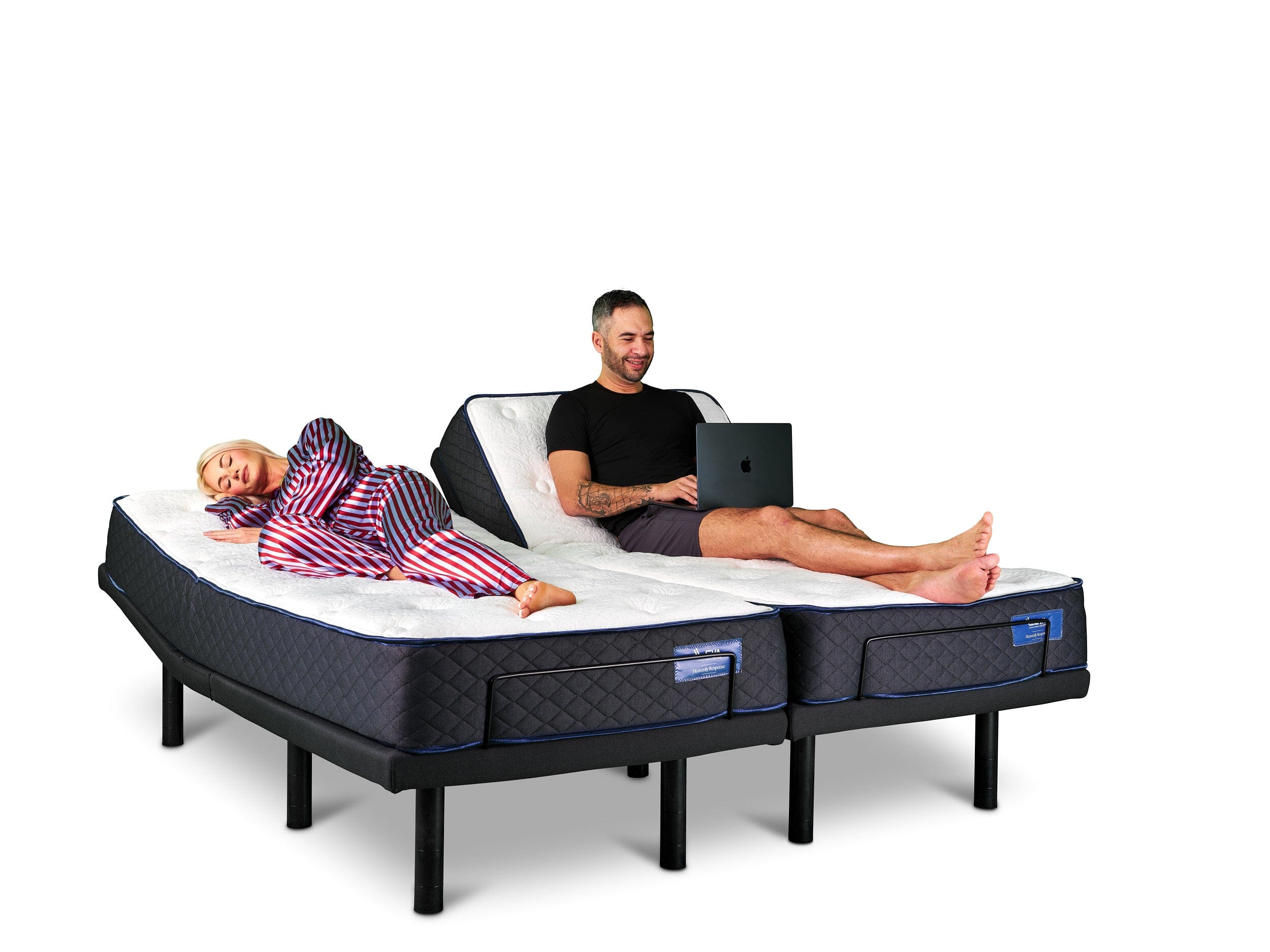
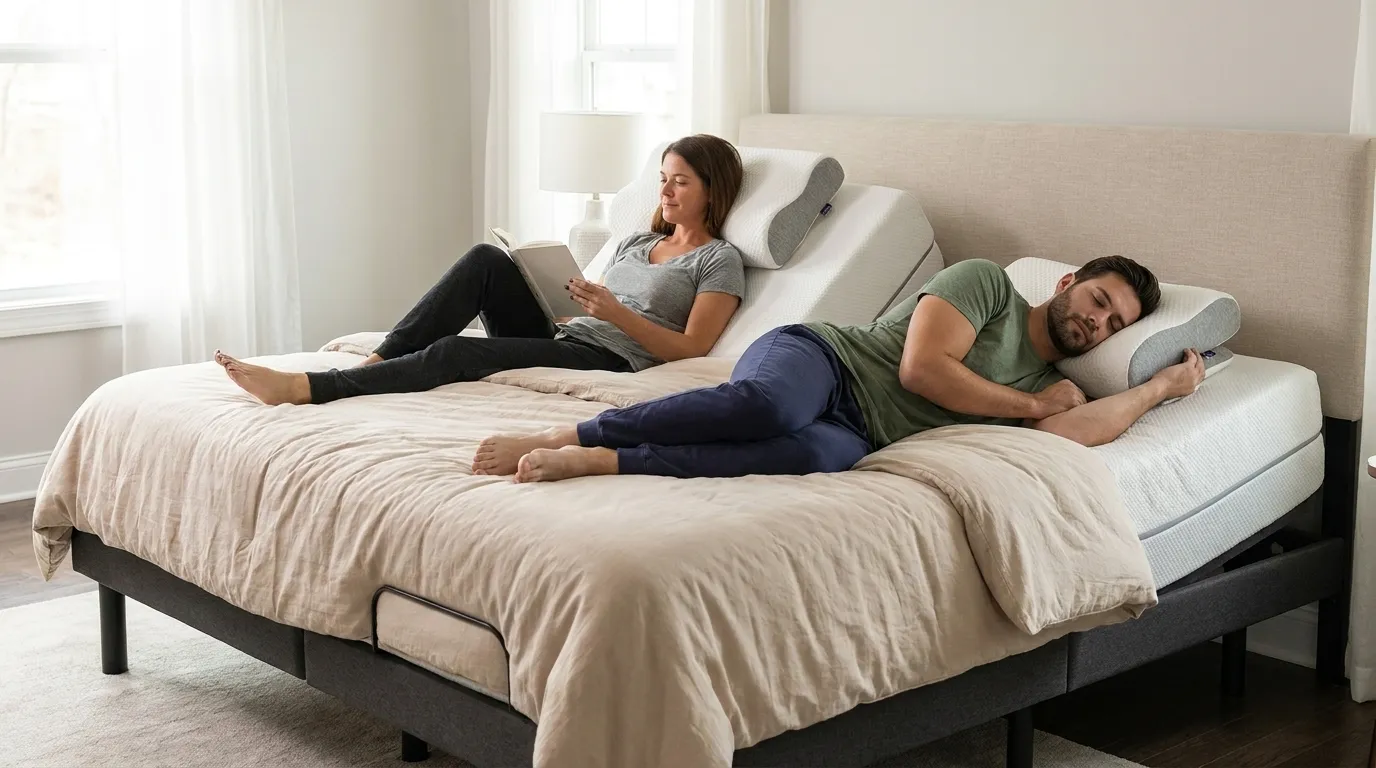
Leva Sleep’s split adjustable systems, available in Split Queen and Split King configurations, let each partner set independent head elevation, lumbar support, and pillow tilt. The pillow-tilt motor makes a small, targeted adjustment to the head zone of the base. A side sleeper can reduce effective loft pressure on one side, while a back sleeper on the other side maintains a gentle cervical curve. Each partner adjusts their side without disturbing the other.
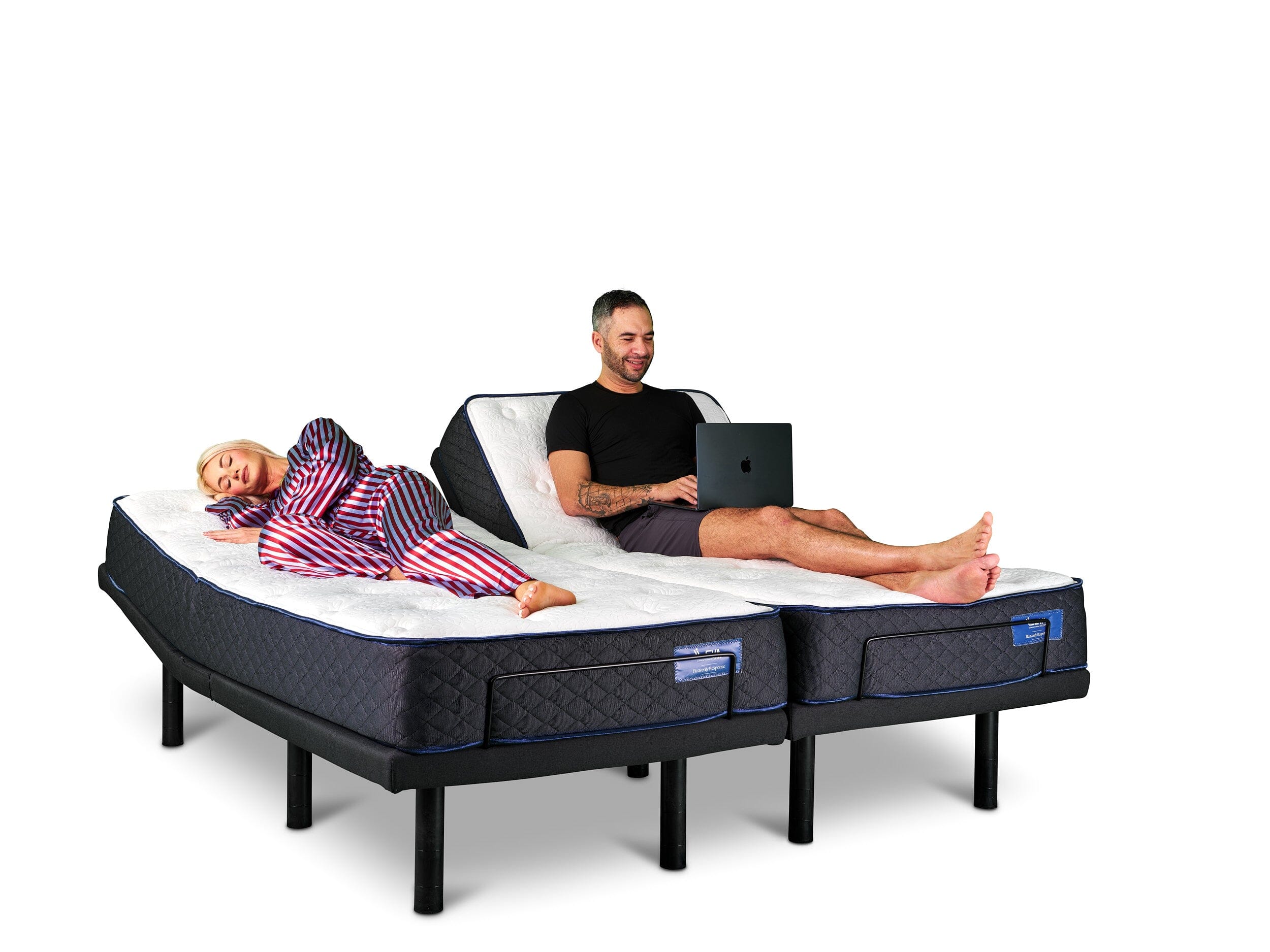
Leva’s whisper-quiet German motors keep position changes during the night almost silent. This avoids the mechanical noise that many basic adjustable bases create, which often turns the base itself into a new source of sleep disruption.
Section 4: How to Judge Pillows for Use With an Adjustable Base
Couples choosing pillows to use with an adjustable base can start with position, loft, and firmness. The table below summarizes typical recommendations.
|
Sleep Position |
Recommended Loft |
Recommended Firmness |
Fill Type to Consider |
|---|---|---|---|
|
Side sleeper |
High (4–6 in) |
Firm |
Solid latex or dense memory foam |
|
Back sleeper |
Medium (3–4 in) |
Medium |
Contour memory foam or shredded latex |
|
Stomach sleeper |
Low (1–2 in) |
Soft |
Shredded fill or thin down alternative |
|
Combination sleeper |
Adjustable (3–5 in) |
Medium |
Shredded fill with removable insert |
When choosing between pillow types, start with the contour-versus-shredded-fill decision. Contour pillows hold a fixed cervical curve and suit sleepers who remain in one position. Shredded-fill pillows allow on-the-fly loft adjustment and suit combination sleepers, but they need periodic re-fluffing to maintain support.
Once you select a pillow type, plan for an adjustment period. Switching pillow type usually requires a break-in phase while the body adapts to new cervical positioning. Discomfort in the first week does not always mean the pillow is wrong. Discomfort that continues beyond two to three weeks signals a need to reassess loft or firmness.
Pillows used on an adjustable base should always be tested at the base’s typical elevated angle, not flat. A pillow that feels correct at zero degrees can feel too high at 20 degrees of head elevation. Couples get better results when they fine-tune pillows at the angles they actually use at night.
Price also matters, especially for Canadian households. Canadian pricing context: specialty cervical pillows in Canada range from approximately $20 to $500 CAD.
Section 5: Real-World Results for Canadian Couples
Couples who combine position-specific pillows with a split adjustable base commonly report three clear gains. Morning stiffness decreases for the partner with neck pain. Nighttime interruptions drop for both partners. Many couples stay in the same bed instead of moving to separate rooms.
Beyond neck pain relief, many Leva customers report that the head elevation they use for cervical support has also reduced their reliance on CPAP equipment, a dual benefit their sleep apnea clinic did not expect. This kind of outcome highlights how one well-tuned setup can address more than one sleep concern at the same time.
Leva’s in-house white-glove delivery service in Ontario and Alberta includes bedroom setup, leg-height adjustment, a full product tutorial, and removal of the old bed. This service removes the assembly burden that often causes couples to delay or abandon the move to an adjustable system.
Section 6: Quick Comparison Checklist for Your Bedroom Setup
|
Feature |
Standard Pillow + Flat Bed |
Specialty Pillow + Basic Adjustable Base |
Position-Specific Pillow + Leva Split System |
|---|---|---|---|
|
Per-partner surface angle |
No |
Shared angle only |
Independent per side |
|
Lumbar support |
No |
Limited |
Yes, independent |
|
Pillow tilt adjustment |
No |
No |
Yes |
|
Motor noise |
N/A |
Often audible |
Whisper-quiet |
|
App control |
No |
Rarely |
Yes, Bluetooth |
|
White-glove setup |
No |
Rarely |
Yes (fee, ON & AB) |
|
Split Queen option |
N/A |
Uncommon |
Yes |
Frequently Asked Questions
What pillow do orthopedic doctors recommend for neck pain?
Orthopedic specialists generally recommend pillows that keep the cervical spine in a neutral position for the sleeper’s dominant position. For side sleepers, this usually means a firm, high-loft pillow that fills the gap between the ear and the mattress surface. For back sleepers, a medium-loft contour pillow that supports the natural inward curve of the neck is typically preferred. Stomach sleeping is discouraged for neck pain sufferers regardless of pillow type, because the rotated head position strains the cervical joints. The specific pillow material, such as memory foam, latex, or shredded fill, matters less than achieving the correct loft for the individual’s shoulder width and sleep position.
What are chiropractic pillows for neck pain, and do they work?
Chiropractic pillows, also called cervical or contour pillows, have a raised outer edge and a lower central depression. This shape is intended to cradle the head and support the neck’s natural curve for back sleepers, while the raised edge supports the neck for side sleepers. These pillows work best for sleepers who remain in one position through the night. Combination sleepers often find the fixed contour restrictive. Chiropractic pillows used on an adjustable base should be re-evaluated at the base’s usual elevated angle, because head elevation changes effective loft and may require a lower-profile pillow than the same sleeper would use on a flat surface.
How does the Tempur neck pillow compare to other options for neck pain?
The Tempur neck pillow uses Tempur material, a proprietary viscoelastic foam that slowly conforms to the shape of the head and neck. It is a fixed-contour design suited to back and side sleepers who maintain a consistent position. Its main advantage is pressure distribution. Its main limitation is that the fixed shape does not suit combination sleepers or frequent position changes during the night. Tempur pillows used at elevated head angles may require a lower-loft variant than the same sleeper would use on a flat surface. Canadian pricing for standard Tempur-Neck pillows is typically $139–$170 CAD on sale.
Can a pillow alone resolve neck pain, or is an adjustable base necessary?
A pillow alone can reduce neck pain when the sleep surface is flat and the sleeper maintains a consistent position. For couples where one partner’s position or movement disrupts the other, or where a flat surface cannot support both partners’ alignment needs at the same time, a pillow alone usually falls short. An adjustable base controls the overall angle of the sleep surface, which a pillow cannot change. The combination of a position-appropriate pillow and an adjustable base that maintains the correct surface angle is more effective than either element on its own, especially for couples with different sleep positions or one partner with a medical condition that requires elevated sleep.
Conclusion: Matching Pillows and Bases for Long-Term Neck Relief
Choosing the right pillow for neck pain matters, yet it solves only part of a larger alignment puzzle. Loft, firmness, and fill type must match the dominant sleep position. That pillow then needs to be tested at the real angle of the sleep surface, which often differs from a flat baseline on an adjustable base. For couples, differing positions and preferences mean that a single pillow solution on a shared flat surface usually creates compromise instead of relief.
Evaluating pillows alongside a split adjustable system that offers independent head elevation, lumbar support, and pillow tilt per partner addresses the full set of variables instead of just one. Leva Sleep’s systems are built for this integrated approach, with Canadian in-house delivery and pricing often 30–50% below comparable luxury competitors.
Find the adjustable bed configuration that solves your household’s neck pain problem.