Written by: Matthew Timmins, Founder and Managing Director, Leva Sleep | Last updated: July 20, 2026
Key Takeaways for Snoring Relief
- Head elevation of 7–12° on an adjustable bed reliably reduces positional snoring by opening airways and moving the soft palate away from the throat.
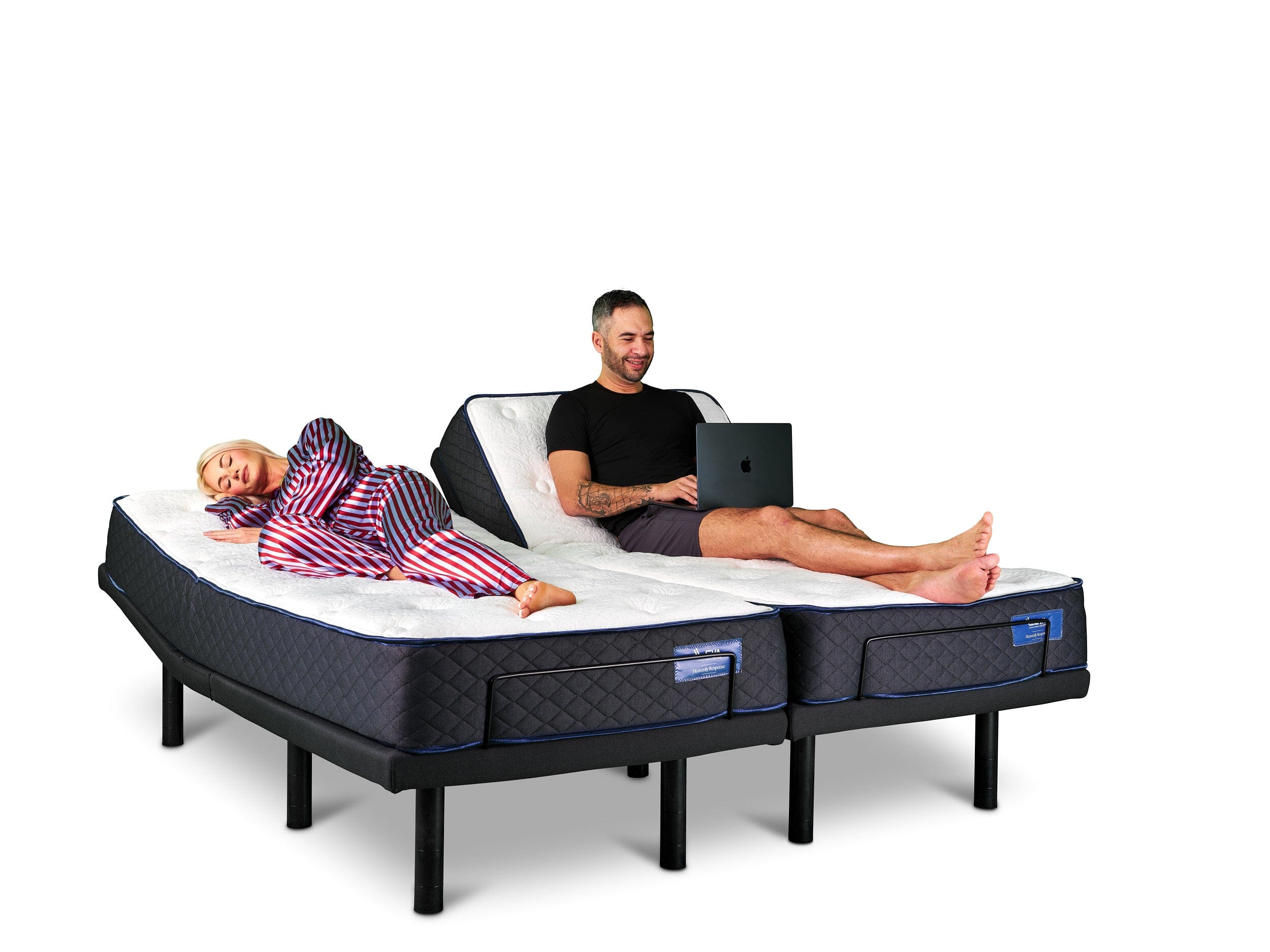
- The most effective bases for couples offer independent Split Queen or Split King controls, quiet motors, and programmable anti-snore presets so one partner can adjust without disturbing the other.
- Automatic snore-detection systems exist but can produce false triggers. Leva Sleep combines automatic responsiveness with app-level sensitivity control for more consistent results.
- Adjustable beds help positional snorers but do not treat diagnosed obstructive sleep apnea. CPAP remains the clinical standard and a doctor should be consulted first.
- For Canadian couples seeking an effective, quiet, and affordable setup, explore Leva Sleep’s Split Queen and King packages with white-glove delivery across Ontario and Alberta.
How Adjustable Beds Reduce Snoring
An adjustable bed reduces snoring primarily through head-of-bed elevation. Souza et al. (2017) found that 7.5° of head-of-bed elevation can help reduce the apnea-hypopnea index in patients with obstructive sleep apnea. A peer-reviewed in-home PMC study found that participants sleeping at a 12° incline for four weeks experienced a 7% relative reduction in objective snoring duration, 4% fewer awakenings, and a 5% increase in deep sleep compared to sleeping flat.
Clinical sleep-medicine studies consistently show snoring reduction of 30–60% at angles of 7–15° by gravity-loading the soft palate away from the back of the throat. These results apply most strongly to positional snorers. Those who snore in all positions see reduced benefits because the issue is likely anatomical rather than positional.
The most effective adjustable beds for snoring share several characteristics:
- Motorized head elevation reaching at least 7–12° with programmable anti-snore presets
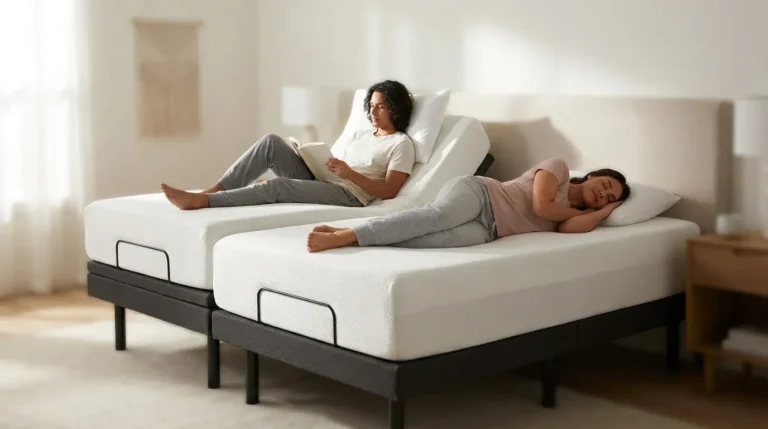
- Independent Split Queen or Split King controls so one partner can elevate without affecting the other
- Whisper-quiet motors that do not disrupt sleep during position changes
- App or remote micro-adjustment capability for fine-tuning the angle
- Compatibility with flexible foam or hybrid mattresses that bend without resistance
Automatic Adjustable Beds for Snoring
Several adjustable bases now offer automatic snore detection, although the technology carries trade-offs. The TEMPUR-Ergo Smart™ Base uses Sleeptracker®-AI sensors to detect snoring and automatically raises the head approximately 12° via its Snore Response™ feature. The Ergomotion SmartSense uses sensors to monitor sleep and offers Quiet-Nite snore intervention.
Automatic snore-detection systems commonly produce false triggers from coughing, heavy breathing, traffic noise, or partner movement, and exhibit inconsistent response timing of 3–5 minute delays or abrupt full-angle raises. These automatic systems are typically found on premium adjustable bases.
Leva Sleep’s app update introduces an anti-snore mode that detects snoring and makes micro-adjustments to the head of the bed. The system combines automatic responsiveness with app-level control that lets couples fine-tune sensitivity and angle. This positions Leva Sleep as a Canadian Split Queen and King specialist offering this feature at 30–50% below comparable competitor pricing.
How Much Adjustable Beds Reduce Snoring
Adjustable beds reduce positional snoring reliably but do not eliminate all snoring in every individual. Multiple polysomnography studies find that 56% of habitual snorers snore exclusively or predominantly in the supine position, making them strong candidates for positional interventions including head elevation. For this group, an adjustable base with clinically supported 7–12° elevation offers a non-invasive intervention.
Adjustable beds can reduce snoring and mild airway obstruction through head elevation but do not treat diagnosed obstructive sleep apnea, for which CPAP therapy remains the gold standard. Research consistently identifies 20–30° of head-section elevation as the effective range; below 15° the gravitational effect is insufficient, while above 35–40° most people find the position uncomfortable for sustained sleep.
Anyone with a suspected sleep apnea diagnosis should consult a physician before relying solely on positional therapy. An adjustable bed complements medical evaluation and treatment rather than replacing it.
Best Adjustable Bed Options in Canada for Couples Who Snore
For Canadian couples, independent control usually matters most. Split King configurations allow partners to set completely different head and foot elevations simultaneously, enabling one partner to use zero-gravity positioning while the other sleeps flat. Split Queen configurations deliver the same independence in a smaller footprint, a format Leva Sleep offers as a Canadian specialty.
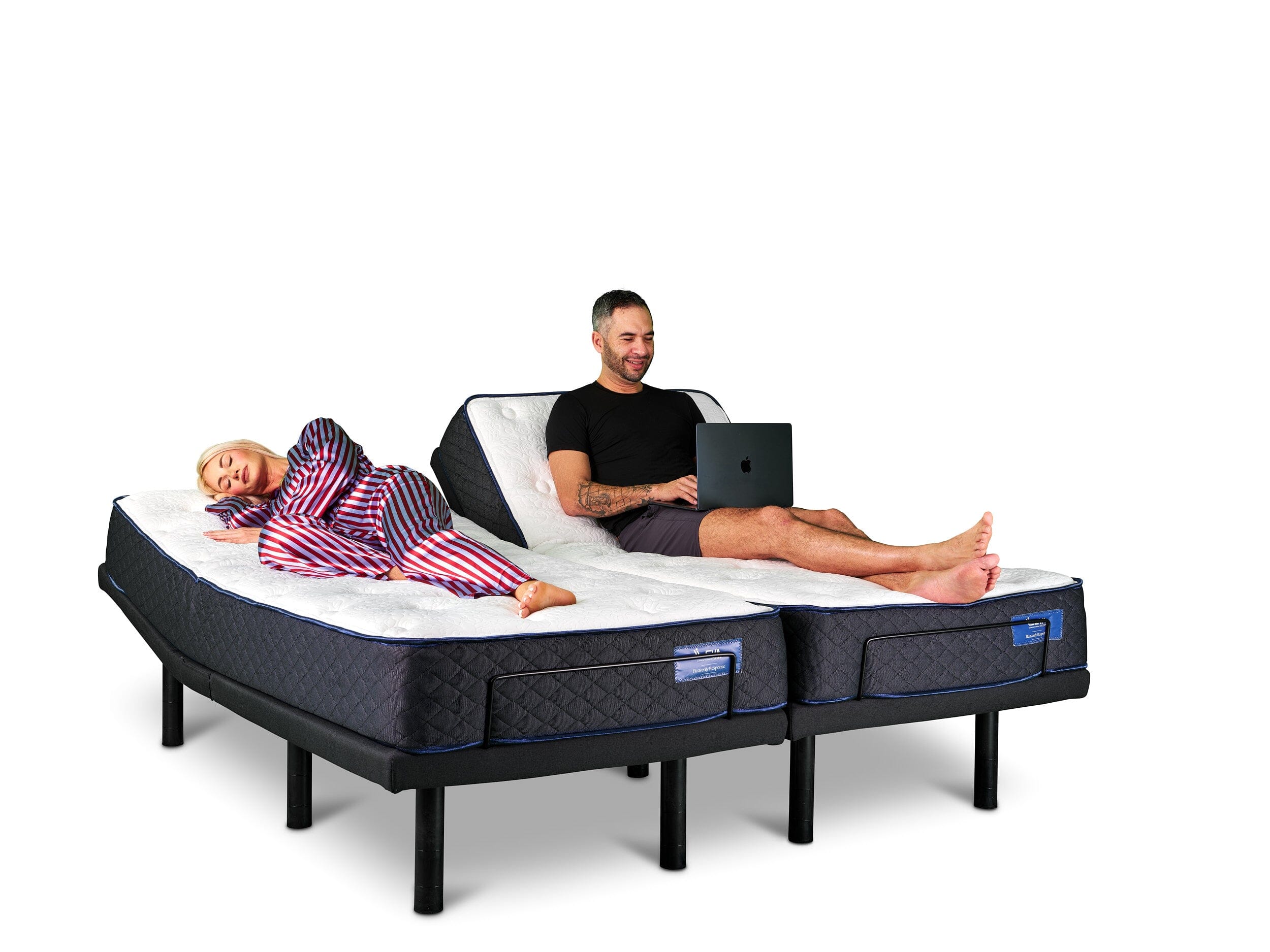
Karena Wu, P.T., D.P.T., states that adjustable beds are best for users with GERD or obstructive sleep apnea and are also helpful for chronic back and neck pain, respiratory issues like snoring or asthma, and circulatory issues. For couples where only one partner snores, a split base means the non-snoring partner is not disturbed by an automatic adjustment or a position change.
Browse Canada’s largest selection of split adjustable bases at Leva Sleep, featuring 15–20 models with app control and in-house white-glove delivery across Ontario and Alberta.
Head Elevation and Sleep Apnea in Canada
A 2017 study of 52 patients with mild to moderate obstructive sleep apnea found that 7.5° of head-of-bed elevation can reduce the apnea-hypopnea index and improve minimum oxygen saturation. Ravesloot et al. (2013) in Sleep and Breathing described positional therapy as having “undervalued potential” as a treatment for position-dependent snoring and obstructive sleep apnea.
Head-of-bed elevation is contraindicated in patients with lower limb edema and venous insufficiency; individuals should consult a doctor before using positional therapy for diagnosed sleep apnea. Sleep apnea clinics in Canada do refer patients to adjustable bed specialists, including Leva Sleep, but medical supervision remains essential for diagnosed conditions.
Model Comparison Table for Canadian Buyers
Now that the clinical evidence and key features are clear, the table below compares eight adjustable bases available to Canadian buyers. Pricing is in CAD. Incline figures reflect head-section elevation at the anti-snore or maximum preset. Delivery notes reflect publicly available information at time of publication.
| Model | Incline & Anti-Snore | Split Options & Price (CAD) | Delivery Notes |
|---|---|---|---|
| Leva Sleep Split Queen/King | 7–12° manual preset, app-based automatic anti-snore mode, whisper-quiet German motors, app micro-adjustment | Split Queen and Split King available, Queen base from $1,400 CAD | In-house white-glove delivery to Ontario and Alberta, includes assembly, leg-height adjustment, tutorial, and old-bed removal |
| TEMPUR-Ergo Smart™ Base | Automatic Snore Response™ raises head ~12° via Sleeptracker®-AI sensors, Smart Snore Pulse vibration alert | Split King available, Queen from ~$2,200 CAD | Available via Sleep Country Canada and Tempur-Pedic retailers, delivery terms vary by retailer |
| Ergomotion SmartSense | Automatic Quiet-Nite snore intervention, gradual head raise, ErgoWellness app sleep tracking | Split configurations available, pricing varies by retailer, contact retailer for CAD pricing | Available through select Canadian retailers, delivery terms vary |
| Douglas Adjustable Bed | Head and foot elevation, manual presets, no automatic snore detection | Split King (2× Twin XL) from $2,398 CAD bases only | Free shipping across Canada, 5–10 business day delivery, 120-night trial with return pickup |
| Orthex Sophia 2 | Head and foot elevation, manual presets, Canadian-made | Available in Twin XL, Queen, King | Available through Mattress Miracle, southern Ontario white-glove delivery |
| Mattress Miracle SleepBeat SE1005 | Head and foot elevation, wireless remote, manual presets, no automatic snore detection | $995 CAD (queen), 750 lb capacity, split configuration not specified | White-glove delivery across southern Ontario including Hamilton, Toronto, Mississauga, London, and Barrie |
| GhostBed Adjustable Base | Head and foot elevation, manual anti-snore preset, no automatic detection | Split King available, pricing varies, available through Costco Canada and direct | Standard delivery, setup terms vary by purchase channel |
| Silk & Snow Adjustable Base | Head and foot elevation, manual presets, zero-gravity preset | Split King available, pricing available on Silk & Snow website in CAD | Ships across Canada, standard delivery, no in-home setup included |
Key Considerations Before Choosing a Base
When evaluating adjustable bases for snoring reduction, focus on a few practical criteria.
- Motor noise: German-engineered motors are marketed as quieter and more reliable than motors found in many big-box store bases, with Canadian pricing ranging from $899–$2,499. This premium matters because a motor that wakes the non-snoring partner during an adjustment defeats the purpose.
- Lumbar and pillow-tilt motors: Head elevation alone may cause lower-back strain over time. Lumbar support and pillow-tilt motors allow fine-tuning that maintains spinal alignment at elevated angles.
- Programmable memory positions: Smart adjustable bases allow users to save 2–4 programmable memory positions, including a dedicated anti-snore preset that elevates the head section 15–20°. Memory positions remove the need to re-set the angle each night.
- Warranty and long-term usability: A 10-year warranty on the base motor and frame is the benchmark for quality in this category. Leva Sleep’s Queen base includes a 10-year warranty.
- Mattress compatibility: Only all-foam or hybrid pocket-coil mattresses flex adequately with an adjustable base. Innerspring mattresses with rigid borders will not articulate correctly and may void the base warranty.
Trade-offs and Limitations of Head Elevation
Head elevation addresses positional snoring but carries limitations buyers should understand before purchasing.
- Elevation benefits are strongest for positional snorers, the majority discussed earlier who snore predominantly when lying flat. Those who snore in all positions are less likely to see dramatic improvement.
- Automatic snore detection adds cost and complexity. Many users disable auto-detection within the first few months due to false triggers and sleep disruption from the adjustment itself.
- Karena Wu, P.T., D.P.T., advises that individuals with spinal fusion and osteoporosis should avoid adjustable beds, and those with heart or respiratory issues should consult a doctor before use.
- As noted earlier, these beds address positional snoring but do not replace CPAP for diagnosed OSA.
- The Canadian adjustable base market is 40–65% more expensive than the US due to currency exchange, import duties, and retail markup, which makes direct-to-consumer pricing from specialists like Leva Sleep a meaningful advantage.
Setup, Ownership, and Day-to-Day Planning
An adjustable base is a long-term investment that requires more planning than a standard bed frame. For Ontario and Alberta buyers, Leva Sleep’s in-house white-glove delivery service covers delivery to the bedroom, full assembly, leg-height adjustment for optimal bed height, a product tutorial, and removal of the old bed, including donation or recycling where available.
Practical ownership considerations include:
- Bedding compatibility: Standard fitted sheets often pull off adjustable bases during elevation. Leva Sleep designs deep-pocket fitted sheets with extra elastic and duvet clips specifically for adjustable bases.
- Leg height: Adjustable bases ship with interchangeable legs. A white-glove technician can set the height during delivery to match existing bedroom furniture or accessibility needs.
- App setup: Bluetooth-connected bases require initial pairing and position programming. A delivery tutorial ensures both partners understand how to operate independent controls before the technician leaves.
- Trial period: Leva Sleep offers a 120-night trial. Use the first two to four weeks to identify the optimal elevation angle for snoring reduction before committing to a permanent preset.
Common Mistakes to Avoid When Buying
The most common purchasing mistakes fall into a few clear categories.
First, configuration errors create frustration later. Choosing a base with only one motor zone removes independent control for couples. Pairing an adjustable base with an incompatible innerspring mattress prevents proper flexing and may affect warranty coverage.
Second, comfort misjudgments reduce long-term use. Selecting the highest incline available without testing often backfires, since angles above 35–40° are typically uncomfortable for sustained sleep and can cause the sleeper to slide toward the foot of the bed. Buyers who understand this usually choose moderate, clinically supported angles instead.
Third, medical and cost oversights can carry real consequences. Purchasing a base with automatic snore detection without understanding the false-trigger rate and the additional cost premium of $500–$1,500 often leads to disappointment. Snoring can be a sign of obstructive sleep apnea, which has serious cardiovascular implications, so skipping a medical evaluation is risky. Buying from a general retailer without adjustable-bed expertise also increases the chance of poor fit, since adjustable bed frames sell best when demonstrated with the mattress, warranty terms are clearly explained, and delivery setup feels simple.
Frequently Asked Questions
Which adjustable bed is effective in reducing snoring?
The most effective adjustable beds for snoring are those that achieve 7–12° of head-of-bed elevation with programmable anti-snore presets, independent Split Queen or King controls for couples, and quiet motors that do not disturb the non-snoring partner during adjustments. Leva Sleep’s Split Queen and King systems meet all three criteria and add app-based micro-adjustment capability.
For couples where one partner snores and the other does not, independent control is the single most important feature. It allows the snoring partner to elevate without affecting the other side of the bed. Buyers should also confirm that the base is compatible with their mattress type, as only all-foam and hybrid pocket-coil mattresses flex adequately with an adjustable base.
Is there an automatic adjustable bed that helps with snoring?
Several automatic adjustable beds can help with snoring. The TEMPUR-Ergo Smart™ Base uses Sleeptracker®-AI sensors to detect sustained snoring and automatically raises the head approximately 12°. The Ergomotion SmartSense uses a similar sensor-based approach with its Quiet-Nite intervention.
Leva Sleep’s spring 2026 app update introduces automatic snore detection with app-level sensitivity control, available on Split Queen and King configurations at 30–50% below comparable competitor pricing. The trade-off with any automatic system is false triggers from coughing, traffic noise, or partner movement. Manual anti-snore presets, where the user or partner presses a button to elevate the head, remain more reliable for light sleepers who are easily disturbed by unexpected movement.
The best approach for most couples is a base that offers both. A manual preset supports predictable nightly use, while an automatic mode helps on nights when the snorer falls asleep before their partner.
Do adjustable beds really stop snoring?
Adjustable beds reliably reduce positional snoring, which occurs predominantly when lying flat on the back, but they do not eliminate all snoring in all individuals. Clinical research shows 30–60% snoring reduction at 7–15° of elevation for positional snorers, with one PMC study recording a 7% reduction in objective snoring duration at a 12° incline over four weeks.
For the roughly 56% of habitual snorers who snore predominantly in the supine position, head elevation is a well-supported, non-invasive intervention. For snorers whose issue is anatomical rather than positional, results are more modest. As noted earlier, these beds address positional snoring but do not replace CPAP for diagnosed OSA. Anyone who suspects they have sleep apnea should complete a sleep study before relying on positional therapy alone.
Head elevation for sleep apnea Canada
Head-of-bed elevation is recognized as a low-cost, well-tolerated positional therapy for mild positional obstructive sleep apnea. A 2017 study found that 7.5° of elevation reduced the apnea-hypopnea index by approximately 32% and improved minimum oxygen saturation in patients with mild to moderate OSA.
Canadian sleep apnea clinics do refer patients to adjustable bed specialists, including Leva Sleep, as a complement to or alternative to CPAP for selected positional OSA phenotypes. Head elevation is contraindicated for patients with lower limb edema and venous insufficiency, and all individuals with a diagnosed sleep apnea condition should consult their physician before substituting positional therapy for prescribed treatment. For Ontario and Alberta residents, Leva Sleep’s white-glove delivery service includes a setup tutorial that covers optimal elevation angles for both snoring reduction and sleep apnea management.
Conclusion: Why Leva Sleep Works for Couples
The clinical case for 7–12° head elevation as a snoring intervention is well established. The practical challenge for Canadian couples is finding a base that delivers that elevation independently on each side of the bed, at a price that reflects direct-to-consumer value rather than retail markup, with a delivery experience that handles the complexity of setup.
Leva Sleep addresses all three requirements. With over 8 years in business, $50M in lifetime sales, and 25,000+ customers, it is Canada’s established Split Queen and King specialist. The lineup includes 15–20 adjustable models, whisper-quiet German motors, app-controlled positioning, and a spring 2026 automatic anti-snore mode at 30–50% below comparable competitors. White-glove delivery across Ontario and Alberta includes assembly, leg-height adjustment, a product tutorial, and old-bed removal.
Find your ideal split configuration and start sleeping better together.