Written by: Matthew Timmins, Founder and Managing Director, Leva Sleep | Last updated: June 24, 2026
Key Takeaways for Back-Pain Sleepers
- Medium-firm mattresses rated 6–7 on a 10-point scale give most back or side sleepers a strong starting balance of support and pressure relief.
- Static firmness ratings lose effectiveness as bodies change with age, weight, injury, pregnancy, and nightly position shifts.
- Adjustable lumbar support systems address these changes by letting sleepers fine-tune spinal alignment in real time for every position and every night.
- Split Queen and Split King bases give Canadian couples independent controls on each side, which helps prevent the compromise that often leads to “sleep divorce.”
- Leva Sleep’s adjustable bed packages deliver personalized lumbar support, whisper-quiet motors, and white-glove setup across Ontario and Alberta. Explore adjustable bed packages with white-glove delivery today.
Firmness Guidelines by Sleep Position and Body Weight
Firmness needs change based on sleep position and body weight. The table below gives general starting recommendations. These are not clinical prescriptions. Treat them as practical criteria that narrow your options before you test a mattress in person.
| Sleep Position | Under 130 lb | 130–230 lb | Over 230 lb |
|---|---|---|---|
| Side sleeper | Soft–Medium (4–5) | Medium (5–6) | Medium-Firm (6–7) |
| Back sleeper | Medium (5–6) | Medium-Firm (6–7) | Firm (7–8) |
| Stomach sleeper | Medium-Firm (6–7) | Firm (7–8) | Extra-Firm (8–9) |
Side sleepers usually need a softer surface that cushions the shoulder and hip while keeping the lumbar spine level. Back sleepers need enough firmness to stop the lower back from sagging. Stomach sleepers rely on a firmer surface that prevents the pelvis from dropping and hyperextending the lumbar spine. Heavier sleepers compress foam more deeply, so they often need a firmer rating to get the same effective support that a lighter person feels on a softer surface.
Why Static Mattresses Often Stop Working
A fixed firmness rating assumes that a sleeper’s body, position, and health status stay constant. That assumption rarely holds in real life. Bodies change with age, injury, weight fluctuation, and pregnancy. A mattress that feels supportive at a 6.5 firmness in year one can feel too soft or too firm by year three.
The mechanical issue is simple. On a mattress that is too soft, the lumbar spine bows downward, which stretches ligaments and compresses the back of the vertebrae. On a mattress that is too firm, gaps form and force muscles to stay active all night. Both situations block the deep muscular relaxation that restorative sleep requires.
Many people still believe that a firmer mattress always helps back pain. Medium-firm mattresses often give a better balance of support and comfort for back pain relief. Keeping the spine neutral during sleep reduces morning stiffness and chronic back pain by supporting natural neck, mid-back, and lumbar curves. Ultra-firm surfaces can stop the shoulder and hip from sinking enough for side sleepers, which creates a different set of alignment problems.
Static mattresses also cannot respond to positional changes during the night. A person who starts on their back and shifts to their side mid-sleep lies on a surface tuned for only one of those positions.
How Adjustable Lumbar Support Protects Your Back
An adjustable bed brings the surface to your body’s natural contours and fills gaps between the body and the bed. This support lets muscles relax fully so the body can enter the repair stage of sleep. Instead of choosing a single firmness and hoping it works every night, an adjustable lumbar system lets you dial in support exactly where the lower back needs it.
The Zero Gravity position places the body in a neutral posture with no muscle group under tension. This relaxation allows the spine to decompress as the lower back sinks naturally into the mattress. The improved alignment supports better blood flow, which improves oxygenation. For people with sciatica or herniated discs, the position adds another benefit. Elevating the knees 15 to 30 degrees relaxes the hamstrings and reduces posterior pelvic tilt and sciatic nerve tugging.
Leva Sleep’s adjustable bases use whisper-quiet German motors that make micro-adjustments without waking a partner. The Leva Sleep app controls head elevation, foot elevation, and massage motors. A spring 2026 anti-snore mode detects snoring and makes subtle head-position changes automatically. Mattresses with targeted support zones cushion shoulders and hips while supporting the lumbar region. Leva’s hybrid pocket-coil mattresses use this zoned design to work with the adjustable base beneath them.
How Adjustable Beds Help Couples Avoid Sleep Divorce
When one partner wakes with lower-back pain and the other sleeps comfortably, a single static mattress forces a compromise. That compromise often fails both people. Over time, this mismatch can push partners into what sleep researchers call “sleep divorce,” where each person moves to a separate room to get enough rest.
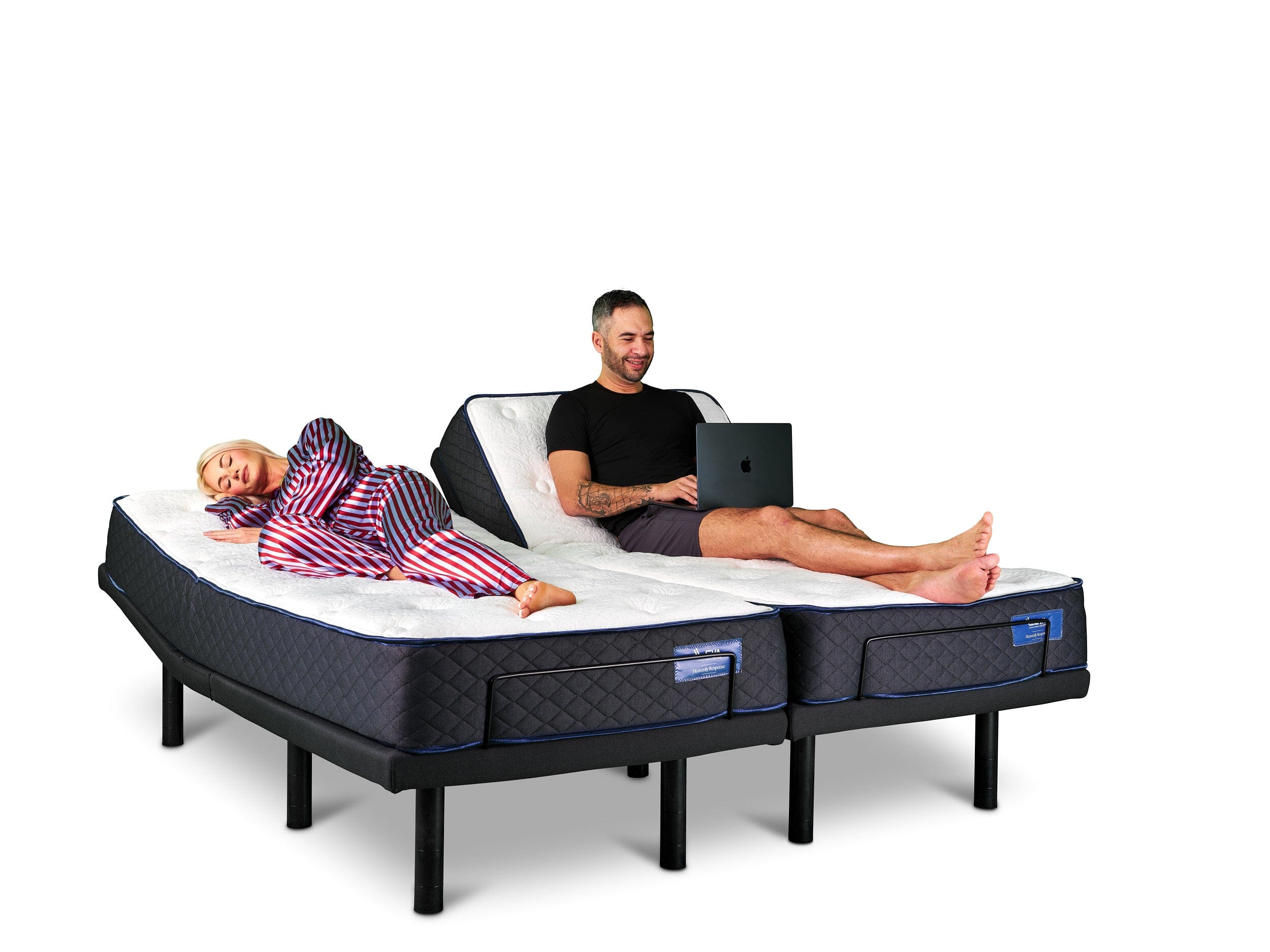
Leva Sleep’s Split Queen and Split King adjustable bases give each side of the bed its own motor, lumbar control, elevation profile, and app settings. One partner can sleep in Zero Gravity with knees elevated. The other can lie flat with maximum lumbar support engaged. The two sides share a smooth surface with no gap or ridge, so couples stay in the same bed without sacrificing either person’s spinal health.
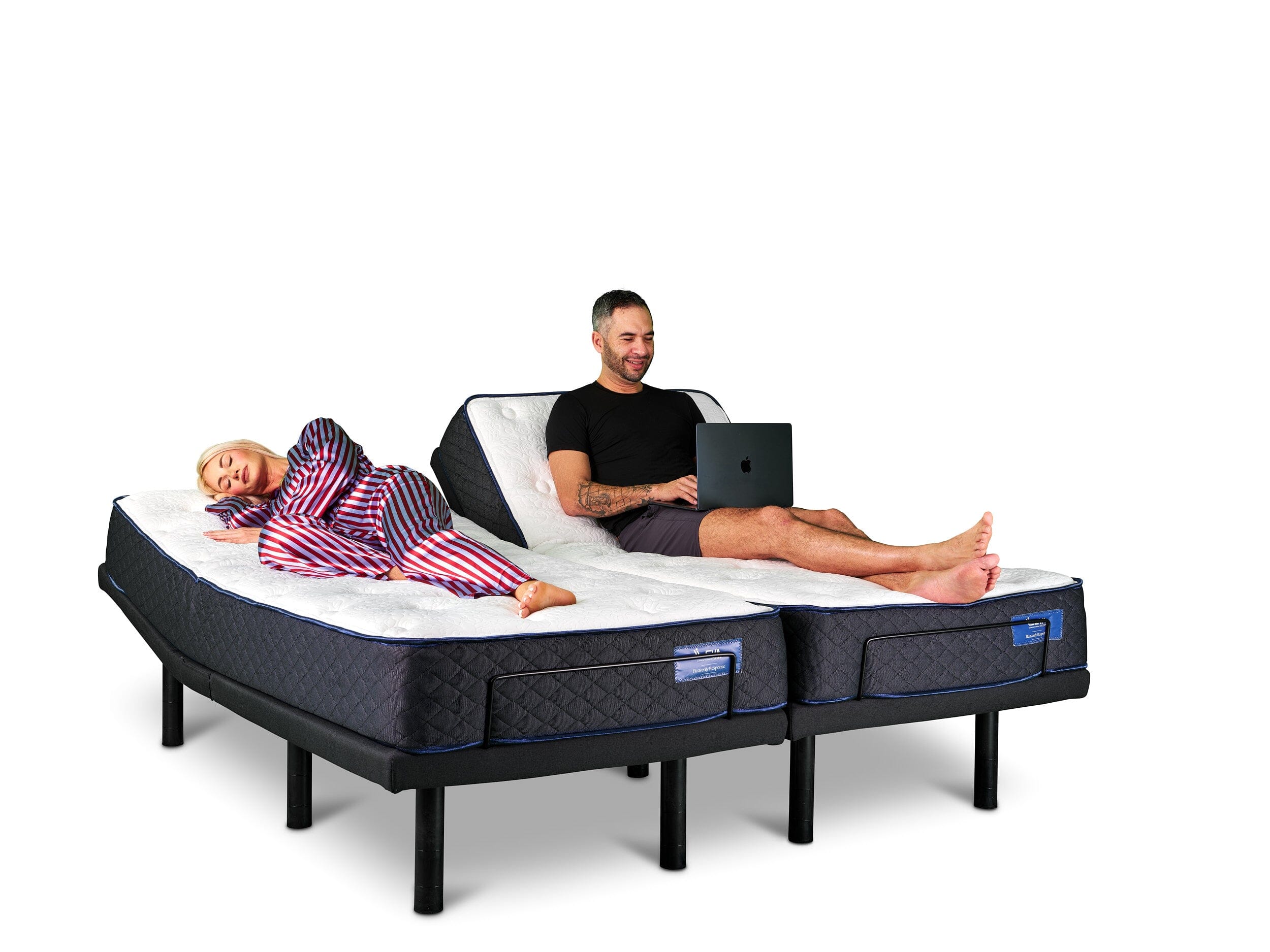
The Split Queen configuration is a particularly rare option in Canada. Canadian retailers most often carry adjustable bases in queen, king, twin XL, and split-king sizes, which leaves couples in smaller rooms with few choices. Leva builds Split Queen bases to customer specifications, so couples in compact spaces can still have independent adjustability.
Browse Split Queen and Split King options
How to Spot a Mattress That Is Too Firm or Too Soft
Simple self-tests can reveal whether your current mattress contributes to back pain. Slide a flat hand under the lower back while lying on your back. A gap large enough to move the hand freely suggests that the mattress is too firm and not filling the lumbar curve. If the lower back feels pushed upward or the hips sink clearly below the shoulders, the mattress is probably too soft.
Morning stiffness that eases within 15–30 minutes of moving around often points to poor overnight spinal support rather than a structural condition. Pain that worsens after a night on a different surface, such as a hotel bed or guest room, can help you confirm whether the home mattress is the main factor.
Chiropractors often recommend adjustable lumbar support for chronic lower-back pain. This approach supports the lumbar curve at the exact angle that reduces disc pressure instead of relying on a fixed foam profile. For spinal stenosis, an adjustable bed can create a semi-Fowler position with slight forward curvature that opens spaces between vertebrae. Many patients describe this relief as similar to leaning on a walker.
Mattress Types That Work Best on Adjustable Bases
Not every mattress can flex safely on an adjustable base. Innerspring mattresses with connected coil systems may crack or warp under repeated bending. The most reliable options are all-foam mattresses and hybrid mattresses with individually wrapped pocket coils. These designs flex without structural damage.
Leva Sleep designs its mattresses specifically for adjustable bases. The hybrid pocket-coil models use zoned coil layouts with softer tension under the shoulders and firmer tension under the lumbar and hip zones. The mattress adds its own layer of position-sensitive support on top of the base’s adjustability. All-foam options work well for sleepers who care most about motion isolation and pressure relief rather than bounce.
White-Glove Delivery and Setup Support in Canada
Once you choose the right mattress and base combination, proper setup becomes critical to performance. Adjustable bed systems involve more complexity at setup than a standard mattress delivery. Leg height, split-base alignment, app pairing, and lumbar calibration all shape the first night’s experience. Leva Sleep’s white-glove delivery service in Ontario and Alberta sends trained professionals directly to the bedroom, not just the front door. They remove and donate or recycle the old bed, assemble the new system, set leg heights to your preferred bed height, pair the app, and walk through every feature before they leave.
This end-to-end service clearly differs from “bed in a box” brands that ship a compressed mattress and leave setup to the customer. For a system as integrated as a split adjustable base, professional setup strongly affects whether the product performs as intended from the first night.
Save or Download the Firmness-by-Position Chart
For quick reference, save or download the firmness-by-position chart shown earlier in this article. The table gives starting guidelines based on sleep position and body weight. Adjustable lumbar support then lets you refine those guidelines in real time beyond any static rating. Couples with different needs can pair these guidelines with a Split Queen or Split King adjustable base that offers independent controls on each side.
Decision Framework Recap and Your Next Step
The most effective mattress firmness for back pain keeps the spine neutral in the positions you actually sleep in at your current body weight. It also accounts for medical conditions and continues to work as those variables change. A 6–7 medium-firm rating suits many people as a starting point, but it remains only a starting point. Couples with different needs, people managing diagnosed spinal conditions, and anyone whose pain persists despite mattress changes often benefit from an adjustable lumbar system with independent split-base controls. Leva Sleep offers 15–20 adjustable base models, specialized mattresses, and white-glove delivery across Ontario and Alberta at 30–50% below comparable luxury competitors.
Compare Leva’s adjustable base models
Frequently Asked Questions
Is a medium-firm mattress always the best choice for back pain?
Medium-firm (6–7 on a 10-point scale) works as the most common starting range for back pain. This range supports the lumbar curve without creating heavy pressure on the hips and shoulders. The range is not universal, though. Side sleepers under 130 lb often need a softer surface so the shoulder can sink enough to keep the spine level. Stomach sleepers over 230 lb often need a firmer surface to stop the pelvis from dropping. Body weight, sleep position, and conditions such as spinal stenosis or sciatica all shift the ideal range. An adjustable lumbar base removes the need to commit to a single fixed firmness by allowing real-time support changes.
Can an adjustable bed actually reduce lower-back pain, or is it only for comfort?
Adjustable beds address back pain through mechanical changes, not comfort alone. Elevating the knees reduces tension on the hamstrings and decreases posterior pelvic tilt, which directly reduces pressure on lumbar discs and the sciatic nerve. The Zero Gravity position spreads body weight evenly, decompresses the spine, and allows deep muscle relaxation that a flat surface cannot match. For spinal stenosis, a semi-reclined position opens the spaces between vertebrae and reduces nerve impingement. These positional changes have documented benefits for symptom management, especially for herniated discs, sciatica, and stenosis. An adjustable bed does not repair structural damage, but it can significantly reduce pain and stiffness from those conditions during sleep.
How do Split Queen and Split King adjustable beds work for couples with different firmness needs?
A Split Queen or Split King base uses two independent motorized units placed side by side in a shared frame. Each side has its own head elevation, foot elevation, lumbar support level, and massage settings. You control these settings independently through the Leva Sleep app or a wireless remote. One partner can sleep flat with maximum lumbar support while the other uses Zero Gravity with knees elevated. Both positions run at the same time without mechanical interference between sides. The mattresses on each side are also independent, so each partner can choose a different firmness level. The result is a shared bed with fully personalized sleep environments that removes the compromise that often pushes couples into separate rooms.
What should I look for in a mattress that pairs with an adjustable base?
The mattress must flex repeatedly without structural damage. Innerspring mattresses with connected coil systems do not suit adjustable bases because the rigid coil grid resists bending and can break down early. All-foam mattresses and hybrid mattresses with individually wrapped pocket coils are the appropriate choices. Within those categories, look for zoned support that cushions the shoulder and hip while providing firmer support under the lumbar region. Leva Sleep’s mattresses are built specifically for adjustable bases, with zoned pocket-coil hybrids and all-foam options that maintain their structure through years of articulation.