Written by: Matthew Timmins, Founder and Managing Director, Leva Sleep | Last updated: July 21, 2026
Key Takeaways for Snoring Couples
- Head elevation of 10–15° on an adjustable bed is the most effective starting position for reducing snoring, with studies showing measurable improvements in snoring duration, awakenings, and deep sleep.
- Snoring disrupts couples’ sleep and relationships, with research linking it to lost sleep hours, increased stress, and higher rates of sleep divorce or separation.
- Single adjustable bases fall short for couples because adjustments affect both partners, while split bases with independent controls and quiet motors allow one partner to move without disturbing the other.
- Effective anti-snore positions range from gentle 10–15° inclines to 20–30° elevations, with the strongest results when combined with side sleeping on a supportive mattress.
- Leva Sleep offers specialized Split Queen and Split King adjustable bed packages with independent controls, automatic anti-snore modes, and couple-friendly bedding. Explore Leva Sleep’s split adjustable bed packages designed for couples.
How Snoring Damages Sleep and Relationships
Mayo Clinic research indicates that partners of snorers lose at least one hour of sleep per night, or roughly 365 hours and nearly 15 full days of sleep deprivation annually. A Sleep Foundation report found that snoring negatively affects the well-being of 77% of individuals sharing a bed with a snorer, contributing to daytime sleepiness, anxiety, depression, and trouble concentrating.
The downstream effects on relationships are significant. Sleep divorce rates among U.S. adults were reported as over one-third (20% occasional + 15% consistent) in 2023 and 31% in 2025, with adults aged 35–44 most likely to sleep separately. Research commissioned by healthcare company 32Co found that 47% of recently divorced Britons cited snoring or sleep disorders as contributing to the breakdown of their relationship, and 85% of those affected by snoring or sleep disorders reported that these issues directly contributed to their separation.
Sleeping apart is not a neutral solution. A 2020 study published in Frontiers in Psychiatry found that couples who regularly slept in the same bed experienced 10% greater total REM sleep duration and less REM fragmentation compared to those who did not. Staying together in the same bed with the right equipment gives both partners better sleep and a stronger relationship. The next step is choosing equipment that actually solves the snoring problem.
Why Flat Beds and Basic Adjustable Bases Fail Snoring Couples
A flat mattress offers no positional help for snoring. Many habitual snorers snore predominantly in the supine position, so the flat-on-the-back default is often the worst configuration for airway health.
A single shared adjustable base is only a partial fix. When one partner adjusts their position, the entire base moves and wakes the other person. Quiet, high-quality motors are essential in split-base adjustable beds so that adjustments on one side do not produce mechanical noise that disturbs the other sleeper. Basic adjustable bases often use loud, jerky motors that undermine the goal of quiet, independent adjustment.
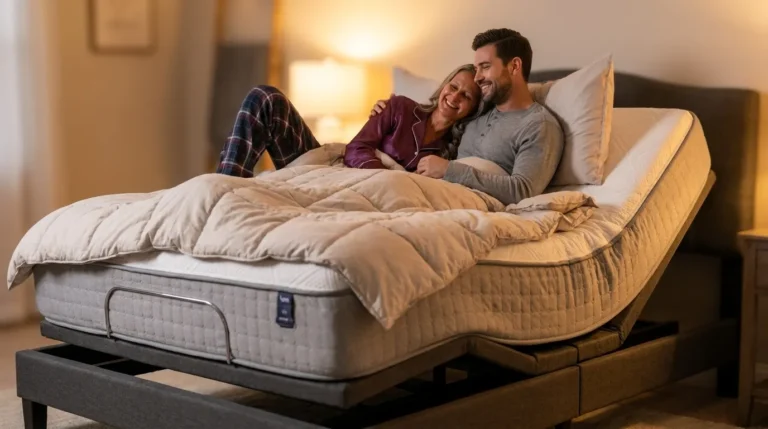
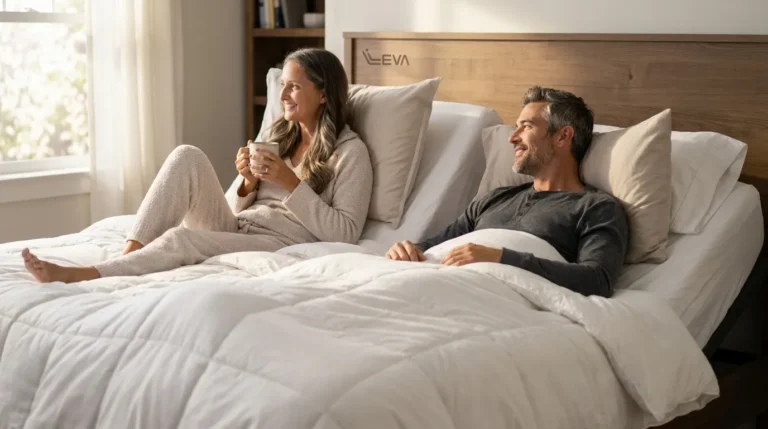
Standard bedding compounds the problem further. When fitted sheets pop off elevated corners, one partner has to wake up to fix them, which cancels out the benefit of quiet motors. Bunched duvets create cold spots that wake the non-snoring partner. These bedding failures mean that even a mechanically sound split base cannot deliver the seamless sleep experience it was designed for.
Leva’s Split Adjustable Systems Built for Two Sleepers
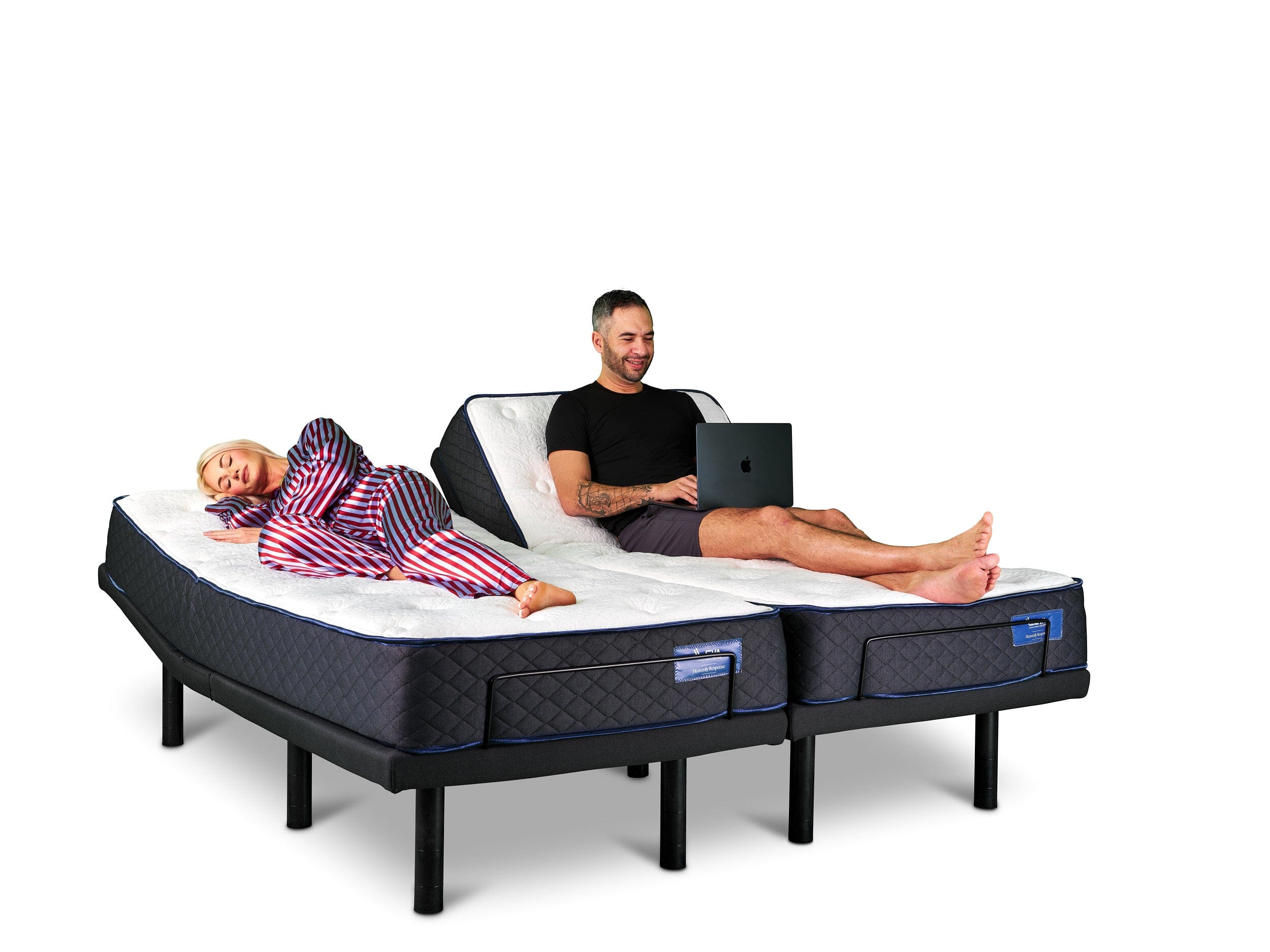
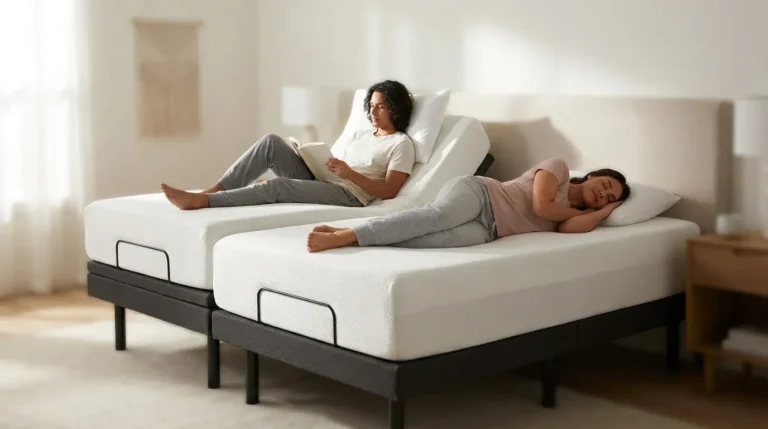
Leva Sleep’s Split Queen and Split King adjustable bases are built specifically for couples with different sleep needs. Each side of the bed operates on its own independent motorized base, powered by whisper-quiet German motors, and is controlled via the Leva Sleep app or a dedicated remote. One partner can raise their head to the anti-snore range while the other stays completely flat, with no mechanical disturbance crossing to the other side.
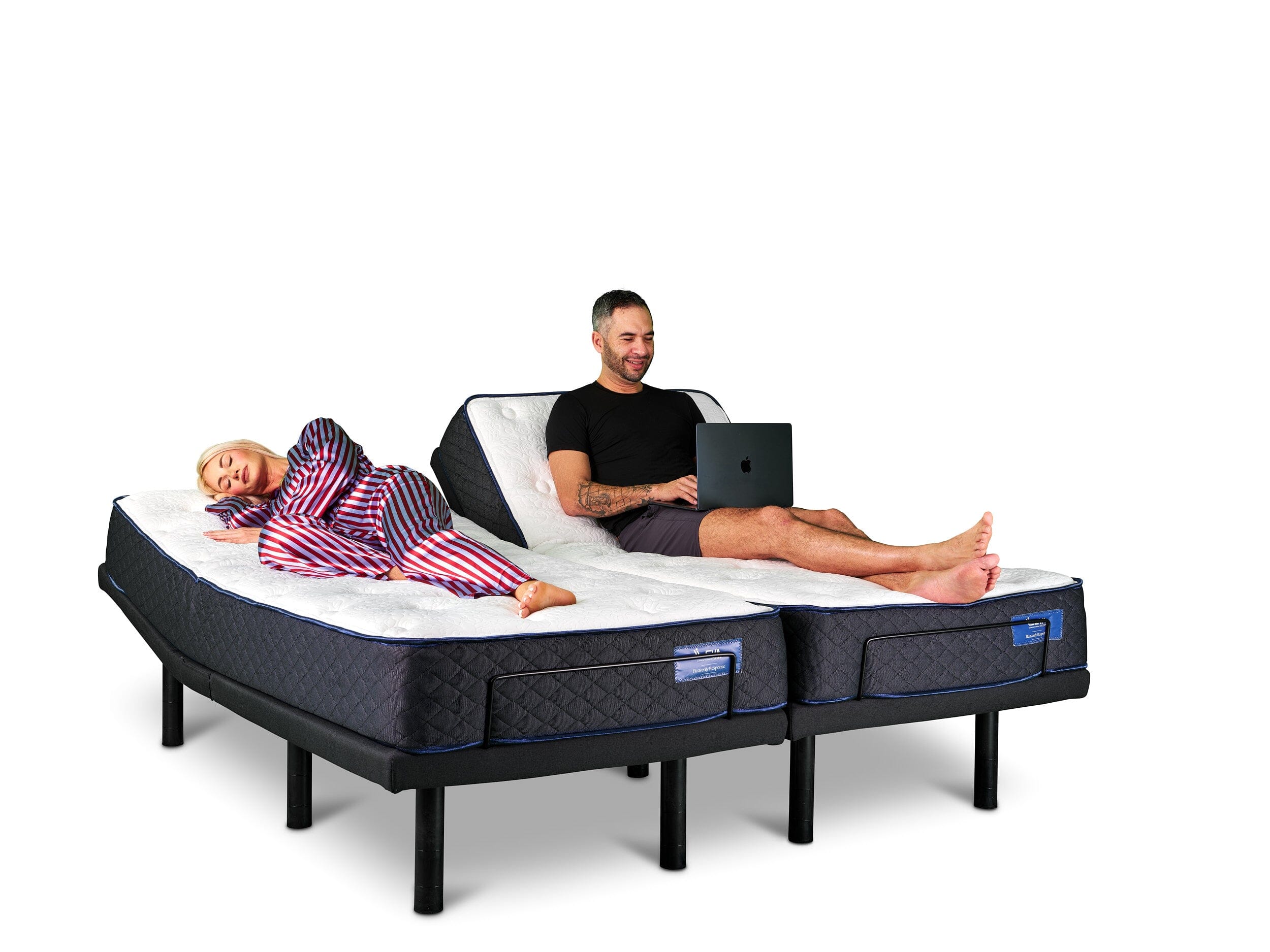
Leva’s spring-2026 anti-snore mode takes this further. It detects snoring and makes automatic micro-adjustments to the head of the bed, correcting the position without either partner needing to wake up. Leva also designs its own bedding accessories, including fitted sheets with deep pockets and extra elastic, duvet clips, and mattress protectors, all engineered to stay in place at elevated angles.
This comprehensive approach reflects Leva’s specialization in the category. With over 8 years of expertise, $50M in lifetime sales, and 25,000+ customers, Leva Sleep is Canada’s specialist in split adjustable bed systems, offering 15–20 models compared to the 3–5 found at general retailers, at 30–50% less than comparable luxury competitors.
Browse Leva’s Split Queen and Split King systems with independent controls.
Adjustable Bed Positions That Help Reduce Snoring
Head elevation uses gravity to pull the soft palate and tongue forward and away from the back of the throat, which is the primary anatomical cause of positional snoring. Clinical sleep-medicine studies show that elevating the torso at a 7–15 degree angle can reduce snoring. The positions below move from the gentlest to the most aggressive intervention.
Position 1: Gentle Incline (10–15°)
This position is the recommended starting point. Start at 15 degrees of head elevation and increase gradually if snoring persists; consistency matters more than the exact angle. Leva’s anti-snore preset is calibrated to this range. The foot section remains flat.
Position 2: Moderate Elevation (20–30°)
Research consistently points to 20–30 degrees of head elevation as an effective range for snoring reduction, and anti-snore presets on adjustable bases are typically calibrated to achieve this angle. A 30-degree elevation of the head and trunk has been shown to reduce AHI and the percentage of apneas.
Position 3: Elevation Combined with Side Sleeping
Pairing head elevation on an adjustable bed with side sleeping tends to reduce snoring more effectively than using either technique alone, according to guidance from Johns Hopkins Medicine and Harvard Health. Leva’s hybrid pocket-coil mattresses provide the shoulder and hip contouring needed to make side sleeping comfortable at an incline.
Position 4: Zero-Gravity Preset
A zero-gravity preset positions the torso and legs into an elevated, weight-neutral posture that research links to reduced airway collapse for snoring and apnea relief. This position also distributes body weight evenly and reduces pressure on the lower back.
Sharing a Bed Comfortably with a Snoring Partner
A standard king adjustable bed forces both partners into one shared position, while a Split King allows each sleeper to select their own head and foot angles independently. On a Leva Sleep split base, the non-snoring partner’s side never moves when the snoring partner adjusts their elevation, either mechanically or acoustically.
Independent app control lets the snoring partner activate the anti-snore preset before bed without disturbing the other side. The automatic snore-detection mode, launching in spring 2026, handles this without waking either partner. Leva-designed bedding, with extra-elastic fitted sheets and duvet clips, keeps the shared sleep surface comfortable regardless of the elevation difference between the two sides.
How Couples Should Evaluate Adjustable Beds for Snoring
Couples evaluating adjustable beds for snoring should assess several criteria that move from core mechanics to bedding fit and delivery experience.
- Independent elevation control: Each side must adjust without moving the other. A shared single base does not solve snoring for couples.
- Anti-snore mode: Look for a preset calibrated to the 10–30° therapeutic range, and ideally an automatic detection feature that adjusts without waking either partner.
- Motor noise: Quiet, high-quality motors are essential so that adjustments on one side do not produce mechanical noise that disturbs the other sleeper. Leva’s German motors, mentioned earlier, meet this standard.
- Mattress and bedding compatibility: The mattress must flex without resistance at elevation angles, and bedding must be designed to stay in place. Leva designs both components as a system.
- White-glove delivery and setup: For a fee, Leva’s in-house team delivers to the bedroom, assembles the system, adjusts leg heights, provides a full product tutorial, and removes the old bed, so there is no assembly burden on the customer.
- Split Queen availability: For couples in smaller bedrooms, Leva is one of the only Canadian providers of a Split Queen adjustable base, which offers full independent control in a more space-conscious footprint.
Compare Leva’s Split Queen and Split King configurations for your room size and budget.
Single vs. Split Adjustable Bed Comparison
| Setup | Independent Control | Noise During Adjustment |
|---|---|---|
| Flat bed (no base) | None, both partners share one fixed position | None from motors, and no elevation benefit for snorers who snore supine |
| Single shared adjustable base | None, one elevation angle for both partners | Motor noise and movement affect both partners simultaneously |
| Split King adjustable base (e.g., Leva Sleep) | Each side operates autonomously via separate motorized bases and remotes | Whisper-quiet motors, adjustment on one side produces no mechanical disturbance on the other |
| Split Queen adjustable base (Leva Sleep exclusive) | Same independent per-side control as Split King in a smaller footprint | Whisper-quiet motors with the same isolation as Split King |
For couples, the differences are clear. Flat beds and single bases force both partners into shared positions, while split bases allow true independence. Leva’s Split King and Split Queen configurations add automatic anti-snore detection and quiet operation, which makes independent adjustment practical for real-world use.
When Snoring Requires Medical Evaluation
Head elevation on an adjustable bed addresses positional snoring, which is snoring caused by airway geometry during sleep. It is not a treatment for obstructive sleep apnea (OSA). The elevation ranges discussed earlier, roughly 7–20 degrees, help positional snoring, but if snoring is accompanied by gasping, choking, witnessed breathing pauses, or severe daytime fatigue, a formal sleep study is warranted.
Snoring can be a sign of obstructive sleep apnea, which has serious cardiovascular implications. An adjustable bed can help with the symptom, but if there is an underlying condition, it needs proper medical attention first. Leva Sleep’s adjustable beds complement medical care and do not replace it. Sleep apnea clinics in Canada do refer patients to Leva for positional support alongside prescribed therapy.
Frequently Asked Questions
Will a split adjustable bed feel like two separate beds pushed together?
A Split King uses two Twin XL mattresses side by side, and a Split Queen uses two narrower mattresses, creating a full king or queen footprint. Connector straps keep the two units aligned so there is no gap during normal sleep. The independent movement only activates when a motor is engaged. Most couples report that the feel of a shared sleep surface is preserved, especially with Leva’s purpose-designed bedding that bridges both sides.
How loud are the motors when one partner adjusts their position at night?
Leva Sleep uses whisper-quiet German motors specifically chosen to minimize noise during adjustments. The goal is that the adjusting partner can change their elevation without waking the other. Leva’s spring-2026 anti-snore mode is designed to make micro-adjustments automatically and gradually, which further reduces any perceptible sound or movement. When evaluating any adjustable base, ask the retailer to demonstrate a full head-raise cycle at night-time volume levels before purchasing.
Does Leva Sleep deliver and set up the bed, or is assembly left to the customer?
For a fee, Leva Sleep offers in-house white-glove delivery across Ontario and Alberta. A trained team delivers the system directly to the bedroom, assembles the base and mattress, adjusts the leg height to the customer’s preference, provides a full product tutorial including app setup, and removes and donates or recycles the old bed. There is no flat-pack assembly burden on the customer.
What mattress works best with a split adjustable base for snoring relief?
The mattress must flex freely at the head and foot sections without resistance or damage to internal components. Leva designs both all-foam and hybrid pocket-coil mattresses specifically for use with its adjustable bases. For couples combining head elevation with side sleeping, which is the most effective combination for snoring reduction, a hybrid with zoned pocket coils provides the shoulder and hip contouring needed for spinal alignment at an incline. Avoid traditional innerspring mattresses with rigid border wires, because these resist articulation and reduce the therapeutic benefit of elevation.
Is a Split Queen available in Canada, and how does it differ from a Split King?
Leva Sleep is one of the only Canadian retailers offering a Split Queen adjustable base, built to customer specifications. A Split Queen provides the same independent per-side elevation control as a Split King but in a smaller overall footprint, which makes it practical for standard Canadian master bedrooms that cannot accommodate a full king size. Both configurations include independent app control, quiet German motors, and compatibility with Leva’s full bedding accessory range. The Split Queen is a unique offering in the Canadian market and a core reason sleep apnea clinics and couples seeking snoring solutions are referred to Leva.
Conclusion: Keeping Your Sleep and Relationship in One Room
Snoring is one of the most common and most damaging forces pushing Canadian couples toward separate bedrooms. Clinical evidence consistently shows that elevating the head of the bed between 10 and 30 degrees meaningfully reduces snoring frequency and airway obstruction, and combining that elevation with side sleeping produces the strongest results. The barrier for couples has always been that a single shared base forces both partners into the same position or wakes the non-snoring partner with motor noise during adjustments.
Leva Sleep’s Split Queen and Split King adjustable bases remove that barrier entirely. Independent whisper-quiet motors, per-side app control, a spring-2026 automatic anti-snore mode, purpose-built bedding, and in-house white-glove delivery across Ontario and Alberta create a complete couple-focused sleep solution in Canada at 30–50% less than comparable luxury competitors.
Keep your relationship and your sleep in the same room with a Leva split adjustable bed.