Written by: Matthew Timmins, Founder and Managing Director, Leva Sleep | Last updated: July 27, 2026
Key Takeaways for Canadian Couples
- Split adjustable beds give each partner independent control over head, foot, firmness, and temperature settings, which removes a major source of sleep conflict.
- Traditional beds and single adjustable bases force shared positions that cannot handle different medical or comfort needs, and this often pushes couples toward sleep divorce.
- Quality split systems use whisper-quiet German motors, anti-snore automation, and motion-isolated bases so one partner’s adjustments do not disturb the other.
- Leva Sleep offers split queen and split king configurations with white-glove delivery across Ontario and Alberta, at 30–50% less than many luxury competitors.
- Explore Leva Sleep’s full range of split adjustable bed packages to find the setup that fits your bedroom and your relationship.
The Problem: When Differing Sleep Needs Become Serious
Many Ontario and Alberta couples live with a familiar pattern. One partner props their head on a stack of pillows to manage acid reflux while the other lies flat and wakes repeatedly from snoring. Neither partner feels rested. Over time, one person drifts to the guest room and the couple quietly accepts a sleep divorce.
The medical drivers behind this pattern are widespread. Obstructive sleep apnea affects a large share of Canadian adults, and most remain undiagnosed. Snoring is also underreported: a 2019 study of 675 women referred to a sleep disorders centre found objective snoring in 88% of participants, yet only 72% self-reported it. Social stigma and symptom misattribution, such as blaming fatigue and low mood on stress or menopause, mean many couples are living with a medical issue they have not named.
The health and relationship costs build over time. Chronic sleep deprivation increases cardiovascular risk, harms cognitive performance, and fuels conflict. When one partner’s snoring or positional needs keep disrupting the other’s sleep, the bedroom shifts from a place of rest to a source of tension.
Explore split configurations that let you share a bed without sharing a position with Canada’s split queen and split king specialists serving Ontario and Alberta.
Why Traditional Beds and Basic Adjustable Bases Fall Short for Couples
Most couples try several partial fixes before they discover a true split adjustable system. Each option below solves one problem while creating another. Seeing where these setups fail makes the requirements for a real solution clear: independent control for each partner without separate rooms or constant compromise.
The table below compares the four most common options on the criteria that matter most to couples with differing sleep needs.
| Option | Independent Control | Medical Positioning | Partner Disruption |
|---|---|---|---|
| Flat traditional bed | None | None, because elevation requires pillow stacking, which bends the neck while the stomach stays flat | Any movement transfers across the shared surface |
| Single adjustable base (queen/king) | None, since one position must work for both partners | Head and foot elevation are available, but both partners must use the same angle | Motor noise and movement affect both sides at once |
| Separate rooms | Full, but at the cost of shared sleep | Each person can use any setup independently | Zero disruption, but sleep divorce is complete |
| Basic split configuration | Partial independent control, but cheaper motors produce audible whine that can disturb a sleeping partner | Independent elevation is available | Noise and motion isolation depend heavily on motor and mattress quality |
A 10–30 degree head elevation on an adjustable base can meaningfully reduce snoring frequency and intensity by keeping the airway more open, but this benefit only holds when each partner can set their own angle. A single base forces a shared compromise that rarely satisfies either person.
How Split Adjustable Sleep Systems Solve Couple Sleep Conflicts
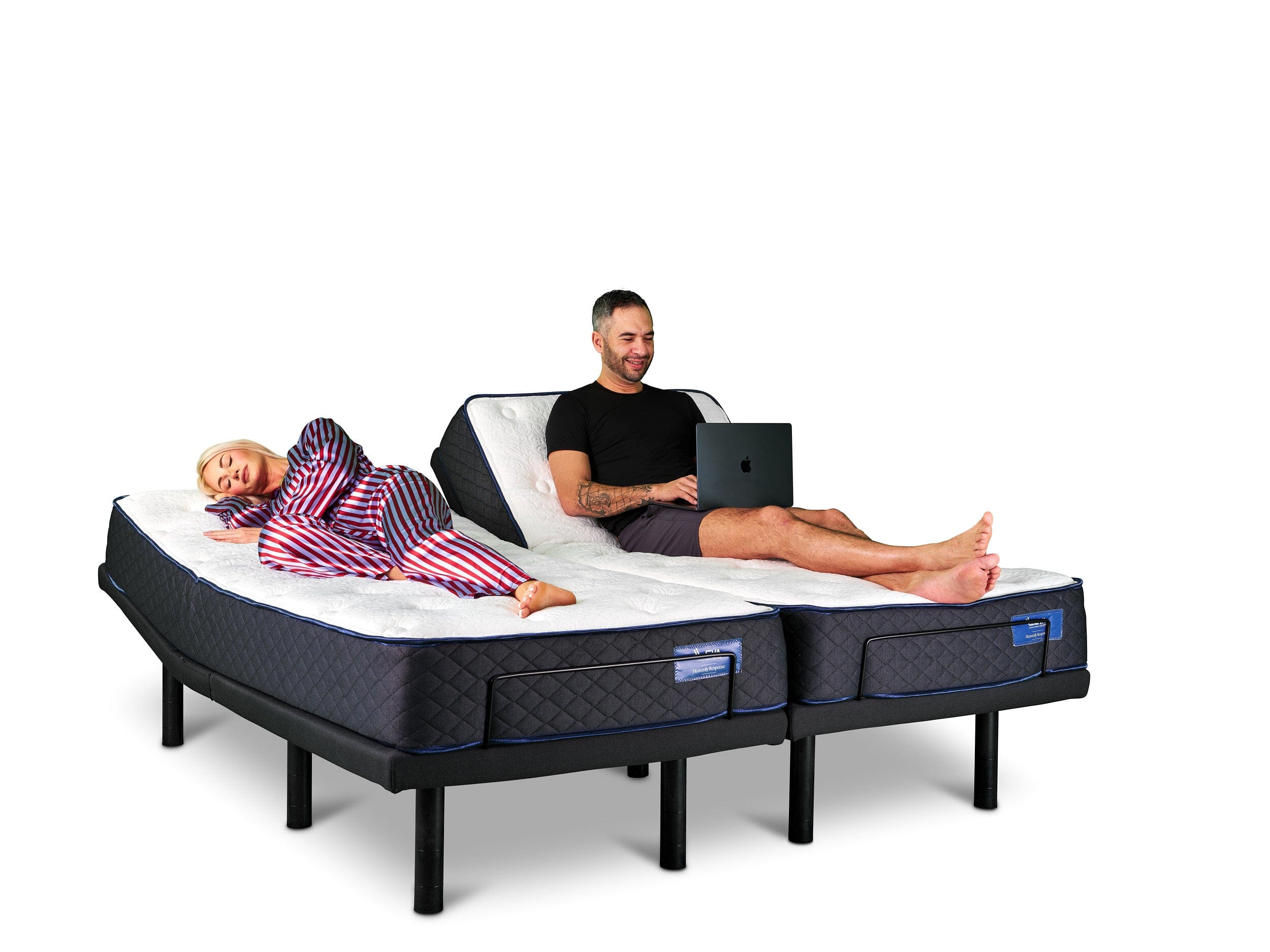
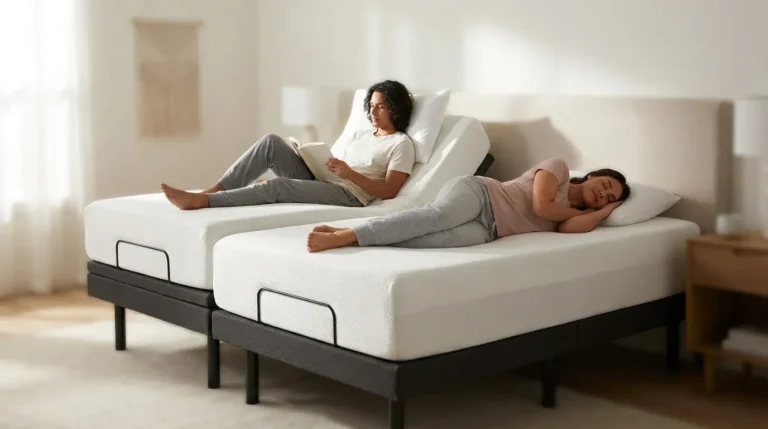
A split adjustable sleep system uses two independent motorized bases inside one shared bed frame. Each base has its own remote or app profile. Each partner controls head elevation, foot elevation, lumbar support, massage intensity, and temperature without affecting the other side. The couple shares a bed while enjoying two personalized sleep environments.
Key capabilities in split systems include:
- Independent head and foot elevation with preset positions such as zero-gravity and anti-snore
- App-based control via Bluetooth for custom position memory, vibrating alarms, and subtle overnight adjustments
- Whisper-quiet motors rated below 45 decibels during movement, which is quieter than a refrigerator
- Motion isolation through separate bases and compatible mattresses so one partner’s adjustment does not transfer to the other side
- Individual temperature regulation through integrated heating and cooling pads for each sleeper
Browse Leva Sleep’s 15–20 adjustable models, including Canada’s only split queen configuration, with white-glove delivery across Ontario and Alberta.
Independent Adjustability: Split Queen vs. Split King Decision Table
Once you decide that a split system fits your relationship, the next choice is configuration. Room size, delivery logistics, and budget all influence whether a split queen or split king suits your home best.
A split king consists of two 38″ × 80″ Twin XL mattresses placed side by side to form a 76″ × 80″ sleeping surface identical in dimensions to a standard king. A split queen, which is Leva Sleep’s unique offering, uses two narrower bases within a queen footprint. This format delivers full independent control in bedrooms where a king will not fit.
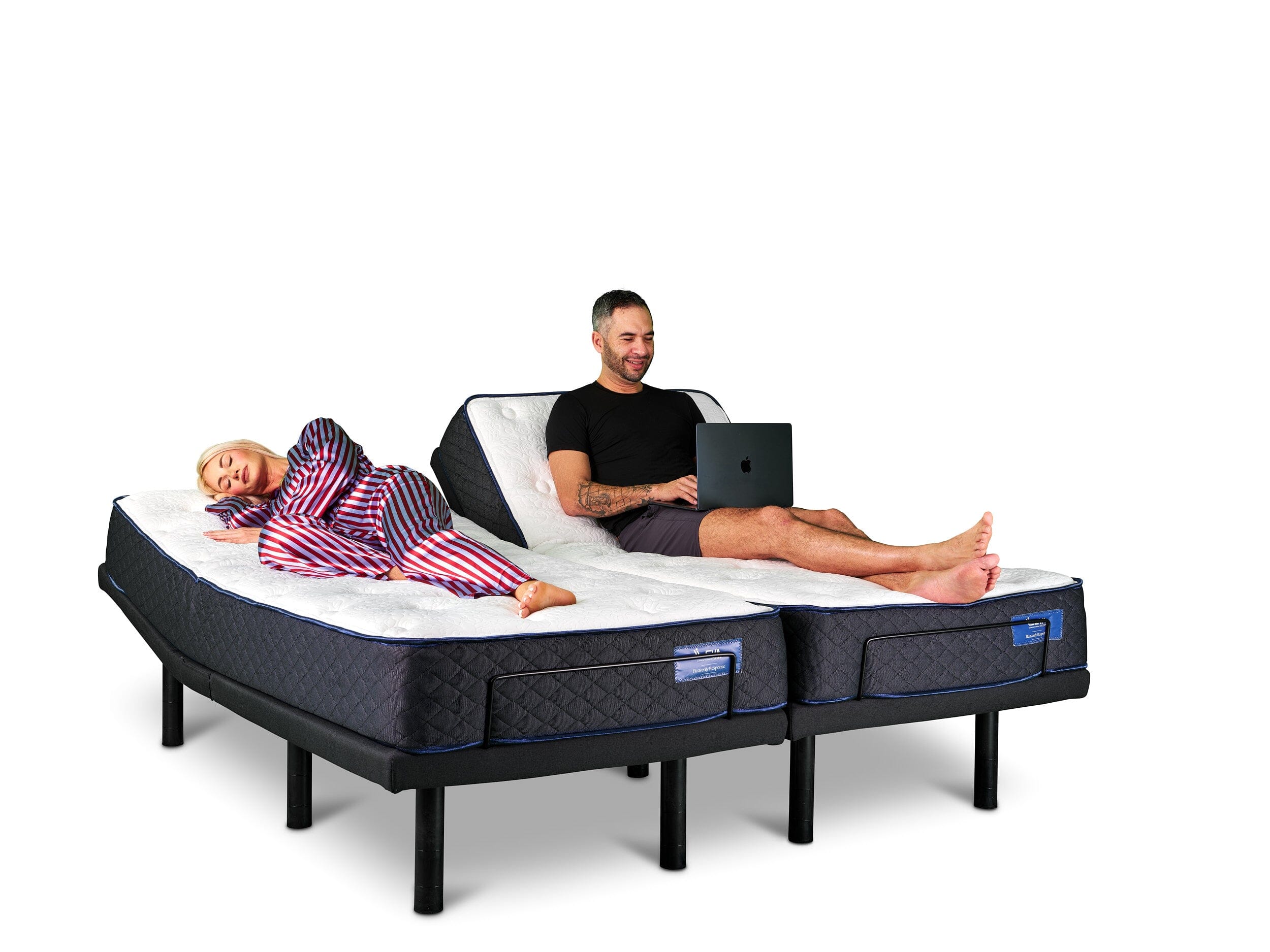
| Factor | Split Queen | Split King |
|---|---|---|
| Overall dimensions | 60″ × 80″ (standard queen footprint) | 76″ × 80″ (standard king footprint) |
| Room suitability | Best for bedrooms under 12 feet wide, condos, and older homes | Needs more clearance and is less suitable for bedrooms under 10 feet wide |
| Delivery maneuverability | Easier to move through narrow staircases and tight doorways | Two lighter Twin XL pieces maneuver more readily than a single large king |
| Independent control | Full, with each side adjusting independently | Full, with each side adjusting independently |
| Typical Canadian cost range | Contact Leva Sleep for split queen pricing | Contact Leva Sleep for split king pricing |
Real-world couple scenarios highlight how split configurations resolve daily conflicts:
- One partner elevates their head 15 degrees to reduce snoring while the other remains completely flat
- One partner uses zero-gravity position for lower-back pain while the other prefers a flat surface
- One partner chooses a firmer mattress for stomach sleeping while the other selects a softer surface for side sleeping
- One partner activates the heating pad on a cold night while the other uses the cooling pad at the same time
Noise, Motion Isolation, and Anti-Snore Automation
Motor noise is the most common complaint about basic adjustable bases, so motor specification matters more than many buyers realize. German-engineered motors have become the standard for residential adjustable beds because they operate quietly and maintain that performance over years of use. Cheaper, unspecified motors often develop an audible whine within one to two years as internal components wear. Leva Sleep’s whisper-quiet German motors keep adjustments at 2 a.m. from waking the other side, even after years of nightly use.
The anti-snore automation feature on Leva Sleep’s systems detects snoring through the base and makes small head-elevation changes, typically raising it 7 to 12 degrees, to open the airway without waking the snoring partner. Anti-snore positions at 10–15 degrees of head elevation are now a core benchmark in adjustable bed evaluations, with research showing that this range can meaningfully reduce snoring frequency and intensity by keeping the airway more open and serving as a supplementary intervention for mild obstructive sleep apnea alongside prescribed treatments.
The medical positioning benefits extend well beyond snoring:
- GERD and acid reflux: A study of patients with gastroesophageal reflux found that elevation of the head of the bed produced a 67% improvement in acid clearance time. The Canadian Association of Gastroenterology includes bed elevation in its GERD management guidelines as a first-line lifestyle modification.
- Sleep apnea: A study in Sleep and Breathing found that 7.5-degree head-of-bed elevation reduced apnea-hypopnea index in patients with obstructive sleep apnea.
- Back pain: Zero-gravity positioning can ease back pain and may improve sleep quality.
- Hip and knee recovery: Leg elevation reduces post-operative swelling while head elevation makes getting in and out of bed easier during restricted-movement recovery periods.
Mattress, Bedding Compatibility, and Temperature Regulation
Compatible mattress types for adjustable bases include memory foam, latex, and pocketed coil hybrids, while traditional innerspring mattresses with continuous coil systems are generally not recommended because the coils can break or take a permanent set when bent. Leva Sleep designs its own all-foam and hybrid pocket-coil mattresses specifically for adjustable bases so the flex points line up correctly and the mattress warranty remains valid.
Standard bedding often fights against adjustable bases because fitted sheets can pop off when the head section rises. Leva Sleep addresses this frustration with purpose-built accessories:
- Fitted sheets with deep pockets and extra elastic that stay in place at full elevation
- Duvets with clips that keep each side separate when partners choose different angles
- Mattress protectors engineered for repeated flexing without bunching
- Remote pockets integrated into the bedding for easy access in the dark
Individual temperature regulation, with a heating and cooling pad for each side, tackles the second most common couple sleep conflict after position. Each partner sets their own thermal environment through the Leva Sleep app without affecting the other.
Delivery, Setup, and Total Cost of Ownership in Ontario and Alberta
A queen adjustable base typically weighs 135 to 140 pounds when shipped in the box, which makes solo setup unrealistic for most people. Common DIY assembly issues include reversed motor connections, loose wire harness connections, legs installed at incorrect heights, and poorly positioned retainer bars that let the mattress slide during articulation.
Leva Sleep’s in-house white-glove delivery service, available across Ontario and Alberta for a fee, handles these challenges. The team delivers to the bedroom, completes full assembly, adjusts leg height, tests motors and remotes, pairs the app, walks you through the features, and can remove the old bed. Split configurations take longer to set up than single bases because two bases must be assembled and synchronized, which makes professional setup especially valuable.
On total cost of ownership, Leva Sleep’s direct-to-consumer, vertically integrated model delivers the same premium engineering at 30–50% less than comparable luxury competitors. The selection covers entry-level through medical-grade configurations, a range far broader than the three to five models typically found at general mattress retailers. Leva Sleep also partners with Tempur-Pedic, Simmons, Beautyrest, Serta, and Kingsdown for customers who prefer a recognized mattress brand paired with Leva’s specialized bases.
See how white-glove delivery works across Ontario and Alberta while you choose the right split package.
Decision-Support Checklist for Split Adjustable Beds
Use the following criteria when you evaluate any split adjustable bed system in Canada:
- Independent control: Confirm each side has its own motor, remote, and app profile, not a shared controller with zone presets.
- Motor noise: Verify the motor specification, since quality German-engineered DC motors are the standard for quiet, long-term performance.
- Anti-snore automation: Distinguish between a manual anti-snore preset, where you press a button, and automated detection that responds to snoring without waking either partner.
- Mattress compatibility: Confirm the mattress warranty explicitly covers use with an adjustable base, because manufacturer approval is typically required to maintain coverage.
- Weight capacity: In split configurations, each Twin XL base is rated independently, so verify the per-side rating covers the mattress weight plus the sleeper.
- Delivery scope: Check whether the delivery fee includes in-room setup, motor testing, remote pairing, and old-bed removal, or only threshold drop-off.
- Room dimensions: Measure stairwell width, doorway clearance, and bedroom floor space before choosing between split queen and split king.
- Medical consultation: Individuals with spinal fusion, osteoporosis, or heart and respiratory conditions should consult a physician before selecting elevation angles.
Frequently Asked Questions
Can a split adjustable bed help with snoring without a CPAP machine?
Head elevation on an adjustable base opens the upper airway by moving the tongue forward and reducing soft tissue collapse. This change reduces snoring frequency and intensity for many positional snorers. Leva Sleep’s 2026 anti-snore mode automates this process by detecting snoring and making micro-adjustments to the head elevation without waking either partner. This approach can complement treatment for mild to moderate positional snoring and mild obstructive sleep apnea. It does not replace CPAP therapy for diagnosed moderate-to-severe sleep apnea, and anyone with a formal diagnosis should discuss positional therapy with their physician before changing a treatment plan.
What is the difference between a split queen and a split king, and which is right for our bedroom?
A split king uses two Twin XL bases side by side to create a 76″ × 80″ surface, which matches a standard king footprint. A split queen uses two narrower bases within a 60″ × 80″ queen footprint. The split queen is Leva Sleep’s unique configuration and the only format that delivers full independent control in a smaller room. If your bedroom is under 12 feet wide, or you live in a condo or older home with narrow staircases, the split queen is usually the more practical choice. Both configurations provide identical independent control, so the decision mainly comes down to room size and budget.
Will the gap between the two mattresses in a split configuration be uncomfortable?
In a split king, the centre gap between two Twin XL mattresses is about half an inch. A mattress bridge or gap filler, which typically costs $50–$150, reduces this seam. A three-inch or thicker king-size topper creates a more unified surface while still allowing independent base adjustment underneath. In practice, most couples sleep on their own side of the bed and do not find the gap bothersome. Leva Sleep’s split configurations account for this reality, and the white-glove setup team can recommend the best gap-management option for your specific mattress combination.
What does Leva Sleep’s white-glove delivery actually include?
Leva Sleep’s in-house white-glove delivery, available in Ontario and Alberta for a fee, covers delivery to the bedroom instead of just the front door. The team completes full assembly of the base or bases, adjusts leg height to your preference, tests motor and remote functions, pairs the Bluetooth app, and provides a complete product tutorial. They can also remove and donate or recycle your old bed. For split configurations, both bases are assembled and synchronized before the team leaves. This service differs significantly from threshold or room-of-choice delivery, where customers must handle assembly, motor connection, and remote pairing on their own.
Are Leva Sleep’s mattresses compatible with the adjustable bases, and what about existing mattresses?
Leva Sleep designs its all-foam and hybrid pocket-coil mattresses to flex with its adjustable bases so the bend points align correctly and the mattress warranty stays valid. If you plan to use an existing mattress, start by checking the mattress type. Memory foam, latex, and pocketed coil hybrids are usually compatible. Traditional innerspring mattresses with continuous or Bonnell coil systems are not, because the coil structure resists bending and can be permanently damaged. You should also confirm that your existing mattress warranty explicitly permits use with an adjustable base, since many manufacturers void coverage without written approval.
Conclusion: Choosing the Right Split System for Your Bedroom
For Canadian couples in Ontario and Alberta dealing with snoring, sleep apnea, acid reflux, joint pain, or clashing firmness preferences, a split adjustable configuration offers a practical path out of sleep divorce. Independent controls, whisper-quiet German motors, 2026 anti-snore automation, and purpose-built bedding create a shared bed that respects each partner’s needs.
Leva Sleep brings more than eight years of adjustable bed experience, 25,000 customers, and $50M in lifetime sales to a direct-to-consumer model that removes middleman markup. The result is a luxury split sleep system at a fraction of the traditional retail price, with 15 to 20 models that match different medical needs, room dimensions, and budgets.
Compare Leva Sleep’s split queen and split king packages with white-glove delivery across Ontario and Alberta.