Written by: Matthew Timmins, Founder and Managing Director, Leva Sleep | Last updated: July 27, 2026
Key Takeaways for Snoring and Sleep Apnea Relief
- Head elevation of 12–20° on an adjustable base reduces airway collapse that causes snoring and mild positional OSA.
- Split Queen and Split King configurations let each partner adjust independently, which helps many couples avoid “sleep divorce.”
- Leva Sleep bases reach the 20–30° range identified in clinical research as most effective for positional OSA. Studies document a 7% reduction in snoring duration at 12° elevation and up to 45% fewer apnea events at 20–30° elevation.
- Quiet German motors, mattress compatibility, and white-glove delivery in Ontario and Alberta support consistent nightly use.
- Leva Sleep’s adjustable bed packages provide 30–50% savings versus many luxury brands while still offering independent anti-snore positioning for both partners.
How Head Elevation Changes Snoring and Sleep Apnea
Snoring and positional OSA share a common mechanical cause. Gravity pulls the tongue base and soft palate toward the back of the throat, which narrows or collapses the airway. Raising the head of the bed reduces that gravitational pull and helps keep the airway more open.
A peer-reviewed in-home study (PMC9021938) compared four weeks of flat sleep to four weeks at a 12° incline using an adjustable bed base. The inclined group recorded a 7% relative reduction in objective snoring duration, 4% fewer awakenings, and a 5% increase in time spent in deep sleep.
Souza et al. (2017) in Sleep & Breathing tested 7.5° head-of-bed elevation in a general OSA population and reported measurable reductions in apnea severity. At higher angles, up to 20–30°, the same research group documented as much as a 45% reduction in apnea-hypopnea index for positional OSA patients.
Across multiple studies, switching from flat back sleeping to back sleeping with the head elevated between 7.5° and 20° reduces snoring, decreases nighttime awakenings, and increases time in deep sleep. Adjustable bases create true torso elevation, while stacked pillows mainly flex the neck and often cause discomfort.
These benefits apply to positional snorers and people with mild positional OSA. Elevation does not correct structural issues such as enlarged tonsils, a deviated septum, or nasal polyps.
How Adjustable Bases Compare to CPAP and Flat Beds
Adjustable beds can reduce apnea events in people with positional OSA by limiting gravity-assisted airway collapse. They do not replace CPAP or medical treatment in moderate-to-severe cases. The people most likely to benefit include those with:
- Mild or positional OSA confirmed by a sleep study
- CPAP use who want a more comfortable elevated position, since an adjustable base does not interfere with a mask or hose
- Nighttime acid reflux, because elevating the upper body 6–8 inches can ease both GERD and positional apnea at the same time
Flat beds cannot provide the 12–30° range that clinical evidence identifies as effective. Basic wedge pillows often create neck flexion instead of full-body elevation and frequently cause neck pain with long-term use.
About 6% of Canadian adults aged 18–79 have been diagnosed with sleep apnea, and 17.5% of adults aged 45+ (21.9% of men) are at high risk. Many remain undiagnosed, which makes practical positional tools increasingly relevant for adults between 35 and 70.
Why Split Queen and Split King Bases Work for Couples
A single-base adjustable bed locks both partners into one elevation setting. When one partner snores and the other does not, that shared setting often leaves the snorer flat or forces the non-snorer into an uncomfortable incline.
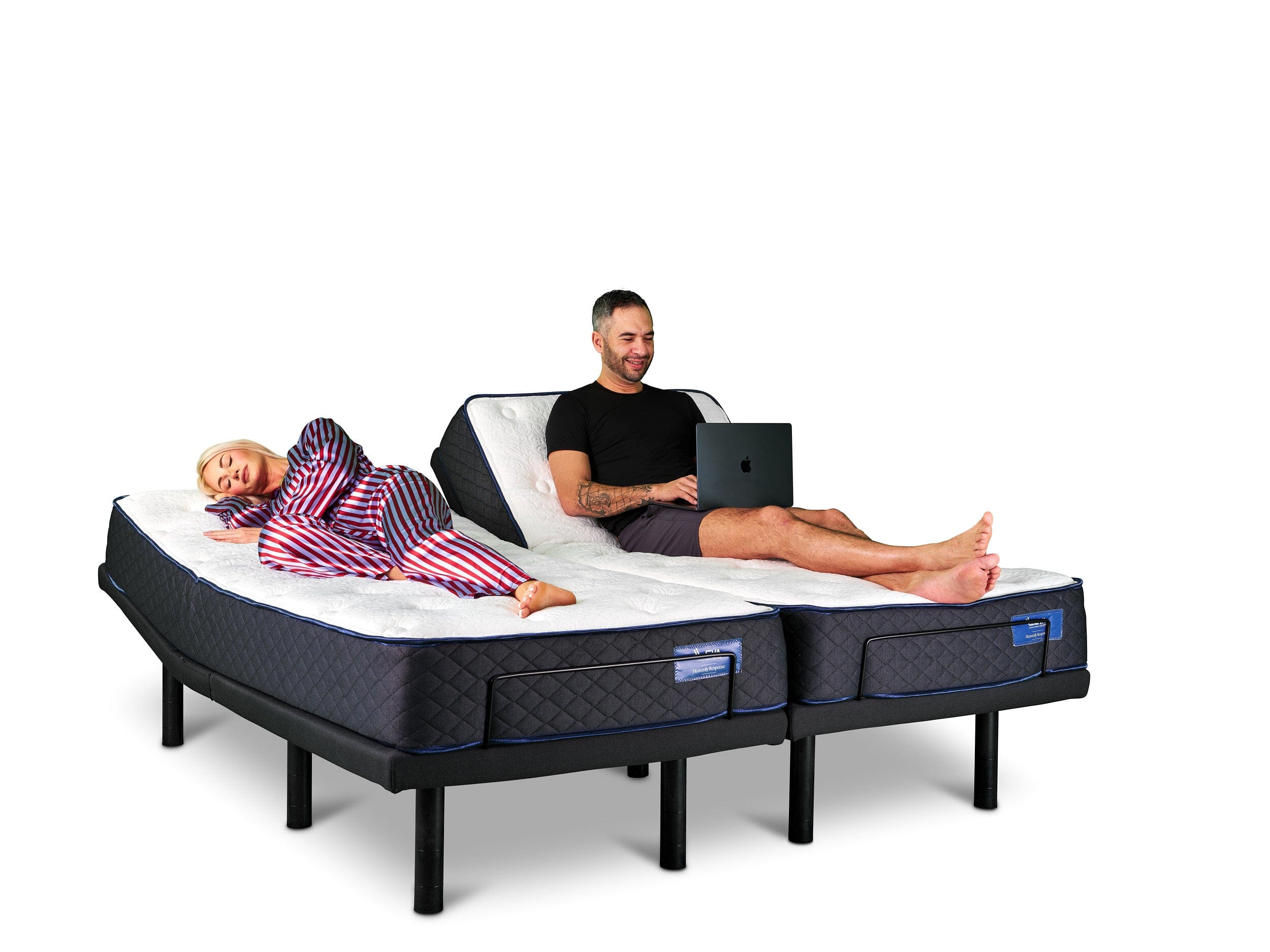
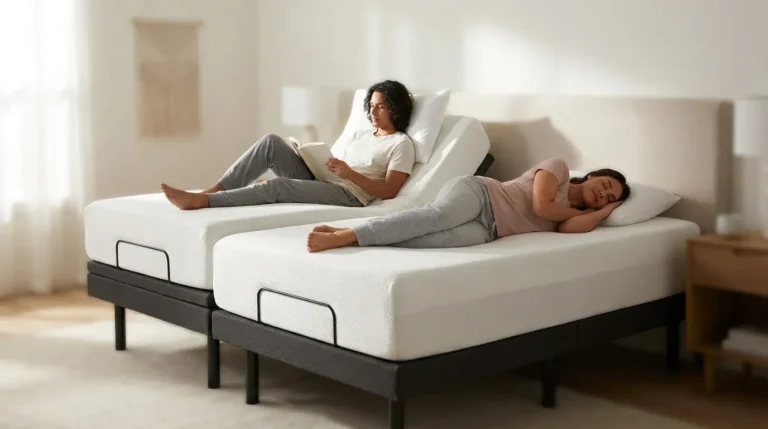
Split configurations avoid this conflict by pairing two independent bases under one shared bed frame. Each side can raise its own head or legs independently, so the snoring partner can elevate to 12–20° while the other sleeps flat. Leva Sleep offers both Split King and the less common Split Queen, which suits rooms where a full King footprint does not fit.
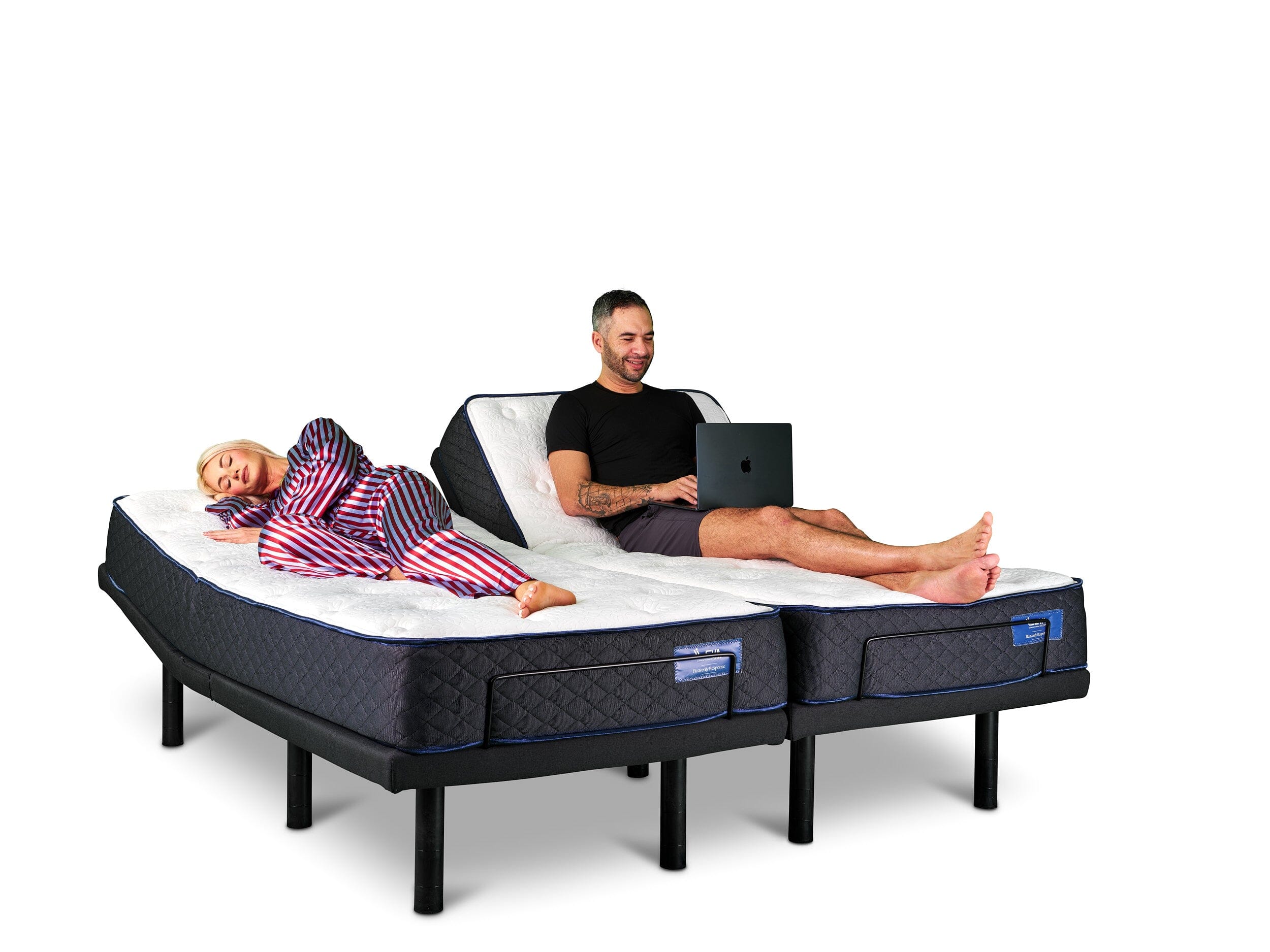
Independent controls on Leva bases extend beyond elevation. Each side can be adjusted for:
- Lumbar support for lower back positioning
- Pillow tilt for a more precise head and neck angle
- Massage intensity and zone
- Temperature through an integrated heating and cooling pad
The Leva Sleep app manages these adjustments over Bluetooth. It supports custom saved positions, vibrating alarms, and the spring-2026 anti-snore mode.
How to Choose an Adjustable Base for Snoring Relief
Effective snoring relief starts with the right elevation range. Confirm that the base can raise the head section to at least 20–30°, which matches the range highlighted in clinical literature for positional OSA.
After elevation, consider whether you will feel comfortable using the base every night. Motor noise strongly affects this. Whisper-quiet motors reduce partner disturbance and encourage regular adjustments, while loud motors often cause couples to avoid changing positions.
Mattress compatibility comes next. All-foam and pocketed-coil mattresses flex smoothly with adjustable bases. Innerspring mattresses with rigid borders resist bending and can prevent the base from reaching therapeutic angles.
Warranty coverage protects your investment over time. A 2-year warranty is a reasonable minimum, with explicit coverage for motor failure, remote issues, and structural defects. Quality bases often remain in service for 10 years or longer.
Finally, think about delivery and setup. Heavy split bases require precise alignment and leg-height calibration, so white-glove in-room assembly usually provides a smoother and safer experience than curbside drop-off.
| Model | Anti-Snore Feature | CAD Price (Queen) |
|---|---|---|
| Leva Sleep Split Queen / Split King | Manual anti-snore preset calibrated to roughly 20–30° head elevation, plus spring-2026 auto-detection mode with whisper-quiet German motors | Contact Leva for current CAD pricing, typically 30–50% below comparable luxury brands |
| Tempur-Pedic TEMPUR-Ergo® Smart Base | Sleeptracker-AI® automatic snore detection with QuietMode™ manual preset; manufacturer does not publish specific degree ranges | $2,199 USD (Queen) |
| Tempur-Pedic TEMPUR-Ergo® ProSmart® Base | Sleeptracker-AI® with enhanced coaching and QuietMode™ manual preset; specific elevation angles not published | From $2,699 USD (Queen) |
| GhostBed Adjustable Base | Basic head elevation without a dedicated anti-snore detection mode; manufacturer has not published elevation specifications for 2026 | Varies by retailer; no published CAD MSRP for 2026 |
In 2026, manual anti-snore presets remain more reliable than automatic detection systems because they hold a consistent angle and avoid false triggers from coughing, traffic noise, or partner movement. Many automatic systems still react slowly or misinterpret sounds, which leads some owners to disable them.
Common Buying Mistakes Couples Can Avoid
Couples often repeat the same mistakes when shopping for snoring or sleep apnea relief. These missteps usually reduce the real-world benefit of an adjustable base.
- Skipping the split configuration: A single base forces one elevation setting for both partners. If only one partner snores, a shared base either leaves them flat or pushes the other into an unwanted incline, which often contributes to “sleep divorce.”
- Choosing solely on price: Entry-level bases often rely on loud motors. Noisy operation discourages adjustments and undermines the clinical value of elevation.
- Ignoring mattress compatibility: A rigid innerspring mattress can block the base from reaching therapeutic angles and may strain the frame.
- Overlooking Split Queen options: Many retailers stock only Split King models. Couples with smaller rooms sometimes assume split adjustability is impossible, even though Leva’s Split Queen fits these spaces.
- Underestimating setup complexity: Split bases need careful alignment and leg-height calibration. Bed-in-a-box delivery shifts this work to the customer, while white-glove service handles it on arrival.
Will an Adjustable Bed Actually Help with Snoring?
For positional snorers, an adjustable bed provides a clinically supported way to reduce symptoms. The reductions documented in the PMC9021938 study, including 7% less snoring duration and 4% fewer awakenings at a 12° incline, show measurable benefit even at a modest angle. These reductions, along with the 45% drop in apnea events that Souza documented at higher elevations, highlight the value of targeted head elevation.
Leva Sleep’s bases reach the 20–30° range that this research identifies as most effective for positional OSA. The spring-2026 anti-snore mode adds automatic micro-adjustments when snoring is detected, while the split configuration lets the snoring partner elevate without disturbing the other side of the bed.
An adjustable bed will not resolve snoring caused by anatomical obstructions such as enlarged tonsils or a deviated septum. Anyone who suspects moderate-to-severe OSA should speak with a sleep specialist before relying on positional therapy alone.
How Much Can Adjustable Beds Reduce Snoring?
Elevation reduces snoring for many people, but it rarely eliminates it completely. Clinical studies consistently show meaningful improvement rather than a full cure for positional cases. A 2022 in-home product intervention study in JMIR Form Res found that inclined sleeping reduces snoring and improves sleep quality, which aligns with the earlier findings from Souza and related work.
Leva Sleep’s spring-2026 anti-snore mode detects snoring through the base and makes subtle head-elevation micro-adjustments without waking either partner. This feature builds on the established manual preset approach, calibrated to roughly 20–30° of head elevation, a range shown to counteract gravity on the tongue and soft palate. For couples who currently sleep apart because of snoring, this combination of independent split control and targeted elevation addresses the core mechanical cause of positional snoring.
Explore Leva’s split bases with anti-snore positioning
What Leva Sleep Ownership Looks Like Day to Day
Leva Sleep serves Ontario and Alberta with in-house white-glove delivery, which simplifies setup for heavier split bases. The service includes:
- Scheduled delivery directly to the bedroom
- Full assembly of the split base and mattress
- Leg-height calibration to match existing furniture or personal preference
- Removal and donation or recycling of the old bed
- A product tutorial covering the Leva Sleep app, saved positions, and the spring-2026 anti-snore mode
After setup, the Leva Sleep app manages all adjustments over Bluetooth. Each partner can save preferred elevation, lumbar, and pillow-tilt positions independently. The spring-2026 update adds real-time micro-adjustments through the anti-snore mode, which can be turned on or off per side without changing the other partner’s settings. For CPAP users, the elevated head position also creates a stable platform behind the headboard section for machine placement and hose routing.
Leva also designs bedding accessories such as deep-pocket fitted sheets with extra elastic, duvet clips, and mattress protectors specifically for adjustable bases. These details help prevent sheets from pulling loose when the bed is elevated.
Conclusion: Matching Clinical Evidence with the Right Base
Clinical research supports head elevation between 12° and 30° for positional snoring and mild OSA. This range reduces snoring duration, decreases awakenings, and can cut apnea-hypopnea index by up to 45% in positional OSA cases. For couples, a split adjustable base adds a practical benefit by giving each partner independent control, which reduces the tension that often leads to sleep divorce.
When comparing bases, focus on elevation range of at least 20°, quiet motors, mattress compatibility, warranty coverage for motors and electronics, and delivery quality. For Canadian couples in Ontario and Alberta, Leva Sleep’s Split Queen and Split King packages combine these features with pricing that typically runs 30–50% below many luxury brands, along with local white-glove setup.
Browse Leva’s adjustable bed packages for Ontario and Alberta delivery
Frequently Asked Questions
What elevation angle is most effective for reducing snoring on an adjustable bed?
Clinical research points to a range of 20–30° as the most effective for reducing snoring and mild positional OSA events. At this angle, the head and upper torso rise enough to shift the tongue base and soft palate forward, which reduces the airway narrowing that produces snoring. Angles below 15° tend to produce more modest results, while angles above 35–40° often feel uncomfortable or cause the sleeper to slide down the mattress. Leva Sleep’s adjustable bases reach this therapeutic range, and the spring-2026 anti-snore mode makes automatic micro-adjustments within it.
Can a split adjustable bed help if only one partner snores?
A split adjustable base works especially well when only one partner snores. Each side of the base operates independently, so the snoring partner can elevate to 20–30° while the other sleeps flat. On a single shared base, both partners must accept the same elevation setting, which either leaves the snorer flat or forces the non-snorer into an uncomfortable incline. Leva Sleep’s Split Queen and Split King configurations include independent app controls, saved positions, and separate anti-snore mode settings per side, so neither partner needs to compromise.
Is an adjustable bed a replacement for CPAP therapy?
An adjustable bed does not replace CPAP in moderate-to-severe obstructive sleep apnea. CPAP remains the primary medical treatment for diagnosed OSA above the mild threshold. For people with mild or positional OSA, head elevation on an adjustable base can meaningfully reduce apnea events by limiting gravity-assisted airway collapse. For existing CPAP users, an adjustable base often complements therapy, since elevation can allow lower pressure settings for some patients and the flat platform behind the headboard section simplifies machine placement and hose routing. Anyone with suspected OSA should consult a sleep specialist before substituting positional therapy for prescribed treatment.
What should I look for in a mattress to pair with an adjustable base for snoring relief?
The mattress must bend repeatedly without damage as the base moves through its elevation range. All-foam mattresses and hybrid mattresses with individually pocketed coils usually perform best. Rigid-border innerspring mattresses resist bending and can prevent the base from reaching therapeutic angles. Motion isolation also matters in a shared bed. Pocketed coils and memory foam help contain movement from position changes and CPAP mask adjustments, which reduces disturbance for the non-snoring partner. Leva Sleep designs its own all-foam and hybrid mattresses for adjustable bases and also carries compatible models from Tempur-Pedic, Simmons, Beautyrest, Serta, and Kingsdown.
Does Leva Sleep deliver and set up adjustable beds in both Ontario and Alberta?
Leva Sleep provides in-house white-glove delivery in both Ontario and Alberta. The service includes scheduled delivery to the bedroom, full assembly of the split base and mattress, leg-height calibration, removal and recycling or donation of the old bed, and a product tutorial covering the app and all features, including the spring-2026 anti-snore mode. This is a fee-based service and differs from standard curbside or threshold delivery. Because split adjustable bases require precise alignment to function correctly and safely, professional in-room setup is strongly recommended over self-assembly.