
Written by: Matthew Timmins, Founder and Managing Director, Leva Sleep | Last updated: June 24, 2026
Key Takeaways
- Directly elevating the painful hip often increases pressure and misalignment. Neutral hip alignment creates more reliable, lasting relief.
- Neutral alignment keeps the pelvis level, the hip joint balanced, and the lumbar spine in its natural curve. This reduces tension on surrounding muscles and soft tissue.
- Pillow stacking under the knees or between the legs can feel better right away, but pillows migrate, compress, and lose their ideal position overnight.
- An adjustable base provides precise, repeatable motorized elevation that holds the correct angle without constant manual repositioning.
- Leva Sleep’s split adjustable bed packages offer independent controls per side, lumbar support, and app-based presets so couples can both sleep comfortably. Shop Leva Sleep’s adjustable beds.
How Neutral Hip Alignment Reduces Nighttime Pain
Neutral hip alignment positions the hip joint so that neither the surrounding muscles nor the joint capsule stays under constant stretch or compression. The Cleveland Clinic describes the goal as keeping the hips stacked and level, with the spine in its natural S-curve rather than rotated or bent to the side. When the hip drops on a mattress that is too soft, the iliotibial band and hip abductors stay under continuous tension throughout the night. When the hip is directly elevated without supporting the knee and lower leg, the pelvis tilts forward and compresses the lumbar facet joints.
Subtle elevation of the lower body creates a more neutral position. For back-sleepers, this means gentle support under the knees. For side-sleepers, this means a pillow that bridges from the knees to the ankles. This setup reduces hip flexor tension and encourages the pelvis to settle into a neutral position. Rebuild Physiotherapy notes that maintaining a neutral pelvis during sleep reduces compressive load on the hip joint and surrounding soft tissue. Positioning strategy therefore matters more than simply adding height.
Step 1: Use Pillow Stacking for Short-Term Relief
Back-sleepers: Place a firm, low-profile pillow under both knees so the knees are elevated about 15–20 degrees, the angle described earlier that reduces hip flexor tension. This slightly flattens the lumbar curve and eases forward pelvic tilt. Avoid placing the pillow under only one knee. Asymmetric elevation rotates the pelvis and can increase hip pain on the unsupported side. If the pillow migrates during the night, place a rolled towel inside the pillowcase at the trailing edge to help anchor it against the mattress.
Side-sleepers: Use a firm pillow between the knees that is thick enough to keep the top knee level with the hip, typically 10–15 cm. Extend the pillow down to the ankles so the entire lower leg is supported and the top hip does not rotate forward. A pillow that ends at the knee allows the lower leg to drop, which rotates the pelvis and cancels out the support. If the pillow keeps shifting, a contoured knee pillow with a strap usually stays in place more reliably than a standard pillow.
Troubleshooting slippage and twisting: Pillow migration is the main weakness of static positioning. Satin or microfibre pillowcases reduce friction against sheets and make migration more likely. Cotton pillowcases on a cotton sheet surface provide more grip. If twisting continues even after pillow adjustments, the mattress may be too soft to keep the pelvis level. Step 2 addresses this foundation issue.
Step 2: Check Your Current Sleep Setup Against Four Criteria
Evaluate your current sleep setup before buying new equipment. Use four simple criteria.
Spinal alignment: Ask a partner to photograph your spine from behind while you lie in your usual sleep position. The spine should appear straight from the base of the skull to the tailbone. A visible side curve shows that the mattress is not supporting neutral alignment.
Pressure distribution: Morning pain focused at the greater trochanter, the bony point of the outer hip, suggests excessive pressure from a mattress that is too firm for side-sleeping. Morning stiffness across the lower back and both hips suggests a mattress that is too soft and allows the pelvis to drop.
Partner compatibility: If one partner’s movement or position changes wake the other, motion isolation is not adequate. Split systems address this directly. A shared mattress on a single base cannot separate each person’s movement.
Repeatability: A setup that needs pillow fixes at 2 a.m. does not qualify as repeatable. Consider whether your current arrangement holds its position from lights-out to morning without manual correction.
Mattress firmness mismatch: A mattress that suits one partner’s body weight and sleep position often fails the other partner. This mismatch is the most common reason pillow strategies fail. The foundation is inconsistent before the pillow even enters the picture.
If your evaluation shows that pillows migrate, your mattress feels too soft or too firm, or your partner’s needs conflict with yours, the next step is to replace the manual positioning system with a motorized one that solves these problems together. If your evaluation reveals that your current setup fails on multiple criteria, explore Leva Sleep’s split adjustable bed packages to see how a motorized system addresses firmness mismatch and partner independence at the same time.
Step 3: Move to Controlled Elevation with an Adjustable Base
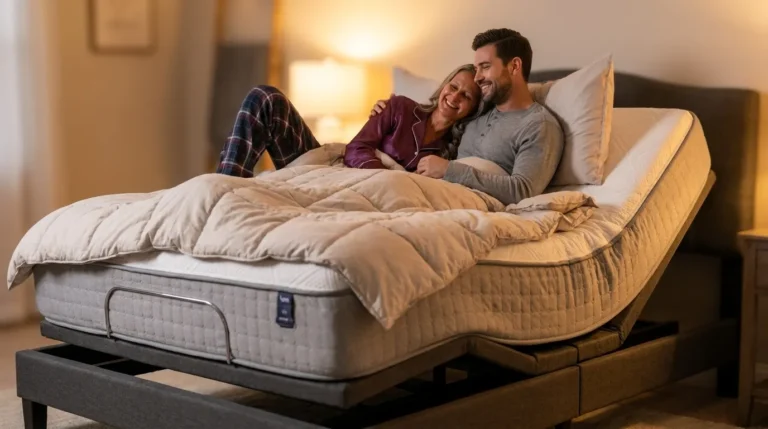
Pillow stacking can provide partial relief, yet often falls short of consistent, repeatable results. A motorized adjustable base becomes the logical next step at that point. The base replaces a static pillow angle with precise, motorized elevation that holds its position even when you move during the night.
For hip pain, the most relevant adjustments are foot elevation and lumbar support. Raising the foot section 10–15 degrees achieves the same knee-flexion benefit described in Step 1, but the angle stays consistent all night and does not migrate. Lumbar support, available on higher-specification bases, provides a gentle lift to the lower back that encourages correction of forward pelvic tilt without requiring conscious effort from the sleeper.
Leva Sleep’s anti-snore mode shows how micro-adjustment technology works in real use. The system detects snoring and raises the head section by a small increment to open the airway. The same motor precision that enables a 1–2 degree head adjustment also applies to foot and lumbar positioning. Hip-relevant angles can be dialled in once and saved as a preset instead of being guessed with pillows every night.
Step 4: Configure Split Queen or King Systems for Couples
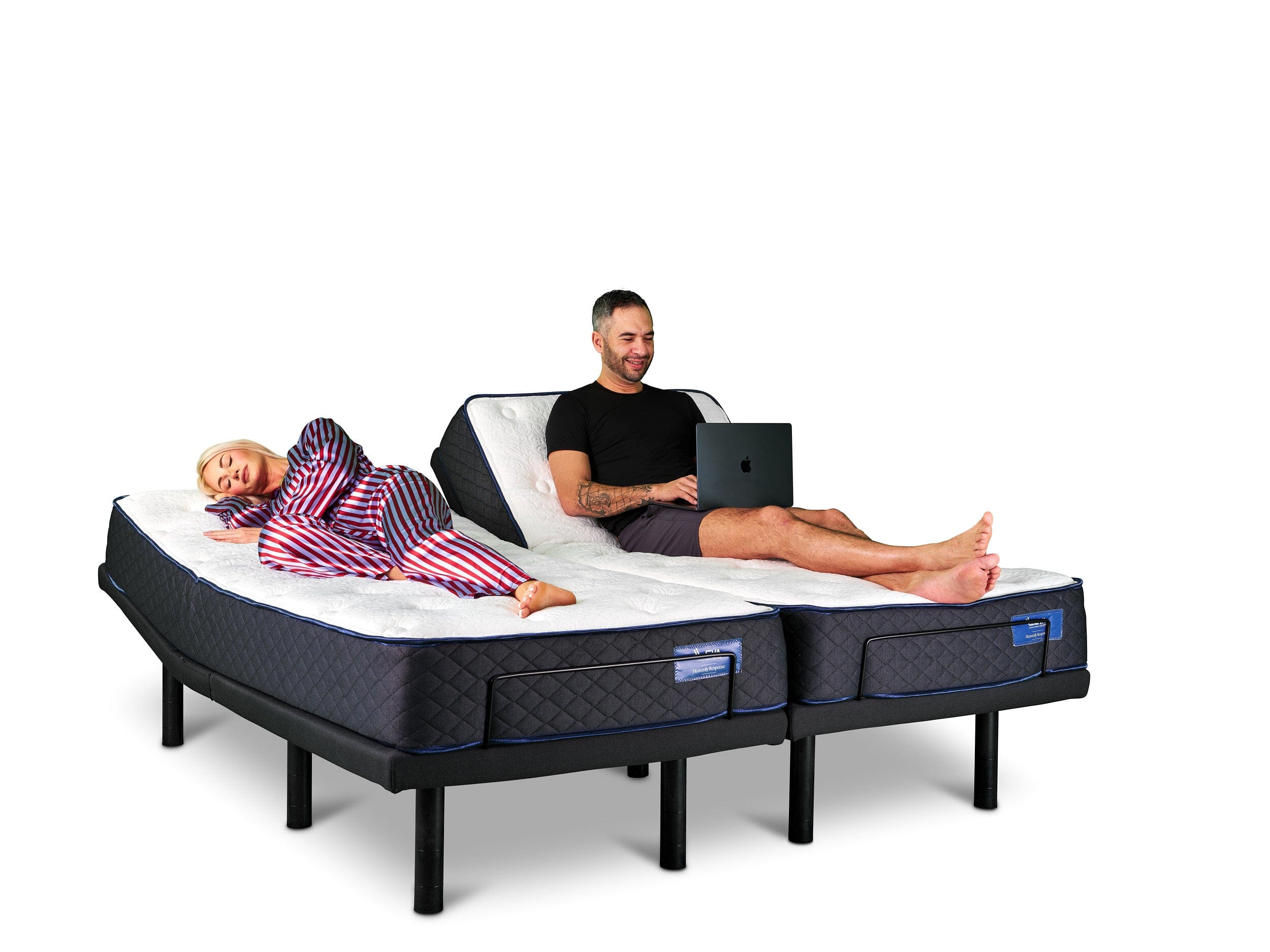
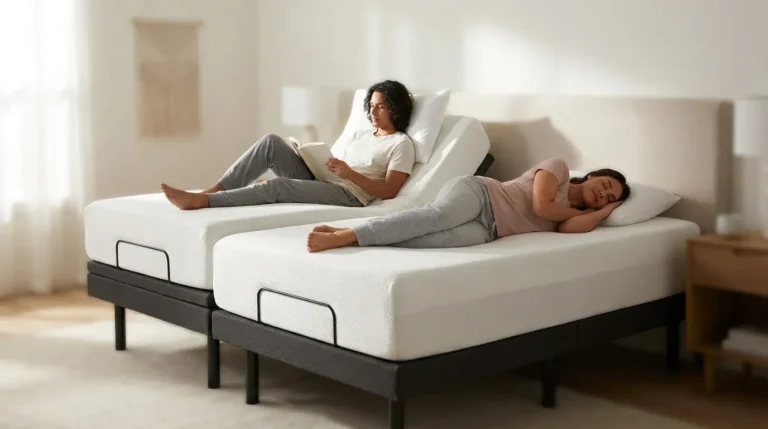
A single adjustable base for couples ties both partners to the same elevation setting. A split system, either Split Queen or Split King, gives each partner an independent base with separate motor controls. One partner can elevate the foot section for hip pain relief while the other sleeps flat.
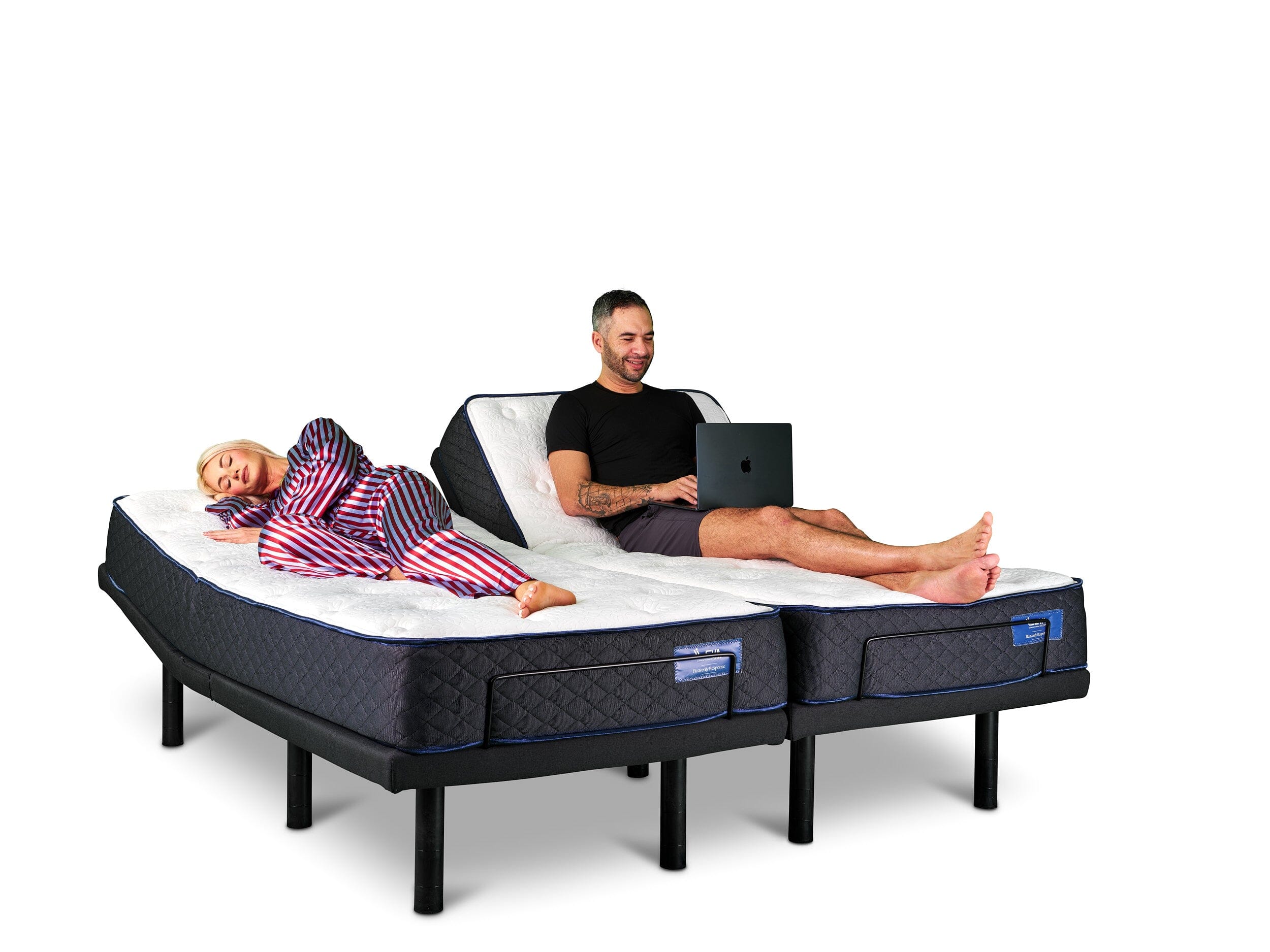
When you configure a split system for hip pain, focus on three areas.
Independent lumbar and pillow tilt: Higher-specification Leva Sleep bases include both lumbar control and a pillow tilt motor. The lumbar feature supports the lower back without raising the entire upper body, which helps sleepers who need pelvic support while staying relatively flat. Pillow tilt adjusts only the head zone, which reduces neck strain when the main goal is lower-body positioning.
Bedding compatibility: Standard fitted sheets often pull off adjustable bases when the foot section rises. Leva Sleep designs its fitted sheets with deep pockets and reinforced elastic specifically for adjustable bases. Duvet clips keep separation between the two sides of a split system so that one partner’s position change does not pull the duvet away from the other side.
App-based presets: Saving a named preset, such as “hip relief,” restores the correct elevation with one tap. This directly supports the repeatability criterion from Step 2 at the hardware and software level.
Compare Leva Sleep’s adjustable bed packages for couples to find a split configuration that matches both partners’ needs.
Static Pillows vs. Controlled Adjustable Elevation
The table below compares static pillows, a single adjustable base, and a split adjustable base using the same criteria from Step 2. It highlights how motorized split systems improve repeatability and partner independence beyond what pillows can provide.
| Criterion | Static Pillows / Wedges | Single Adjustable Base | Split Adjustable Base |
|---|---|---|---|
| Elevation precision | Approximate, varies by pillow compression and placement | Motorized, repeatable via saved presets | Motorized, supports independent positioning per side |
| Repeatability | Low, pillows migrate and compress over months of use | High, preset positions restore automatically | High, independent presets per partner |
| Partner independence | None, shared surface means one adjustment affects both | None, single base moves as one unit | Full, each side operates independently |
| Total cost of ownership | Low upfront, pillows require replacement every 1–2 years and do not address mattress firmness mismatch | Higher upfront, no recurring replacement cost, addresses firmness and elevation together | Highest upfront, removes need for separate sleep solutions or sleep divorce |
Step 5: Monitor These Success Indicators
Three clear indicators show that a positioning strategy is working, no matter which elevation approach you choose. First, reduced morning stiffness. Hip and lower back stiffness that previously lasted 20–30 minutes after waking should shorten over one to two weeks as your body adapts to sustained neutral alignment during sleep. Second, uninterrupted shared sleep. If both partners sleep through the night without frequent position changes or disturbances from the other side, the system is delivering partner independence. Third, maintained neutral alignment. The same partner photograph used in Step 2 should show a straight spine after two weeks on the new setup. If side curvature remains, adjust mattress firmness or elevation angle further.
Frequently Asked Questions
Is an adjustable base suitable for hip arthritis?
An adjustable base can support the positioning goals commonly recommended for hip arthritis, such as reducing compressive load on the joint and maintaining neutral pelvic alignment during sleep. Foot elevation reduces hip flexor tension, and lumbar support discourages forward pelvic tilt. Hip arthritis varies widely in severity and symptoms, and an adjustable base functions as a positioning tool, not a medical treatment. Anyone managing hip arthritis should discuss sleep positioning with a physician or physiotherapist before making changes and then use adjustable base settings to complement the prescribed treatment plan.
Can I use my existing mattress with a split adjustable base?
Many mattresses do not work well with adjustable bases. Innerspring mattresses with interconnected coils, euro-top mattresses with thick foam borders, and mattresses with rigid edge support systems can crack or separate when flexed repeatedly. Mattresses designed for adjustable bases, usually all-foam or individually wrapped pocket coil constructions, flex without structural damage. Leva Sleep designs its own mattresses specifically for use with its adjustable bases and also carries compatible options from partner brands. If you plan to use an existing mattress, confirm with the manufacturer that it is rated for adjustable base use before you proceed.
How does white-glove delivery work in Ontario and Alberta?
Leva Sleep offers in-house white-glove delivery as a paid service in Ontario and Alberta. A trained delivery team brings the base and mattress to the bedroom, assembles the system, adjusts leg heights to the customer’s preferred bed height, connects the app, and provides a full product tutorial. The tutorial covers preset creation, lumbar and pillow tilt controls, and accessory fitting. The team also removes and donates or recycles the old bed. Because Leva Sleep manages delivery in-house rather than using third-party carriers, the team has direct product knowledge and can make real-time adjustments during setup.
When should I consult a physician about hip pain at night?
Sleep positioning adjustments suit general hip discomfort related to pressure, posture, or muscle tension. A physician visit becomes necessary when hip pain at night consistently prevents sleep, when pain appears with swelling, warmth, or redness at the joint, when pain follows a recent fall or injury, when it radiates down the leg, or when it does not improve after two to four weeks of consistent positioning changes. Night pain that wakes a person from sleep, rather than pain that only makes it hard to fall asleep, can signal intra-articular pathology and needs clinical assessment instead of a positioning change alone.
Conclusion: Choose Repeatable Elevation for Lasting Relief
Pillow stacking offers a practical starting point for hip pain relief during sleep, yet its benefits are limited by migration, compression, and the inability to meet each partner’s separate needs. When you evaluate any elevation system, whether a wedge, a single adjustable base, or a split system, prioritize repeatability above everything else. Repeatability depends on four supporting features. First, whisper-quiet motors that allow position changes without waking either partner. Second, independent controls so that one partner’s adjustment does not force the other into an uncomfortable position. Third, accessory compatibility, meaning sheets, duvets, and protectors designed for adjustable bases that maintain their fit in every position. Fourth, total cost of ownership that includes reduced pillow replacement and avoided sleep divorce, which lowers the long-term cost compared with the upfront price.
Leva Sleep’s split adjustable bases are built around these criteria. They provide independent controls per side, lumbar and pillow tilt motors, app-based presets for repeatable positioning, and a full suite of accessories designed for adjustable bases, all at 30–50% below comparable luxury competitors.
Find your Leva Sleep adjustable bed package and create a repeatable elevation setup that supports lasting hip pain relief.