Written by: Matthew Timmins, Founder and Managing Director, Leva Sleep | Last updated: July 17, 2026
Key Takeaways
- Sleep divorce often starts with snoring, motion transfer, and clashing comfort needs that a shared flat bed cannot fix.
- Split adjustable sleep systems give each partner independent head and foot elevation so couples stay in the same bed without disturbing each other.
- For 2026, focus on whisper-quiet motors, anti-snore positioning, Zero-G mode, and mattresses that keep motion transfer low.
- Leva Sleep stands out with Split Queen options, in-house white-glove delivery in Ontario and Alberta, and pricing 30–50% below many premium brands.
- Explore Leva Sleep’s full range of adjustable bed packages to find the split setup that helps you share a bed and wake up rested.
The Problem: Sleep Divorce and Its Impact on Canadian Couples
Sleep divorce often builds slowly over time. One partner snores, and the other starts wearing earplugs. One runs hot, and the other piles on blankets. These small compromises gradually erode sleep quality for both people. A 2024 OnePoll survey found that 82% of people in relationships say their partner’s sleep habits regularly wake them up, and 25% specifically blame tossing and turning.
The contributing factors most commonly reported by couples include:
- Snoring and sleep apnea: One partner’s airway obstruction disrupts both sleepers throughout the night.
- Differing firmness preferences: One partner needs a firm surface for back support, while the other needs pressure relief for hip or shoulder pain.
- Temperature incompatibility: Sleeping too hot or too cold affects how quickly you fall asleep and how often you wake up.
- Motion disturbance: Partner movement can trigger frequent awakenings.
- Medical conditions: Joint pain, acid reflux, GERD, and post-surgical recovery often require specific positional support that a flat bed cannot provide.
When these issues go unresolved, couples often feel forced to choose between poor sleep in the same room or better sleep apart. A split adjustable sleep system offers a third option that keeps you together while addressing individual needs.
Why Traditional Beds and Basic Adjustable Bases Fall Short
Traditional sleep setups rarely solve these shared-bed challenges. A standard flat mattress offers no positional adjustability. A single adjustable base moves the entire surface as one unit, so one partner’s elevation change always affects the other. Separate rooms remove disturbances but also remove physical closeness and can increase relationship strain. CPAP machines treat sleep apnea mechanically but do not correct the positional cause of many snoring issues and often feel uncomfortable for the wearer.
Basic adjustable bases sold as add-ons at general furniture retailers usually include limited features, louder motors, and no split configuration. To understand how these limitations show up across the Canadian market, the table below compares pricing, split availability, and service across four major brands. This comparison highlights why Leva Sleep’s mix of features, service, and price is difficult to match.
| Brand / Option | Price Positioning vs. Leva Sleep | Split Queen Availability | Anti-Snore Technology | White-Glove Delivery (Canada) |
|---|---|---|---|---|
| Leva Sleep | Baseline, 30–50% below comparable luxury competitors | Yes, a unique Canadian offering built to specification | Anti-snore mode (spring 2026); manual head elevation presets available now | In-house white-glove service including old-bed removal, assembly, and tutorial (Ontario and Alberta) |
| Douglas | Lower entry price; limited adjustable base selection | Not available | Not available on adjustable bases | Standard delivery; no in-house white-glove setup service |
| Tempur-Pedic | 30–50% higher than Leva Sleep for comparable configurations | Split King available; Split Queen not listed | TEMPUR-Ergo Smart Base includes snore response; premium pricing applies | Available through retail partners; service levels vary by retailer |
| Orthex | Mid-range; adjustable bases sold as add-ons | Not a primary offering | Not a listed feature | Standard retail delivery; setup not included as standard |
Note: Price comparisons reflect publicly available positioning as of July 2026. Feature availability can change, so confirm current specifications with each brand before you buy.
Compare Leva Sleep’s split configurations with a sleep specialist and see which setup fits your space, budget, and sleep needs.
The Split Adjustable Solution for Shared Beds
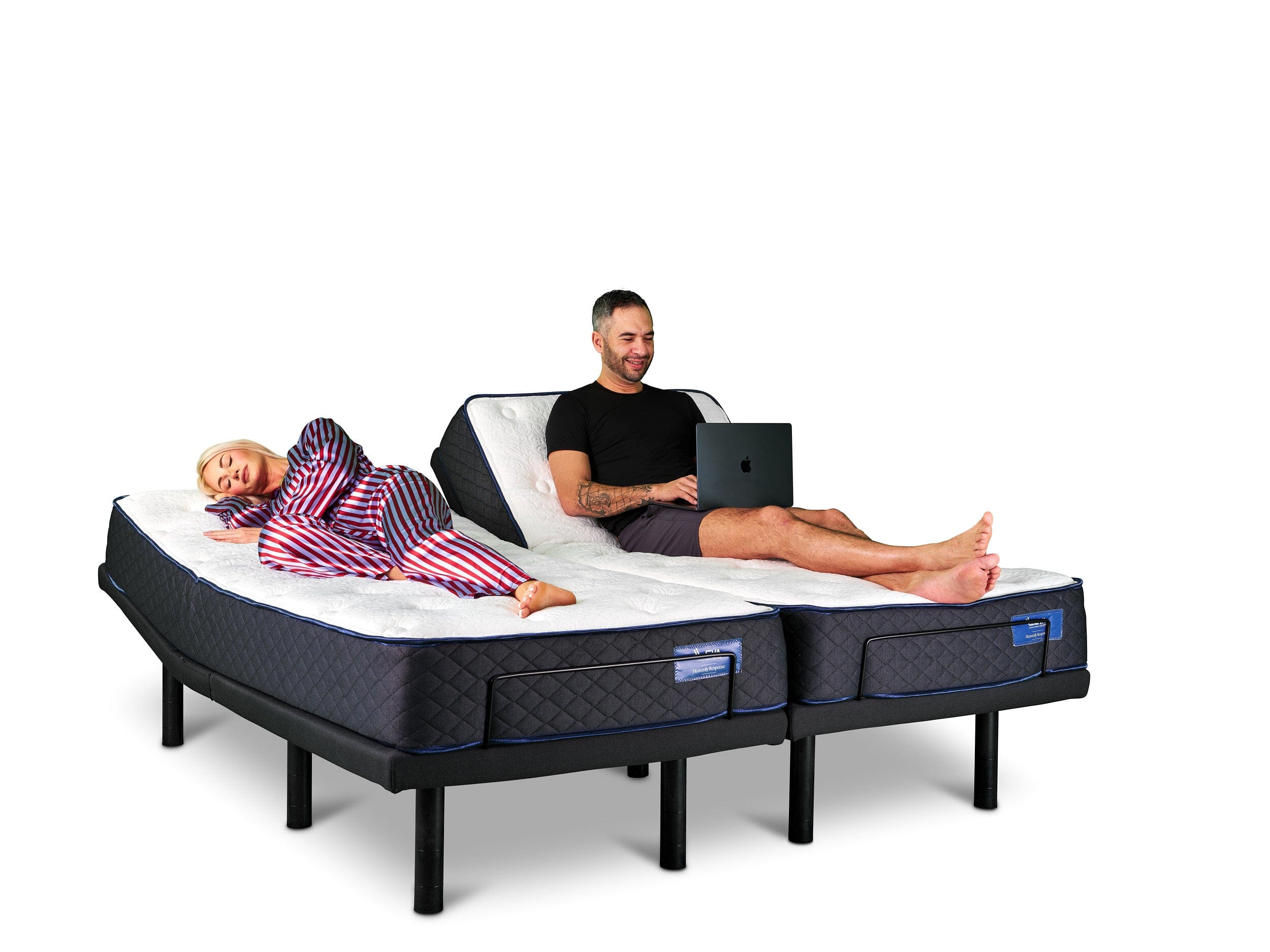
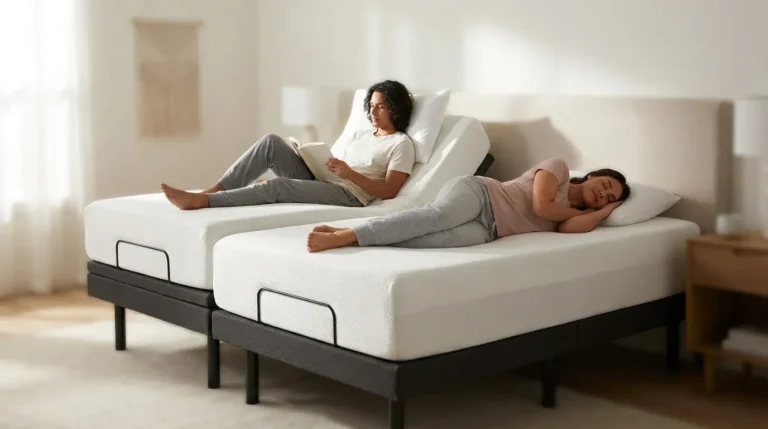
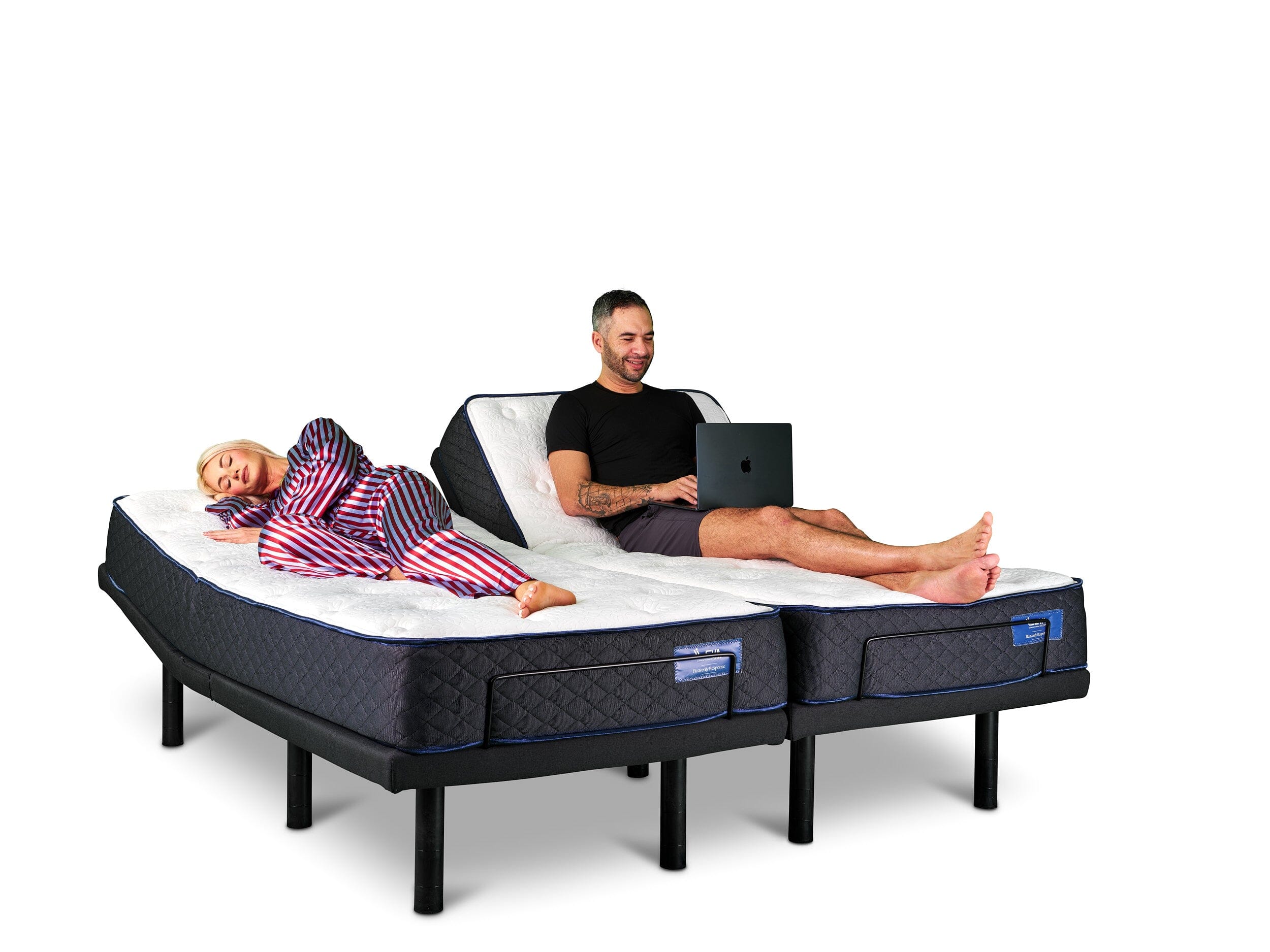
A split adjustable sleep system uses two independent bases under one shared frame. Each base has its own motor, remote or app control, and elevation range. Each partner controls their side without affecting the other. Key features to look for in a 2026 system include:
- Independent head and foot elevation: One partner can raise to an anti-snore angle while the other stays flat.
- Zero-G mode: Elevates both head and knees at the same time to reduce spinal pressure and open airways. NASA originally developed this position to reduce spinal pressure on astronauts, and it now helps decompress the spine, improve circulation, and reduce snoring.
- Anti-snore mode: Leva Sleep’s spring 2026 feature detects snoring and makes small automatic head adjustments.
- Massage and lumbar support: Independently controlled per side for targeted relief.
- Temperature regulation: Heating and cooling pads that each partner can adjust separately.
- Whisper-quiet motors: Quiet operation so mid-night adjustments do not wake the other partner.
Split King and Split Queen configurations both use this same architecture. The main difference is overall width and how much space you have in your bedroom, which the decision framework below explains.
Key Evaluation Criteria for Canadian Buyers
Independent Adjustability and Anti-Snore Positioning
Most sleep specialists recommend 10 to 30 degrees of elevation for snoring relief, with 20–30 degrees as the target range for moderate to heavy snorers. Research suggests that head elevation can help reduce the apnea-hypopnea index for people with positional obstructive sleep apnea. Confirm that any base you consider reaches this range and holds the position quietly throughout the night.
Noise Levels
Motor noise often ranks as a top complaint with basic adjustable bases because loud adjustments can wake the non-adjusting partner. Leva Sleep uses whisper-quiet German motors that operate below normal conversation volume. When you evaluate any base, request a live demonstration or ask about decibel ratings during movement so you know the motor will not create new disturbances while solving old ones.
Mattress Compatibility and Motion Transfer
Mattress construction has a direct impact on motion transfer and compatibility with an adjustable base. Memory foam usually isolates motion better than pocketed coil systems. All-foam and individually wrapped pocket-coil hybrid mattresses work well with adjustable bases. Traditional innerspring mattresses with connected coils resist bending and usually do not pair well with adjustable frames.
How to Keep Adjustable Beds from Separating
Split configurations place two independent bases side by side, which can drift apart without proper anchoring. Look for systems that include a connector bar or strap system that holds both bases together. Leva Sleep’s systems are engineered with this in mind. A fitted sheet with deep pockets and strong elastic also helps maintain a unified surface feel.
Gap Fillers and Centre Comfort
A mattress gap filler, also called a bed bridge or centre connector, sits between the two mattresses to soften the seam. These accessories work best when both sides stay flat. When one or both sides elevate, the gap naturally widens and a filler becomes less effective. Leva Sleep designs bedding accessories for adjustable bases, including fitted sheets with extra elastic that help manage the centre area.
Mattresses That Minimize Partner Movement
In a true split configuration, each partner sleeps on a separate mattress, which removes cross-transfer almost entirely. Split King setups are popular partly because the physical break between mattresses creates the strongest motion isolation. Within a single mattress, all-foam designs absorb movement at the source more effectively than most spring systems.
Specialized Bedding for Adjustable Bases
Standard fitted sheets often pop off the corners when the base elevates. Leva Sleep designs its bedding line with deep pockets, reinforced elastic, and duvet clips that keep each side in place even when partners choose different angles.
Delivery and Setup in Ontario and Alberta
Adjustable bed systems are heavy, complex to assemble, and need proper calibration. Leva Sleep’s in-house white-glove delivery service in Ontario and Alberta includes bedroom delivery, full assembly, leg height adjustment, a product walkthrough, and removal of the old bed. This level of support clearly separates Leva Sleep from many bed-in-a-box brands that leave all setup to the customer.
Schedule Leva Sleep white-glove delivery in Ontario or Alberta and let the team handle installation from start to finish.
Real-World Outcomes for Couples
Couples who move to split adjustable systems often report three main improvements: fewer physical symptoms, better individual sleep quality, and a return to shared sleeping arrangements.
On the medical side, a review in Sleep and Breathing found consistent evidence that head elevation reduces snoring intensity and frequency and that positional therapy remains undervalued for position-dependent snoring and mild-to-moderate OSA. Dr. Raj Dasgupta, a quadruple board-certified physician in pulmonary and sleep medicine, notes that elevating the upper body may reduce snoring and ease mild sleep apnea symptoms by keeping airways open.
For joint pain and post-surgical recovery, the zero-gravity position described earlier is frequently recommended by orthopedicians for lower back pain, sciatica, and post-surgery recovery, with Dr. Harish Chafle reporting measurable reductions in spinal pressure compared with lying flat.
Sleep apnea clinics in Canada actively refer patients to Leva Sleep as a non-mask complement to positional therapy. Many couples who had moved to separate rooms have returned to sharing a bed after switching to a split adjustable system.
Decision Framework: Choosing Split King or Split Queen and Value Level
A Split King uses two Twin XL mattresses (38″ × 80″ each) for a combined 76″ × 80″ surface that suits bedrooms around 12 × 12 ft. A Split Queen uses two 30″ × 80″ halves for a combined 60″ × 80″ surface that fits a standard queen footprint and works well in 10 × 10 ft rooms or condos.
Choose a Split King if:
- Your bedroom measures 12 × 12 ft or larger.
- One or both partners are tall, restless, or heavier sleepers who benefit from 38 inches of individual width.
- Snoring or sleep apnea is a primary concern that requires consistent head elevation.
Choose a Split Queen if:
- Your bedroom is closer to 10 × 10 ft or you live in a condo.
- Both partners feel comfortable with 30 inches of individual width.
- Independent adjustability matters more than maximum personal space.
Leva Sleep offers 15–20 adjustable bed models, compared with the three to five options often found at general mattress retailers, and is one of the only Canadian providers offering a Split Queen configuration built to specification. With over eight years in business, $50M in lifetime sales, and more than 25,000 customers, Leva Sleep’s direct-to-consumer model removes middlemen and delivers a luxury-level experience at 30–50% below many premium competitors.
When you compare value, look at the full system cost. Include the base, mattress, compatible bedding, delivery, and setup. A lower sticker price from a general retailer often excludes accessories and professional installation, which can add up quickly.
Conclusion: Matching the Right System to Your Relationship
Sleep divorce does not have to be the outcome for couples dealing with snoring, motion disturbance, joint pain, or clashing comfort needs. For couples in Ontario and Alberta, a split adjustable sleep system targets the root causes by combining independent elevation, quiet operation, low-motion-transfer mattresses, purpose-built bedding, and professional setup.
Leva Sleep focuses specifically on this shared-bed problem. As Canada’s split adjustable bed specialist, it offers deep product selection, technical expertise, and end-to-end service that general retailers and many bed-in-a-box brands cannot match, while keeping pricing accessible.
Explore Leva Sleep’s split adjustable systems and choose the configuration that helps you and your partner stay in the same bed and sleep better.
Frequently Asked Questions
What is sleep divorce and can an adjustable bed actually fix it?
Sleep divorce describes partners choosing separate rooms or beds because of incompatible sleep habits, snoring, motion disturbance, or different comfort needs. A single adjustable bed cannot fix every cause, but a split adjustable system directly addresses the most common ones. Independent elevation lets the snoring partner raise their head to reduce airway obstruction while the other partner remains flat. Independent firmness and temperature controls remove the need to compromise on surface feel or warmth. Both partners can share one bed with settings tailored to their needs, which removes many of the pressures that push couples into separate rooms.
What is the difference between a Split King and a Split Queen adjustable bed?
As detailed in the decision framework above, a Split King provides 76″ × 80″ of total sleeping surface, or 38 inches per person. A Split Queen offers 60″ × 80″, or 30 inches per person, which matches the footprint of a standard queen bed. The key difference is individual width. Split King gives each partner more personal space, which helps taller, heavier, or more restless sleepers. Split Queen fits smaller bedrooms and condos while still providing independent adjustability. Leva Sleep is one of the only Canadian providers offering a Split Queen configuration built to specification, which makes it a strong option when room size is limited.
How do I prevent the gap between split adjustable mattresses from being uncomfortable?
The gap between two mattresses in a split configuration can feel noticeable without the right setup. Several practical solutions reduce this issue. A connector bar or strap system anchors both bases together so they do not drift apart, and this should be standard on any split system you consider. A foam bed bridge or mattress gap filler can sit between the two mattresses when both sides are flat to create a more unified surface. Fitted sheets with deep pockets and reinforced elastic help hold both mattresses together under the sheet. Leva Sleep designs bedding accessories for adjustable bases, including sheets and duvet clips that support independent elevation on each side while keeping the centre area comfortable.
Is head elevation on an adjustable bed a medically supported treatment for snoring?
Head elevation is a well-documented positional therapy for snoring and mild-to-moderate obstructive sleep apnea. Raising the head reduces the gravitational pull on the soft palate, tongue base, and throat tissues that collapse and block the airway during sleep. As discussed in the evaluation criteria above, the medically supported elevation range is 10 to 30 degrees, with 20 to 30 degrees most effective for moderate to heavy snorers. Research shows that head elevation can help reduce the apnea-hypopnea index in people with positional obstructive sleep apnea. Adjustable beds make it practical to maintain this angle throughout the night, which pillow stacking rarely achieves. If snoring comes with gasping, choking, or severe daytime fatigue, a sleep study is recommended before relying only on positional therapy, since these signs may indicate a more serious condition.
What should I look for in a mattress to use with a split adjustable base?
The mattress needs enough flexibility to bend with the base without damaging its internal structure. Traditional innerspring mattresses with connected coils usually resist bending and often do not work well on adjustable frames. All-foam mattresses and hybrids that use individually wrapped pocket coils are the recommended choices. For motion isolation within a single mattress, all-foam designs absorb movement at the source more effectively than most spring systems. In a true split configuration, each partner sleeps on a separate mattress, which removes cross-transfer regardless of mattress type. Edge support also matters. Look for mattresses that stay firm at the centre seam where the two mattresses meet so neither partner feels instability near the middle of the bed. Leva Sleep designs its mattresses to pair with its adjustable bases, which supports flexibility, durability, and compatibility across all elevation ranges.