
Written by: Matthew Timmins, Founder and Managing Director, Leva Sleep | Last updated: July 17, 2026
Key Takeaways for Couples
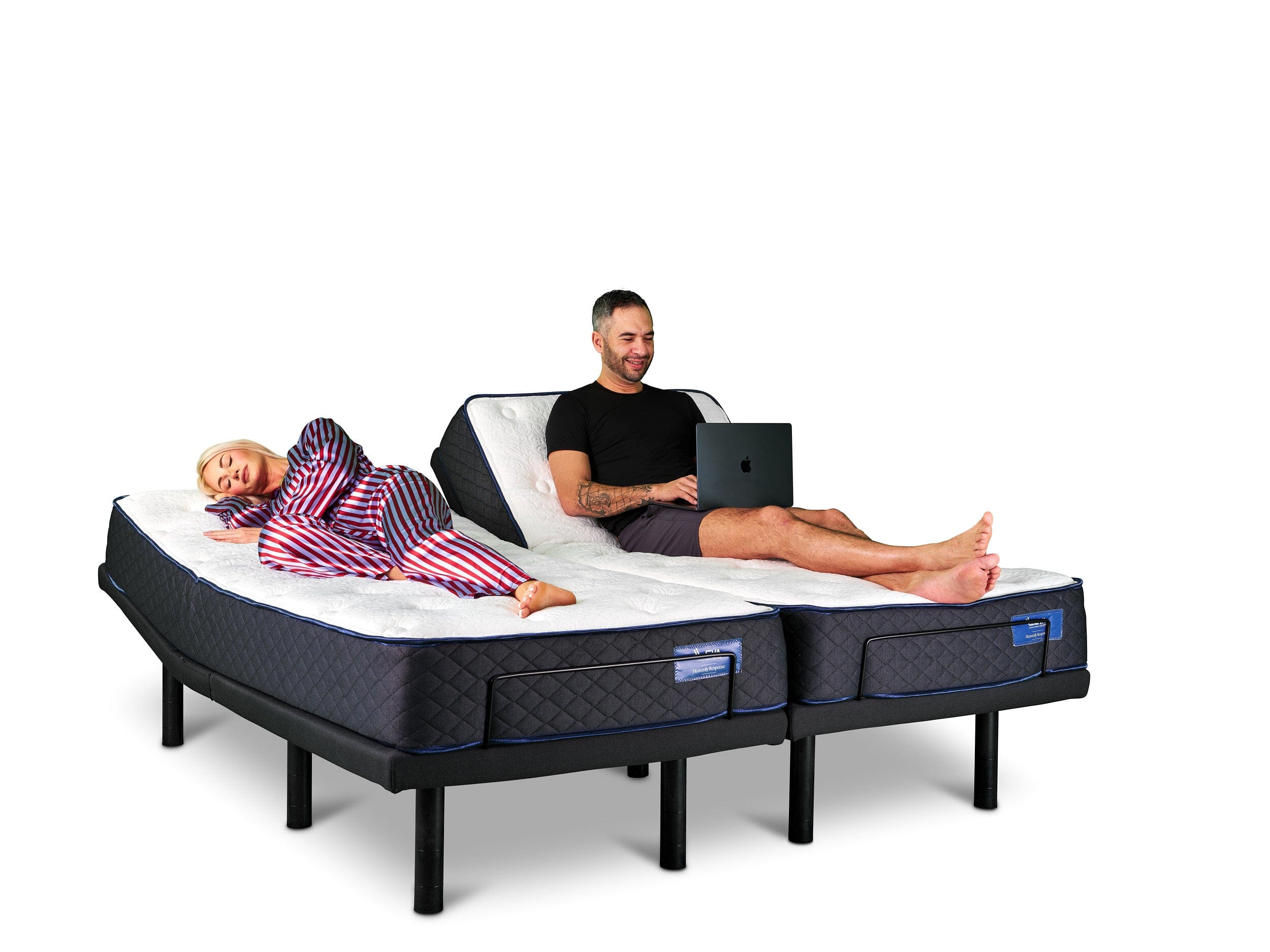
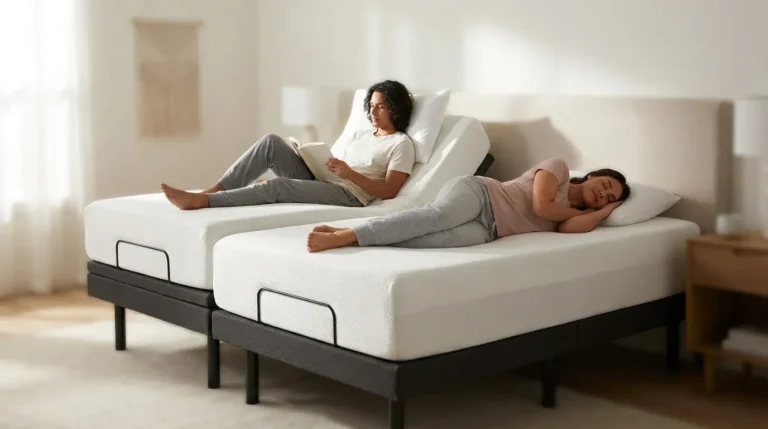
- Split adjustable sleep systems give each partner independent control over head and foot elevation, firmness, and temperature while sharing one bed footprint.
- Traditional shared mattresses transmit motion and force identical positioning, which contributes to sleep disruption and the rising trend of sleep divorce.
- Separate mattresses on independent bases eliminate motion transfer and allow fully customized firmness and elevation for each sleeper.
- Additional benefits include individual temperature regulation, reduced snoring through targeted elevation, and preserved intimacy without separate rooms.
- Leva Sleep offers Split Queen and Split King adjustable bed packages designed for Canadian couples. Explore Leva’s Split Queen and Split King packages to find the right configuration.
The Problem: Why Traditional Beds Force Couples Apart
Habitual snoring affects approximately 40% of adult men and 24% of adult women according to the American Academy of Sleep Medicine, and the bed partner of a snorer can lose a significant amount of sleep per night due to noise disruption. Motion transfer compounds the problem, because a partner’s movement can lead to notable nighttime awakenings. Many couples also have mismatched firmness preferences, and many partners require medical elevation for conditions such as sleep apnea, GERD, or post-surgical recovery that a flat mattress cannot provide.
The cumulative result is that nearly one-third (31%) of U.S. adults have engaged in a sleep divorce, per 2025 AASM survey data, with Canadian couples facing the same pressures.
Traditional Sleep Setups Compared for Couples
Most traditional setups solve only part of the problem, which leaves couples choosing between comfort, health, and staying in the same bed. The table below shows why only split adjustable systems deliver complete independence: traditional and single-base solutions still transmit motion and force shared positioning, while split systems eliminate both problems entirely.
| Solution Type | Motion Isolation | Independent Elevation | Independent Firmness |
|---|---|---|---|
| Traditional flat bed | Innerspring: ~12.41 m/s² motion transfer | None | None |
| Single adjustable base (shared mattress) | Memory foam: ~4.04 m/s² motion transfer | Shared only, one angle for both partners | None |
| Bed-in-a-box (foam, flat) | Memory foam: ~4.04 m/s² motion transfer | None | None |
| Split adjustable base + separate mattresses | Zero cross-transfer between independent bases | Fully independent per partner | Fully independent per partner |
Bed-in-a-box brands also rely on drop-ship delivery, which leaves couples to assemble complex systems without professional guidance. Single adjustable bases with a shared mattress still transmit elevation changes across the entire surface, so one partner’s anti-snore adjustment forces the other into the same incline.
How Split Adjustable Bases with Separate Mattresses Solve the Problem
Split adjustable systems solve each of these problems through independent controls that separate motion, elevation, and firmness. Leva Sleep’s Split King and Split Queen bases use whisper-quiet German motors so position changes do not wake a sleeping partner, which addresses the motion transfer problem at its source. Each side offers head elevation, foot elevation, lumbar support, and pillow tilt, all manageable through the Leva Sleep app, so partners can adjust for snoring, pain relief, or comfort without negotiating a shared position.
An app-based anti-snore mode, arriving spring 2026, will detect snoring and make micro-adjustments to the head of the bed automatically, which removes the need for middle-of-the-night manual changes. Integrated heating and cooling pads allow each partner to set their own sleep temperature, and AI-powered sleep tracking enables real-time micro-adjustments throughout the night.
Five Key Benefits for Couples
- Zero motion transfer. Two separate mattresses on two independent bases produce absolutely zero motion transfer between partners, unlike any shared mattress regardless of its isolation technology.
- Independent firmness. Each partner selects the mattress type, all-foam or hybrid pocket coil, that matches their body weight, sleep position, and comfort preference. This approach resolves mismatched firmness preferences among couples.
- Independent elevation for snoring and apnea. Head-of-bed elevation of 20–30 degrees can help reduce symptoms in patients with positional obstructive sleep apnea. One partner can elevate independently while the other remains flat.
- Temperature control. Individual heating and cooling pads address the common conflict between partners who sleep hot and those who sleep cold, without requiring a shared thermostat compromise.
- Preserved intimacy. A 2025 study of 860 Taiwanese couples found that sleeping in separate rooms significantly lowers well-being, including happiness and life satisfaction. Split systems keep couples in the same bed while still giving them sleep independence.
How Split Beds Support Couple Sleep
Split adjustable beds address the documented root causes of partner sleep disruption without requiring separate rooms. Bed partners can cause more arousals per hour compared to sleeping alone, and sleep efficiency can decrease when sharing a bed. Split systems reduce that disruption by eliminating shared motion and shared elevation.
Among couples who do sleep apart, 52.9% report improved sleep quality and an average of 37 extra minutes of sleep per night, and split adjustable systems can deliver similar outcomes while keeping partners in the same bed. Couples where one partner has a medical elevation requirement, a snoring issue, or a significantly different firmness preference are the strongest candidates for this configuration.
Why Couples Choose a Split Mattress
The primary purpose of a split mattress is to give each partner a sleep surface matched to their individual needs. A 2016 study found that sleep location does not appear to have a strong and consistent effect on sleep quantity or quality in young couples. A split mattress eliminates cross-surface motion and allows each side to be specified with different foam density, coil type, or firmness level.
When paired with a split adjustable base, a split mattress also enables independent head and foot positioning. No single shared mattress can provide that level of control, regardless of its construction.
Split King Benefits for Couples
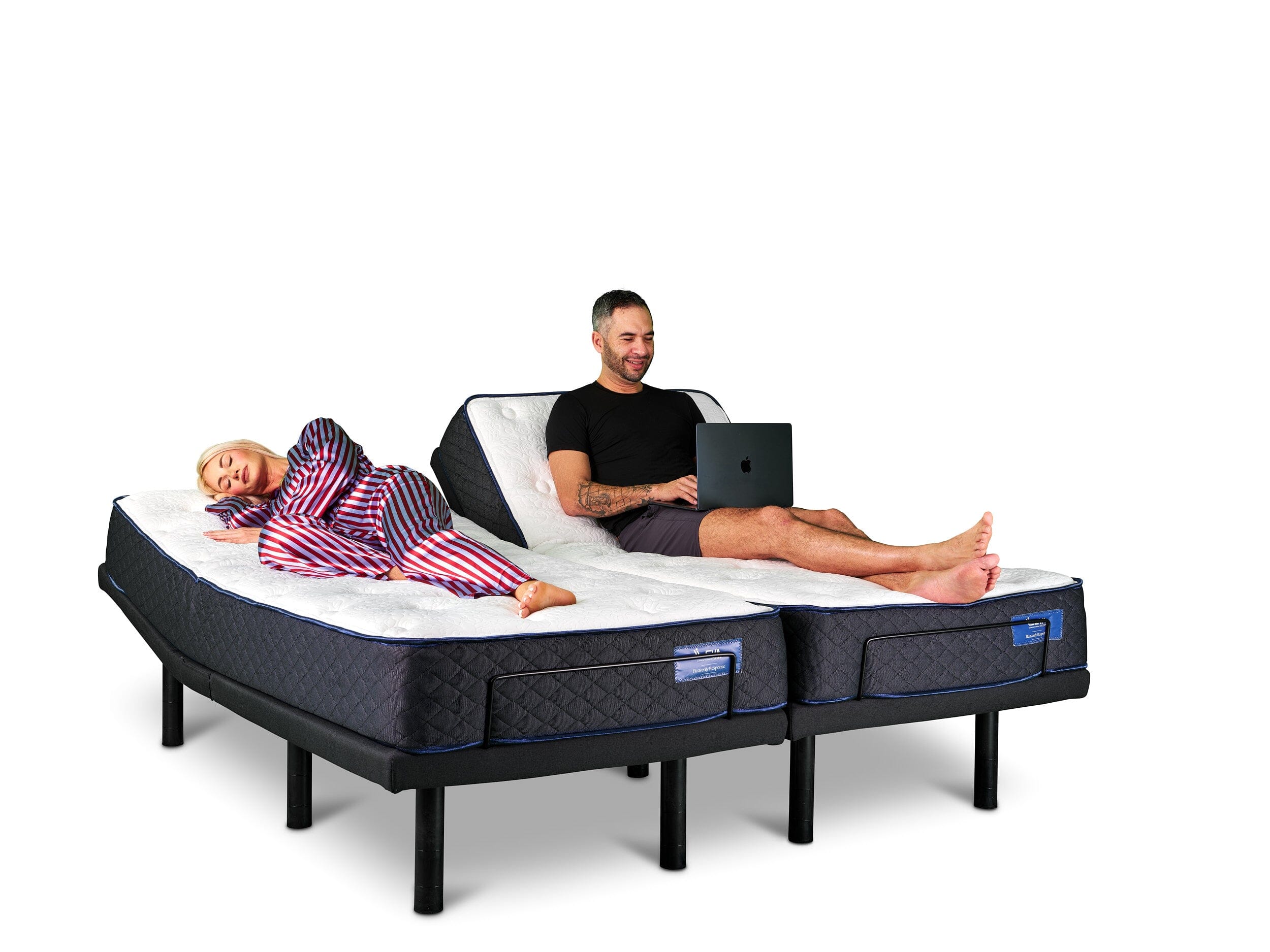
A Split King consists of two Twin XL mattresses (each 38″ × 80″) and two independent adjustable bases placed side by side, creating the same 76″ × 80″ footprint as a standard King. Each partner controls their own side entirely. From a logistics standpoint, Twin XL mattresses typically weigh 17–39 kg while King mattresses weigh 33–77 kg, depending on model and materials.
The Split King is the most widely available split configuration and suits couples in larger master bedrooms across Ontario and Alberta. The motion isolation that makes split configurations effective is backed by substantial research, which shows how partner movement disrupts deep sleep.
Separate Mattresses and Motion Transfer
A 2024 OnePoll survey found that 82% of people in relationships admit their partner’s sleeping habits consistently wake them up. The nighttime awakenings mentioned earlier stem from a measurable shift in sleep architecture. Research published in Perceptual and Motor Skills found that motion transfer across a mattress causes a significant increase in Stage 1 light sleep and a significant decrease in Stage 3 and Stage 4 deep, restorative sleep.
The motion transfer data shown earlier, which ranges from 12.41 m/s² for innerspring to 4.04 m/s² for memory foam, demonstrates that even the best shared-mattress isolation cannot match the zero cross-transfer of physically separate bases. Separate mattresses on independent bases remove the mechanical pathway through which one partner’s movement reaches the other. No foam density, coil count, or isolation layer in a shared mattress can replicate the complete separation achieved by two distinct sleep surfaces.
Split Queen Adjustable Beds in Canada
A split Queen adjustable base consists of two 30″ × 80″ platforms placed side by side to form a standard 60″ × 80″ Queen footprint, which makes it the right choice for couples in smaller bedrooms or those who prefer a Queen size. Leva Sleep is one of the few Canadian providers offering a Split Queen configuration built to customer specifications, a meaningful gap in the market, as split queen mattresses are less commonly stocked at Canadian chain retailers.
Leva’s in-house white-glove delivery service handles assembly, leg-height adjustment, and product tutorials, which removes the logistical burden that deters many couples from pursuing this configuration. Browse Split Queen options with delivery across Ontario and Alberta.
Sleep Divorce and Separate Beds
The 2025 AASM survey found that 31% of U.S. adults report sleeping in a different bed or room from their partner, with the rate reaching 39% among adults aged 35–44. Some couples who sleep apart report improved relationship quality, but the Taiwanese study cited earlier found this well-being reduction persists even after controlling for prior relationship quality.
Split adjustable systems offer a third path, which combines the sleep independence that drives those relationship improvements with the shared space that supports closeness. Many couples who adopt sleep divorce resume sleeping together after the snoring partner receives treatment, which suggests that resolving the underlying disruption, not permanent separation, is the preferred outcome for most couples.
Mattress Gap Fillers and Bedding Compatibility
The gap between two Twin XL mattresses can be addressed by inserting a foam mattress bridge filler and securing both mattresses with a connector strap. Foam bed bridges are available on Amazon.ca. For bedding, a Split King setup requires two Twin XL fitted sheets plus one King-sized flat sheet to accommodate independent movement of each side.
Leva Sleep designs its fitted sheets with deep pockets and extra elastic to prevent slippage during elevation, and its duvets include clips to maintain separation when bed positions differ. Gap fillers or bridges can interfere with independent movement on some bases, so confirming compatibility with the manufacturer before adding any accessory is advisable.
Independent Adjustable Bases for Couples
Couples can use a few key criteria to compare independent adjustable bases and choose one that will stay quiet, comfortable, and reliable over time.
- Motor noise. Whisper-quiet motors prevent position adjustments from waking a sleeping partner, which forms the first line of defense against motion disruption. Older or budget bases with louder motors can negate this core benefit entirely.
- Durability and weight capacity. Once you confirm quiet operation, verify that each base can handle the combined weight of mattress and sleeper. Split adjustable bases have varying per-side load ratings, and exceeding capacity can shorten motor life and void warranties.
- Temperature regulation. Integrated heating and cooling pads address the differing temperature preferences that drive many couples toward separate sleeping arrangements, while keeping them in the same bed.
- Pain relief features. Lumbar support, pillow tilt, and zero-gravity positioning address back, hip, and knee pain. Adjustable sleep surfaces can help reduce pressure points and improve spinal alignment compared to flat sleeping positions.
- App and preset controls. Programmable positions, vibrating alarms, and anti-snore presets add practical value for couples with differing schedules or medical needs, and they make nightly use simple.
Cost and Value Considerations
Split king setups in Canada (two bases plus two mattresses) typically range from $2,000 to $6,000 CAD. Leva Sleep’s vertically integrated, direct-to-consumer model, which designs and assembles systems locally without retail middlemen, delivers comparable features at 30–50% less than top-tier competitors. The table below breaks down the four cost components that determine total investment, showing where Leva Sleep’s vertical integration delivers savings without sacrificing features.
| Cost Factor | What to Evaluate | Leva Sleep Approach |
|---|---|---|
| Base price | Per-side base cost including motor and app features | 30–50% below comparable luxury competitors through vertical integration |
| Mattress cost | Two separate mattresses required; foam or hybrid pocket coil | Designed specifically for adjustable base articulation |
| Delivery and setup | White-glove vs. drop-ship, assembly complexity | In-house white-glove delivery with setup, tutorial, and old bed removal |
| Accessories | Gap fillers, connector straps, split-compatible sheets | Bedding designed with extra elastic and duvet clips for adjustable bases |
Compare transparent pricing on Split Queen and Split King packages with Canadian delivery.
Frequently Asked Questions
How difficult is it to set up a split adjustable bed?
Split adjustable bases arrive as two separate units, which actually simplifies delivery through narrow hallways and staircases common in older Canadian homes. Most tool-free assembly takes under 15 minutes. The steps involve positioning both bases side by side, connecting the sync cable, placing each mattress, inserting a foam gap filler, and securing a connector strap around both mattresses.
Leva Sleep’s white-glove delivery service handles every step, including leg-height adjustment and a full product tutorial, so couples do not need to manage setup themselves.
Can a split adjustable bed replace a CPAP machine for sleep apnea?
A split adjustable base is not a substitute for a CPAP machine or medical treatment for diagnosed obstructive sleep apnea. Head-of-bed elevation of 20–30 degrees has clinical support for reducing snoring and mild positional apnea, but anyone with a confirmed sleep apnea diagnosis should follow their physician’s treatment plan.
An adjustable base can complement medical care by providing consistent, stable elevation throughout the night, something stacked pillows cannot maintain, and by allowing the snoring or apnea-affected partner to elevate independently without disturbing the other. Leva Sleep’s anti-snore mode, arriving spring 2026, adds automated micro-adjustments as an additional layer of support.
Who benefits most from a split adjustable sleep system?
Couples where at least one partner experiences snoring, motion sensitivity, a medical elevation requirement such as GERD, sleep apnea, hip or knee pain, or post-surgical recovery, or a significantly different firmness preference gain the most from a split adjustable system. The configuration also suits couples with different schedules, since one partner can enter or exit bed, or adjust their position, without disturbing the other.
Couples who both sleep flat with identical firmness preferences and no medical needs may find a standard King simpler and less expensive.
What maintenance does a split adjustable base require?
Routine maintenance includes checking power cords and sync cables periodically to confirm they are secure, dusting motors with a dry cloth or vacuum brush attachment, and applying silicone lubricant to pivot points if any squeaking develops. Mattresses should be rotated 180 degrees every six months but never flipped, and a waterproof protector is recommended to prevent moisture buildup.
Connector straps and gap fillers should be checked after laundering sheets, as fabric shrinkage can shift their fit. Leva Sleep’s in-house expertise means customers can contact the team directly for maintenance guidance rather than navigating a third-party retailer.
Do standard sheets fit a split king or split queen?
Standard fitted sheets do not work well on split configurations because the two mattresses move independently. A split king requires two Twin XL fitted sheets, one per mattress, plus a standard King flat sheet or duvet on top.
A split queen can use a standard queen fitted sheet over both halves, but the centre seam tends to cause slipping. The practical alternatives are a mattress connector strap to pull the halves together, two separate 30″ × 80″ fitted sheets with a shared flat sheet on top, or specialty split queen sheets. Leva Sleep designs its fitted sheets with extra-deep pockets and reinforced elastic specifically for adjustable base movement, and its duvets include clips to keep covers in place when partners are at different elevations.
Conclusion: Choosing the Right Sleep System
Partner motion, snoring, and differing firmness needs are leading causes of disrupted couple sleep, and those disruptions compound over time into relationship strain and sleep divorce. Split adjustable systems address all three simultaneously through physical separation of sleep surfaces, independent elevation, and per-side customization.
When evaluating options, couples should assess motor noise, weight capacity, temperature regulation, app functionality, mattress compatibility, and total delivered cost including accessories and setup. Leva Sleep’s Split Queen and Split King systems are designed specifically for Canadian couples in Ontario and Alberta, combining whisper-quiet engineering, locally assembled components, and white-glove delivery at 30–50% below comparable luxury competitors.
Find your ideal split configuration, sized for your bedroom, priced for your budget, and customized for your sleep needs.