
Written by: Matthew Timmins, Founder and Managing Director, Leva Sleep | Last updated: July 17, 2026
Key Takeaways for Couples Considering Split Adjustable Beds
- A split adjustable bed gives each partner an independent surface and controls, which reduces motion transfer, snoring conflicts, and mismatched comfort preferences.
- Traditional beds and single-unit adjustable bases force shared settings that often push couples into separate rooms, while split configurations keep partners together with personalized positions.
- Independent head elevation on split bases can reduce snoring and GERD symptoms for one partner without disturbing the other, which offers a practical alternative or complement to CPAP therapy.
- Gap management accessories, purpose-designed bedding, and quiet motors support long-term comfort and stability on split adjustable systems.
- Canadian couples in Ontario and Alberta can explore tailored Split King and Split Queen packages at Leva Sleep with expert delivery and setup support.
The Problem: When Sleep Conflicts Push Couples Apart
Many couples in cities like Mississauga or Calgary face the same pattern. One partner snores, the other is a light sleeper who wakes at every movement, and by 2 a.m. someone has retreated to the guest room. This scenario is far from rare. A 2025 AASM survey of 2,007 U.S. adults found that 31% have tried a sleep divorce (sleeping in another bed or space to accommodate a partner), with 23% sleeping in another space. The rate climbs to 39% among adults aged 35–44, which is the core demographic most likely shopping for a solution.
Snoring is the single largest trigger. The ResMed 2025 Global Sleep Survey of 30,026 people across 13 countries found that 18% of couples reported sleeping in separate rooms due to snoring and restlessness. Even when snoring is not present, motion transfer creates a second pathway to sleep disruption. A 2020 study using actigraphy data from bed-sharing couples found that a partner’s movements can cause awakenings in the other person. These physical disturbances combine with environmental conflicts such as temperature disagreement, which affects a significant portion of couples according to NSF-referenced surveys, and together they create a layered problem that no single quick fix can fully resolve.
The consequences extend beyond tiredness. A 2025 study of 860 older Taiwanese couples found that those sleeping in separate rooms had lower psychological well-being, including reduced happiness, life satisfaction, and fulfilment, even after controlling for health, conflict, and mismatched bed or wake times. Co-sleeping can also increase and stabilize REM sleep. The goal becomes clear. Couples need to stay in the same bed while eliminating the disturbances that make sharing it unsustainable.
Why Shared Mattresses and Basic Adjustable Bases Fall Short
A flat mattress, regardless of its motion-isolation marketing claims, is still a single shared surface. Research has found that bed partners can cause more arousals per hour compared to sleeping alone, which reduces overall sleep efficiency. No foam formulation closes that gap completely when both bodies lie on one continuous surface.
Basic single-unit adjustable bases improve on flat beds but introduce a different problem. One elevation setting applies to both partners. If one partner needs head elevation for snoring and the other does not, the choices narrow to compromise or separate rooms. Older and entry-level models also use loud motors that create new disturbances when one partner adjusts position at night.
Luxury competitors such as Tempur-Pedic offer split configurations, but at price points that place them out of reach for many Canadian households. At the other end of the market, general mattress retailers, including large Canadian chains, typically carry only three to five adjustable base models and lack the specialist knowledge to match a couple’s specific combination of medical needs, size constraints, and budget. This leaves couples trapped between unaffordable premium options and underequipped mass-market retailers, which creates a market gap that forces them to either overpay or settle for inadequate solutions.
How Split Adjustable Beds Stop Motion Transfer
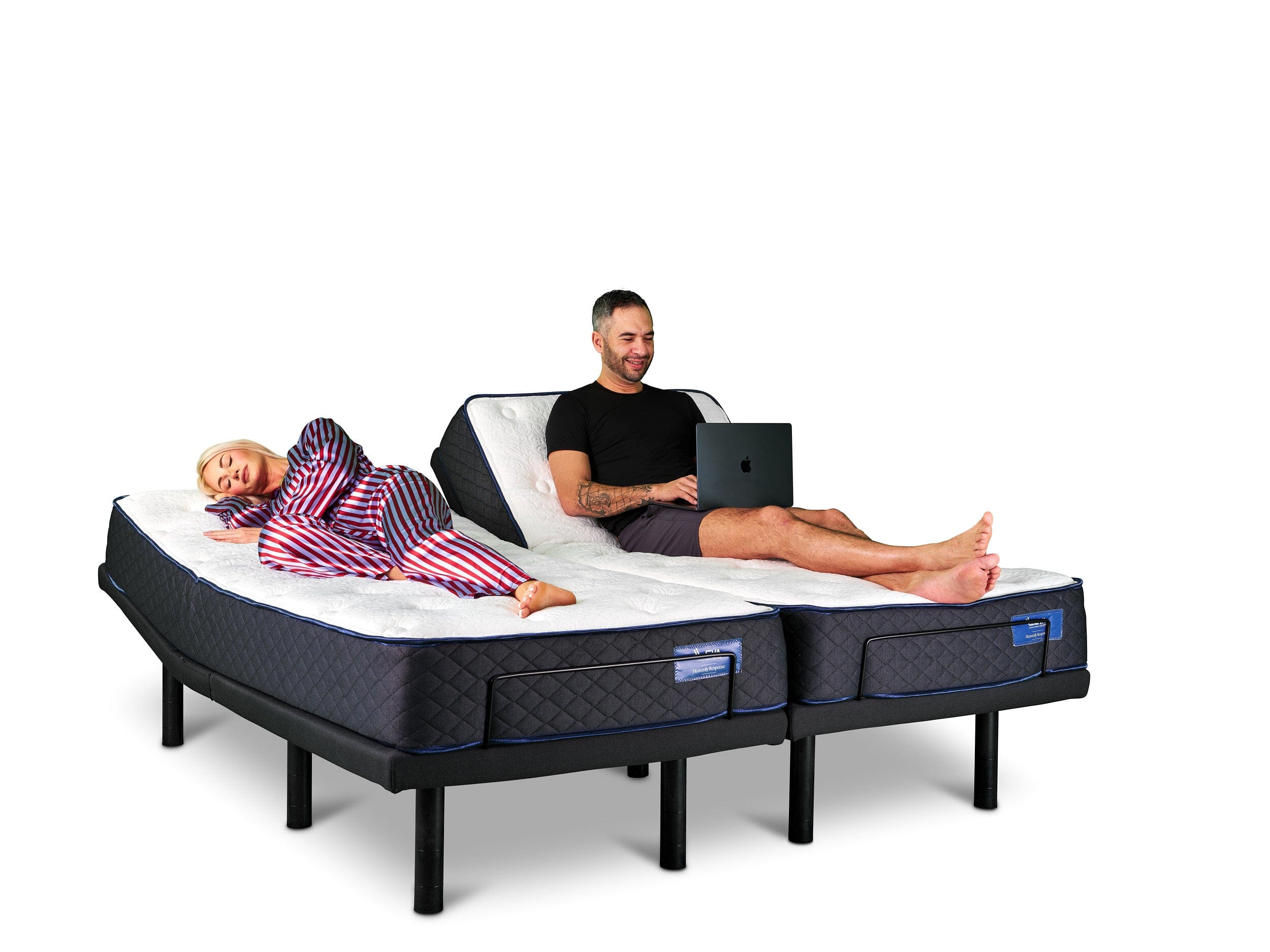
Two separate Twin XL mattresses on two separate adjustable bases create a setup with effectively zero motion transfer between partners. This outcome is physically impossible with any shared mattress, regardless of its motion isolation claims. When the surfaces are mechanically independent, one partner’s tossing, turning, or 3 a.m. trip to the bathroom generates no vibration on the other side.
A Split King uses two 38″ × 80″ Twin XL mattresses placed side by side, which produces a combined 76″ × 80″ sleeping surface identical to a standard king. A Split Queen, a configuration Leva Sleep offers and most Canadian retailers do not, uses two 30″ × 80″ platforms. This size makes independent adjustability available for couples in smaller bedrooms or for those who prefer a less expansive footprint.
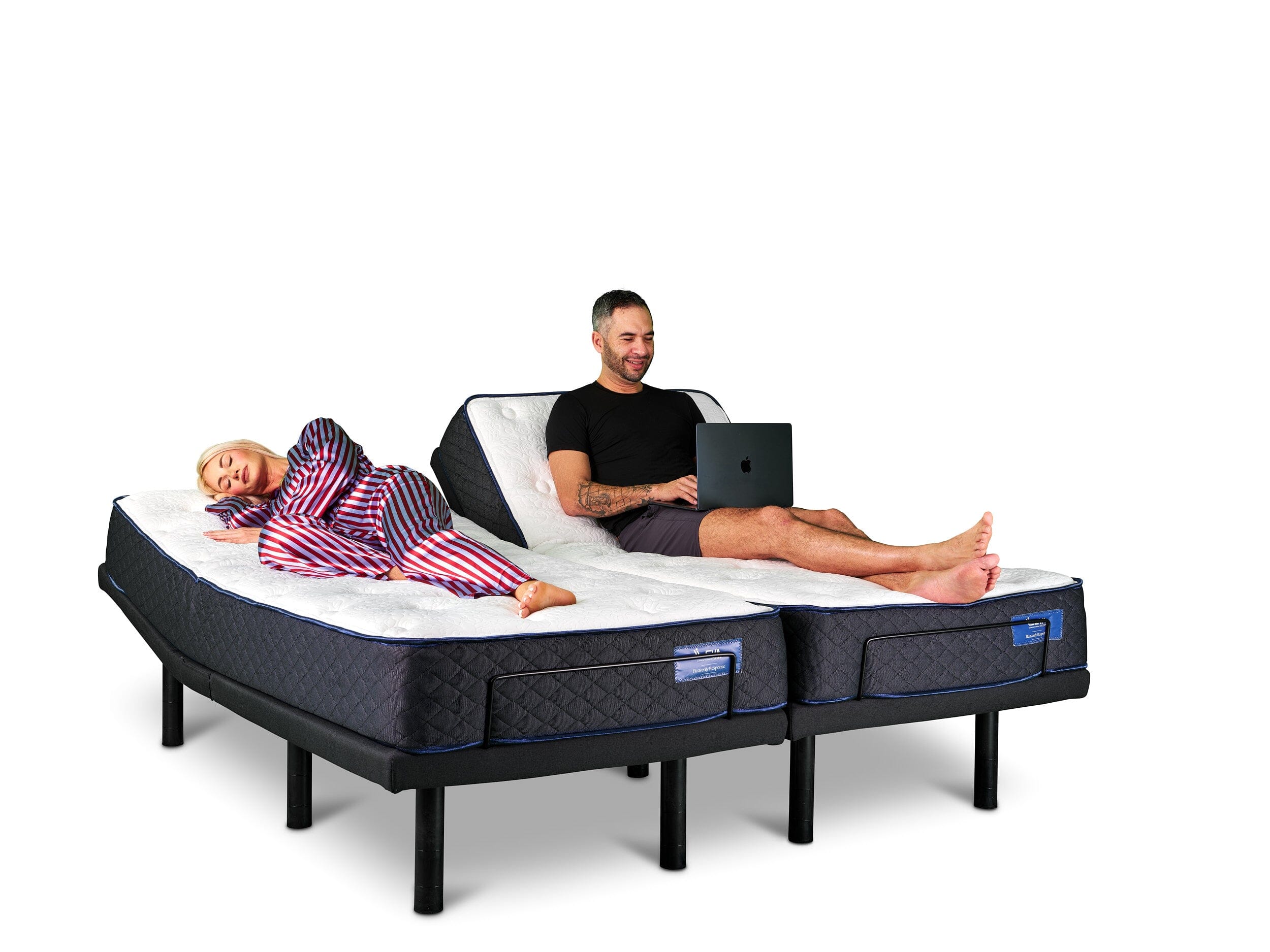
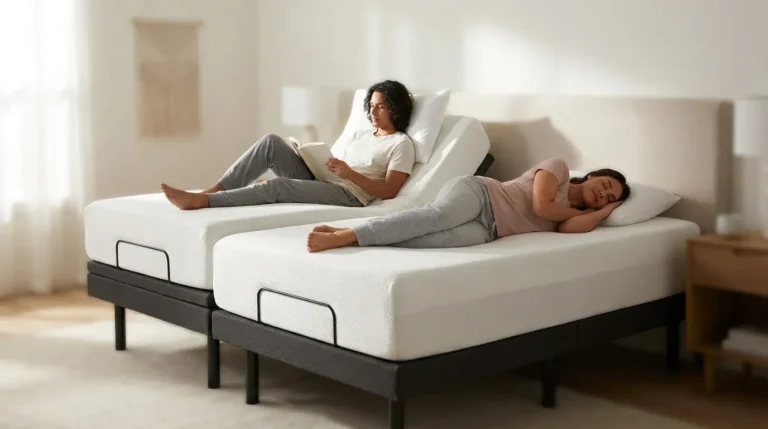
Each base operates independently. One partner can elevate their head to read while the other lies flat. One can activate a massage function without the other feeling it. This independent control architecture turns a shared bed from a source of disturbance into a shared space with private comfort zones.
Snoring Relief and Health Benefits from Head Elevation
Head elevation of 15 to 30 degrees is a common clinical recommendation for reducing snoring and mild obstructive sleep apnea. This position helps reposition the airway and reduces soft tissue collapse. On a split base, only the snoring partner’s side elevates while the other partner remains flat. This difference is the core mechanical advantage over a single-unit adjustable base.
GERD affects 13–29% of Canadians. Elevating the head of the bed 15 to 20 centimetres is a first-line gastroenterologist recommendation. A split configuration makes this possible without forcing the unaffected partner into the same inclined position.
Leva Sleep’s anti-snore mode, arriving in spring 2026, extends these benefits. The system detects snoring through the base and makes micro-adjustments to the head elevation of that side only. These small changes can reduce or eliminate snoring events without the snoring partner needing to wake up and manually adjust. For couples managing mild sleep apnea, this positions the adjustable base as a complementary tool alongside CPAP therapy, and in some cases as an alternative for those who find masks intolerable. Beyond the health benefits, split systems introduce practical considerations that couples need to address.
Managing the Gap Between Split Mattresses
Centre gap formation is the number one consumer complaint about split mattress setups. Over time, the two halves can shift apart under body weight and movement. If couples ignore this, the gap disrupts cuddling and can cause one partner to roll into the crack during sleep.
Foam wedge gap fillers fail on multiple fronts. They compress within weeks under body weight, which creates a noticeable bump through the sheets and still allows the mattresses to slide apart over time. Many wedges also pop out entirely when used on adjustable beds where the surfaces move independently. A horizontal mattress connector solves these problems. This strap-based bridge wraps underneath both mattresses, locks them together without creating a surface bump, and remains effective when each side raises or lowers independently.
Leva Sleep addresses the gap problem through a combination of compatible accessories and purpose-designed bedding. Fitted sheets with deep pockets and extra elastic help prevent slippage when the base elevates. Duvet clips maintain separation between two duvets, which is a practical solution when partners prefer different weights or temperatures. Remote pockets keep controllers accessible without tangling in sheets. These accessories are designed specifically for adjustable bases rather than retrofitted from standard bedding.
What Couples Should Look For in a Split Adjustable System
When assessing split adjustable bed systems, couples should evaluate the following factors.
- Independent controls: Confirm that each side operates entirely independently. Head elevation, foot elevation, massage, and any temperature or anti-snore features should be controllable per side without affecting the other.
- Motor noise: Test or verify motor decibel ratings. Quiet motors matter when one partner adjusts position while the other is asleep.
- Gap management: Ask what gap solution the retailer recommends and whether it is compatible with the specific base when both sides are elevated at the same time.
- Mattress compatibility: Adjustable bases require flexible mattresses such as all-foam or hybrid pocket coil constructions. Innerspring mattresses with rigid border wires are not compatible.
- Bedding fit: Standard fitted sheets will not stay on an elevated adjustable base. Confirm that purpose-designed sheets are available in the split size you are purchasing.
- Size options: For bedrooms under 12 feet wide, a Split Queen may be more practical than a Split King. Verify that the retailer actually stocks or builds Split Queen configurations rather than treating them as a special order afterthought.
- Delivery and setup: Large adjustable bases require professional assembly. White-glove delivery, including old bed removal, in-room setup, leg height adjustment, and a product tutorial, reduces the risk of incorrect installation that can void warranties or reduce performance.
- Canadian delivery coverage: Confirm that the retailer delivers to your specific city in Ontario or Alberta, not just to major urban centres.
Leva Sleep carries 15 to 20 adjustable base models, compared to the three to five typically found at general mattress retailers, and offers in-house white-glove delivery across Ontario and Alberta, including old bed removal and real-time setup adjustments.
Real-World Outcomes: Split Beds vs Luxury Brands vs Separate Rooms
Sleep Foundation research found that adults who began sleeping separately gained an average of 37 extra minutes of sleep per night, with 52.9% reporting better sleep quality. A split adjustable bed targets the same disturbances, including snoring, motion, temperature, and position conflicts, while keeping both partners in the same room and on the same bed frame.
About 25.7% of adults who tried sleeping separately eventually returned to sharing a bed, most often because they missed each other. A split system removes the need to make that trade-off in the first place.
| Factor | Split Adjustable Bed (e.g., Leva Sleep) | Luxury Competitor (e.g., Tempur-Pedic Split King) | Separate Rooms |
|---|---|---|---|
| Motion isolation | Independent bases with no partner movement felt | Independent bases with no partner movement felt | Complete isolation with no shared surface |
| Snoring relief | Independent head elevation 15–30° and anti-snore mode arriving spring 2026 | Independent head elevation available, no anti-snore mode on current models | Snoring noise may still travel through walls, no positional intervention |
| Gap solution | Mattress bridge accessories and purpose-designed bedding available | Proprietary accessories available at additional cost | Not applicable, no shared surface |
| Relationship well-being | Co-sleeping preserves REM synchronisation and physical proximity | Same benefit as any shared-room split setup | Separate rooms linked to significantly lower well-being (β = −0.12, p < 0.05) |
Compare detailed specifications and pricing for Leva Sleep’s split adjustable packages.
Frequently Asked Questions
How common is sleep divorce among Canadian couples?
Canadian-specific prevalence data is limited, but the pattern mirrors findings from comparable English-speaking markets. As noted earlier, American surveys place sleep divorce rates around 31% of adults, with the highest rates among couples aged 35–54, and Canadian couples face the same underlying causes. Canadian sleep experts quoted in national media describe partner movement as the most frequent complaint they hear from clients, with snoring, restless leg syndrome, and mismatched schedules close behind. The underlying causes, including snoring, motion transfer, and temperature disagreement, are biological and behavioural rather than geography-specific, so Canadian couples face similar pressures at comparable rates.
Does independent elevation on one side disturb the other partner?
On a properly engineered split adjustable base with independent motors, one side’s elevation produces no movement on the other. The two bases are mechanically separate units placed side by side on a shared frame. Motor noise becomes the critical variable. A whisper-quiet motor operating at low decibels will not wake a sleeping partner, while a loud or jerky motor might. When evaluating a system, ask for the motor’s decibel rating and, where possible, listen to it operate at the retailer’s showroom or request a video demonstration. Leva Sleep’s bases use whisper-quiet German motors specifically to address this concern.
Are Split Queen adjustable beds available in Canada?
Split Queen adjustable beds, which use two 30″ × 80″ platforms side by side, are not widely stocked by Canadian retailers. Most general mattress stores and even some adjustable bed specialists carry only Split King configurations. Leva Sleep builds Split Queen systems to order, which makes them one of the few Canadian sources for this size. A Split Queen is particularly relevant for couples in condominiums or older homes in Ontario and Alberta where bedroom dimensions make a full Split King impractical.
What bedding works best with split adjustable bases?
Standard fitted sheets are designed for flat mattresses and will pull off the corners when a base elevates, particularly at head angles above 20 degrees. The bedding that works best has deep pockets of at least 18 inches, extra-wide elastic bands that wrap fully around the mattress, and fabric with enough stretch to accommodate elevation without tension. For couples using two separate duvets, which is a common solution when partners have different temperature preferences, duvet clips prevent the covers from sliding to one side during the night. Leva Sleep designs its entire bedding line specifically for adjustable bases, including fitted sheets, mattress protectors, and duvet accessories, so compatibility is built in rather than assumed.
Conclusion: A Practical Path Back to Shared Sleep
A split adjustable bed resolves sleep divorce through three independent mechanisms. Physically separated surfaces reduce motion transfer, independent head elevation addresses snoring and GERD without affecting the other partner, and per-side customisation ends the firmness and temperature compromises that erode sleep quality over time. Clinical evidence supports each of these mechanisms.
For Canadian couples in Ontario and Alberta, Leva Sleep offers this solution at a significantly lower price point than luxury competitors, with a specialist catalogue of 15 to 20 adjustable models, a Split Queen option for smaller bedrooms, purpose-designed bedding, and in-house white-glove delivery that includes assembly, setup, and old bed removal. With over 25,000 customers and eight years of adjustable bed expertise, Leva Sleep focuses specifically on the problem this article describes.