Written by: Matthew Timmins, Founder and Managing Director, Leva Sleep | Last updated: August 3, 2026
Key takeaways for Canadian couples
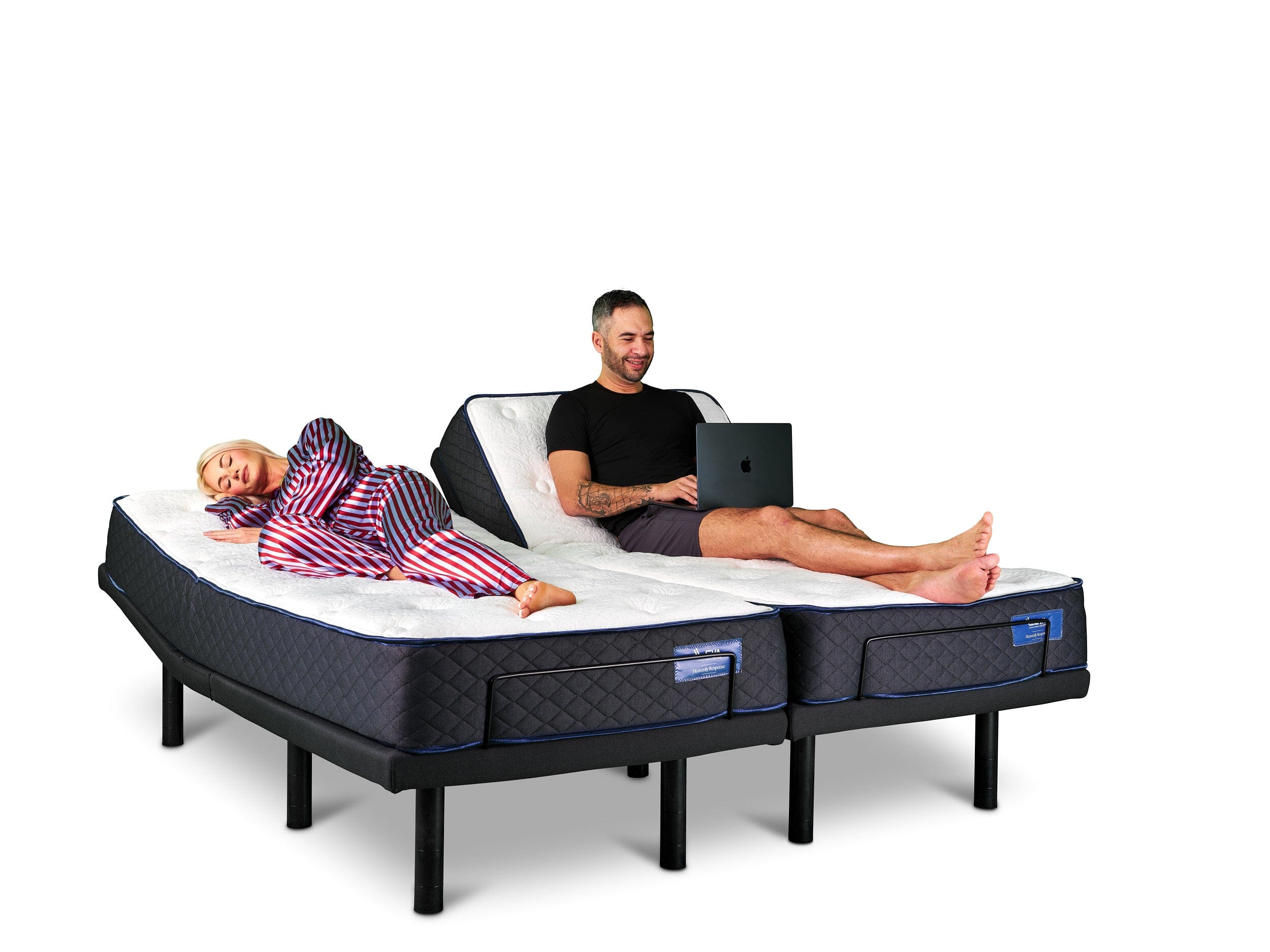
- Split adjustable sleep systems let each partner control head and foot elevation, firmness, and temperature without disturbing the other side.
- Head elevation and independent surfaces reduce snoring, motion transfer, and sleep disturbances, which improves overall sleep quality for couples.
- Split king offers more personal width (38 inches each) but needs larger bedrooms, while split queen fits standard queen footprints and smaller Canadian rooms.
- Premium features such as anti-snore modes, lumbar support, temperature regulation, and quiet motors target couple-specific sleep issues like snoring, pain, and temperature conflicts.
- Leva Sleep provides split queen and split king adjustable bed packages at 30–50% below luxury competitors with white-glove delivery in Ontario and Alberta, so you can compare complete adjustable bed packages for your bedroom.
How adjustable beds improve sleep quality for couples
Positional therapy using head elevation has produced reductions in apnea episodes in published research. Couples sharing a standard flat bed experience significantly more movement arousals than those using independent sleep surfaces, and wider, independent sleep surfaces are associated with fewer disturbances and higher subjective sleep quality scores. For couples, a split system tackles both positional and motion-transfer problems at the same time.
Explore Leva Sleep split adjustable systems that are available for delivery in Ontario and Alberta.
Split King vs Split Queen sizing for Canadian bedrooms
Size selection is the first practical decision for Canadian couples. A split king uses two Twin XL mattresses (each 38″ × 80″) placed side by side to create a 76″ × 80″ surface, which usually requires a bedroom of at least 12 × 12 feet for comfortable clearance. A split queen consists of two 30″ × 80″ halves that together form a standard 60″ × 80″ queen footprint, so it suits smaller Ontario condos or Alberta homes where a king frame will not fit.
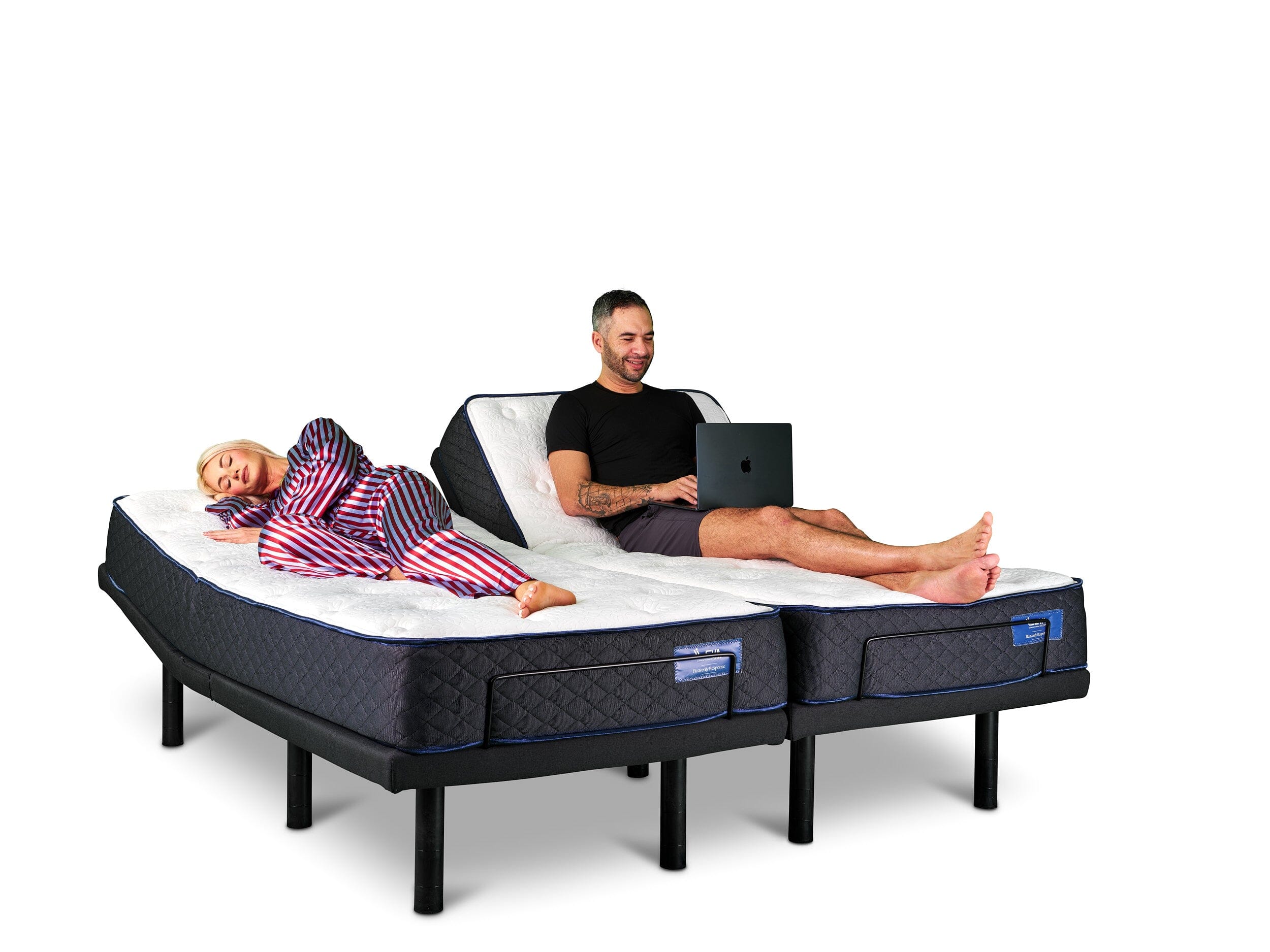
The trade-off is per-person width. A split king gives each partner 38 inches, while a split queen gives each partner 30 inches. Couples who prioritize personal sleeping space and have the room usually prefer split king. Couples in a bedroom that comfortably fits a queen but not a king can still enjoy independent control with a split queen in a smaller footprint. Leva Sleep is one of the few Canadian retailers that builds split queen adjustable systems to customer specifications, which fills a gap that most national brands and AI overviews overlook.
A gap between split mattresses can be addressed with a mattress bridge pad costing $30–$50, and split queen sheet slippage can be managed with a mattress connector strap or specialty split sheets.
Features that target snoring, temperature, and pain
The adjustable base market has moved well beyond basic head and foot articulation. Complete sleep systems now incorporate massage, lumbar support, temperature management, anti-snore positions, lighting, and charging. The features most relevant to couples include the following.
- Anti-snore mode: Head elevation can reduce snoring by opening the airway. Leva Sleep’s anti-snore mode detects snoring and makes micro-adjustments to the head of the bed automatically. Premium tiers now add voice control, snore detection, and app-guided positions.
- Lumbar support and pillow tilt: Raising the knees slightly eases lower-back tension by reducing the lumbar arch. A dedicated pillow tilt motor then adjusts head position independently of the main head section.
- Temperature regulation: Smart adjustable systems account for a significant share of the global market, driven partly by app-controlled temperature and biometric monitoring. Leva Sleep integrates a heating and cooling pad so each partner sets a personal thermal environment.
- Whisper-quiet motors: Leva Sleep uses German-engineered motors designed to adjust position without waking a sleeping partner, which solves a common complaint with entry-level bases.
- AI sleep tracking: Some smart bases incorporate AI for automatic anti-snore head elevation, and Leva Sleep’s system uses AI-powered tracking for real-time micro-adjustments.
- Zero-gravity preset: The zero-gravity position raises both head and knees into a gentle V, which distributes weight evenly and relieves lower-back pressure.
2026 value comparison for Ontario and Alberta shoppers
The table below compares four adjustable sleep system providers on criteria relevant to Canadian couples. All prices reflect approximate CAD ranges based on publicly available information.
| Brand | Split Queen Available | Anti-Snore / Temperature |
|---|---|---|
| Leva Sleep | Yes, built to specification | Both included on premium models |
| Tempur-Pedic | Not widely listed | AI snore detection on Smart Base upgrade, no integrated cooling pad |
| Sleep Number | Not standard | Partner Snore on FlexFit 2, Climate collection for temperature |
| Saatva | Not listed for Canada | Limited anti-snore, no integrated temperature pad |
Leva Sleep’s direct-to-consumer, vertically integrated model eliminates retail markups and produces a 30–50% price advantage over Tempur-Pedic, Sleep Number, and Saatva on comparable feature sets. Leva is also among the only providers offering a split queen adjustable system in Canada, a configuration that neither Tempur-Pedic nor Sleep Number prominently lists for the Canadian market.
View current Leva Sleep pricing for split queen and split king systems tailored to Canadian buyers.
White-glove delivery and setup in Ontario and Alberta
Delivery logistics matter as much as price for large adjustable systems. A queen adjustable base can require assembly, which creates a real burden in a self-install bed-in-a-box scenario.
Leva Sleep offers in-house white-glove delivery for a fee across Ontario and Alberta. The service includes delivery to the bedroom, full assembly, leg-height adjustment, a product tutorial, and removal of the old bed for donation or recycling. This creates a distinct operational advantage. Tempur-Pedic and Saatva include white-glove delivery as standard, yet they do not pair that service with local assembly expertise or the split queen configuration that Leva provides in these provinces.
Couples purchasing remotely from brands outside these provinces often face extra steps. Canadian orders from US-based brands can involve multiple shipments and may incur customs duties, which adds cost and complexity that Leva’s local model avoids.
Check Leva Sleep delivery options and white-glove availability for your postal code in Ontario or Alberta.
Choosing the right system without overspending
Budget tier determines which features you can realistically expect. The table below outlines what Canadian couples typically see at each investment level.
| Tier | Approx. CAD Range (Split System) | Typical Features Included |
|---|---|---|
| Entry | ~$2,200–$3,500 | Independent head and foot elevation, wireless remote, basic massage, quiet motor |
| Mid | ~$3,500–$6,000 | Entry features plus lumbar support, pillow tilt, app control, memory presets, anti-snore program |
| Premium | ~$6,000–$10,000+ | Mid-tier features plus AI sleep tracking, biometric monitoring, integrated temperature regulation, voice control |
Leva Sleep’s direct model places its mid and premium tiers at price points that national brands often charge for entry and mid tiers. Couples should match features to their specific problems, such as anti-snore and temperature regulation for most, and lumbar support for those with back or hip pain. This approach prevents paying for features that will not see regular use.
Disadvantages of adjustable beds to consider
Split configurations require two sets of fitted sheets rather than one, and standard sheets can slip at the centre gap. Assembly requires two people, so self-install delivery adds setup work. Adjustable bases also cost more than flat frames, and they are not a replacement for CPAP or medical treatment in moderate-to-severe sleep apnea cases.
Head-only elevation on adjustable bases
All adjustable bases allow independent head elevation without raising the foot section. Elevating the upper body reduces nighttime acid reflux by using gravity to help keep stomach acid in the stomach. Sleep specialists commonly reference 30–45 degrees of head elevation for meaningful positional benefit in obstructive sleep apnea. Models with a pillow tilt motor add a secondary adjustment at the very top of the head section for finer control.
How couples with different preferences share one bed
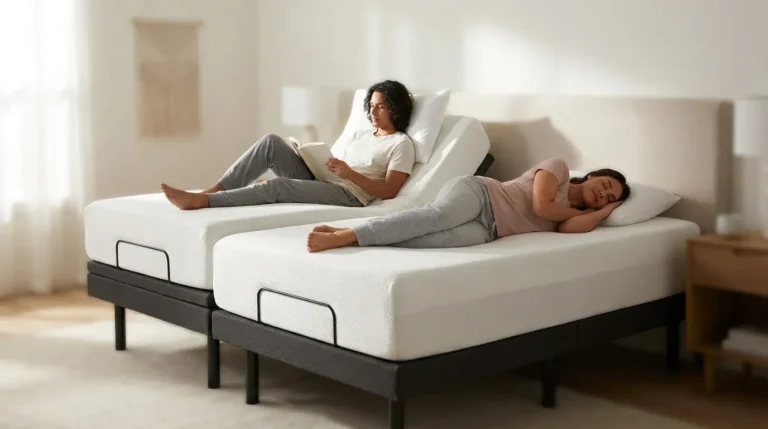
A split adjustable system gives each partner a fully independent base. One side can raise the head for snoring or reflux while the other stays flat, without disturbing the partner. Each partner can also select a different mattress firmness on a split configuration, which removes the compromise that leads to body impressions and dissatisfaction over time. Temperature regulation pads operate per side as well.
Common mistakes when buying an adjustable sleep system
- Focusing only on base price: A low-cost base without anti-snore, lumbar support, or temperature regulation may not address the specific problems driving the purchase. If the base does not solve snoring or temperature issues, any money saved on price becomes irrelevant, so you should evaluate features against your actual sleep complaints before comparing price.
- Ignoring sheet compatibility: Standard fitted sheets pop off adjustable bases during elevation. Leva Sleep designs bedding with deep pockets, extra elastic, and duvet clips specifically for adjustable use, which solves a detail that generic retailers often overlook.
- Underestimating motor noise: Quiet motors are now a standard feature in mid-tier and above products, but entry-level bases from general retailers can still produce disruptive noise. Ask for a motor specification or an in-store demonstration before purchasing.
- Skipping white-glove setup: An adjustable base assembled incorrectly can void warranties and create safety risks. Professional setup confirms leg height, remote pairing, and app connectivity before the technician leaves.
Conclusion: a decision framework for Canadian couples
The decision framework for Canadian couples in 2026 comes down to four variables. Bedroom size guides the choice between split queen for rooms under 12 × 12 feet and split king for larger spaces. Specific sleep problems such as snoring, temperature, firmness, and pain determine which features matter most. Budget tier ranges from entry through premium, and delivery model varies between local white-glove and freight self-install.
The global adjustable beds and mattress market is projected to reach USD 10.1 billion in 2026 and grow at 9.7% CAGR through 2036, so product options and feature sets will keep expanding. The fundamentals of couple-specific independent control, however, remain the core value proposition.
Leva Sleep’s combination of split queen availability, a 30–50% price advantage over national luxury brands, and in-house white-glove delivery in Ontario and Alberta addresses gaps that no top-ranked competitor currently fills. Couples comparing current Canadian pricing, configurations, and delivery zones can review the full product range below.
Browse Leva Sleep adjustable bed packages for couples in Ontario and Alberta.
Frequently Asked Questions
Is a split queen adjustable bed available in Canada?
Split queen adjustable beds remain rare in the Canadian market. Most national brands and large retailers stock split king configurations only, which require a king-size bedroom footprint. Leva Sleep is one of the few Canadian providers that builds split queen adjustable systems to customer specifications, which makes independent-control adjustability accessible for couples whose bedrooms fit a queen but not a king.
Each half of a split queen measures 30 inches wide by 80 inches long, forming a standard 60 × 80 inch queen footprint when placed together. Leva Sleep also designs compatible bedding, including fitted sheets with extra elastic and mattress connector straps, to address the centre-gap and sheet-slippage issues common to split configurations.
Can an adjustable bed help with snoring without a CPAP machine?
Head elevation on an adjustable base can reduce snoring and breathing disruptions for people with mild or positional obstructive sleep apnea by changing how gravity affects the tongue and soft tissue in the airway. Studies have shown reductions in apnea episodes with positional therapy that includes head elevation. An adjustable bed does not qualify as a medical treatment and does not replace CPAP in moderate-to-severe cases.
This approach works best for positional snoring, where events occur primarily when lying flat on the back, and for couples where one partner’s snoring disturbs the other. Leva Sleep’s anti-snore mode detects snoring and makes automatic micro-adjustments to the head of the bed, which provides a passive solution that does not require the snoring partner to wake up or manually adjust position. Anyone with diagnosed obstructive sleep apnea should consult a sleep specialist before relying on positional therapy alone.
What is the difference between a split king and a split queen adjustable bed?
As detailed earlier, a split king gives each partner 38 inches of personal width, for a total surface of 76 × 80 inches. A split queen provides 30 inches per person, for a total surface of 60 × 80 inches. Both configurations allow fully independent head and foot elevation, firmness selection, and temperature control per side.
The practical difference for Canadian households is bedroom size. A split king usually requires a room of at least 12 × 12 feet for comfortable clearance, while a split queen fits in rooms sized for a standard queen. Split king is more widely available from national brands, while split queen remains a specialty configuration that Leva Sleep builds to order for Ontario and Alberta customers.
How much does a split adjustable bed system cost in Canada in 2026?
Entry-level split adjustable systems in Canada start at approximately $2,200–$3,500 CAD and include independent head and foot elevation, a wireless remote, basic massage, and a quiet motor. Mid-tier systems range from roughly $3,500–$6,000 and add lumbar support, pillow tilt, app control, memory presets, and anti-snore programming. Premium systems above $6,000 incorporate AI sleep tracking, biometric monitoring, integrated per-side temperature regulation, and voice control.
Leva Sleep’s direct-to-consumer, vertically integrated model, which designs and assembles systems locally without retail markup, positions its products at 30–50% below comparable luxury competitors such as Tempur-Pedic, Sleep Number, and Saatva. White-glove delivery and setup is available for a fee in Ontario and Alberta and includes old-bed removal, full assembly, and a product tutorial.
What bedding works with an adjustable bed?
Standard fitted sheets are not designed for the repeated flexing and elevation of an adjustable base and often pop off the corners during use. Adjustable-bed-compatible bedding uses deeper pockets, extra elastic around the full perimeter, and reinforced corner anchors to stay in place through elevation cycles.
For split configurations, a shared top sheet or duvet can bunch and pull when one side elevates. Leva Sleep addresses this with duvet clips that keep each half of the duvet in place independently. Mattress protectors should also be confirmed as adjustable-compatible, because rigid or non-stretch materials can restrict base movement and wear prematurely. Leva Sleep designs and sells a full suite of bedding accessories, including sheets, duvets, mattress protectors, and pillows, specifically engineered for adjustable bases and sold as part of a complete sleep system rather than as aftermarket additions.