
Written by: Matthew Timmins, Founder and Managing Director, Leva Sleep | Last updated: July 21, 2026
Key Takeaways for Canadian Couples
- Sleep divorce often comes from incompatible sleep needs like snoring, temperature differences, and medical conditions such as sleep apnea that a shared flat bed cannot resolve.
- Traditional beds and single adjustable bases force both partners to move together, while split king options require a larger bedroom footprint that many Canadian homes lack.
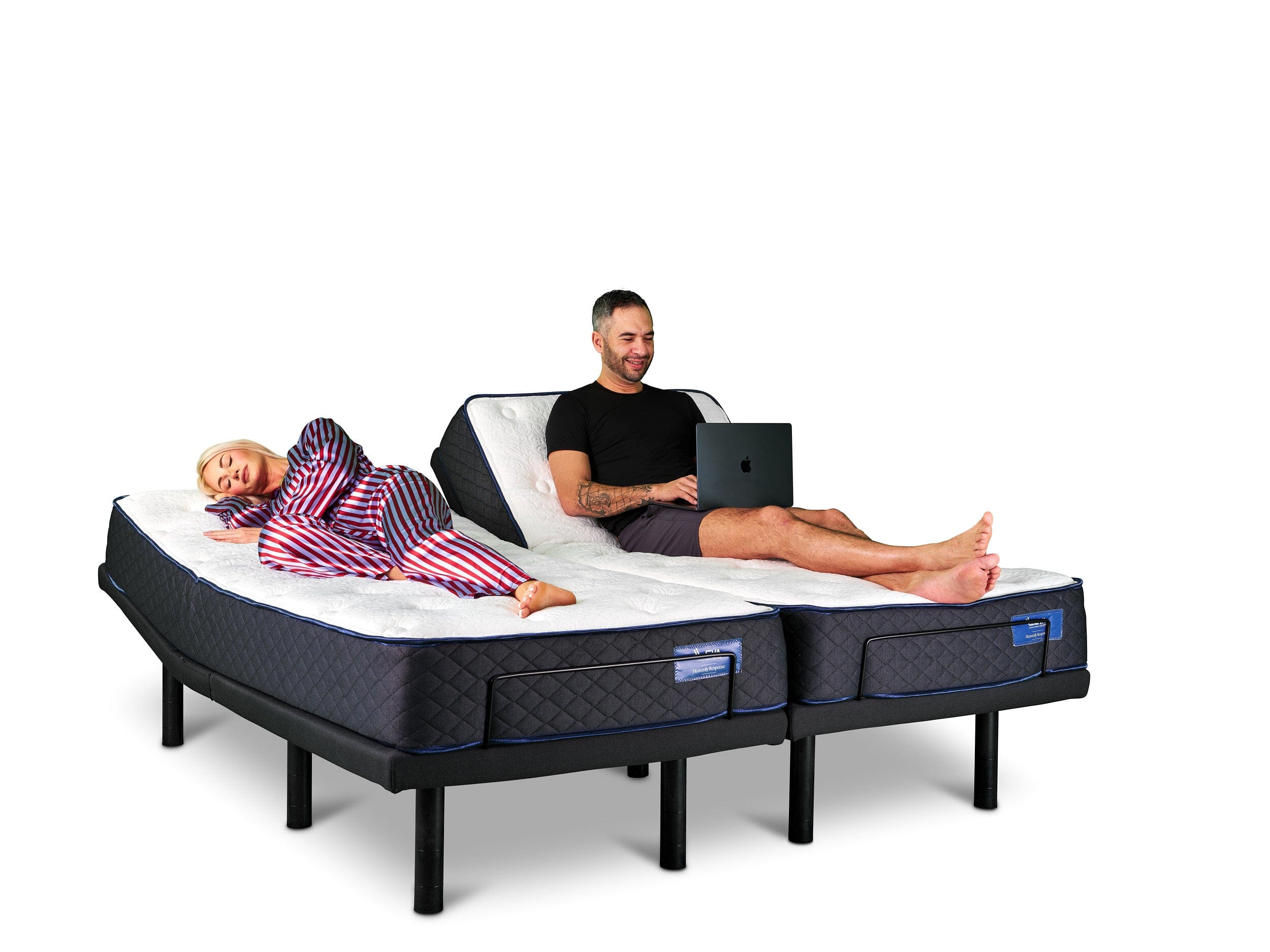
- True split queen adjustable bases give each partner full independent head and foot control within a standard 60″ × 80″ queen frame, which solves the core compatibility problem.
- Key evaluation factors include quiet motors, zero-gravity and anti-snore presets, hybrid mattress compatibility, per-side temperature control, and a tiered Canadian warranty with local service.
- Leva Sleep specializes in true split queen systems with white-glove delivery across Ontario and Alberta; browse split queen configurations that let both partners sleep their way.
The Problem: Sleep Divorce, Snoring, and Medical Sleep Needs
Adults who share a bed experience 50% more sleep disturbances than solo sleepers, mainly from partner movement, temperature disagreements, snoring, and mismatched schedules. Snoring is common among adults, and the non-snoring partner loses an estimated one hour of sleep per night as a result.
The medical dimension compounds the problem. Combined moderate and severe obstructive sleep apnea affected 28.1% of adults aged 45–85 in the 2015 Canadian Longitudinal Study on Aging sample, yet about 6% of Canadian adults aged 18–79 reported a formal diagnosis of sleep apnea by a health care professional in 2016–2017. Among older adults, high risk for obstructive sleep apnea was estimated at 21.9% of men and 13.1% of women. Meanwhile, insomnia disorder affects approximately 16.3% of Canadian adults according to a 2023 survey by the Canadian Sleep Research Consortium, with nighttime insomnia symptoms increasing 42% between 2007 and 2015 among Canadian adults.
Given these widespread compatibility and medical issues, many couples start comparing different bed configurations. They usually discover that common setups only solve part of the problem.
Why Flat Beds, Basic Adjustable Bases, and Split Kings Miss the Mark
Each common solution addresses part of the problem but not all of it. The table below compares the four main options on the criteria that matter most to Canadian couples with independent sleep needs.
| Solution Type | Independent Articulation Per Partner | Queen Footprint (60″ × 80″) | Canadian Availability |
|---|---|---|---|
| Traditional Flat Bed | None | Yes | Universal |
| Single Queen Adjustable Base | None, both sides move together | Yes | Widely available |
| Split King (two Twin XL bases) | Full independent control per side | No, requires 76″ × 80″ king frame | Widely available |
| True Split Queen Adjustable Base | Full independent control per side | Yes, two 30″ × 80″ bases in queen frame | Specialty item; limited floor stock |
The split king is the most widely marketed adjustable couple’s solution in Canada, but it requires a king-sized bedroom footprint. Split queen adjustable bases are under-represented on Canadian showroom floors because the product is more niche and requires explanation. Canada’s population is roughly one-tenth of the United States, and the specialty demand for split queen foundations or bases does not generate enough volume to justify floor stock at most retail locations. As a result, couples who need independent adjustability in a queen footprint have very few places to turn.
The Split Queen Solution: Independent Control in a Queen Room
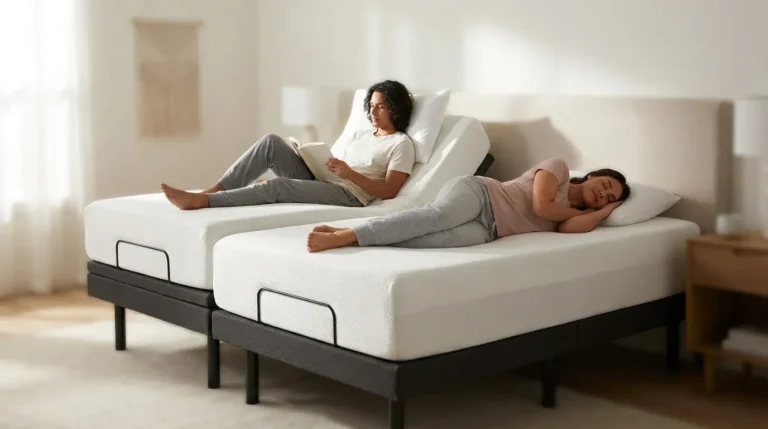
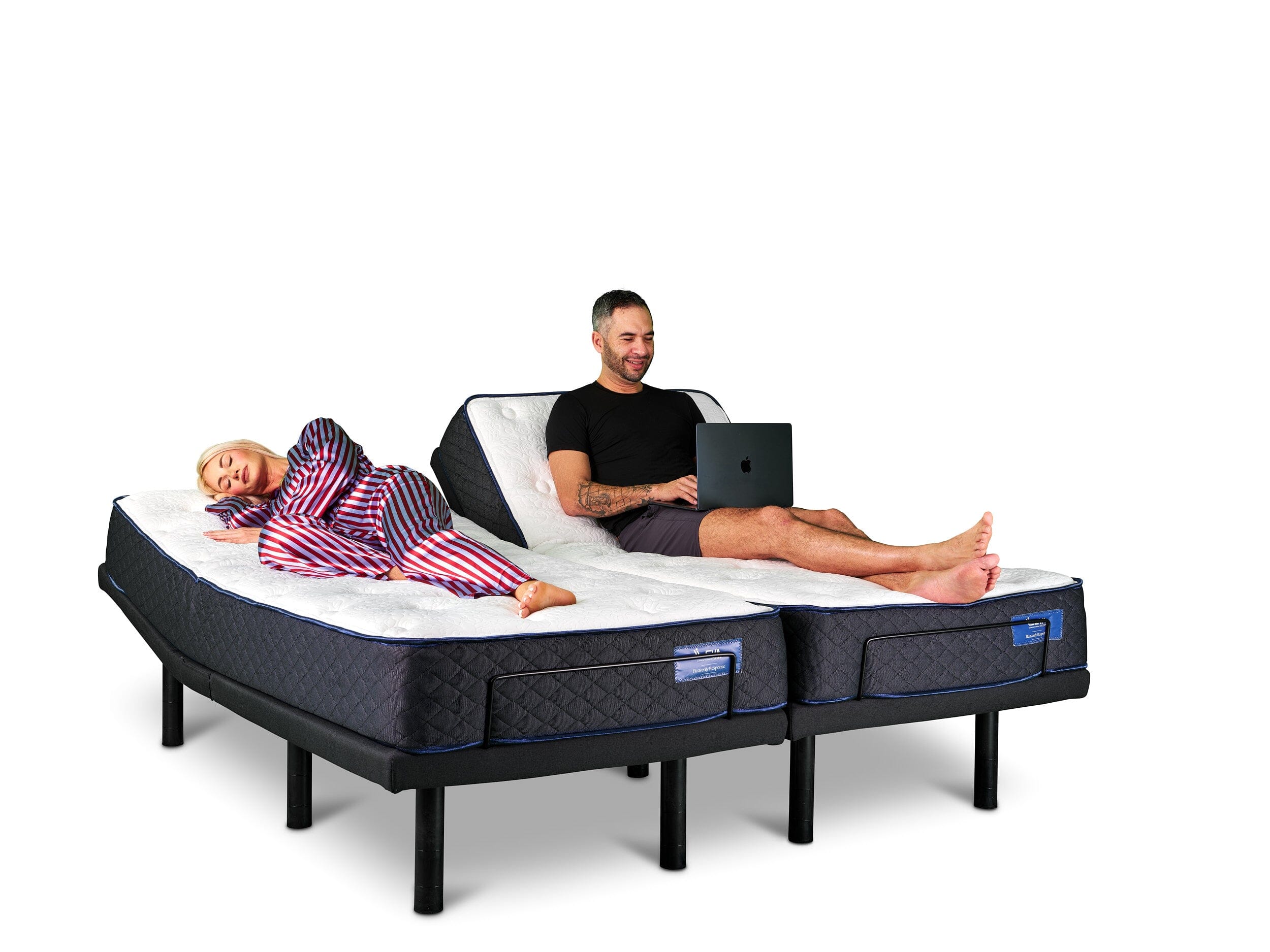
A split queen adjustable bed base consists of two separate bases, each 30 inches wide and 80 inches long, that sit side by side within a standard queen frame. Each half operates independently. One partner can elevate their head for snoring or apnea management while the other remains flat. One can raise their feet for circulation while the other does not. There is no mechanical linkage between the two sides.
Leva Sleep is one of the only Canadian retailers that designs, builds, and stocks true split queen adjustable systems as a primary product rather than a special order. With a broad adjustable lineup and in-house white-glove delivery across Ontario and Alberta, Leva Sleep provides the full ownership experience: base, compatible mattress, specialized bedding, and professional setup. Compare all current split queen models and find your configuration.
Key Evaluation Criteria for Split Queen Adjustable Beds
Independent Articulation, Zero-Gravity, and Anti-Snore Positions
Start by confirming that each half of the base articulates fully independently at the head and foot, with no mechanical link to the other side. Once you confirm independent control, check whether the base reaches a true zero-gravity preset, where both head and knees are raised above heart level. This position reduces joint stress for arthritis sufferers, of whom over 80% report sleep trouble according to the Arthritis Foundation. After that, look for an anti-snore preset that raises the head section to 10–20 degrees without requiring manual adjustment each night.
Quiet Motor Performance for Shared Bedrooms
- Adjustable beds in the $1,200–$2,000 CAD range in Canada often feature German-engineered motors (Okin or Kaidi) for quieter operation and higher durability.
- Ask the retailer for the motor brand and decibel rating, because a loud motor that wakes the non-adjusting partner defeats the purpose of independent control.
- Motor quality strongly influences long-term ownership costs and overall satisfaction.
Mattress Compatibility and Bedding That Actually Stays Put
Hybrid mattresses with individually pocketed coils are compatible with adjustable bases because each coil moves independently, whereas traditional innerspring mattresses using interconnected Bonnell or continuous coils resist bending and can permanently deform. For adjustable bases, mattress thickness should ideally stay in the 10–14 inch range and generally not exceed 14–15 inches. Thicker mattresses can exceed base weight ratings and create excessive bending stress at hinge points.
Standard fitted sheets will not stay on a split queen base during articulation. You need sheets with deep pockets and reinforced elastic, and duvets with clips designed to maintain separation when the two sides sit at different angles. This combination keeps each side secure while both partners move independently.
Per-Side Temperature Control
- Look for integrated heating and cooling pad compatibility on each side independently, so a partner who sleeps hot is not affected by the other’s warmth preference.
- Confirm that temperature controls are accessible per side through an app or remote, not a single shared panel.
Noise Levels and Long-Term Reliability
Well-constructed adjustable bases in Canada are engineered for a 10- to 15-year lifespan with proper care. Adjustable base warranties in Canada typically follow a tiered structure covering motors for 3–25 years, frames for 10–20 years, and remotes or electronics for 1–3 years. Before you buy, ask whether motor replacement under warranty is full or prorated and who pays shipping costs on defective parts. These details affect both noise-related repairs and overall reliability.
Canadian Delivery, Stairs, and Setup
- Canadian buyers should measure all entry points, including doors, hallways, stairwells, and bedroom doorways, against the packaged dimensions of the adjustable base before purchase.
- A split queen ships as two separate 30-inch-wide units, which navigate narrow staircases more easily than a single queen base or a split king pair.
- White-glove delivery should include in-bedroom setup, leg height adjustment, a product tutorial, and removal of the old bed, not just curbside drop-off.
Practical Benefits for Couples in Everyday Use
The clinical evidence for head elevation is consistent across multiple studies. A 2017 study of 52 patients with obstructive sleep apnea found that elevating the head of the bed by 7.5 degrees can reduce the apnea-hypopnea index and improve minimum oxygen saturation. Clinical research also shows that head-of-bed elevation can reduce the apnea-hypopnea index by roughly 30–45%, which makes it a useful positional therapy for selected obstructive sleep apnea profiles.
For couples, the split configuration means these benefits do not require the other partner to change position. Consider three common scenarios.
- Snoring and apnea: One partner elevates their head to 10–20 degrees while the other sleeps flat. Neither disturbs the other during adjustment.
- Joint pain and circulation: Vascular specialists and physical therapists recommend leg elevation above heart level for venous insufficiency, post-surgical swelling, or lower-leg edema. Independent foot articulation achieves this without affecting the other side of the bed.
- Temperature and firmness: Each partner controls their own heating or cooling pad and selects a mattress firmness suited to their body weight and sleep position. This approach removes the nightly negotiation over blankets and thermostat settings.
Leva Sleep’s anti-snore mode detects snoring and makes micro-adjustments to the head of the bed automatically, so the snoring partner does not need to wake and reposition manually. See which model tiers include automatic snore detection.
Split Queen Adjustable Bed Model Comparison for Canada
The table below outlines key purchase considerations across representative options available to Canadian buyers in 2026. Leva Sleep pricing reflects direct-to-consumer positioning; competitor figures are drawn from published Canadian retail sources. Because model features vary significantly, buyers should verify current specifications directly with each retailer before purchasing.
| Retailer / Model Tier | True Split Queen Available | Indicative Queen Base Price (CAD) | Warranty Structure |
|---|---|---|---|
| Leva Sleep (specialist, Ontario & Alberta) | Yes, primary product offering | 30–50% below comparable luxury competitors; contact for current pricing | In-house warranty; local service in Ontario and Alberta |
| Amerisleep Adjustable Bed+ (Canada) | No, split king only | $1,400 CAD (queen); split queen not offered | 10-year tiered; customer pays shipping from year 2; no returns |
| Orthex Sophia 2 (Canada-wide) | Not confirmed for split queen | From $2,499.99 CAD (queen); $400 flat-rate white-glove delivery | 10-year warranty; local Quebec service |
| General mattress retailers (e.g., Sleep Country) | Rarely, adjustable bases are add-on products | Lifestyle tier from about $1,000–$2,000 CAD | Varies by brand; cross-border service common for US-manufactured bases |
For couples specifically seeking a true split queen configuration in Ontario or Alberta, Leva Sleep is the only retailer in this comparison that offers it as a standard, in-stock product with local white-glove delivery and in-house warranty service. Review the split queen lineup side by side and shortlist suitable models.
Frequently Asked Questions
Will fitted sheets stay on a split queen adjustable base when both sides move?
Standard fitted sheets will not stay on a split queen adjustable base when the two sides are elevated to different positions. The sheet is designed for a flat, single-surface mattress and cannot accommodate independent articulation on each half. The solution is purpose-built bedding: fitted sheets with deep pockets, typically 18–22 inches, and reinforced elastic around the entire perimeter, not just the corners. Duvets with clip systems that allow each half to move independently without pulling the cover off the other side are also necessary. Leva Sleep designs its entire bedding accessory line specifically for adjustable bases, including split configurations, so all components work together without modification.
Do doctors recommend adjustable beds for sleep apnea and snoring?
Sleep specialists and pulmonologists often recommend head-of-bed elevation as a supplemental strategy for mild obstructive sleep apnea and positional snoring, particularly for patients who are intolerant of CPAP therapy. Elevating the head reduces the gravitational collapse of the tongue and soft tissues into the airway. Multiple peer-reviewed studies have documented reductions in the apnea-hypopnea index of 31–45% at elevation angles between 7.5 and 30 degrees. Head-of-bed elevation does not replace CPAP in moderate-to-severe apnea, and any patient with suspected sleep apnea should obtain a formal sleep study before relying on positional therapy alone. For couples, a split queen adjustable base allows the partner with apnea to maintain a therapeutic head elevation every night without requiring the other partner to sleep at an incline. Leva Sleep is also referred to by sleep apnea clinics for patients seeking non-CPAP positional support.
What is the difference between a split queen and a split king in Canada, and which suits smaller bedrooms?
A split king consists of two Twin XL bases, each 38 inches wide and 80 inches long, placed side by side for a total width of 76 inches, the standard king size. A split queen consists of two bases, each 30 inches wide and 80 inches long, placed side by side for a total width of 60 inches, the standard queen size. For bedrooms that cannot accommodate a king-sized frame, a split queen is the only configuration that delivers full independent adjustability per partner without requiring a room upgrade. The trade-off is that split queens are significantly harder to find in Canada because market demand is lower and most retailers do not stock them. Couples in Ontario and Alberta with queen-sized bedrooms who want independent controls should evaluate Leva Sleep’s split queen packages directly, as this is one of the few Canadian retailers that carries the configuration as a standard product.
What should Canadian buyers know about warranty and service for adjustable beds?
As noted in the evaluation criteria, Canadian adjustable base warranties usually follow a tiered structure. The most important questions to ask before purchasing are whether motor replacement under warranty is full or prorated, who pays shipping costs on defective parts, and whether service is handled locally or requires cross-border logistics. For US-manufactured bases sold through Canadian retailers, warranty service often involves shipping components across the border, which adds time and cost. Leva Sleep handles warranty service in-house through its Ontario and Alberta operations, which removes cross-border complications and ensures local technician access for the life of the product.
Conclusion: Choosing a True Split Queen to End Nightly Compromise
Sleep divorce and medical sleep requirements do not resolve through compromise alone. They improve when each partner gains independent control. A true split queen adjustable base gives each partner full articulation of their own head and foot sections within a standard queen footprint. This configuration addresses snoring, sleep apnea, joint pain, temperature differences, and firmness preferences at the same time. The category remains rare in Canada because demand has historically been too low for most retailers to stock it, which makes specialist sourcing essential.
When evaluating options, prioritize true independent articulation per side, quiet German-engineered motors, certified mattress compatibility, purpose-built bedding, a transparent tiered warranty with local service, and white-glove delivery that includes in-bedroom setup. Leva Sleep meets all of these criteria as Canada’s dedicated split queen and split king authority, with 8 years of expertise, 25,000+ customers, and pricing 30–50% below comparable luxury competitors. Find your split queen configuration and end the nightly compromise.