
Written by: Matthew Timmins, Founder and Managing Director, Leva Sleep | Last updated: July 24, 2026
Key Takeaways for Hip Pain and Shared Beds
- Split-queen adjustable beds keep a standard queen footprint while giving each partner independent head, foot, and lumbar control for hip pain relief.
- Zero-gravity positioning with a medium-firm hybrid mattress spreads weight away from the hips and eases pressure for side sleepers with bursitis or arthritis.
- Unlike a split king, a split queen fits existing queen frames and sheets, which suits Canadian bedrooms that cannot handle a larger footprint.
- Key evaluation factors include quiet motors, dedicated lumbar tilt, hybrid mattress compatibility (10–14 in), and white-glove delivery with domestic parts support.
- Leva Sleep offers purpose-built split-queen adjustable packages with white-glove delivery in Ontario and Alberta. Explore split-queen packages with white-glove delivery.
The Problem: How Hip Pain Disrupts Shared Sleep
Approximately one in ten adults reports hip pain, and prevalence rises with age. In one large survey of US adults aged 60 and older, 14.3% reported significant hip pain on most days over the past 6 weeks. The sleep consequences are severe, and many patients with common orthopaedic conditions report sleep problems related to those conditions.
The Arthritis Foundation reports that more than one-third of adults experience sleep disruption from hip, knee, or foot pain. Side sleepers face higher risk. Nighttime hip pain is frequently caused by sleep position or mattress, with side sleepers prone to pressure on the hip joint and potential strain on the opposite hip. Hip bursitis, particularly common in women over 40, causes pain and stiffness at the hip joint and is associated with extremely poor sleep for side sleepers.
The mechanical cause is straightforward. Many people spend a significant portion of the night on their side, and maintaining natural spinal curvature in that position requires different support zones for the shoulders, waist, and hips. When a flat mattress is too firm, it concentrates pressure at the greater trochanter. When it is too soft, the hip sinks and the spine curves laterally. Because both extremes create pressure points or misalignment, neither position is sustainable across a full night.
When one partner’s pain causes repeated repositioning, the motion transfer wakes the other. Over time, the couple often chooses between compromised sleep and separate rooms, a pattern sleep specialists call a “sleep divorce.”
Traditional Hip Pain Solutions and Their Limits
Three conventional approaches exist, and each carries a significant limitation for couples dealing with hip pain.
| Solution | Hip Pressure Relief | Partner Motion Isolation | Independent Elevation |
|---|---|---|---|
| Flat mattress (medium-firm hybrid) | Partial, depends on firmness match; medium-firm hybrids can balance hip contouring with support | Moderate, pocketed coils reduce but do not eliminate transfer | None |
| Basic single adjustable base (queen) | Improved, elevation reduces joint load, but both partners move together | None, one motor controls the entire surface | None, both sides rise and fall as one unit |
| Split king adjustable base | High, full independent control per side | High, two separate mattresses eliminate cross-transfer; research published in the journal Sleep found that bed partners influence movement during sleep, with a second study comparing subjects who slept with versus without a partner. | Full, head, foot, and lumbar independent per side |
The split king solves the problem mechanically but introduces a space challenge. A split king uses two 38″ × 80″ twin XL halves to create a 76″ × 80″ king surface, which requires a larger room, a new frame, and dedicated split-king sheets. For couples in standard Ontario or Alberta bedrooms who are not prepared to reconfigure their space, the split king is a non-starter.
The Split-Queen Adjustable Bed Solution
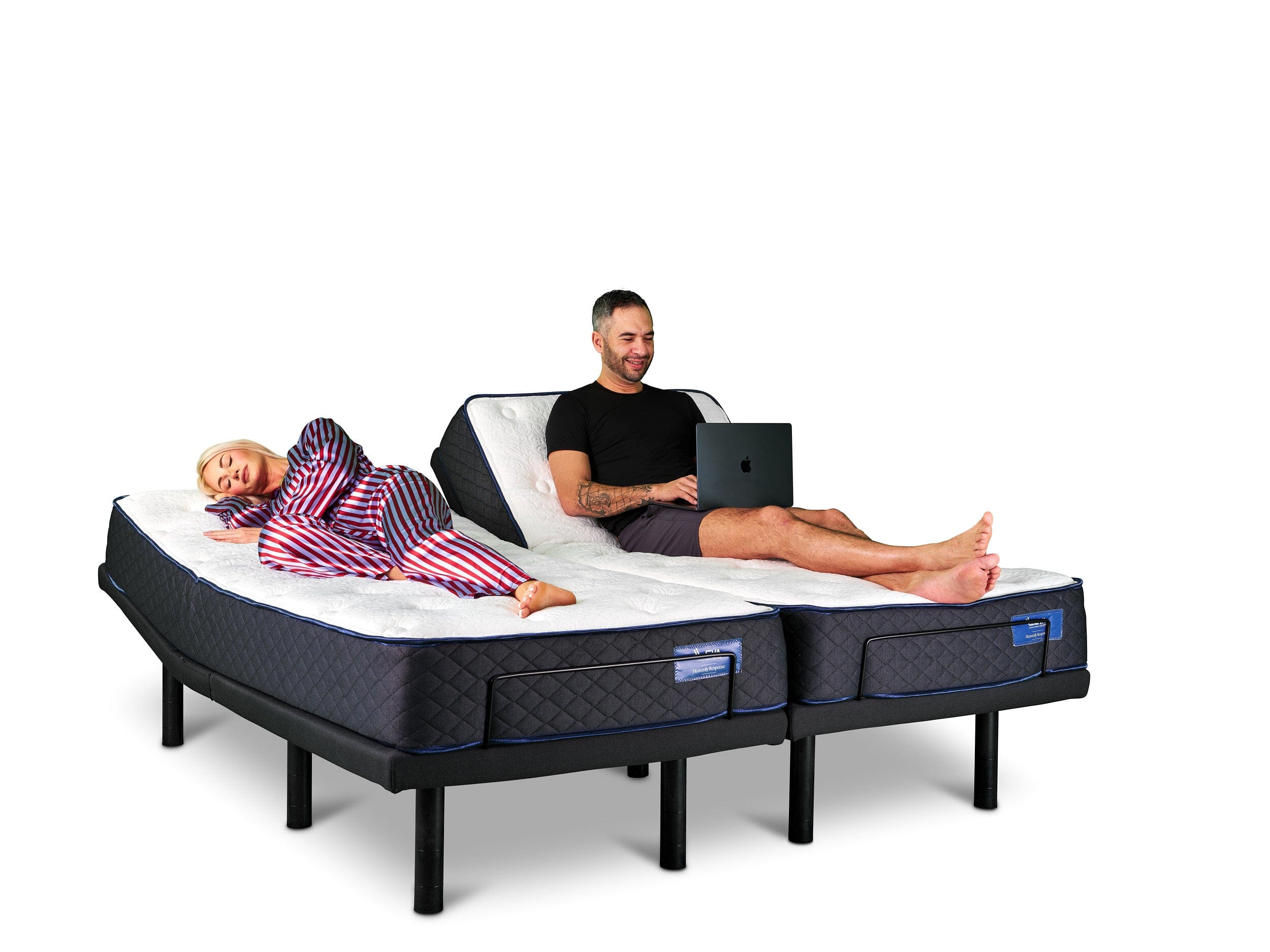
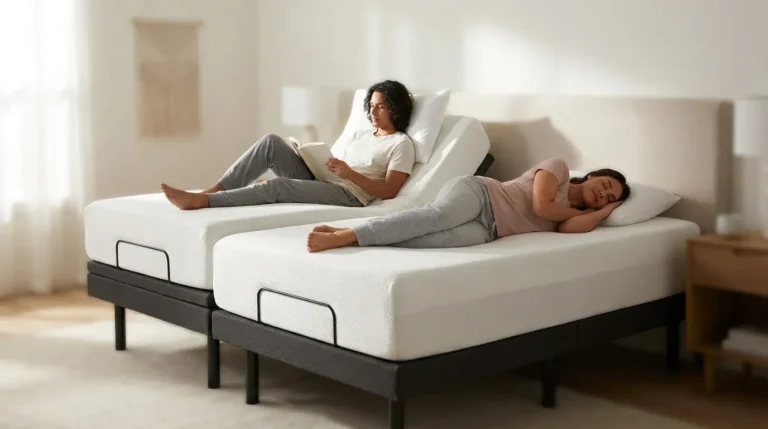
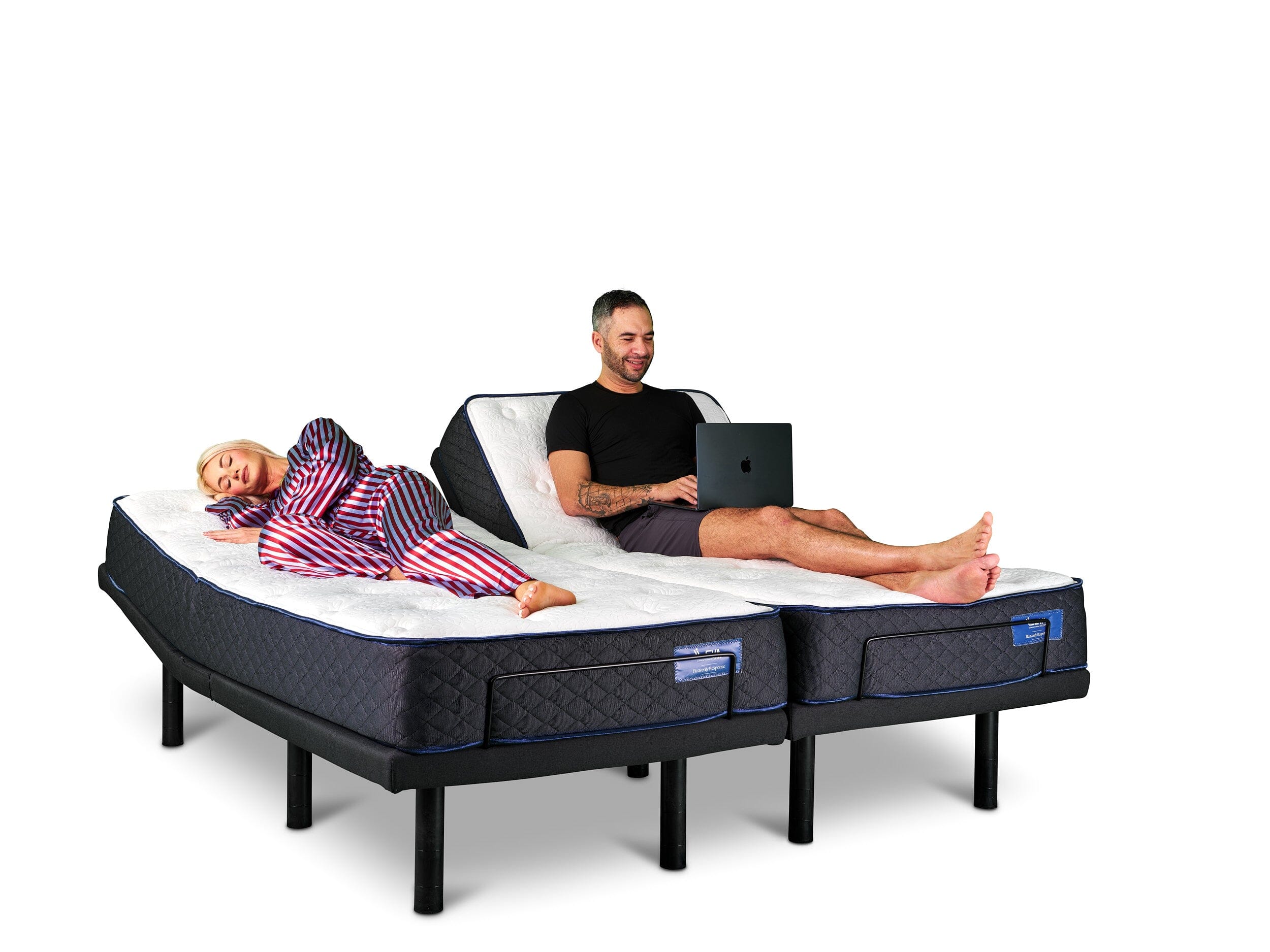
This is where the split queen becomes the practical alternative. A split queen mattress consists of two 30″ × 80″ halves that together form a standard 60″ × 80″ queen footprint. A split-queen adjustable base places two independent platforms side by side inside a standard queen frame, which enables fully separate head, foot, and lumbar adjustments for each partner. As noted earlier, this preserves your existing room layout and bedding.
The zero-gravity position raises the head and knees so the body approximates the posture of an astronaut at launch. This posture distributes body weight across the full sleep surface rather than concentrating it at the hips and lumbar spine. An adjustable bed frame with zero-gravity positioning can further reduce hip and lumbar disc pressure for chronic sufferers when paired with zoned medium-firm mattresses. Lumbar tilt adds a secondary adjustment, where a bar or bladder behind the lower back provides targeted support that a flat mattress cannot replicate regardless of firmness.
Because each side operates independently, one partner can use zero-gravity positioning for hip pain relief while the other remains flat, reads with the head raised, or uses a different elevation entirely. For couples with differing sleep positions or pain needs, the core benefit of either split format is independent positional control so one partner’s required elevation does not force movement on the other side.
Finding a retailer that treats split-queen systems as a core product line improves selection and support. Leva Sleep builds and delivers split-queen adjustable systems as a specialty focus with in-house white-glove delivery in Ontario and Alberta. With over 25,000 customers and $50M in lifetime sales, Leva offers 15–20 adjustable base models compared to the 3–5 typically found at general mattress retailers, and prices its systems 30–50% below comparable luxury competitors through a direct-to-consumer model.
How to Evaluate a Split-Queen for Hip Pain Relief
Firmness and Pressure Relief
Medium-firm hybrids often perform well for hip pain because they balance contouring for hip pressure relief with enough support to prevent excessive sinkage. To verify this balance for your body, lie on your side for at least ten minutes and assess whether the hip sinks past the shoulder line. If it does, the mattress is too soft. If the hip feels a concentrated point of pressure, it is too firm.
Lumbar and Pillow-Tilt Support
Look for bases that offer a dedicated lumbar support bar or bladder that adjusts independently of head and foot elevation. An adjustable lumbar support bar provides extra lower-back support and pressure relief in zero-gravity mode. Pillow tilt uses a secondary motor to adjust the uppermost section of the head panel, which lets you fine-tune neck and shoulder alignment without changing the overall head elevation angle.
Motor Noise
Motor quality directly affects how disruptive adjustments feel at night. Basic adjustable bases use open-gear motors that produce audible clicking and grinding during movement. Whisper-quiet motors, such as the German-engineered motors used in Leva Sleep’s bases, make micro-adjustments without waking a sleeping partner. Ask for a live demonstration at any elevation speed before purchasing.
Mattress Compatibility
Hybrid mattresses with individually wrapped pocketed coils flex well on adjustable bases without coil binding, which makes them suitable for split-queen configurations. Most adjustable base manufacturers recommend hybrid mattresses between 10 and 14 inches thick for smooth flex and strong support at an incline. Traditional innerspring mattresses with connected coils are incompatible and should not be used.
Temperature Regulation
Temperature control matters for many people with hip pain, especially women over 40 who often experience night sweats. Check whether the mattress uses open-cell foam, gel infusions, or phase-change materials. Also confirm whether the base supports an integrated heating and cooling pad for per-side temperature control.
Bedding Retention
Standard fitted sheets often pop off adjustable bases during elevation. Confirm that the retailer offers sheets with deep pockets, extra elastic, and split-queen dimensions. Leva Sleep designs its bedding accessories specifically for adjustable bases, including fitted sheets, duvet clips, and mattress protectors sized for split configurations.
Delivery and Setup
A split-queen adjustable system involves two independent bases, two mattresses, electrical connections, and leg-height calibration. White-glove delivery, where trained professionals deliver to the bedroom, assemble the system, calibrate leg heights, remove the old bed, and provide a product tutorial, removes the risk of incorrect setup that can void warranties or reduce performance.
Long-Term Serviceability
Post-purchase service should factor into your decision. Confirm that the retailer services its own products and that replacement parts for motors, remotes, and lumbar components are available domestically. Retailers that assemble locally and operate direct-to-consumer models are often better positioned to provide support than those relying on international supply chains for warranty claims.
Real-World Outcomes for Couples with Hip Pain
Consider a couple in their late 40s in Calgary. One partner has hip bursitis and wakes two to three times per night repositioning, and the other is a light sleeper disturbed by every movement. On a flat queen mattress, both sleep poorly. On a split-queen adjustable base with zero-gravity positioning on the affected side and a medium-firm hybrid mattress, the hip-pain partner reduces joint pressure through elevation while the other side remains flat and undisturbed.
Now picture a couple in Mississauga where one partner has been advised by a physician to sleep elevated for hip and lower-back pain. A standard queen adjustable base elevates both sides simultaneously and forces the pain-free partner into an unwanted incline. A split-queen base solves this by allowing independent elevation without requiring either partner to leave the bed.
The Arthritis Foundation recommends sleeping on the back with a pillow between the knees or using a more supportive mattress to relieve nighttime hip pain. A split-queen adjustable base turns this recommendation into a stable mechanical setup, enabling the back-sleeping position with leg elevation without requiring the partner to adopt the same posture.
Split Queen vs. Split King: Matching Your Space
| Factor | Split Queen | Split King |
|---|---|---|
| Total footprint | 60″ × 80″ — standard queen | 76″ × 80″ — king |
| Per-person width | 30″ per side | 38″ per side |
| Frame compatibility | Standard queen frame, no room reconfiguration required | Requires king frame and typically a larger room |
| Independent elevation | Full, head, foot, lumbar per side | Full, head, foot, lumbar per side |
| Bedding availability | Specialty, split queen is a specialty item rarely stocked on retail floors; Leva Sleep designs purpose-built bedding | Requires dedicated split-king sheets or two Twin XL sheet sets |
| Best for | Couples in standard bedrooms who need independent positioning without upsizing | Couples who prioritize maximum personal space and have room for a king footprint |
Brad Grose, owner of Mattress Miracle in Brantford, Ontario with more than 38 years in the industry, has observed growing interest in split king adjustable beds among couples. The split queen serves the portion of that market that cannot or will not upsize their room, a group that has historically had very few purpose-built options in Canada.
Frequently Asked Questions About Split-Queen Adjustable Beds
Do doctors recommend adjustable beds for hip pain?
Physicians and orthopaedic specialists frequently recommend positional adjustments for hip bursitis, arthritis, and lateral hip pain. Sleeping on the back with the legs slightly elevated reduces pressure on the greater trochanter and the hip joint capsule. An adjustable base mechanically achieves this position and holds it consistently through the night, which a pillow arrangement cannot reliably do. Patients who have been advised to sleep elevated for hip or back pain should confirm the specific elevation angle with their treating physician, because recommendations vary by diagnosis.
What is the best zero-gravity setup for a side sleeper with hip pain?
Zero-gravity positioning elevates both the head and the knees so the body weight is distributed across the full mattress surface rather than concentrated at the hips and lumbar spine. For side sleepers transitioning to zero-gravity, a practical approach starts with a modest head elevation of 15–20 degrees and a knee elevation of 10–15 degrees, then adjusts based on comfort. A medium-firm hybrid mattress with zoned support, softer at the shoulder and hip and firmer at the lumbar, complements the position by cushioning the trochanter while maintaining spinal alignment. Lumbar tilt, where available, adds targeted lower-back support that further reduces hip load.
How noisy are split-queen adjustable bases during adjustment?
Motor noise varies significantly by base quality. Entry-level bases use open-gear motors that produce audible clicking during movement. Premium bases use closed-gear or brushless motors engineered for quiet operation. Leva Sleep’s bases use whisper-quiet German motors designed to make adjustments without waking a sleeping partner. When evaluating any base, request a demonstration at full elevation speed and listen for grinding, clicking, or vibration transmitted through the frame. A base that is noisy in a showroom will be noisy in a bedroom.
What warranty and service considerations apply to split-queen adjustable bases in Canada?
Split-queen adjustable bases are specialty products with limited retail availability in Canada, which makes post-purchase service a critical evaluation factor. Confirm that the retailer services its own products domestically and that motor, remote, and structural components are available without international shipping delays. Retailers that design and assemble locally, as Leva Sleep does, are better positioned to fulfill warranty claims quickly. Review the warranty terms for motor coverage specifically, because motors are the highest-wear component in any adjustable base and coverage periods vary from two years to lifetime depending on the manufacturer.
Is a split-queen adjustable bed suitable for couples with very different firmness preferences?
A split-queen adjustable base provides independent positional control, including head, foot, and lumbar elevation, for each side. Firmness, however, comes from the mattress rather than the base. For couples with significantly different firmness preferences, a split-queen setup with two separate mattresses, one per 30″ half, allows each partner to select a different firmness level. Leva Sleep builds split-queen systems to customer specifications, including the option to pair different mattress models on each side. This combination of independent positioning and independent firmness selection addresses a wide range of differing sleep needs without requiring separate beds or separate rooms.
Conclusion: Selecting the Right Split-Queen System
Hip pain relief in a shared bed is a solvable problem. The solution relies on four components working together: a split-queen footprint that preserves the existing room layout, independent head and foot elevation per side, lumbar tilt for targeted lower-back support, and a medium-firm hybrid mattress with pocketed coils that flexes cleanly through the full range of adjustable positions.
When you compare options, prioritize motor noise, lumbar control availability, mattress thickness compatibility, purpose-built bedding, and the quality of the delivery and setup experience. Retailers that specialize in adjustable beds, rather than offering them as an add-on to a general mattress catalogue, usually carry more models, provide deeper technical guidance, and are better equipped to service the product after purchase.
Leva Sleep has built its entire business around this category, with more than 8 years in operation, over 25,000 customers, and a direct-to-consumer model that delivers split-queen adjustable systems with white-glove setup in Ontario and Alberta at 30–50% below comparable luxury competitors.