Written by: Matthew Timmins, Founder and Managing Director, Leva Sleep
Key Takeaways
-
Many Canadian couples who switch between side and back sleeping struggle with one static mattress that cannot meet both partners’ firmness and support needs.
-
Medium-firm ratings on traditional hybrids average support across positions, which often leaves sleepers with shoulder or back pain on a fixed surface.
-
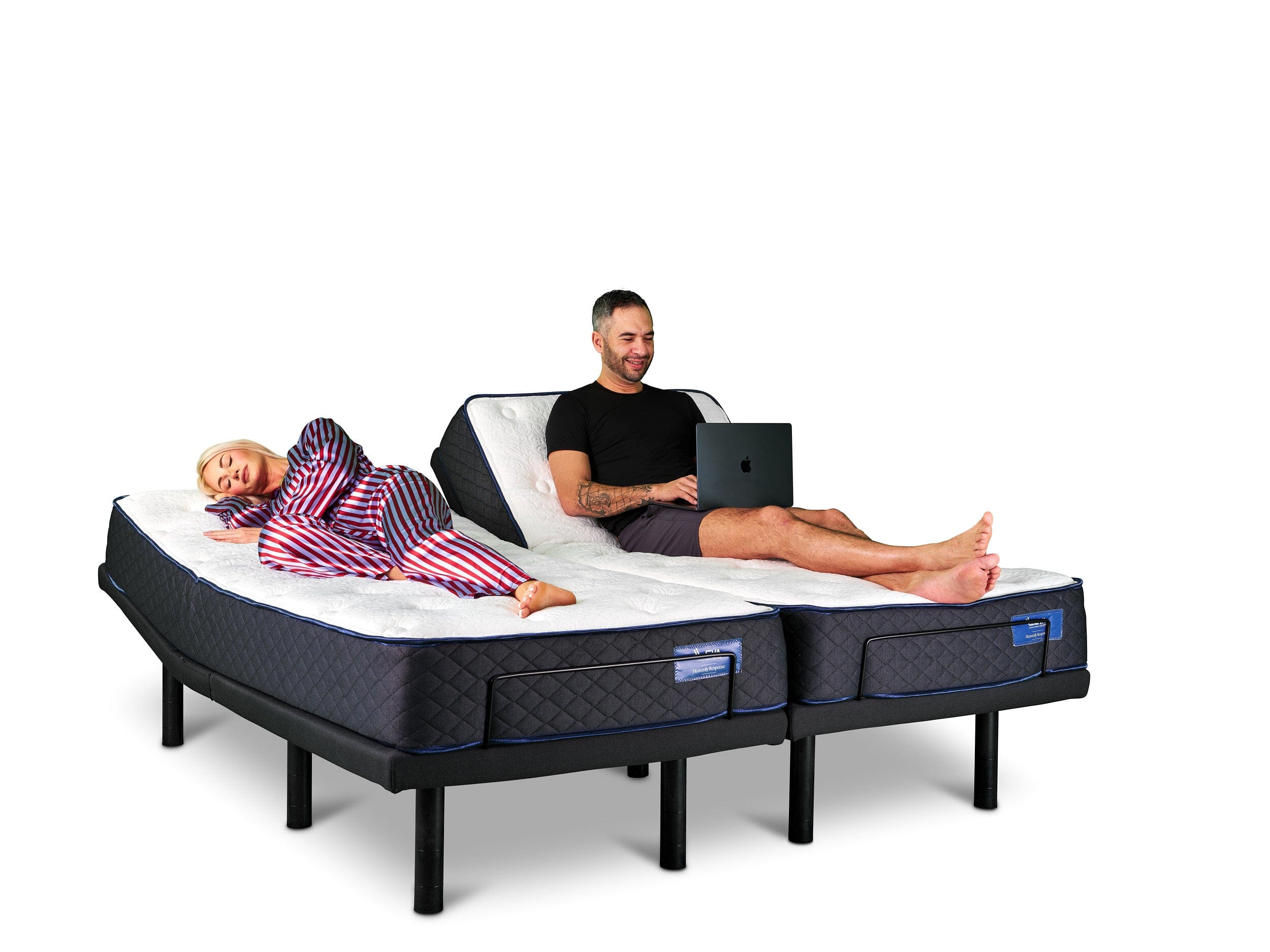
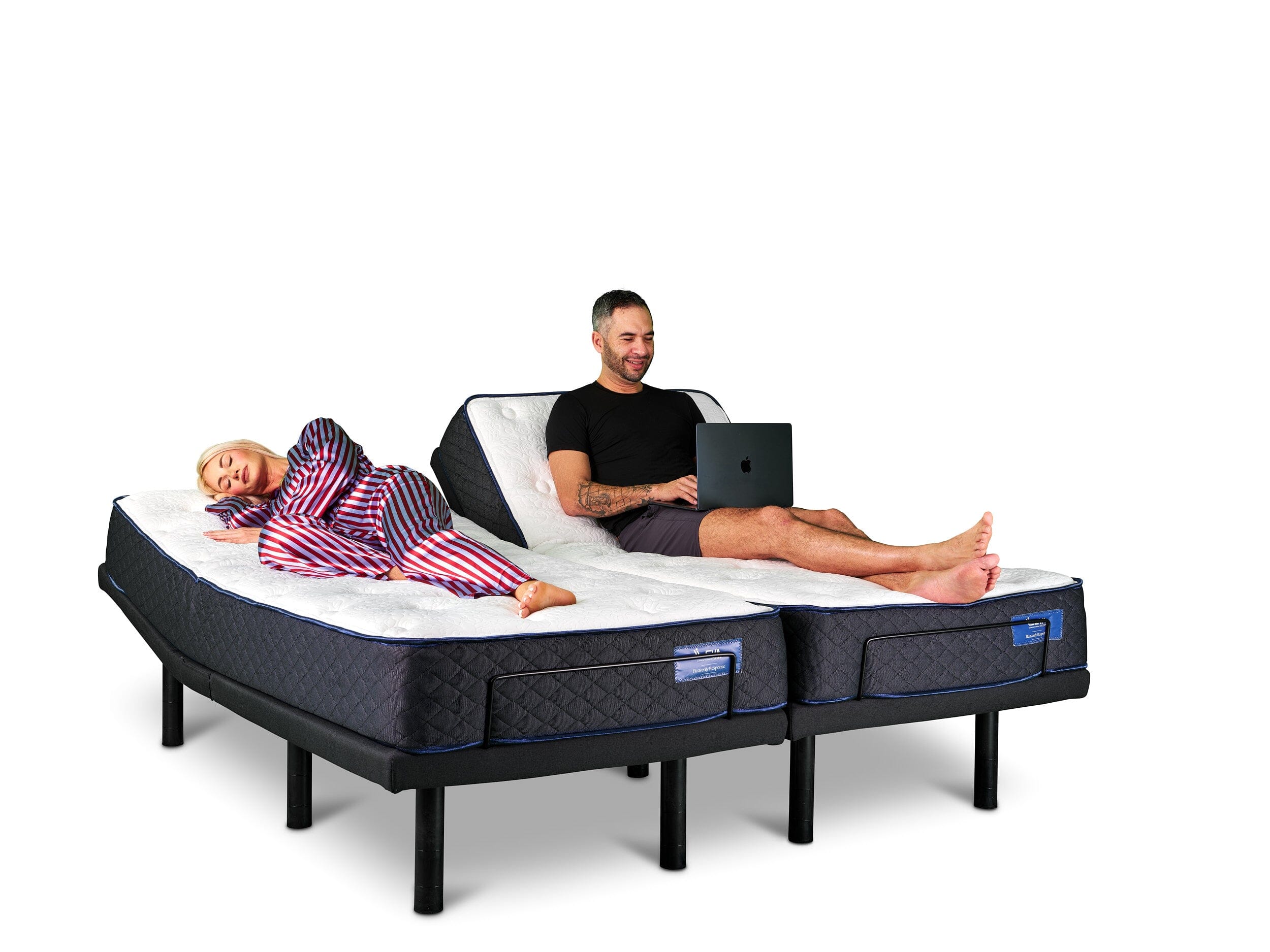
Split adjustable systems let each partner control firmness, head and foot elevation, and lumbar support separately, so the bed can match changing sleep positions through the night.
-
Features such as anti-snore incline, motion isolation on split bases, and targeted positioning can reduce snoring, pressure points, and the pressure to move to separate beds.
-
Couples in Ontario and Alberta who want customizable comfort can explore Leva Sleep’s Split Queen and King adjustable bed packages for a configuration tailored to both sleepers.
Why Medium-Firm Mattresses Often Fail Mixed-Position Couples
A medium-firm mattress, rated roughly 5–7 on a 10-point scale, is often recommended for mixed-position sleepers because it balances surface cushioning with deeper support. That rating still describes a fixed, averaged response. About 40% of Canadian couples disagree on mattress firmness, and that disagreement reflects real biomechanical differences in body weight, shoulder width, hip structure, and preferred sleep position, not just personal taste. A static surface cannot adjust to those differences at the same time for both partners.
Side & Back Sleepers with Shoulder Pain: Why Static Hybrids Fall Short
Side sleeping concentrates body weight on the shoulder and hip. When a mattress feels too firm, the shoulder is pushed inward instead of cradled, which creates pressure that can radiate through the rotator cuff and upper back. When the surface feels too soft, the spine loses lateral alignment and the shoulder can still ache. The Silk & Snow Hybrid’s pressure-relieving foam comfort layers can feel comfortable for many side sleepers and show how weight range narrows the effective window of any static mattress.
Couples face an extra complication because one partner’s shoulder-pain needs may conflict directly with the other partner’s preference for a firmer surface. Static hybrids address this only partially through zoned coil arrangements that vary support by body region but stay fixed after purchase. Independent elevation on a split adjustable base adds a second variable. Raising the head slightly while side sleeping can reduce pressure on the downward shoulder by shifting some weight toward the torso. A static mattress cannot create that kind of positional change.
Side & Back Sleepers with Back Pain: How Elevation Complements Firmness
A 2003 Lancet study found that medium-firm mattresses reduced chronic back pain more effectively than firm mattresses, although ideal firmness still varies by person. Back sleeping requires lumbar support to prevent the lower back from sinking into a gap between the mattress and the natural curve of the spine. Side sleeping requires lateral alignment along the length of the spine. A sleeper who alternates between both positions through the night needs a surface that can support both patterns, and adults change their body position an average of 11 to 13 times per night.
Elevation adds a dimension that firmness alone cannot cover. Raising the foot of the bed slightly can reduce pressure on the lumbar spine and hip joints during back sleeping, which matters for people managing hip or knee conditions. Adjustable lumbar support, available on some higher-end bases, allows targeted support exactly where the lower back needs it, independent of the mattress firmness you choose.
Adjustable Systems for Couples: Snoring, “Sleep Divorce,” and Shared Beds
Snoring is one of the most disruptive factors for couple sleep quality and one of the most common reasons couples end up in separate beds. Some snoring is positional, with back sleeping often worsening snoring and side sleeping helping reduce it. Sleep apnea still requires separate medical evaluation.
Adjustable beds help with snoring by elevating the head and torso to keep airways open, using gravity to prevent the collapse of soft tissues in the throat. Different inclines can help reduce snoring depending on severity. A split king adjustable bed allows couples independent control, so one partner can maintain an anti-snore incline while the other sleeps flat without disturbance.
Canadian forum discussions increasingly use the term “sleep divorce” for couples who move to separate rooms. Dual-zone adjustable beds allow customization for sleeping partners with different preferences and address the root cause instead of just the symptom. Features such as anti-snore mode, app-controlled micro-adjustments, and independent lumbar control, available on systems like those from Leva Sleep, show how adjustable beds have evolved beyond simple head and foot elevation.
Static Hybrids vs Split Adjustable Systems for Canadian Couples
Split adjustable systems deliver three capabilities that static hybrids cannot match: independent firmness per side, elevation for medical or comfort positioning, and motion isolation across the split. The table below compares how static hybrids and adjustable systems perform on these criteria so you can see where each category excels and where trade-offs appear. Pricing for static hybrids reflects publicly listed Canadian retail figures, and adjustable system pricing varies by configuration. Verify current pricing, motor noise levels, and sheet compatibility directly with each retailer before purchasing.
|
Criteria |
Douglas / Endy / Silk & Snow (Static Hybrids) |
Split Adjustable Systems (e.g., Leva Sleep) |
|---|---|---|
|
Firmness zoning |
Fixed at purchase, some zoned coil designs |
Independent per side, adjustable after purchase |
|
Elevation range |
None (flat only) |
Head and foot elevation available on some models |
|
Anti-snore / medical positioning |
Not available |
10–30° head incline shown to reduce snoring |
|
Motion isolation |
Strong on Endy and Silk & Snow Hybrid |
Dependent on mattress selected, split base eliminates cross-side movement |
|
Canadian pricing range (approx.) |
$900–$2,200 CAD (mattress only) |
From ~$1,399 CAD (base only, Queen) at comparable Canadian retailers, Leva Sleep positions at 30–50% below luxury-tier competitors |
Adjustable Bed Trial Periods: How Leading Brands Compare
Trial periods vary widely across the Canadian market, and they affect your real risk level. The table below reflects publicly available information. Confirm current terms directly with each retailer before you buy.
|
Brand / Product |
Trial Period |
Return Policy Notes |
|---|---|---|
|
Endy Adjustable Base |
30 nights |
Verify current terms with Endy directly |
|
Casper Lift |
30 nights |
Verify current terms with Casper directly |
|
Logan & Cove (Canada) |
120 nights for mattresses purchased before May 31, 2023 |
Free shipping to most Canadian regions |
|
Nectar Adjustable Base |
60 nights |
Described as generous for an adjustable base |
|
Nolah Smart Adjustable Base |
No trial period |
Cannot be returned for free if unsatisfied |
|
Sealy Ease Power Base |
25-year limited warranty, no returns accepted |
|
|
Leva Sleep |
Verify current trial terms at levasleep.com |
White-glove delivery and setup included for a fee, Split Queen and King available |
Pre-Purchase Checklist for Adjustable Bed Buyers
-
Motor noise: Motor volume affects real-world comfort at night. Ask for a video demonstration or read verified owner reviews that mention noise during position changes while a partner sleeps.
-
Sheet and bedding compatibility: Standard fitted sheets often slip off elevated bases. Confirm whether the retailer sells or recommends deep-pocket sheets with reinforced elastic that are designed for adjustable use.
-
Split Queen availability: Most Canadian retailers stock Split King, which uses two Twin XL bases, but not Split Queen. If your room size requires a Queen, confirm the retailer can supply a true split configuration before you commit.
-
White-glove delivery scope: Clarify whether delivery includes bedroom placement, full assembly, leg-height adjustment, old-bed removal, and a product tutorial, or only curbside drop-off. Providers use the term “white-glove” inconsistently, and some charge extra for assembly or removal. Confirm exactly what your delivery fee covers so you avoid surprise costs on delivery day.
-
Ontario and Alberta delivery coverage: Not all adjustable bed retailers offer in-home setup in both provinces. Confirm that your postal code falls within the delivery zone before you place an order.
-
Trial period conditions: Confirm whether the trial applies to the base, the mattress, or both, and whether return pickup is included or billed to you.
-
Mattress compatibility: Not all mattresses flex safely on an adjustable base. All-foam and pocket-coil hybrid designs are generally compatible, while traditional innerspring mattresses are not. Verify compatibility before pairing products from different brands.
-
Total cost of ownership: Add the base price, mattress price, compatible bedding, delivery fee, and any accessory costs, then compare that total against a static hybrid’s all-in price.
Choosing the Right Setup for Shared Sleep
Static medium-firm hybrids from brands like Douglas, Endy, and Silk & Snow work well for individual sleepers or couples with closely matched needs. Their structural limitation is clear, because a fixed surface cannot independently serve two people with different body types, pain profiles, position habits, and firmness preferences.
Split adjustable systems address that limitation by separating each side’s elevation, firmness, and positioning controls. A simple evaluation framework helps. Identify which pain or disruption matters most, confirm that specific adjustable features address it, verify the trial period and delivery terms, and calculate total cost including bedding and setup before you compare prices.
For Canadian couples in Ontario and Alberta, Leva Sleep offers Split Queen and King configurations, including the Split Queen, which remains rare in the Canadian market. Packages include white-glove delivery, local assembly, and pricing positioned at 30–50% below many luxury-tier competitors. That mix of specialization, service, and value deserves a place beside any static hybrid shortlist.
Frequently Asked Questions
Can one partner use an elevated position on a split adjustable bed without disturbing the other?
Yes. A split adjustable base uses two independent frames placed side by side under a split mattress. Each side runs its own motor, so one partner can raise the head to an anti-snore incline or a zero-gravity position while the other remains flat. The two sides do not share mechanical components, which means position changes on one side do not move the other. This separation is the main functional advantage of a split configuration over a single adjustable base that moves both sides together.
What is a Split Queen adjustable bed and why is it harder to find in Canada?
A Split Queen uses two narrow Queen-width bases, each about 30 inches wide, placed together to form a standard Queen footprint of 60 by 80 inches. Most Canadian and American retailers stock Split King configurations, which use two Twin XL bases at 38 inches each, because Twin XL is a standard mattress size with broad manufacturing support. Split Queen often requires custom or semi-custom production, which most general retailers do not offer. Leva Sleep is one of the few Canadian retailers that builds Split Queen systems to order, so it suits couples who need independent controls but cannot fit a King-size footprint.
Do I need a special mattress for an adjustable base?
Yes. A mattress used on an adjustable base must flex repeatedly without damaging its internal structure. All-foam mattresses and hybrid mattresses with individually wrapped pocket coils are generally compatible. Traditional interconnected innerspring mattresses are not designed to flex and will wear out quickly on an adjustable base. When you purchase a split adjustable system, confirm that the mattress is explicitly rated for adjustable base use. Leva Sleep designs its mattresses, including all-foam and hybrid pocket-coil options, specifically for use with its adjustable bases, which removes compatibility guesswork.
How does head elevation reduce snoring, and is it a substitute for a CPAP machine?
Head and upper-torso elevation uses gravity to keep the airway open by preventing soft tissues in the throat, including the soft palate and base of the tongue, from collapsing backward during sleep. This approach works best for positional snoring, where lying flat is the main trigger. It does not replace a CPAP machine in cases of diagnosed obstructive sleep apnea, which requires medical management. For couples where one partner snores without a formal sleep apnea diagnosis, head elevation between 10 and 30 degrees offers a non-invasive first step that many people find effective. Anyone with suspected sleep apnea should consult a physician before relying on positional therapy alone.
What should white-glove delivery include, and what questions should I ask before booking?
White-glove delivery should at minimum include delivery to the bedroom, full assembly of the base and frame, mattress placement, leg-height adjustment to your preference, a working demonstration of all controls and app features, and removal of the old bed. Ask the retailer whether old-bed removal is included or costs extra, whether the delivery team will adjust leg heights on-site, and whether they will walk through the app or remote setup before leaving. Leva Sleep’s white-glove service covers all of these steps for a fee, with trained delivery staff who specialize in adjustable bed setup rather than general furniture delivery. Confirm that your postal code in Ontario or Alberta falls within the service area before you schedule.