
Written by: Matthew Timmins, Founder and Managing Director, Leva Sleep
Key Takeaways
- Chronic back pain in couples is easier to manage with an adjustable base that offers independent lumbar control, zero-gravity positioning, and a flexible, bend-safe mattress.
- Elevation between 30–45 degrees, combined with zoned lumbar support, reduces disc pressure, eases sciatic tension, and cuts down on morning stiffness.
- Traditional flat mattresses and basic adjustable bases lack the geometry changes and quiet motors needed for lasting pain relief and undisturbed partner sleep.
- Key evaluation criteria include quiet motors, true split configurations, clear adjustable-base mattress compatibility, and bedding that stays in place through the night.
- Leva Sleep offers Canadian couples adjustable bed packages with independent lumbar motors and white-glove delivery; shop Leva Sleep’s adjustable beds to find a configuration that matches your pain and space needs.
How Chronic Back Pain Disrupts Couples’ Sleep
Chronic lower-back pain often affects both people in a shared bed, even when only one partner has the diagnosis. When one partner shifts repeatedly to relieve pressure, the motion transfers across a flat mattress and wakes the other. Over time, the disruption compounds as one partner stacks pillows for elevation while the other tolerates the new shape and both accumulate sleep debt. In severe cases, couples move to separate rooms, sometimes called a “sleep divorce,” and trade intimacy for pain control.
The mechanical issue is simple. A flat mattress holds the lumbar spine in a neutral-to-compressed position all night. For people with disc issues at L4-L5 or L5-S1, ongoing compression without positional relief prolongs inflammation and morning stiffness. On a conventional flat base, neither partner can adjust elevation independently without disturbing the other.
How Elevation and Zoned Lumbar Support Relieve Pain
Raising the head between 30 and 45 degrees while elevating the feet reduces compressive load on lumbar discs by spreading body weight across a larger surface area. This position, often called zero gravity, was developed to reduce gravitational stress on astronauts during launch. Applied to sleep, it decompresses the spine, eases pressure on the sciatic nerve, and lowers muscular tension in the lower back.
Why zero gravity works: Elevating the head and knees together tilts the pelvis toward its natural neutral angle. This reduces lumbar disc pressure and allows paravertebral muscles to relax more completely. Many people notice less morning stiffness and better circulation to previously compressed soft tissue.
Zoned lumbar support adds a third articulation point at the mid-base. A dedicated lumbar motor inflates or raises a support zone beneath the L1-L5 region, filling the gap that forms between the mattress and the natural lumbar curve when the head and foot sections rise. The Sleep Foundation identifies lumbar support and pressure relief as primary criteria when selecting a mattress for back pain, and adjustable bases with dedicated lumbar motors address both at the same time.
Limits of Flat Mattresses and Basic Adjustable Bases
A flat mattress, regardless of foam grade or coil count, cannot change shape in three dimensions. It can soften or firm the surface, yet it cannot elevate the knees, decompress the lumbar spine, or adapt to each partner’s independent preference. For chronic back pain, surface comfort alone rarely solves the problem.
Basic adjustable bases change geometry but introduce new issues. Entry-level motors are often audible, with some producing 45–55 dB during movement, which is loud enough to wake a light sleeper. Many budget bases offer only head and foot articulation with no lumbar zone. Mattress compatibility is frequently ignored. Traditional interconnected innerspring mattresses have limited compatibility with adjustable bases and risk permanent warping or motor strain under repeated bending. Couples who pair an incompatible mattress with a new base often void the mattress warranty and damage the motor within months.
Even when the mattress is compatible, standard bedding introduces a separate set of problems. Conventional fitted sheets lack the deep pockets and elastic tension required to stay anchored when a base articulates to 60 degrees. Sheets that pop off at 2 a.m. erase much of the comfort and therapeutic benefit the base can provide.
Key Features to Evaluate in an Adjustable System
Independent lumbar motors: A dedicated lumbar zone motor operates separately from head and foot articulation. When evaluating lumbar motors, check whether the base offers continuous adjustment or only preset positions. Continuous adjustment matters because it allows micro-tuning for specific conditions such as L4-L5 or L5-S1 disc issues, where small changes in support angle can noticeably affect pain relief.
Motor noise: Quiet, German-engineered motors support nighttime adjustments without waking a partner. Verify noise levels before purchasing, since some manufacturers list motor wattage but not acoustic output. Customer reviews and in-store demos can help confirm real-world sound levels.
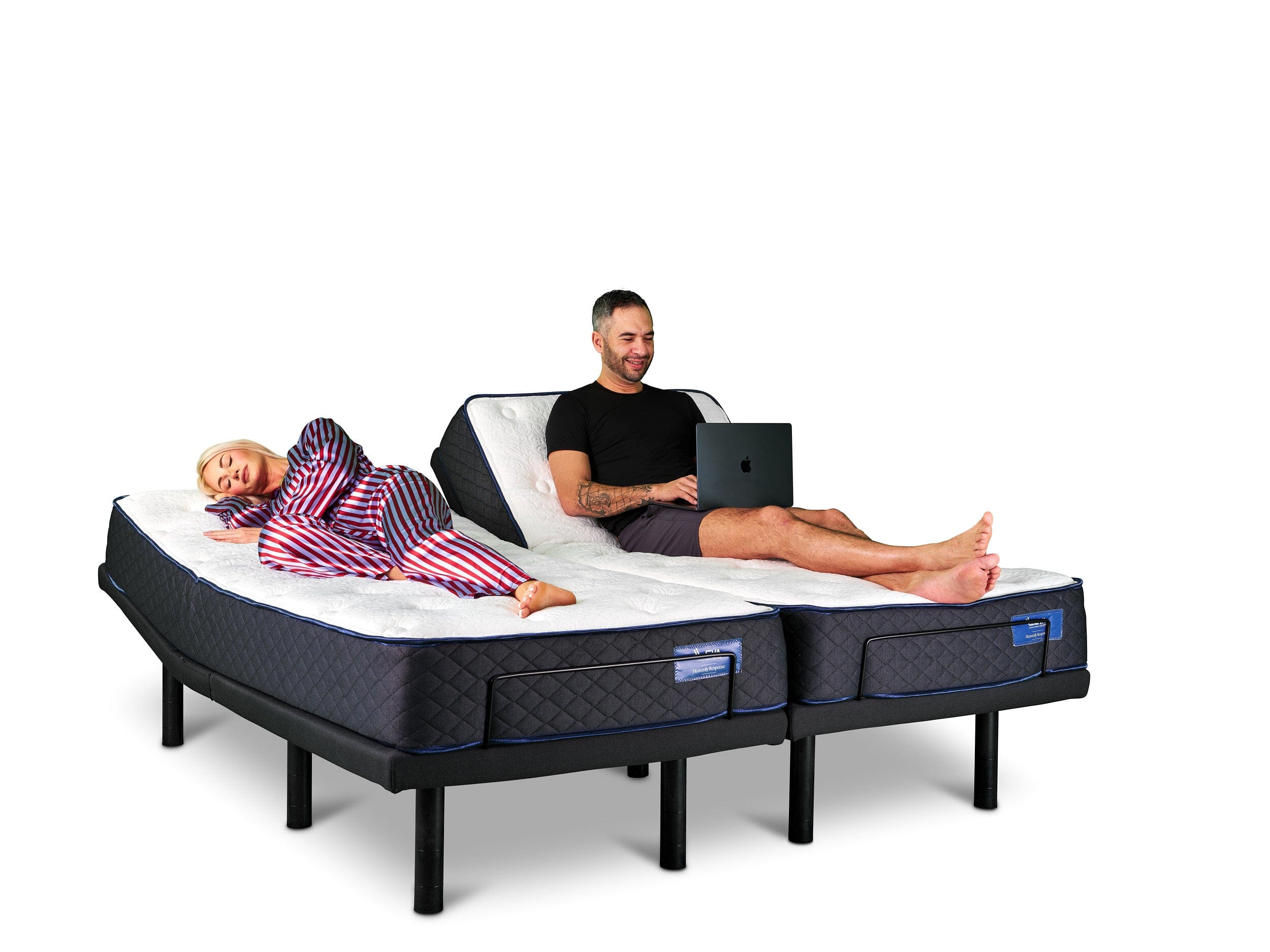
Split Queen and King configurations: A full-split King using two separate Twin XL mattresses on dual bases provides complete independence, including independent lumbar control. A split-head mattress divides only the upper portion of the bed and offers partial separation. For couples with different pain patterns, full-split independence is the practical standard. Split Queen configurations, which are rare in the Canadian market, provide the same independence in a smaller footprint.
Mattress compatibility: Memory foam usually rates highest for adjustable-base compatibility because its cellular structure returns quickly to shape. Latex ranks second for resilience under repeated bending. Pocketed-coil hybrids work well when coils are individually wrapped. Confirm that the mattress carries an explicit adjustable-base warranty. A thickness between 10 and 12 inches often provides the best balance of flexibility and support, while mattresses over 14 inches can cause bridging or motor strain.
Temperature regulation: Integrated heating and cooling pads let each partner set an independent sleep temperature. This feature addresses a common secondary complaint among couples who share a bed but run at different comfort levels.
Tailored bedding: Purpose-designed fitted sheets with deep pockets and reinforced elastic stay in place during articulation. Duvet clips help maintain separation when each side of the bed rises to a different angle.
Delivery and setup: White-glove delivery, which includes in-room assembly, leg-height adjustment, a product tutorial, and old-bed removal, removes the setup burden that “bed in a box” models place on the customer.
How Clinicians Use Adjustable Beds in Treatment Plans
Healthcare providers who manage chronic lower-back pain increasingly recommend positional sleep therapy alongside physiotherapy and medication. The elevation angles discussed earlier, with the head raised 30–45 degrees and the knees elevated, address both disc compression and muscular tension. This position reduces load on the iliopsoas muscle, which attaches directly to the lumbar vertebrae and often contributes to lower-back discomfort.
Sleep apnea clinics also refer patients to adjustable bases as a non-mask option for mild-to-moderate cases. Gentle head elevation helps open the airway and can reduce positional snoring, without the compliance challenges associated with CPAP therapy. Leva Sleep receives direct referrals from sleep apnea clinics across Ontario and Alberta for this reason.
Split-Bed Solutions for Couples With Different Needs
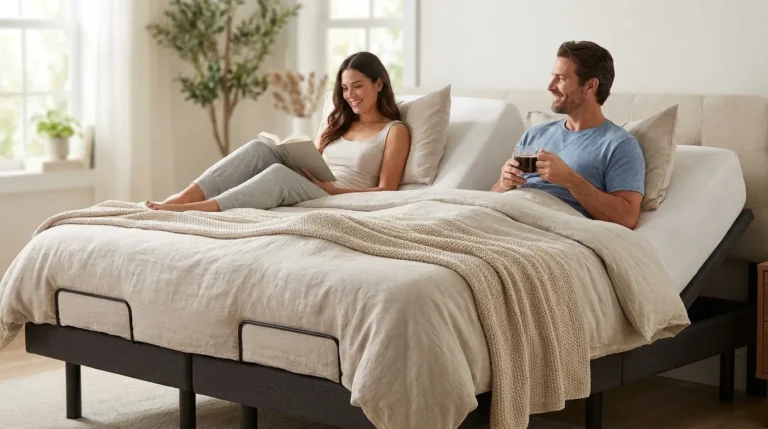
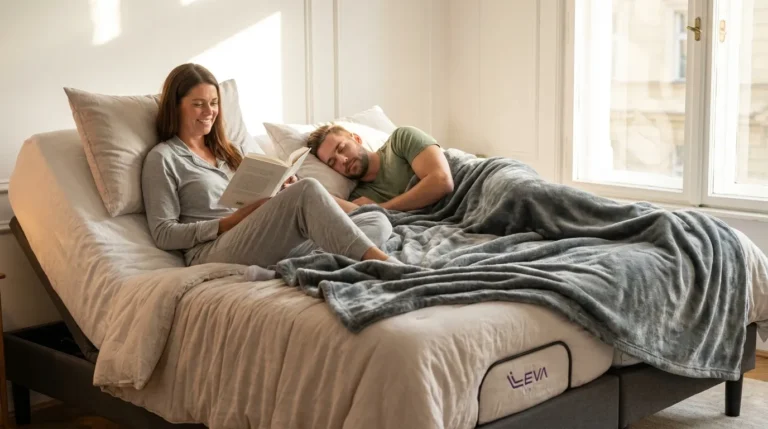
Split configurations give each partner control over their own sleep mechanics. Two people with different body weights, pain profiles, and preferred sleep positions cannot share a single articulation zone without compromise. A split system assigns each partner an independent base, mattress, and control interface.
Split King, built from two Twin XL bases, is the most widely available configuration. Split Queen, which uses two narrower bases totalling standard Queen width, is rare in Canada and works well in rooms where a King footprint is not practical. Leva Sleep is one of the few Canadian retailers building Split Queen configurations to customer specification, which makes independent lumbar control possible in smaller bedrooms.
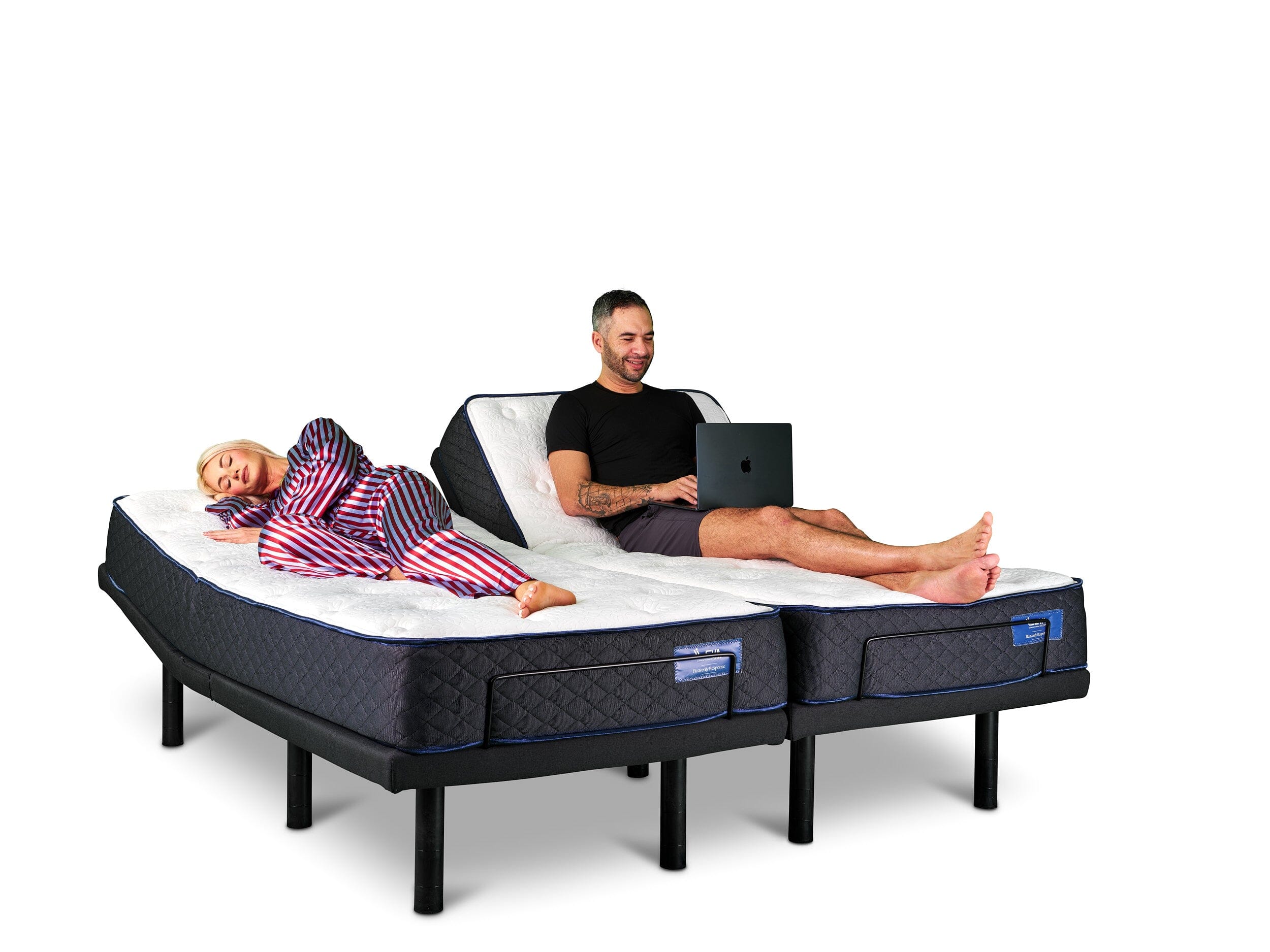
App-based control lets each partner save custom positions, set vibrating alarms that do not disturb the other side, and activate anti-snore micro-adjustments automatically during the night.
2026 Canadian Pricing and Delivery Details
Premium adjustable systems from brands such as Tempur-Pedic and Ultramatic sit at the top of the Canadian market. Leva Sleep’s vertically integrated, direct-to-consumer model, with local design and regional assembly, removes traditional retail markup and keeps pricing below many premium adjustable systems with similar feature sets. Shoppers can choose from a wide selection of adjustable models.
White-glove delivery is available for a fee and covers in-room setup, height adjustment, a usage tutorial, and removal of the existing bed. Delivery currently operates across Ontario and Alberta, with scheduling coordinated directly through Leva Sleep.
Decision Checklist for Comparing Adjustable Bed Brands
The following comparison table shows how Leva Sleep and three major competitors address the core features discussed above. Use it as a quick reference when matching each system to your pain-management, independence, and service priorities.
| Feature | Leva Sleep | Ultramatic | Ghostbed | Tempur-Pedic Bundle |
|---|---|---|---|---|
| Independent lumbar control | Yes, dedicated motor with continuous adjustment | Yes, on select models | Limited, head and foot only on most models | Yes, on Ergo models |
| Split Queen availability | Yes, built to specification | Not widely listed | No | No |
| Motor noise | Whisper-quiet German motors, low noise | Quiet, varies by model | Standard, not independently rated | Quiet, varies by model |
| Canadian white-glove delivery | Yes, Ontario and Alberta | Yes, in select regions | Standard delivery only | Via retail partners |
| Relative price positioning | Lower than comparable luxury tier | Upper-mid to premium | Mid-range | Premium to ultra-premium |
Note: Noise and pricing data for competitor models reflect publicly available positioning and customer-reported information. Confirm current specifications directly with each manufacturer before purchasing.
Leva Sleep is a vertically integrated Canadian specialist that assembles systems locally, offers a broad selection of models, and delivers white-glove service across Ontario and Alberta.
Frequently Asked Questions
Is an adjustable mattress suitable for L4-L5 disc problems?
An adjustable base with independent lumbar control can help people with L4-L5 disc issues by allowing the sleeper to elevate the knees and support the lumbar curve with targeted pressure. This combination reduces compressive load on the affected disc space. The mattress itself should be memory foam, latex, or a pocketed-coil hybrid rated for adjustable-base use, with a thickness of 10–12 inches for flexibility and support. Consult your physician or physiotherapist to confirm that positional elevation suits your specific diagnosis before purchasing.
Can an adjustable bed replace a CPAP machine?
An adjustable base does not replace CPAP therapy prescribed for moderate-to-severe obstructive sleep apnea. Gentle head elevation on an adjustable base can reduce airway obstruction for people with mild sleep apnea or positional snoring, and some sleep apnea clinics refer patients to adjustable beds as a complementary or alternative approach for mild cases. Leva Sleep receives direct referrals from sleep apnea clinics in Ontario and Alberta. Always follow your sleep physician’s guidance regarding CPAP use.
How do I maintain an adjustable base long-term?
Adjustable bases need only light maintenance. Keep the motor and articulation joints clear of dust and debris, avoid exceeding the stated weight capacity, and use mattresses and bedding confirmed as compatible with the base. Periodically check that the foot-end retainer bar is secure, since it prevents the mattress from sliding during movement. Leva Sleep’s white-glove delivery includes a full product tutorial covering maintenance, and the company’s direct-to-consumer model keeps support accessible without a third-party retailer.
What trial period should I expect from a Canadian adjustable bed retailer?
Trial periods in the Canadian adjustable bed market vary widely. When evaluating any system, confirm the trial length in writing and clarify whether the trial covers both the base and the mattress. Ask about return logistics, including who pays for disassembly and removal of a large adjustable system. A white-glove delivery provider that assembled the bed should also be able to coordinate a structured return if the product does not meet your needs within the trial window.
Will standard fitted sheets work on an adjustable bed?
Standard fitted sheets usually lack the pocket depth and elastic tension needed to stay anchored when an adjustable base rises to higher angles. Sheets designed for adjustable bases use reinforced elastic around the full perimeter and deeper corner pockets. Leva Sleep designs its own bedding line, including fitted sheets, duvet clips, and mattress protectors, specifically for adjustable bases, which removes the common frustration of sheets pulling free during the night.