
Written by: Matthew Timmins, Founder and Managing Director, Leva Sleep | Last updated: July 28, 2026
Key Takeaways for Seniors Choosing Adjustable Beds
- Split Queen and Split King setups let each partner move head and foot separately, so couples stay in the same bed even when pain needs differ.
- Zero-gravity positioning with lumbar support and quiet motors under 50 dB is the most common recommendation for seniors with chronic back, hip, or joint pain.
- Height-adjustable legs, head-elevation assist, zero-clearance frames, and under-bed lighting make getting in and out of bed safer for older adults.
- Leva Sleep’s direct-to-consumer model typically runs 30–50% below comparable luxury brands and includes white-glove delivery with local assembly in Ontario and Alberta.
- Browse Split Queen and Split King packages to match your room size, pain needs, and budget.
Split Queen vs. Split King: Best Adjustable Bed Setups for Seniors
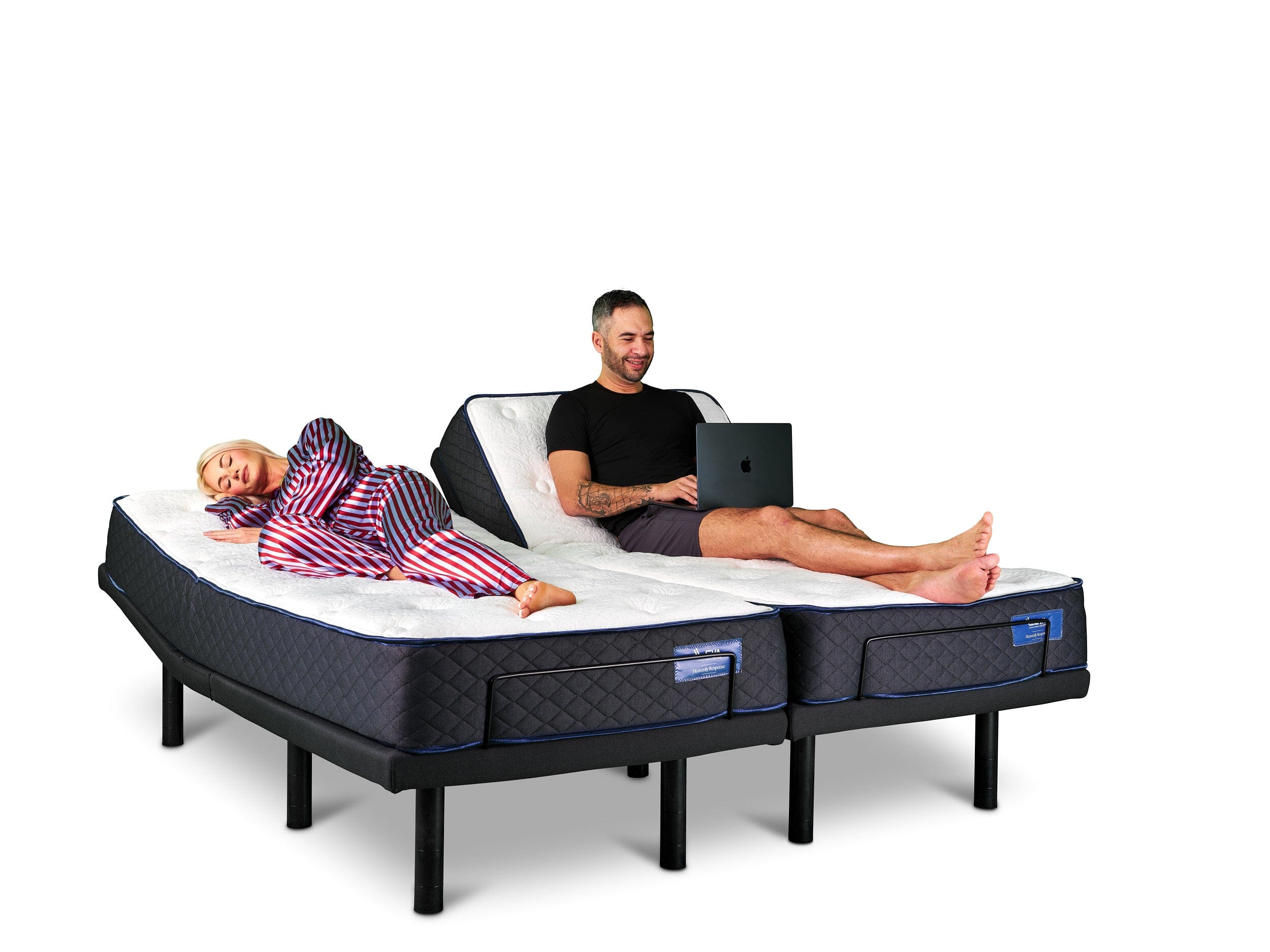
For couples, the main decision is between a Split King and a Split Queen. Both use two independent bases side by side so each partner adjusts head and foot elevation without affecting the other side.
Split King uses two Twin XL bases placed side by side, totalling 76 × 80 inches, the same footprint as a standard king. It provides the most independent full-body control and suits couples with very different pain or positioning needs.
Split Queen uses two narrower bases in a queen footprint (60 × 80 inches). Leva Sleep is one of the few Canadian retailers that builds Split Queen systems to order, so couples in smaller rooms still get independent adjustability.
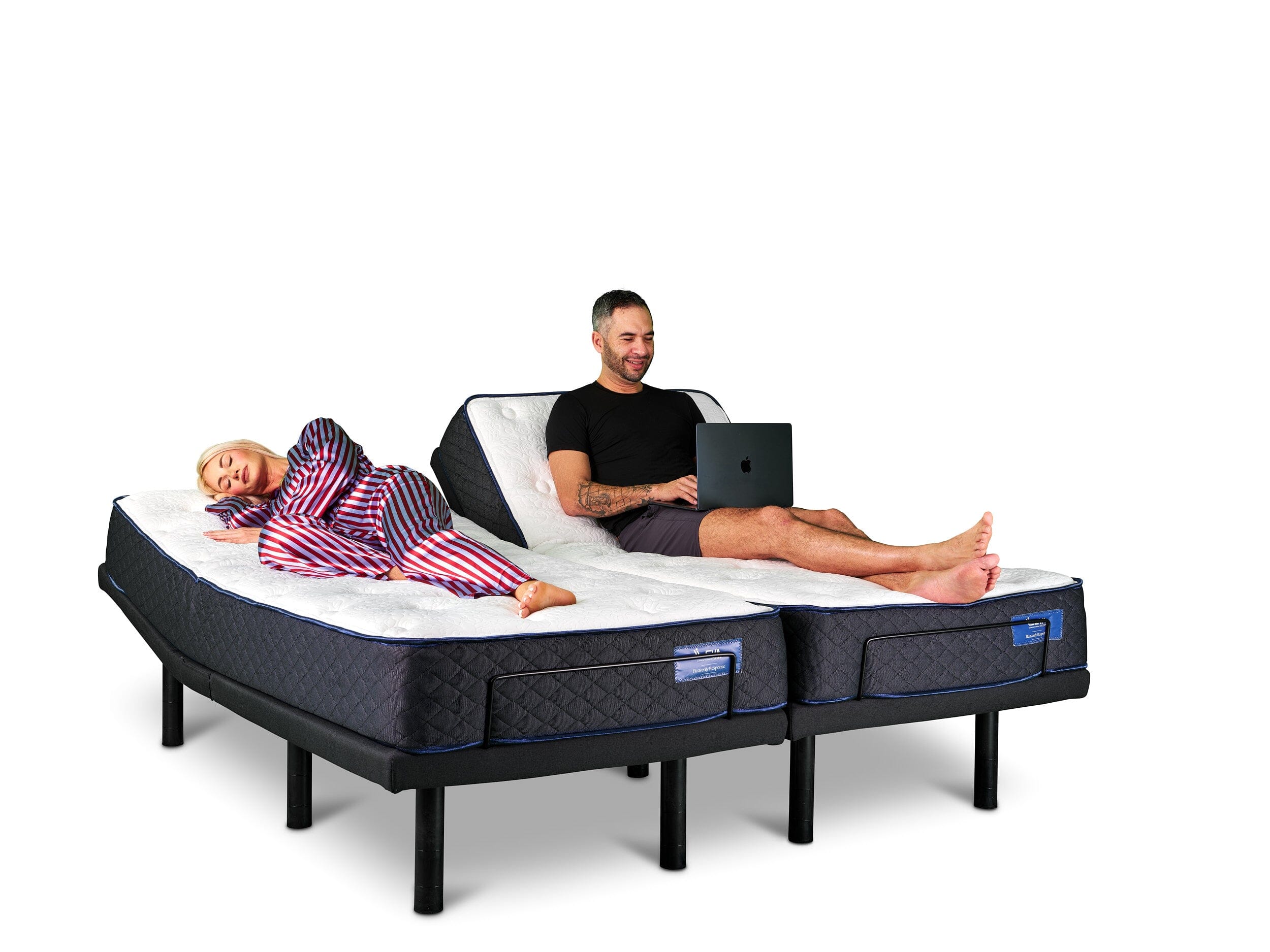
A unified queen or king base moves as a single unit, so both partners share the same position. That setup works when preferences are similar, but it forces compromise when one partner needs zero-gravity elevation for back pain while the other sleeps flat.
Split configurations create a centre seam that some couples notice. This seam is a real tradeoff, so choose a split base when independent positioning matters more than a perfectly smooth surface.
How Doctors Use Adjustable Beds in Senior Pain Management
Adjustable bases are not medical devices and do not treat diagnosed conditions. They simply change body position. Within that scope, clinicians and sleep specialists often recommend specific positions for specific conditions.
Raising the head or foot of an adjustable bed can prevent pressure points or relieve symptoms of chronic health conditions including arthritis and joint pain in older adults, according to Sleep Foundation analysis. Models with massage and heat functions may further ease arthritis and joint pain symptoms.
Some studies suggest zero-gravity positioning can help with chronic low-back pain and may increase deep sleep.
Several caveats still apply. Seniors with moderate-to-severe sleep apnea should not rely on head elevation as a substitute for CPAP or physician-directed treatment. Those with pacemakers or implanted cardiac devices should confirm compatibility with their cardiologist before using massage or vibration motors. Post-surgical patients must verify approved positioning angles with their surgeon.
Best Adjustable Bed Positions for Lower Back Pain Relief
Zero-gravity positioning elevates both the head and feet above heart level. Research shows that this position can reduce lumbar paraspinal muscle activity compared with lying flat on the back.
Raising the torso above the hip line can widen the lumbar disc space, which may help relieve nerve root impingement in early-stage stenosis. This widening effect combines with zero-gravity positioning’s ability to lower intradiscal pressure compared to standing, which allows discs to restore height over the course of sleep.
Knee elevation adds another layer of benefit. Elevating the knees can reduce lower-back muscle activity by shortening the iliopsoas and rectus femoris to their ideal resting length.
Sleep consultant and occupational therapist Annie Schlecht notes that zero-gravity positioning can ease lower back pain, sciatica, hip and joint discomfort, arthritis, and leg swelling. She also explains that over time, it supports spinal alignment, reduces inflammation, and helps the nervous system shift into rest and repair.
Erin Flynn-Evans, director of the Fatigue Countermeasures Laboratory at NASA Ames Research Center, offers a counterpoint. She cautions that forcing the body into a single posture could create new discomfort rather than relieve it, since movement during sleep naturally reduces pressure on different body parts. A quality adjustable base supports position changes throughout the night instead of locking a sleeper in place.
Adjustable Bed Features That Help Seniors With Hip and Joint Pain
Different pain conditions respond to different base features. The table below connects common pain patterns with recommended adjustable bed features and shows how Leva Sleep’s systems address each scenario.
| Pain Condition | Recommended Features | Leva Sleep Model Benefit |
|---|---|---|
| Chronic lower back pain | Zero-gravity preset (head 20–30°, knees 15–20°), adjustable lumbar support | Lumbar Control feature for precise lower-back positioning, one-touch zero-gravity preset |
| Hip and joint pain / arthritis | Head and foot elevation to prevent pressure points, massage and heat functions | Split configuration keeps one partner elevated without disturbing the other, massage zones available on select models |
| Leg swelling / poor circulation | Leg elevation above heart level to boost venous return | Independent foot elevation on each side, no shared position required |
| Positional snoring | Head elevation to reduce apnea events, anti-snore preset | App-controlled anti-snore mode (spring 2026) detects snoring and makes micro-adjustments automatically |
Safety Features That Help Seniors Get In and Out of Bed
Safe entry and exit matter for seniors with reduced hip mobility or core strength. Several base features directly support safer transfers.
- Height-adjustable legs: Options such as 8, 10, 11, 12.5, or 14 inches allow customization so seniors can place their feet flat on the floor when sitting on the edge. A bed height of 24–26 inches from mattress surface to floor is optimal for most adults to enable easy standing.
- Head elevation for transfers: Elevating the head section 30–45° significantly reduces the effort and joint stress required to transition from lying to sitting.
- Zero-clearance frames: Zero-clearance designs lower the sleeping surface and improve independent entry and exit for seniors with limited mobility, with no exposed moving parts that create trip hazards.
- Under-bed LED lighting: Remote-activated LED lighting illuminates the floor during nighttime bathroom trips, which supports fall prevention.
- Weight capacity: Adjustable bases have varying weight capacities. Leva Sleep adjustable bed systems have weight capacities of 450 lb per base for some models and 650–1300 lb for others depending on configuration. Confirm the specific model capacity at purchase.
2026 Canadian Pricing and Delivery: Leva Sleep vs. Premium Brands
Canadian queen adjustable bed base pricing in 2026 falls into three main tiers: entry-level models cost approximately $800–$1,200 CAD, mid-range models with massage and zero-gravity presets cost $1,200–$2,000 CAD, and premium models cost $2,500–$4,500+ CAD.
The table below compares like-for-like metrics for split queen and king configurations in Canada. Leva Sleep pricing reflects the company’s direct-to-consumer model, while competitor tiers come from published 2026 Canadian market data.
| Metric | Leva Sleep (Split Queen / Split King) | Typical Premium Canadian Competitor (Split King) |
|---|---|---|
| Price position vs. top-tier competitors | 30–50% lower than comparable luxury brands | Luxury tier: $2,500–$4,500+ CAD for queen base alone |
| Split Queen availability | Yes, built to order | Rarely available at most retailers |
| Weight capacity | 450 lb per base for some models and 650–1300 lb for others depending on configuration | Varies by model, confirm with manufacturer |
| Delivery model | In-house white-glove: bedroom delivery, assembly, height adjustment, tutorial, old-bed removal | Threshold or bed-in-a-box, customer assembles |
| Assembly location | Ontario and Alberta | Varies, often overseas with third-party logistics |
Leva Sleep’s vertically integrated model, which includes design, assembly, and delivery in-house, removes distributor and retailer markups. This structure delivers a premium system at a price point that major department-store brands and luxury imports rarely match on a like-for-like basis.
Step-by-Step Path From Pain Type to Bed Configuration
The following decision path helps you narrow down the right configuration before you speak with a specialist.
- Confirm whether both partners share the same positioning needs. If both do, a unified queen adjustable base may be sufficient. If not, move to step 2.
- Measure your bedroom for a king-size frame (76 × 80 inches). If the room fits a king, a Split King with two Twin XL bases provides maximum independent full-body control. If not, continue to step 3.
- Check whether a queen footprint (60 × 80 inches) is the largest size that fits. If so, a Split Queen is the right configuration, and Leva Sleep builds these to order, which remains rare in Canada.
- Identify whether only one partner needs independent head elevation. A split-head king uses one solid mattress with only the upper third splitting. It does not allow independent leg elevation or full zero-gravity positioning on one side only, so it does not work when both partners need complete independent control.
Real Couples Who Returned to the Same Bed
“We had been sleeping in separate rooms for two years because of my husband’s snoring and my back pain. The split base meant he could elevate his head for the snoring while I used zero-gravity for my back. We’re back in the same room and the same bed.” — Leva Sleep customer, Ontario
“After my hip replacement, my surgeon recommended I sleep slightly elevated. My wife doesn’t need that at all. The split queen was the only option that fit our room and gave us both what we needed.” — Leva Sleep customer, Alberta
Sleep apnea clinics in Canada have referred patients to Leva Sleep when positional elevation forms part of a broader sleep management plan, always alongside physician-directed treatment.
Conclusion: Matching Leva Sleep Systems to Your Needs
For Canadian couples aged 60–75 managing chronic hip, back, or knee pain, the decision process stays simple. Identify each partner’s primary pain condition, connect it to the features in the table above, decide whether a Split Queen or Split King fits the room, and confirm weight capacity and delivery scope before purchasing.
Leva Sleep offers 15–20 adjustable base models, compared with the 3–5 typically found at general retailers. These models are assembled locally in Ontario and Alberta, powered by whisper-quiet German motors, and delivered by an in-house white-glove team that sets leg height, provides a product tutorial, and removes the old bed. The app-controlled anti-snore mode launches in spring 2026. Pricing generally runs 30–50% below comparable luxury competitors.
Frequently Asked Questions
Do doctors recommend adjustable beds for elderly patients with chronic pain?
Doctors and sleep specialists often recommend specific positions, particularly zero-gravity and leg elevation, for conditions including chronic lower back pain, arthritis, hip pain, acid reflux, and positional snoring. Adjustable bases provide the mechanical means to reach and maintain those positions through the night. They are not medical devices and do not treat diagnosed conditions on their own. As noted earlier, CPAP and physician-directed treatment remain essential for moderate-to-severe sleep apnea. Those with pacemakers or implanted cardiac devices should confirm compatibility with their cardiologist before using massage or vibration functions. Post-surgical patients must verify approved positioning angles with their surgeon.
What is the difference between a Split Queen and a Split King adjustable bed?
As explained earlier, a Split King uses two Twin XL bases with a total footprint of 76 × 80 inches, while a Split Queen fits two narrower bases into a 60 × 80 inch queen footprint. Both provide independent head and foot control for each partner. Split Queen systems remain uncommon in Canada, and Leva Sleep builds them to order. Both configurations require split-specific sheets, since standard king or queen sheets do not fit properly when the sides move independently.
What adjustable bed features matter most for safe entry and exit for seniors?
The most important features for safe entry and exit are height-adjustable legs, head-elevation assist, zero-clearance frame design, and under-bed LED lighting. Height-adjustable legs let you set the mattress surface at a level that supports easier standing, and raising the head section 30–45° reduces the effort needed to move from lying to sitting, which helps after hip or knee surgery. Zero-clearance frames remove exposed moving parts that can create trip hazards. Under-bed LED lighting, activated by remote, illuminates the floor during nighttime bathroom trips and supports fall prevention. Leva Sleep’s white-glove delivery team adjusts leg height to each customer’s needs at setup.
How much does a split adjustable bed cost in Canada in 2026?
Canadian queen adjustable base pricing in 2026 falls into three main tiers: entry-level models cost approximately $800–$1,200 CAD, mid-range models with massage and zero-gravity presets cost $1,200–$2,000 CAD, and premium models cost $2,500–$4,500+ CAD. Split King configurations typically carry a 10–20% premium over standard king pricing because they require two independent motor systems. As outlined in the pricing section, Leva Sleep’s direct-to-consumer, vertically integrated model positions its Split Queen and Split King systems well below comparable luxury competitors. White-glove delivery, which includes bedroom setup, leg-height adjustment, product tutorial, and old-bed removal, is available for a fee and priced transparently at purchase. Confirm final pricing, including applicable taxes, with Leva Sleep directly, since rates vary by province.
Can a split adjustable bed prevent sleep divorce for couples with different pain needs?
A split adjustable bed offers a direct mechanical solution for couples whose differing pain-driven positioning needs have pushed them into separate rooms. When one partner requires zero-gravity elevation for lower back pain and the other sleeps flat, a unified base forces a compromise that leaves at least one person uncomfortable. A split configuration gives each partner a fully independent base, including separate head elevation, foot elevation, lumbar support, and massage settings, with no mechanical connection between the two sides. Leva Sleep’s customer base includes many couples who returned to sharing a bed after years apart, and sleep apnea clinics in Canada refer patients to Leva when positional elevation forms part of a broader sleep management plan.