Written by: Matthew Timmins, Founder and Managing Director, Leva Sleep
Key Takeaways
- Head elevation between 7–15 degrees uses gravity to keep the airway open and reduce snoring vibration during back sleeping.
- Clinical studies show 7.5–12-degree inclines can lower AHI scores by up to 32% and improve deep sleep for mild positional snorers.
- Incremental 2-degree adjustments on any Leva Sleep base let couples fine-tune the ideal anti-snore angle without neck strain.
- Split adjustable beds allow one partner to use an elevated anti-snore position while the other stays flat, reducing sleep disruption.
- Discover the full range of Leva Sleep adjustable bed packages designed for couples at Leva Sleep.
The Physics of Airway Collapse and Why Elevation Works
When a person lies flat on their back, throat muscles relax and gravity pulls the tongue and soft tissue backward into the airway. Air must then push through a narrowed opening, and the vibration of that relaxed throat tissue is the source of the snore.
Raising the upper body changes the gravitational pull on those tissues. Elevating the torso 7–15° gravity-loads the soft palate away from the back of the throat, which reduces airway collapse even when the sleeper remains on their back. Clinical data support this effect. A study of 52 patients with mild-to-moderate obstructive sleep apnea found that 7.5-degree head-of-bed elevation reduced the apnea-hypopnea index (AHI) from 15.7 to 10.7 events per hour, a 31.8% reduction, and improved minimum oxygen saturation from 83.5% to 87.0%.
The same PMC9021938 study also recorded 4% fewer awakenings and a 5% increase in time spent in deep sleep at a 12-degree incline. This pattern shows more stable breathing and fewer arousals throughout the night. Propping only the head with multiple pillows can worsen snoring and cause neck pain. Elevating the full head of the bed avoids neck over-flexion while still reducing airway collapse.
With this understanding of how elevation changes airway physics, the next step is choosing a practical position that couples can use every night.
Finding the Best Adjustable Bed Position for Snoring
The target range for snoring relief is 7–15 degrees of head elevation. An incline of 10–12 degrees is sufficient for most sleepers to gain snoring-reduction benefits without feeling too steep. The steps below apply to any Leva Sleep adjustable base.
- Start with the base completely flat and lie in your normal sleeping position.
- Use the remote or Leva Sleep app to raise the head section by approximately 2 degrees.
- Stay at that angle for one or two nights to assess comfort and any change in snoring reported by your partner.
- Continue raising in 2-degree increments until snoring is reduced or you reach the upper end of the recommended range.
- Save the position to a memory preset so the base returns to it automatically each night.
Zero-gravity presets, which raise both the head and knees simultaneously to distribute body weight evenly, are designed primarily for back-pain relief. For snoring, the recommended anti-snore preset elevates the head 15–30 degrees with the foot section at 0 degrees. This setup keeps the airway open without the knee bend that zero-gravity requires.
Explore Leva Sleep adjustable bases with precise 2-degree increments
Clinical Proof That Anti-Snore Adjustable Beds Help
Head elevation of 7–45° has been shown to lower AHI scores in patients with positional and mild obstructive sleep apnea, with clinical studies reporting 30–50% AHI reductions with head elevation alone in mild positional OSA. A multicenter observational study found that head-of-bed elevation reduced AHI and was described as a low-cost, well-tolerated positional therapy for selected positional OSA phenotypes.
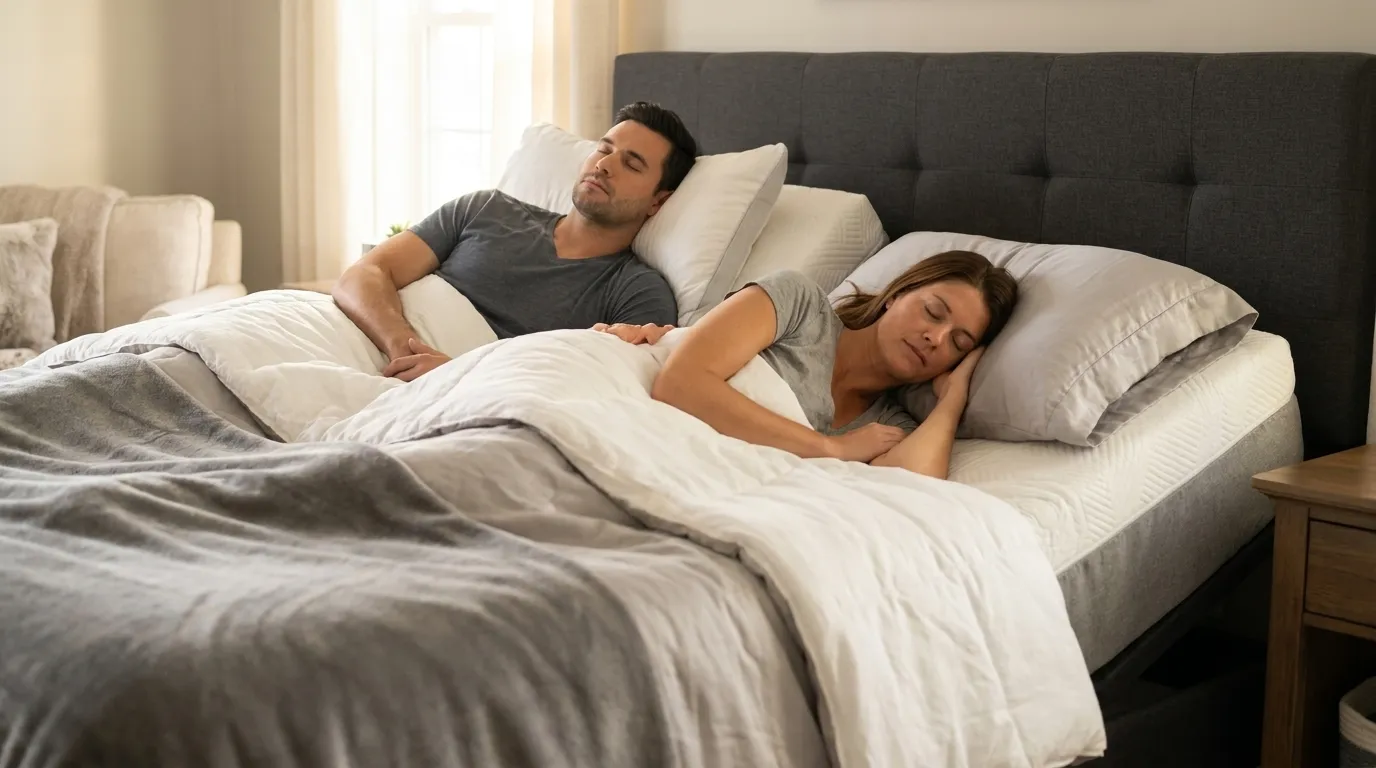
For couples where only one partner snores, a split adjustable bed lets the snoring partner benefit from this proven elevation therapy while the other partner sleeps undisturbed in their preferred position.
Setting Up Anti-Snore Positions on a Split Adjustable Bed
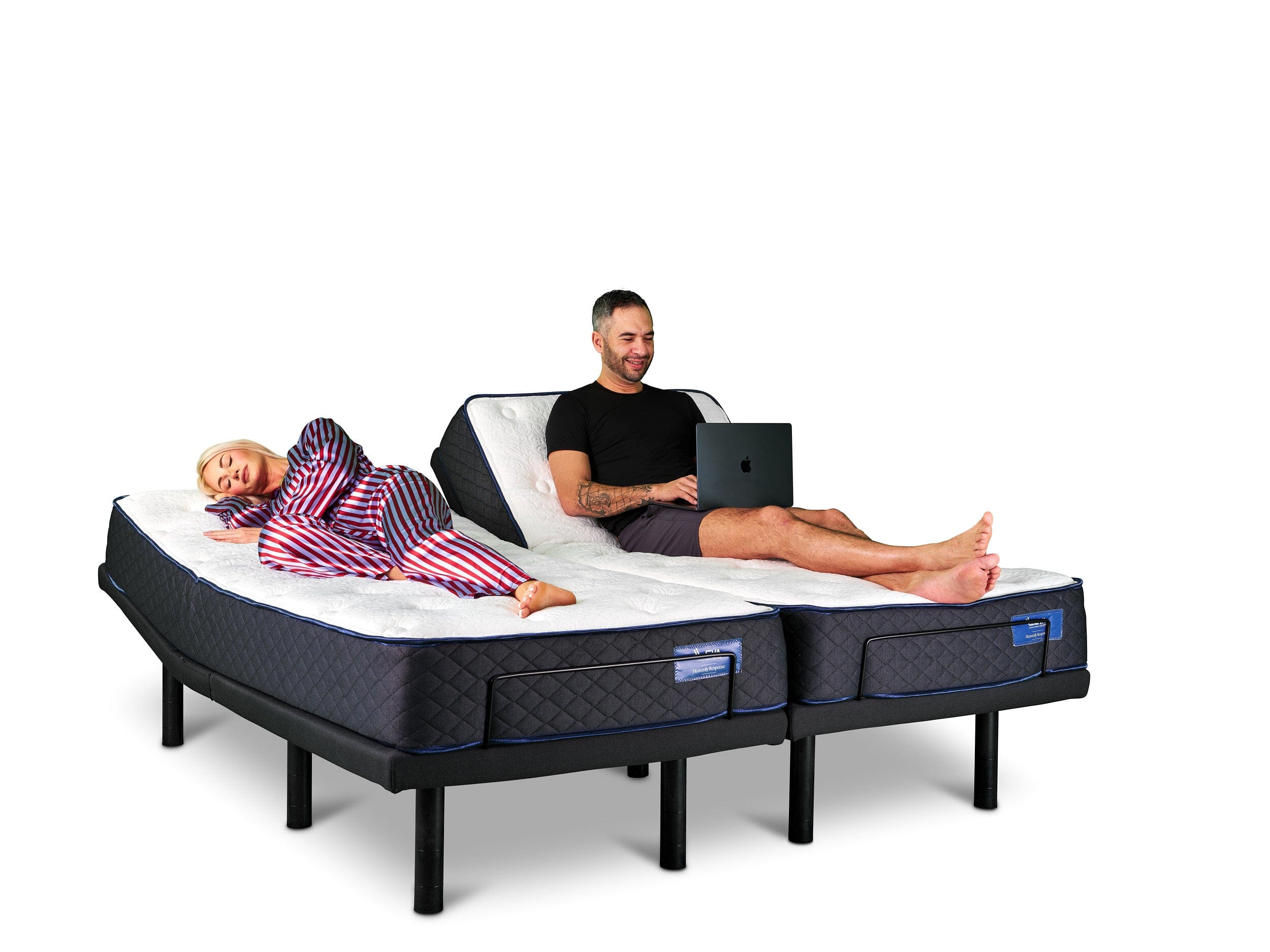
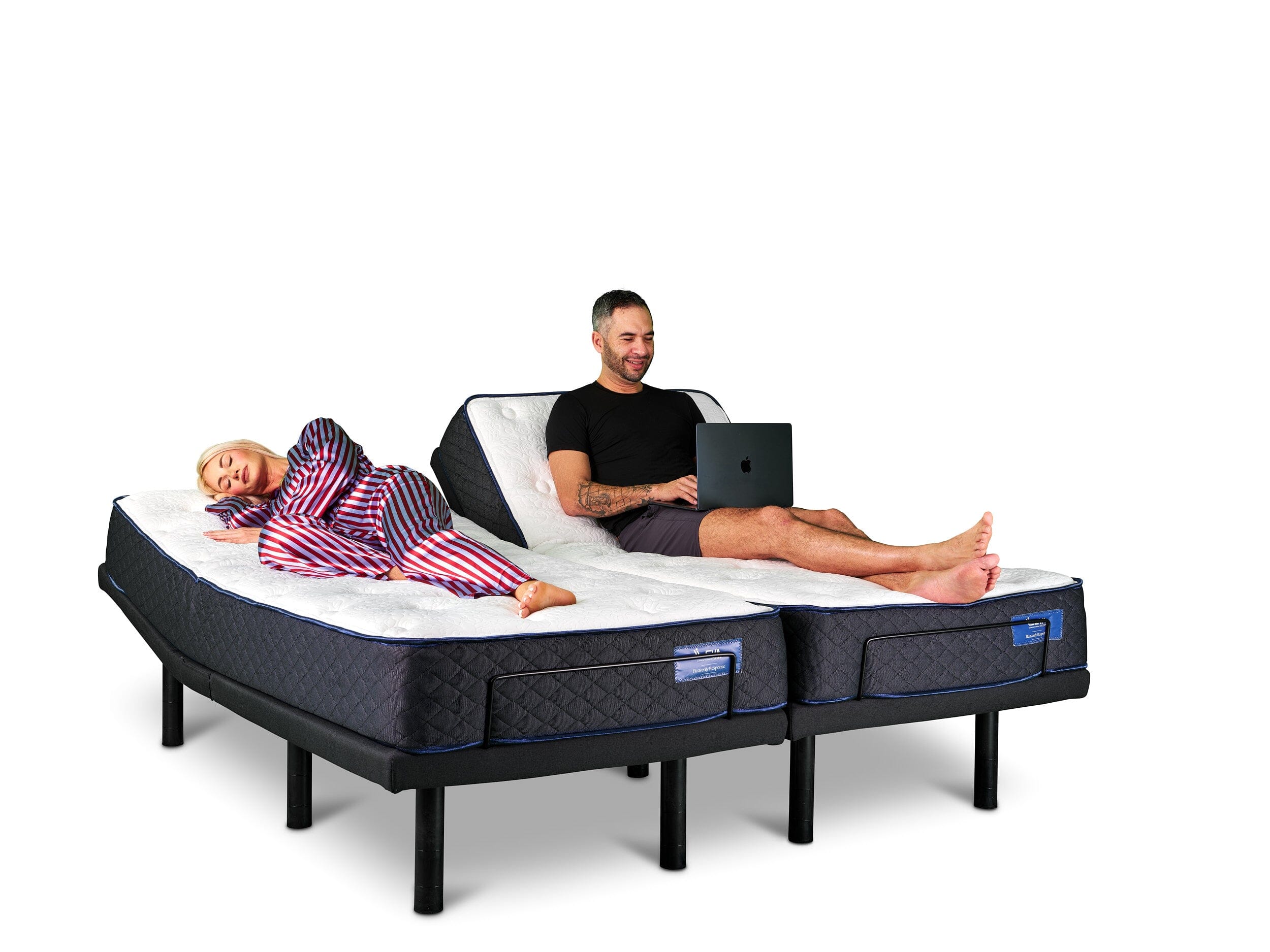
A split adjustable bed consists of two separate bases placed side by side, each with its own motor, remote, and independent head and foot controls. This configuration allows the partner who snores to sleep at an elevated angle while the other remains completely flat. The following steps apply to Leva Sleep’s Split Queen and Split King configurations.
- Position the bases: Place the two bases side by side within the bed frame. Confirm the frame has no fixed centre support beam that would create a ridge at the seam.
- Fit the mattresses: Slide each mattress under the retainer bar at the foot of its base to prevent sliding during elevation. Most adjustable bed bases include this retainer bar for exactly this purpose.
- Add a non-slip pad: Place a non-slip pad between each mattress and its base to prevent the two halves from drifting apart during independent adjustments.
- Bridge the centre gap: Use a foam bed bridge to fill the centre gap and create a smooth transition that prevents discomfort at the midline.
- Use deep-pocket fitted sheets: Leva Sleep’s purpose-built fitted sheets feature extra elastic and deep pockets designed to stay in place when the head section is elevated. This design prevents the common frustration of sheets popping off.
- Label the remotes: Label the identical remotes to avoid confusion, and confirm each remote is paired to the correct base before programming memory presets.
- Program memory presets independently: Each partner programs their own M1 preset. The snoring partner sets an elevated head position within the therapeutic range, and the other partner sets their preferred position. Pressing M1 on one remote moves only that side of the bed.
- Enable anti-snore mode: Via the Leva Sleep app, activate the 2026 auto-detection feature on the snoring partner’s side. The base then makes micro-adjustments automatically throughout the night.
Browse Leva Sleep Split Queen and Split King configurations
What Not to Do with an Adjustable Bed for Snoring Relief
Common Mistakes to Avoid
The most frequent setup errors fall into two groups: over-correction and poor preparation. Over-correction often creates discomfort that discourages regular use. Poor preparation usually causes sliding, sheet issues, or neck strain that undermines the benefits of elevation.
- Raising the head above 30–35 degrees for snoring relief. Overly steep elevation can be uncomfortable and cause the sleeper to slide toward the foot of the bed, which reduces practical benefit.
- Using standard flat-sheet sets that cannot accommodate elevation and tend to pull free, which disrupts sleep.
- Stacking multiple pillows instead of raising the base. As explained earlier, pillow-propping creates neck flexion that can worsen snoring and trigger neck pain.
- Skipping the incremental 2-degree testing process and jumping directly to a steep angle, which can cause neck strain before the body adapts.
Troubleshooting Tips for Common Issues
- If the mattress slides despite the retainer bar, add a non-slip pad between the mattress and the base surface.
- If neck discomfort develops at a moderate incline, reduce elevation by 2 degrees and use Leva’s pillow tilt motor to fine-tune head support without changing the overall angle.
- If one partner’s motor adjustment wakes the other, verify that the Leva app’s whisper-quiet motor setting is active. Also confirm that the bases are not touching the bed frame in a way that transmits vibration.
Limitations: When Elevation Alone Is Not Enough
Head elevation works less well for non-positional snorers whose snoring occurs in all positions. This pattern often points to anatomical causes such as enlarged tonsils, a deviated septum, or nasal polyps rather than gravity-related airway collapse.
Adjustable beds are not a substitute for medical evaluation when snoring is loud every night regardless of position or is accompanied by breathing pauses, gasping or choking, excessive daytime sleepiness, or morning headaches. Head elevation is not sufficient treatment for severe obstructive sleep apnea (AHI above 30), and CPAP remains the clinical standard of care. The Canadian Sleep Society recommends that positional therapy, including bed elevation, be used alongside rather than instead of prescribed treatments such as CPAP.
If snoring persists after two to four weeks of consistent elevation within the recommended range, a referral to a sleep clinic and a formal sleep study is the appropriate next step.
What Success Looks Like for Couples Using Elevation
For couples dealing with positional snoring, consistent use of head elevation on a split adjustable base often produces clear changes within the first two to four weeks. The snoring partner experiences less airway vibration, and the non-snoring partner reports fewer nighttime awakenings. The deep-sleep improvements documented earlier translate to more restorative rest for both partners.
Couples who had moved to separate rooms due to snoring, a pattern sometimes called sleep divorce, can often return to sharing a bed with independent elevation settings on each side. Leva Sleep adjustable bases include whisper-quiet German motors, auto-detection anti-snore mode, and purpose-built bedding accessories that address many of the practical barriers that prevent consistent use of elevated sleep positions.
Find the right Leva Sleep adjustable bed package for your household
Frequently Asked Questions
Is a Leva Sleep adjustable bed suitable for mild snoring, or only for diagnosed sleep apnea?
Leva Sleep’s adjustable beds work well for mild, positional, or occasional snoring, which is the most common type among couples. The recommended elevation range targets the gravitational mechanism behind positional snoring without requiring a clinical diagnosis. The 2026 auto-detection anti-snore mode makes micro-adjustments throughout the night, which helps sleepers who shift positions and lose the benefit of a fixed preset. For diagnosed obstructive sleep apnea, an adjustable base can complement prescribed treatments such as CPAP, but it does not replace them. Anyone with suspected sleep apnea should consult a physician before relying on positional therapy alone.
Does Leva Sleep deliver to Ontario and Alberta, and what does white-glove delivery include?
Leva Sleep currently serves customers in Ontario and Alberta with in-house white-glove delivery available for a fee. The service includes delivery directly to the bedroom, full assembly of the adjustable base and mattress, leg-height adjustment, a product tutorial covering the remote and app features, and removal of the old bed through donation or recycling. This approach differs from bed-in-a-box brands that leave customers with heavy components to assemble independently. Because Leva designs and assembles its systems locally, delivery teams receive specific training on the product rather than relying on third-party contractors unfamiliar with the base’s features.
Can a Leva Sleep Split Queen or Split King base be used with a temperature regulation pad?
Yes. Leva Sleep’s adjustable bases are compatible with the Leva Sleep Heating and Cooling Pad, which integrates into the sleep system for individual temperature regulation on each side. This feature helps couples where one partner sleeps hot and the other cold, a common secondary complaint alongside snoring. The pad is designed to flex with the base during elevation adjustments, so it does not interfere with the anti-snore position or create bunching at the head section. Leva’s purpose-built fitted sheets with deep pockets and extra elastic accommodate both the pad and the elevated position at the same time.
What is the price difference between Leva Sleep and comparable adjustable bed brands in Canada?
Leva Sleep’s direct-to-consumer, vertically integrated model, which covers design, local assembly, and in-house delivery without retail markup, positions its adjustable bed packages at 30–50% below comparable luxury competitors such as Tempur-Pedic’s adjustable base offerings. This price advantage applies across the full range of 15–20 models Leva carries, compared with the 3–5 adjustable base options typically found at general mattress retailers in Canada. The Split Queen configuration, a unique Leva offering not widely available elsewhere in Canada, delivers the same independent-control benefits as a Split King in a more space-conscious footprint.
Conclusion
Anti-snore adjustable bed positions work by applying a straightforward gravitational principle. Raising the head within the recommended range shifts the tongue and soft palate forward, keeps the upper airway more open, and reduces the tissue vibration that causes snoring. Clinical evidence at 7.5 and 12 degrees confirms meaningful reductions in snoring duration, AHI, and nighttime awakenings for mild-to-moderate positional snorers.
For couples in Ontario and Alberta, Leva Sleep’s Split Queen and Split King adjustable bases deliver this benefit independently on each side of the bed. Whisper-quiet German motors, auto-detection anti-snore mode, and a complete system of purpose-built bedding accessories support consistent use of elevated positions. Shop Leva Sleep’s adjustable beds to find the right split configuration for your household.