
Written by: Matthew Timmins, Founder and Managing Director, Leva Sleep | Last updated: June 18, 2026
Key Takeaways for Couples Dealing With Snoring
- Split adjustable beds let one partner raise their head 7–12° to reduce snoring while the other stays completely flat.
- Independent head elevation on split bases keeps the non-snoring partner from being forced into an uncomfortable position.
- Leva Sleep offers one-touch anti-snore presets with app control, with snore detection launching in spring 2026.
- Whisper-quiet German motors and white-glove delivery in Ontario and Alberta make Leva Sleep a strong fit for couples.
- Find the right split adjustable bed package for your needs at Leva Sleep.
Best Adjustable Bed Position to Reduce Snoring
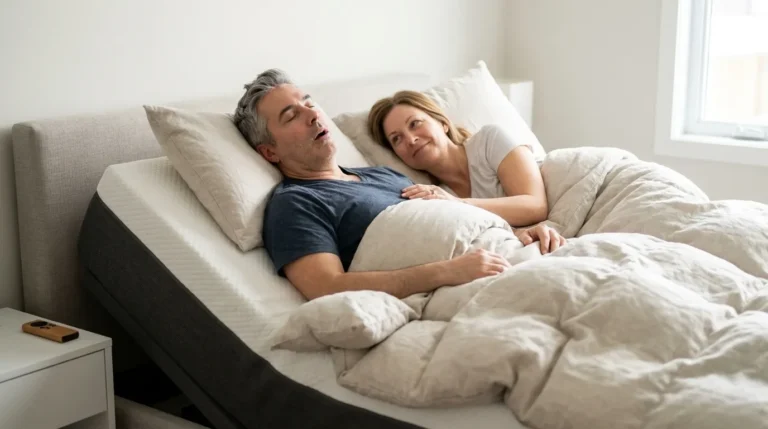
The most widely recommended anti-snore position on an adjustable base is a head elevation of 7–12°. At this angle, the airway opens enough to reduce the soft-tissue collapse that produces snoring, without placing strain on the neck or lower back. Independent head elevation controls let the snoring partner reach this position while the other side of the bed stays completely flat.
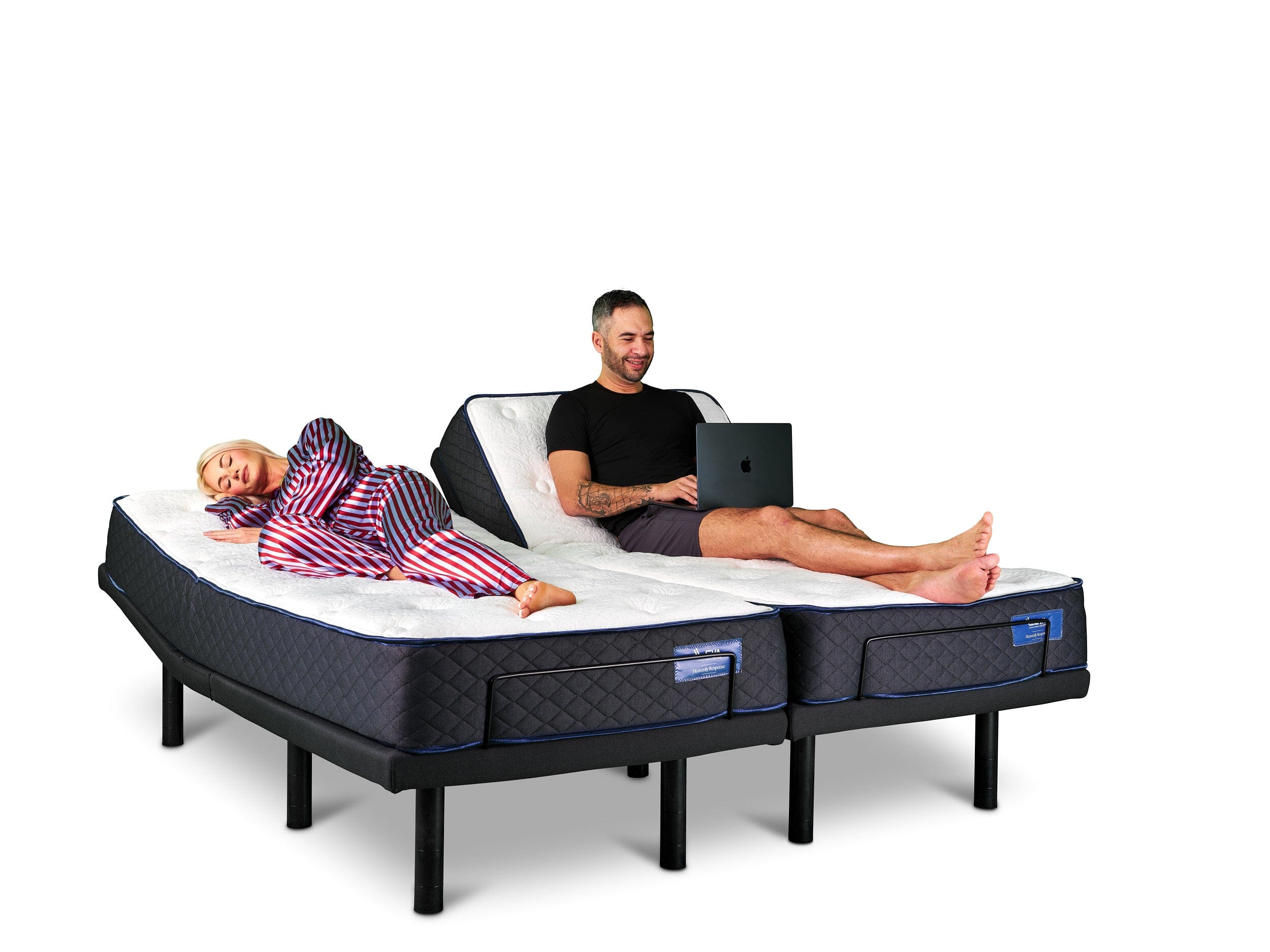
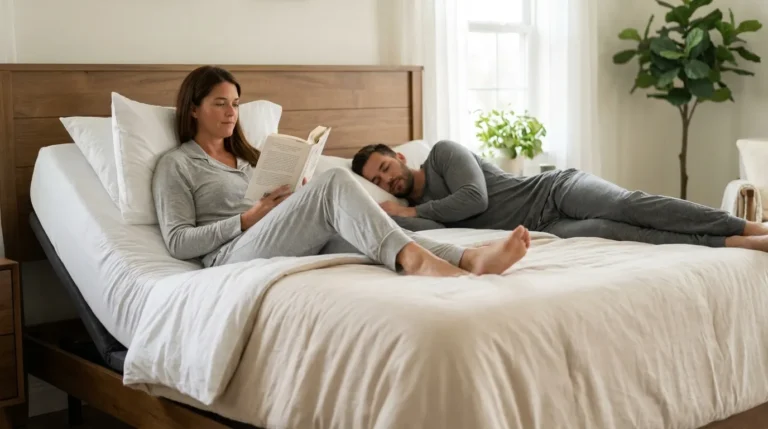
On a split adjustable base, each side runs on its own motor with its own remote or app control. One partner can raise their head section to the anti-snore angle mid-sleep without moving, waking, or repositioning the other partner. Non-split bases move both sides at once, which means the non-snoring partner is forced into the same elevated angle whether they want it or not.
Adjustable Beds With Snore Detection and Presets
Adjustable beds address snoring through two main approaches: automatic snore detection and one-touch preset elevation modes.
Automatic Snore Detection
Smart adjustable bed bases with AI-enhanced snore detection are a growing segment of personalised sleep technology as of 2026. The TEMPUR-Ergo Smart Base uses Sleeptracker AI to detect snoring vibrations and automatically adjust head elevation in real time. The TEMPUR-Ergo Smart Base adds Snore Response and Sleeptracker-AI sleep analytics and typically costs $500–$700 more than the standard TEMPUR-Ergo Power Base, depending on size and retailer. Automatic detection increases cost and depends on sensor accuracy, and false positives can trigger unnecessary adjustments.
One-Touch Preset Modes
Sleep Number’s FlexFit 2 includes a Partner Snore feature that lets one partner raise the other’s head section via a single preset button, without automatic detection. Preset modes stay simpler, cost less, and give the user direct control over when elevation occurs.
Leva Sleep’s app-controlled bases use one-touch preset positioning, with an anti-snore detection mode launching in spring 2026. The app lets each partner save custom elevation positions, trigger the anti-snore preset independently, and make micro-adjustments without disturbing the other side.
Why Split Adjustable Bases Work Best for Snoring Couples
A non-split adjustable base has a single head section that spans the full width of the mattress. When one partner activates an anti-snore elevation, both partners are elevated. The non-snoring partner must either accept an unwanted position or leave the bed flat and lose the snoring reduction entirely. This design limitation often pushes couples into what sleep specialists call a “sleep divorce”, with separate rooms, separate beds, and strained relationship dynamics.
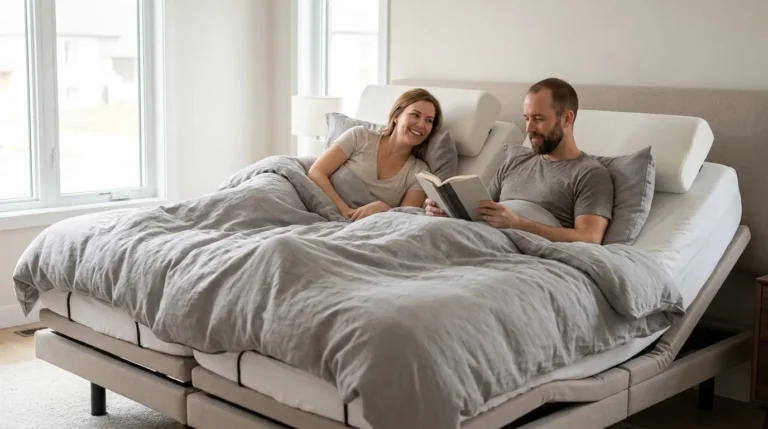
Split configurations solve this by dividing the base into two fully independent halves. Each half has its own motor, its own elevation range, and its own controls. The snoring partner raises their head to 7–12°. The other partner stays flat. Both sleep in the same bed, on the same night, without compromise.
Leva Sleep designs every split base specifically for couples. The Split King uses two Twin XL mattresses on independent bases. The Split Queen, a configuration most general retailers do not carry, uses a space-conscious format that fits standard queen-sized bedroom layouts while still delivering full independent control. Quiet, high-quality motors are essential on split adjustable bases because loud mechanical sounds can wake a partner during independent position changes. Leva Sleep’s whisper-quiet German motors address this directly.
Explore Leva Sleep’s Split Queen and Split King configurations
Split Queen Adjustable Bases for Canadian Bedrooms
The Split Queen offers a rare configuration in the Canadian market. Most adjustable bed retailers stock Split King options only, which leaves couples in smaller bedrooms without an independent-control solution. Leva Sleep builds Split Queen bases to customer specifications, making it one of the few Canadian sources for this size.
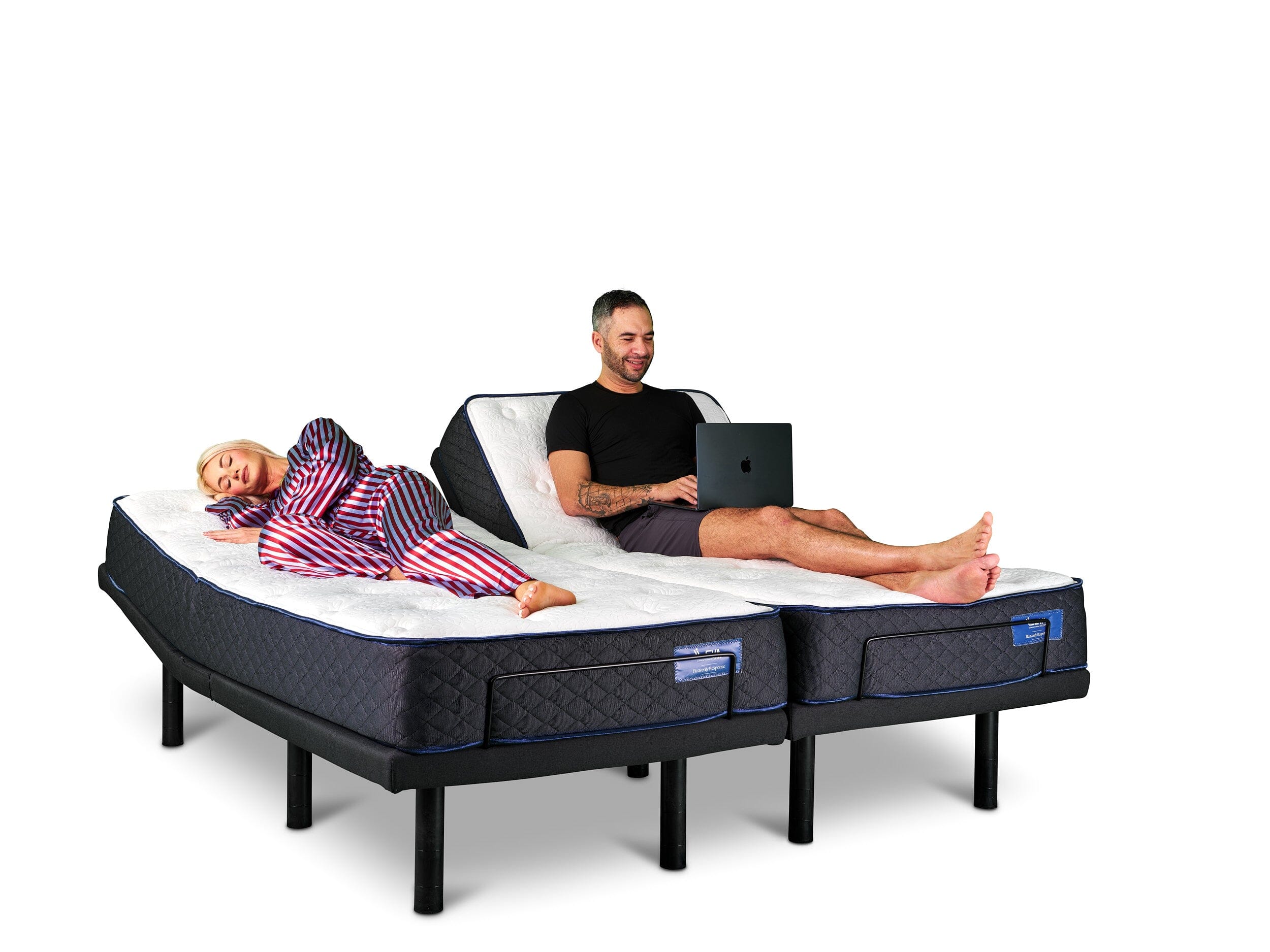
The independent head elevation on Leva’s Split Queen reaches the 7–12° anti-snore range on each side separately. A couple in a standard queen-sized room can have full independent positioning, with anti-snore elevation on one side and flat on the other, without upgrading to a larger bed frame or bedroom.
Leva Sleep delivers and assembles in Ontario and Alberta through an in-house white-glove service. Trained professionals bring the base to the bedroom, complete assembly, set leg heights, provide a product tutorial, and remove the old bed. No third-party couriers and no flat-pack assembly left to the customer.
How to Evaluate Anti-Snore Adjustable Beds
Shoppers can compare adjustable bases for anti-snore use by checking each model against a few clear criteria.
- Independent elevation range: Confirm the head section reaches at least 7–12° on each side independently. Verify this specification directly with the retailer for 2026 models.
- Motor noise: Whisper-quiet operation often falls below 45 dBA, with many quality bases operating in the 35–40 dBA range. Sleep Advisor notes that noise tolerance varies by sleeper and recommends reading reviews, as even quiet motors may wake light sleepers. Ask retailers for decibel ratings and read verified customer reviews.
- Mattress compatibility: Memory foam achieves the highest compatibility with adjustable bases, followed by latex and pocketed-coil hybrids; traditional innerspring mattresses with interconnected coils are generally incompatible. Ideal mattress thickness is 10–12 inches; mattresses over 14 inches can become too rigid and increase motor wear.
- Warranty length and terms: Confirm the warranty covers motor and frame components. Mattress warranties are frequently voided when used on an improper foundation, so verify that both the base and mattress warranties are compatible with each other.
- Delivery and setup logistics: Confirm whether delivery includes in-room setup, assembly, and old-bed removal, or whether the customer is responsible for these steps.
- Split Queen availability: Most retailers only stock Split King. If bedroom size is a constraint, confirm Split Queen availability before purchasing.
Comparison Table: Anti-Snore Adjustable Beds for Couples
The following table applies these criteria to four leading adjustable bases available to Canadian couples in 2026, with a focus on independent elevation, motor noise, and delivery options.
| Model | Anti-Snore Features | Split Queen / Split King | Motor Noise & Canadian Delivery |
|---|---|---|---|
| Leva Sleep Split Base | One-touch anti-snore preset, app-controlled independent 7–12° head elevation per side, snore detection launching spring 2026 | Split Queen (rare in Canada) and Split King available, built to customer specifications | Whisper-quiet German motors, in-house white-glove delivery in Ontario and Alberta including assembly and old-bed removal |
| Tempur-Pedic Ergo Smart Base | AI-powered Sleeptracker detects snoring via heart rate and blood oxygen, automatically adjusts head elevation, ~$300 premium over standard Ergo Power Base | Split King available, Split Queen availability not confirmed in current Forbes listing | Third-party delivery standard, white-glove available at additional cost |
| GhostBed Adjustable Base | Head elevation preset available, no published automatic snore-detection feature | Split King available through Costco and direct, Split Queen not listed as standard offering | Broad distribution model, delivery experience varies by channel, motor noise specifications not independently published |
| Saatva Adjustable Base Plus | One-touch anti-snore preset elevation, no automatic detection published | Split King available, Split Queen not listed as standard offering | White-glove delivery in select U.S. markets, Canadian delivery availability limited, verify current service areas before purchase |
Specifications change. Verify all features, pricing, and delivery terms directly with each retailer before purchasing. Table reflects publicly available information as of June 2026.
Beyond specifications and feature comparisons, the real test is how these bases change sleep for couples who live with snoring every night.
Real Couples, Real Results With Split Bases
Leva Sleep’s customer base includes couples who had moved to separate bedrooms entirely before purchasing a split adjustable base. The pattern stays consistent: one partner’s snoring, combined with a flat bed that offered no positional solution, made shared sleep unsustainable. After switching to a split base with independent anti-snore elevation, both partners returned to the same bed.
The outcome extends beyond snoring reduction. Couples report improved relationship dynamics, reduced morning tension, and better overall sleep quality for both partners. The non-snoring partner benefits from the other side’s quiet motor adjustment instead of being woken by a sharp elbow or a partner leaving the room.
Sleepopolis notes that motor noise matters in shared sleep environments because adjustments made during the night can wake a sleeping partner. Leva Sleep’s German motors are engineered to operate below the threshold that disrupts light sleepers, which keeps mid-night anti-snore adjustments genuinely unobtrusive.
Sleep apnea clinics in Ontario and Alberta refer patients to Leva Sleep as a non-mask alternative for mild cases, which supports the clinical relevance of positional elevation for airway management.
How to Choose and Verify 2026 Adjustable Bed Models
Adjustable bed specifications, including elevation ranges, motor ratings, app features, and delivery terms, change between model years. A buying decision based on 2024 or 2025 specifications may not match what is currently available. Before purchasing any adjustable base in 2026, confirm the following directly with the retailer.
Start with the core anti-snore functionality. Confirm the exact head elevation range in degrees for the current model year, and clarify whether snore detection is automatic, preset, or app-controlled and whether it operates independently per side.
Next, check physical compatibility and comfort. Confirm the motor decibel rating for the current production run, verify mattress compatibility for your specific mattress model and thickness, and confirm Split Queen availability if your bedroom requires it.
Finally, review purchase logistics and protection. Confirm the delivery scope, including whether white-glove service covers assembly, leg-height adjustment, and old-bed removal in your postal code, and review warranty terms for both the base and any paired mattress.
Leva Sleep’s team specialises exclusively in adjustable beds and carries 15–20 models, compared to the 3–5 typically found at general mattress retailers. That depth of inventory means the right configuration for a couple’s specific needs is more likely to be in stock and available for local delivery.
Conclusion: A Clear Path to Quieter Nights
For Canadian couples dealing with snoring, the solution is specific: a split adjustable base with independent 7–12° head elevation, whisper-quiet motors, and a mattress confirmed compatible with articulating movement. Non-split bases, loud motors, and incompatible mattresses all undermine the outcome. Leva Sleep’s Split Queen and Split King bases address each of these variables, with in-house white-glove delivery across Ontario and Alberta.
With Leva Sleep’s specialised inventory of 15–20 adjustable bed models, couples gain access to configurations rarely stocked by general retailers, including the Split Queen format that solves space constraints without sacrificing independent control.
Frequently Asked Questions
What degree of head elevation actually reduces snoring on an adjustable bed?
The most commonly recommended range for anti-snore positioning on an adjustable base is 7–12°. At this angle, the head and upper torso are elevated enough to reduce the soft-tissue collapse at the back of the throat that causes snoring, without placing excessive strain on the neck or lower back. The exact angle that works best varies by individual body type and snoring cause. Adjustable bases with app control let users fine-tune their elevation in small increments until they find the position that produces the best result. Leva Sleep’s bases allow independent adjustment to this range on each side of the bed, so the snoring partner can dial in their optimal angle without affecting the other side.
Is a Split Queen adjustable bed available in Canada, and how does it differ from a Split King?
Split Queen adjustable beds remain rare in the Canadian market. Most retailers stock Split King configurations only, which use two Twin XL mattresses on independent bases. A Split Queen uses a narrower format that fits standard queen-sized bed frames and smaller bedrooms while still providing fully independent head and foot elevation for each partner. Leva Sleep is one of the few Canadian retailers that builds Split Queen bases to customer specifications, with delivery available in Ontario and Alberta. For couples who want independent anti-snore positioning but do not have the bedroom space for a king-sized setup, the Split Queen offers a practical solution.
What type of mattress works best with a split adjustable base for anti-snore use?
Memory foam and latex mattresses are the most compatible options for split adjustable bases. Both materials flex repeatedly without damage and conform to the base’s articulation at the head and foot sections. Pocketed-coil hybrid mattresses also work well when the coils are individually wrapped rather than interconnected. Traditional innerspring mattresses with rigid border wires are not compatible and can be permanently damaged by base movement. Mattress thickness of 10–12 inches provides the best balance of flexibility and support, while mattresses over 14 inches can become too stiff for the base to move efficiently. Leva Sleep designs its own all-foam and hybrid pocket-coil mattresses specifically for use with its adjustable bases, and also carries compatible mattresses from Tempur-Pedic, Simmons, Beautyrest, Serta, and Kingsdown.
How loud are adjustable bed motors, and will they wake my partner during a nighttime adjustment?
Motor noise is a legitimate concern for couples using adjustable bases independently at night. Quality modern motors operate in the 35–45 dBA range during movement, which is roughly equivalent to a quiet hum or rustling leaves. Motors at or below this range are unlikely to wake most sleepers, though light sleepers may still notice the sound. Beyond decibel level, the smoothness of the movement matters. Jerky or vibrating motion can transfer through the mattress and disturb a partner even if the motor itself is quiet. Leva Sleep uses whisper-quiet German motors engineered for smooth, low-noise operation. When evaluating any adjustable base, ask the retailer for the motor’s decibel rating and read verified customer reviews from couples who have used the base for nighttime adjustments.
Does Leva Sleep offer white-glove delivery across all of Canada?
Leva Sleep’s in-house white-glove delivery service currently operates in Ontario and Alberta. The service includes delivery to the bedroom, full assembly of the adjustable base, leg-height adjustment to the customer’s preference, a product tutorial covering the remote and app controls, and removal of the old bed through donation or recycling. This is handled by Leva Sleep’s own trained delivery team rather than a third-party courier, which supports consistency in setup quality. Customers outside Ontario and Alberta should contact Leva Sleep directly to confirm current service area coverage before purchasing.