Written by: Matthew Timmins, Founder and Managing Director, Leva Sleep | Last updated: June 20, 2026
Key Takeaways for Back-Pain-Friendly Adjustable Bases
- Adjustable bases that support back pain relief need at least 750 lb lift capacity, quiet German motors, and split-side controls for couples.
- Zero-gravity positioning has clinical support from orthopedic specialists for reducing spinal pressure and easing lower-back pain.
- Split Queen and Split King configurations let each partner adjust independently without disturbance, which suits different pain levels or sleep preferences.
- Leva Sleep offers 30–50% lower pricing than luxury competitors through vertical integration, with white-glove delivery available in Ontario and Alberta.
- Explore Leva Sleep’s durable adjustable bed packages designed for long-term back pain relief.
Which adjustable bed is best for back pain?
The table below compares six adjustable bases on four durability criteria: weight capacity, lumbar motor presence, zero-gravity and wall-hugger features, and Canadian delivery and pricing transparency. Weight ratings, pricing, and delivery details come from manufacturer pages and independent editorial sources current to mid-2026.
| Model | Weight Capacity / Lumbar Motor | Zero-Gravity / Wall-Hugger | Canadian Delivery / 2026 Price (Queen) |
|---|---|---|---|
| Tempur-Pedic Tempur-Ergo Power Base | Lumbar reinforcement bar (raises/lowers); weight capacity not publicly disclosed | Zero-gravity preset included, wall-hugger not confirmed | Under USD $1,600, white-glove delivery standard |
| Tempur-Pedic Ergo Smart Base | Adjustable lumbar support bar, zero-gravity lumbar mode confirmed by consumer testers | Zero-gravity preset, wall-hugger not confirmed | White-glove delivery standard, price varies by retailer |
| Nectar Comfort Premier Adjustable Base | Weight capacity not publicly disclosed, lumbar motor not listed | Zero-gravity preset, wall-hugger not confirmed | Under USD $800 on promotion, free shipping |
| Bedgear Flex LSX Adjustable Base | Positioned as best for back pain by Forbes Vetted, lumbar specs not publicly disclosed | Zero-gravity preset, wall-hugger not confirmed | US pricing, Canadian availability not confirmed |
| Brooklyn Bedding Ascension Luxe | Split King configuration available, per-side capacity not publicly disclosed | Zero-gravity preset, wall-hugger not confirmed | US pricing, Canadian white-glove delivery not confirmed |
| Leva Sleep Split Queen / Split King | Leva Sleep Quest Elite Split Queen/Split King bases have 1300 lb weight capacity and German-engineered motors, Elite 500/250 models have 450 lb per base and whisper-quiet German-made Okin motors, no Leva model lists an active lumbar support motor. | Zero-gravity preset on Elite models, wall-hugger mechanics not confirmed | White-glove delivery in Ontario and Alberta, pricing advantage over comparable luxury competitors, view current CAD pricing |
Compare Leva Sleep’s Split Queen and Split King configurations with transparent Canadian pricing.
What kind of bed do chiropractors recommend?
Orthopedic physical therapist Karena Wu, P.T., D.P.T., identifies the zero-gravity position as creating a 120-degree angle between thighs and torso that reduces pressure on the lower back and pelvis, with knees resting at approximately 20 degrees. Orthopedic spine surgeon Nitin Bhatia, M.D., recommends adjustable bases with leg elevation and zero-gravity positioning for individuals with lower-back pain because these features unload pressure from the pelvis and backbone. For couples, the clinical value of these positions is only fully realized when each partner can access them independently, which rules out single-motor flat bases and entry-level adjustables without split configurations.
Split Queen vs Split King for Canadian bedrooms
That independence requirement leads directly to the choice between Split Queen and Split King configurations. Both provide per-side control, yet they fit bedrooms differently. A split king consists of two Twin XL mattresses (each 38″ × 80″) on two independent motorized bases, creating a standard 76″ × 80″ king footprint. A Split Queen, a configuration Leva Sleep offers and most national retailers do not stock, uses two narrower mattresses to achieve a standard queen footprint, which suits Canadian bedrooms where a king footprint is impractical.
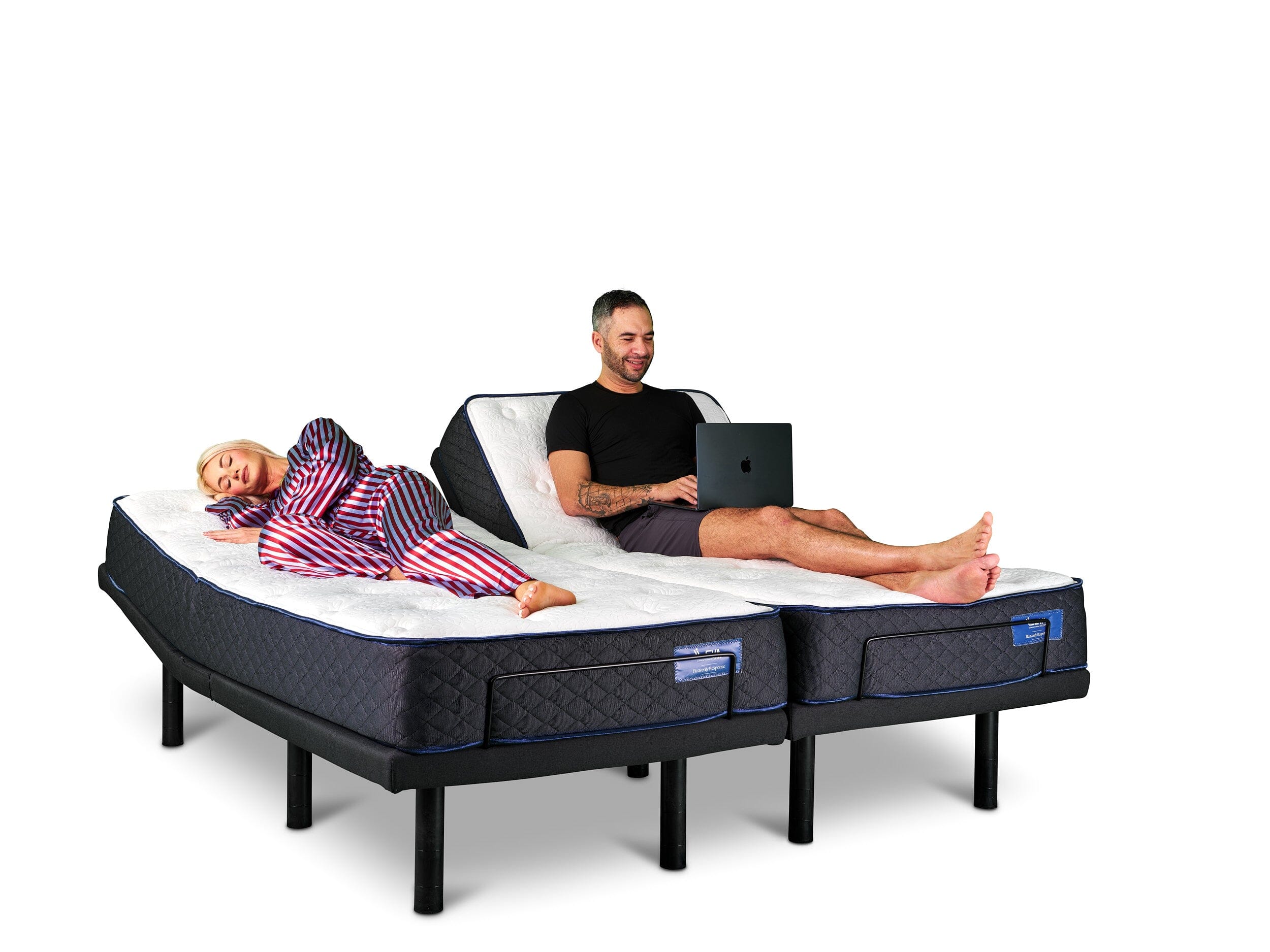
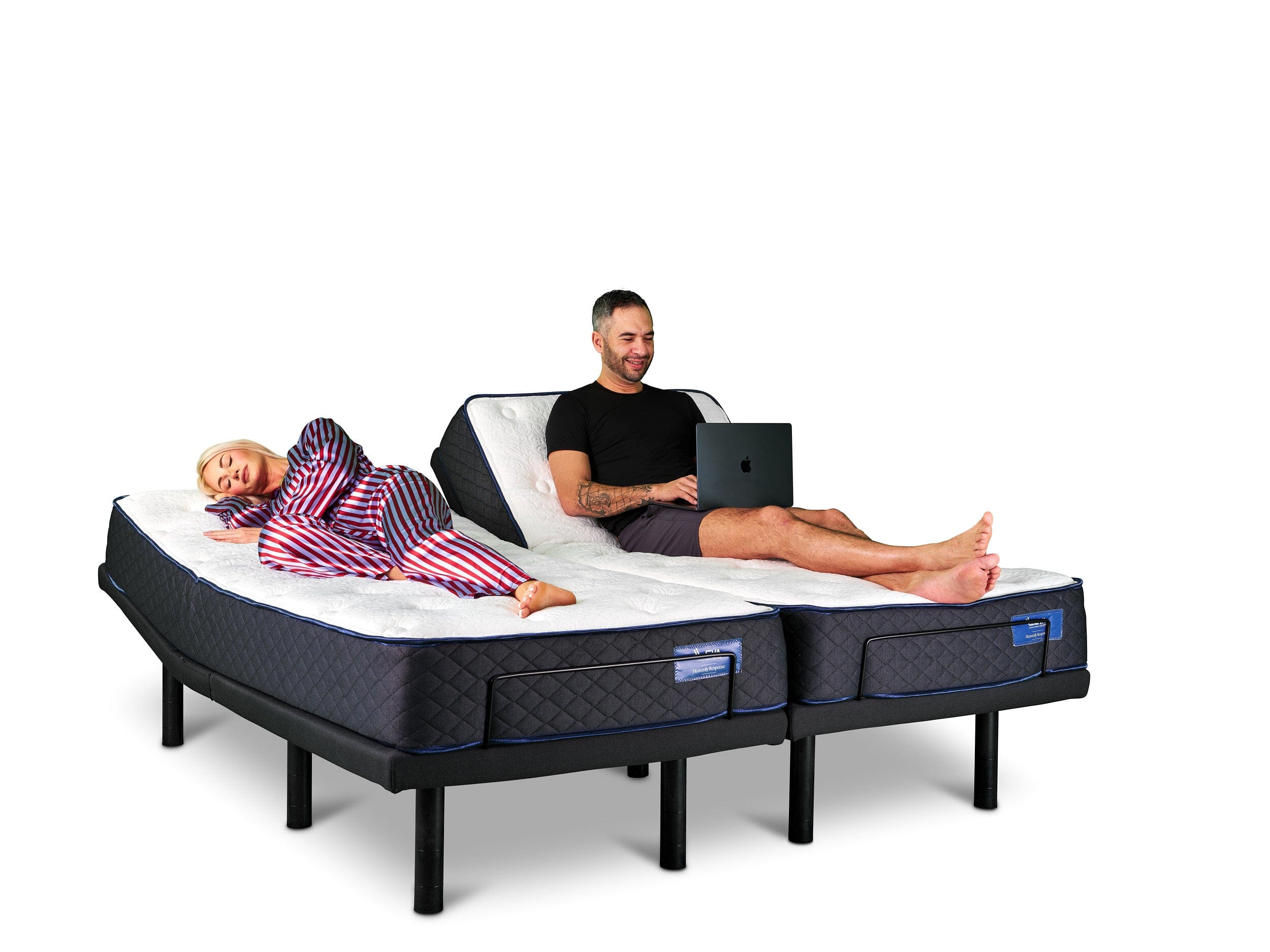
Split configurations allow one partner to use an elevated or zero-gravity position for lumbar relief, reflux, or snoring while the other remains flat, without disturbing the second sleeper. For sciatica or chronic lower-back issues, one user can elevate their knees slightly to reduce tension on the sciatic nerve while the other side stays in a preferred flat position. Modern split bases also include sync features or connector straps so both sides can move together when desired or remain fully autonomous.
How to evaluate durability yourself
The comparison table above shows that many manufacturers do not publicly disclose weight capacity, motor origin, or warranty details. These gaps make it hard to judge durability from marketing materials alone. Before purchasing any adjustable base, verify the following directly with the retailer or manufacturer.
- Weight capacity: Confirm the published per-side or combined lift rating in writing. A minimum of 750 lb combined is a practical threshold for couples.
- Motor type and origin: Ask whether motors are German-engineered and what the decibel rating is at full articulation. Noise specifications should appear in the product sheet, not just marketing copy.
- Warranty length and coverage: Distinguish between frame, motor, and electronics warranties. A base with a 10-year frame warranty but a 1-year motor warranty carries meaningful long-term risk.
- Mattress compatibility: Confirm the base accepts your mattress type (all-foam, hybrid pocket coil) without voiding either warranty.
- Accessory fit: Ask whether the retailer supplies fitted sheets with deep pockets and extra elastic rated for the base’s maximum elevation angle.
Addressing real-user concerns: sheet slippage, partner disturbance, motor noise
Even a clinically effective adjustable base loses value if everyday annoyances prevent consistent use. Verifying specs on paper is necessary but not sufficient. The durability checklist above focuses on mechanical longevity, while three practical concerns determine whether you will use the base’s features every night.
Forum discussions on adjustable bases consistently surface three complaints: fitted sheets pulling free at elevation, one partner waking the other during position changes, and audible motor hum. Each has a documented solution that preserves the clinical benefits outlined above. Sheet slippage is solved by fitted sheets with deep pockets and reinforced elastic bands that remain anchored through the full range of head and foot articulation. Partner disturbance from blanket movement is addressed by duvet clips that maintain separation between two independently moving sides so blankets do not bunch or slide. Motor noise is reduced by whisper-quiet German motors, the standard on Leva Sleep’s lineup, which operate below conversational noise thresholds and remove the mechanical grinding associated with older or budget bases. Finally, remote pockets integrated into the base frame keep handsets accessible without nightstand clutter or the risk of accidental activation under bedding.
Leva Sleep’s vertical-integration advantage
Most adjustable bases sold in Canada pass through an importer, a distributor, and a general mattress retailer before reaching the consumer. Each intermediary adds margin. Leva Sleep designs its systems in-house, oversees manufacturing, and assembles locally, a structure that removes those markups and delivers the pricing advantage noted earlier. The same model supports a selection of 15–20 adjustable bases, compared to the 3–5 models typically stocked by general furniture retailers.
Canada’s home furniture market is projected to grow through 2031 as consumers prioritize longevity and features over the lowest upfront price. This trend favours specialists over generalists. The white-glove delivery noted earlier includes bedroom setup, leg-height adjustment, product tutorial, and removal of the old bed.
Neutral recap of the decision framework
A durable adjustable base for back pain relief requires verified weight capacity, low-noise actuation, and, for couples, independent split-side controls. The zero-gravity positioning detailed earlier has clinical support from orthopedic specialists for reducing spinal load. Split configurations address differing pain levels and sleep preferences without requiring separate rooms.
Canada’s online furniture channel is expanding, yet delivery timelines for bulky imported goods remain a variable because supply chain disruptions can affect lead times for imported furniture. Retailers with local assembly and in-house logistics reduce that exposure. Evaluate any shortlisted base against the checklist above before committing.
Frequently Asked Questions
How long is the warranty on a Leva Sleep adjustable base?
Leva Sleep provides warranty coverage on its adjustable bases covering the frame, motors, and electronics. Warranty terms vary by model. Contact Leva Sleep directly or review the product page for the specific base you are considering to confirm the exact duration and what components are covered. When comparing warranties across brands, distinguish between frame coverage and motor or electronics coverage, because these are often different lengths.
What is the weight capacity of Leva Sleep’s heavy-duty adjustable bases?
Leva Sleep adjustable bases have model-specific weight capacities ranging from 450 lb to 1300 lb, which makes them suitable for couples across a wide range of body types. For split configurations, each side operates independently, so the per-side capacity is the relevant figure to verify for your specific situation. Confirm the published rating for the model you select before purchasing.
Does Leva Sleep offer an anti-snore mode?
Leva Sleep is exploring an anti-snore mode for future availability. The feature would be designed to detect snoring and make subtle micro-adjustments to the head of the bed to reduce or eliminate snoring without waking the sleeper. On split configurations, this would operate on the affected side only, leaving the other partner’s position undisturbed. Check the current product listings for availability status on specific models.
How long does delivery take for a Leva Sleep adjustable base in Ontario or Alberta?
Leva Sleep offers white-glove delivery in Ontario and Alberta. Because Leva assembles its systems locally and manages its own logistics, delivery timelines are not subject to the international freight delays that have affected imported furniture. Specific scheduling windows depend on your location and the model selected. Contact Leva Sleep at the time of purchase for a confirmed delivery estimate. White-glove service includes in-room setup, leg-height adjustment, a product walkthrough, and removal of your existing bed.
Will standard fitted sheets work on a Leva Sleep adjustable base?
Standard fitted sheets frequently pull free when an adjustable base elevates the head or foot section, because the sheet’s elastic is not designed for that range of motion. Leva Sleep designs its own fitted sheets with deep pockets and reinforced extra elastic specifically for adjustable bases. Using Leva’s purpose-built bedding accessories eliminates sheet slippage at any elevation angle and ensures the full functionality of the base is not compromised by incompatible bedding.
Conclusion
Couples managing differing back pain levels, snoring, or mismatched sleep preferences have a documented clinical case for zero-gravity support and a practical case for split configurations that deliver those positions independently on each side of the bed. Leva Sleep’s Split Queen and Split King systems meet the core durability criteria, maintain the cost advantage described above, and are supported by white-glove delivery in Ontario and Alberta. Explore Leva Sleep’s current Split Queen and Split King packages, specifications, and 2026 Canadian pricing.