Written by: Matthew Timmins, Founder and Managing Director, Leva Sleep | Last updated: July 25, 2026
Key Takeaways for Split King Adjustable Beds
- Split king adjustable beds let each partner control temperature, firmness, and elevation on their own side, so no one has to compromise every night.
- Traditional king mattresses and linked adjustable bases lock both partners into the same settings, which often worsens temperature and position conflicts.
- Active dual-zone cooling pads and independent Twin XL mattresses deliver precise per-side temperature control that passive materials cannot match.
- Independent elevation on each side supports needs like snoring, sleep apnea, or acid reflux without waking or disturbing the other partner.
- Explore Leva Sleep split king packages designed for Canadian couples who want separate temperature, firmness, and elevation settings.
The Problem: Why Shared King Beds Cause Conflicts
A 2025 AASM survey found that 31% of U.S. adults have opted for sleep divorce, with that figure climbing to 39% among adults aged 35–44, the group most actively searching for solutions. Half of couples prefer different temperatures while sleeping, and couples experience more sleep disturbances when sharing a bed than when sleeping alone.
Standard king mattresses on fixed frames share every variable: surface temperature, firmness, and position. When one partner shifts or heats up, both feel it. Basic adjustable bases sold at general furniture retailers address elevation on one side only, because both halves of the base move together. A partner who needs head elevation for snoring or acid reflux forces the other into the same incline. With a standard king mattress on an adjustable base, both sides are mechanically linked and must move together, which removes the independence couples with different needs require. This mechanical limitation, combined with temperature and firmness conflicts, helps explain why many couples now sleep apart on some nights, often citing temperature incompatibility as a key reason.
How Split King Systems Resolve Temperature and Firmness Clashes
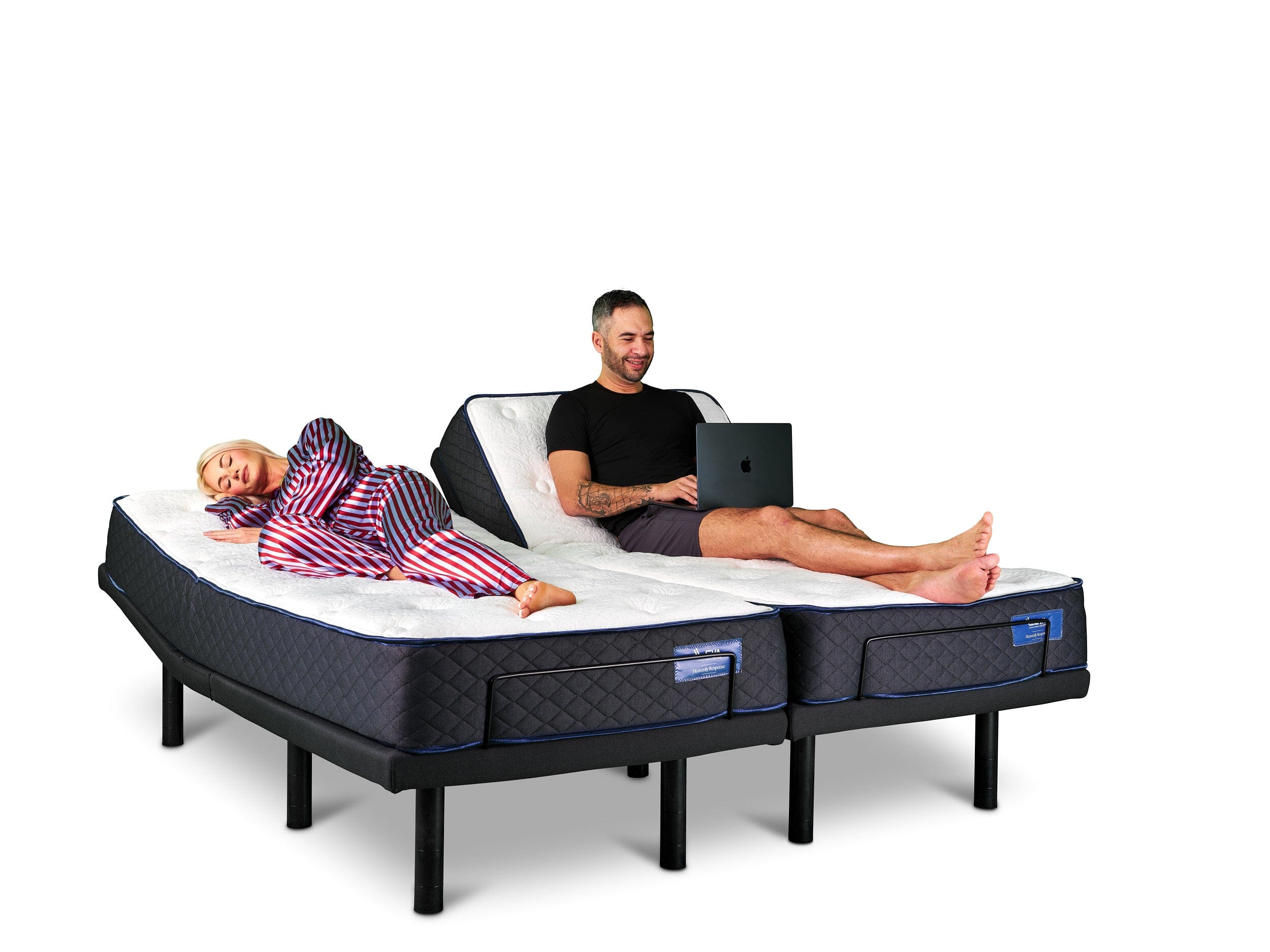
A split king adjustable system uses two Twin XL mattresses, each 38″ × 80″, on two independent motorized bases that together fill the footprint of a standard king. Each base operates separately, so one partner can raise their head section for snoring relief or acid reflux while the other remains completely flat. Modern split king adjustable bases include a sync and unsync function so the two halves can move together when desired and operate separately for personalized positioning.
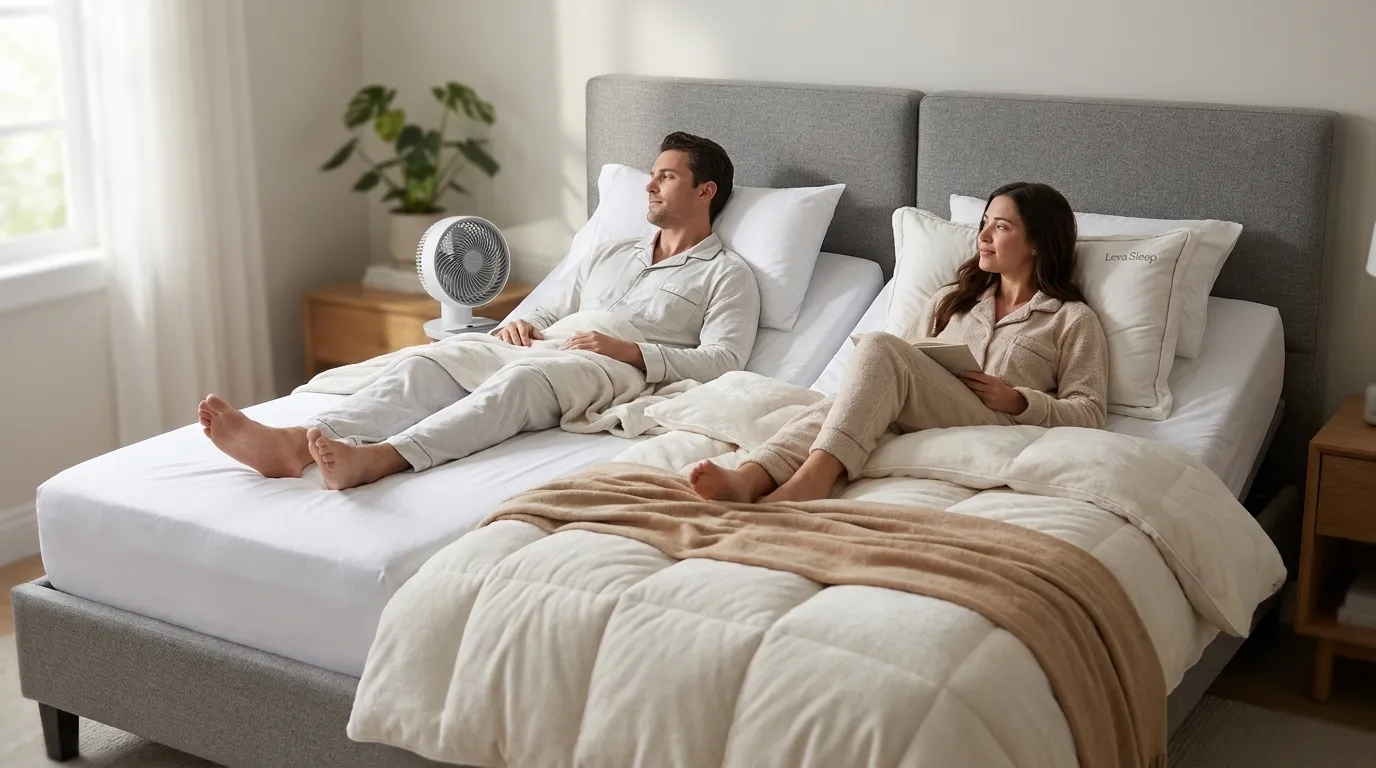
Split king setups let each partner choose a mattress with distinct thermal properties, such as cooling gel foam on one side and warmer memory foam on the other. This creates independent temperature regulation without nightly negotiation. When an active dual-zone cooling pad sits on top, each side can be set to a specific temperature independent of the other, which covers the full range of thermal mismatch.
Compare Leva Sleep adjustable bed packages to see split king options with separate elevation, temperature, and firmness controls.
Comparing Split King Temperature Regulation Technologies
Three main technologies handle per-side temperature control in a split king setup: cooling foams and other passive materials, phase-change materials (PCM), and active dual-zone hydronic or air-based pads. The table below compares four common couple sleep profiles against these options.
| Couple Profile | Recommended Mattress Type | Base Features Needed | Active Cooling Solution |
|---|---|---|---|
| Hot sleeper / Cold sleeper | Cooling gel hybrid (hot side) + warmer foam Twin XL (cold side) | Independent elevation, lumbar control | Eight Sleep Pod 5 or Chilipad Dock Pro (55–115°F dual-zone) |
| Hot sleeper / Hot sleeper | Hybrid or latex Twin XL on both sides for airflow | Independent elevation, fan-assisted base preferred | ORION Smart Cooling (dual-zone, no subscription) |
| Cold sleeper / Cold sleeper | All-foam Twin XL on both sides for heat retention | Independent elevation, warming function | Eight Sleep Pod 4 Cover (heating to 110°F per side) |
| Medical needs (sleep apnea / acid reflux / edema) | Hybrid Twin XL, independent head and foot elevation 10–30 degrees per side | Anti-snore mode, lumbar support, pillow tilt, zero-gravity preset | ChiliSleep OOLER (dual-zone, app scheduling, no subscription for core features) |
The couple profiles above show how physiological differences create thermal asymmetry that calls for different solutions on each side of the bed. For hot and cold sleeper pairings in particular, active dual-zone systems become crucial because passive materials cannot cool below ambient room temperature, so a cooling foam mattress alone will not help if the room itself stays warm.
Phase-change material covers, such as those using TitanCool technology, create a cool-to-the-touch surface and help regulate heat throughout the night. This option sits between basic passive foams and fully active hydronic systems in both performance and cost.
Matching Firmness and Temperature to Sleep Positions
Firmness choice directly affects temperature regulation. A slightly firmer mattress helps hot sleepers by limiting body sinkage, which increases exposed surface area for airflow and reduces heat buildup. The table below matches common sleeper profiles to Leva Sleep configuration options.
| Sleeper Position & Preference | Firmness Target | Temperature Priority | Recommended Leva Configuration |
|---|---|---|---|
| Side sleeper, pressure relief needed | Medium-soft foam or hybrid Twin XL | Neutral to cool | Split king with pillow tilt motor and a cooling gel hybrid mattress on that side |
| Back sleeper, lower back pain | Medium-firm hybrid Twin XL | Neutral | Split king with adjustable lumbar control and head elevation of 7–15 degrees |
| Back sleeper, sleep apnea or snoring | Medium hybrid Twin XL | Cool preferred | Split king with anti-snore mode and head elevation of 10–30 degrees independent of the partner |
| Side sleeper, runs hot | Medium-firm hybrid or latex Twin XL | Active cooling required | Split king with an active dual-zone cooling pad and a breathable latex or gel hybrid mattress |
Better Sleep Council data shows a near-even split in mattress firmness preferences, with 51% preferring firm and 49% preferring soft. This suggests that about half of couples will have mismatched firmness preferences. A split king system solves this directly because each Twin XL mattress is chosen independently.
Motion Isolation and Cuddling Tradeoffs
Split king adjustable bases provide strong motion isolation because each side is mechanically independent, so when one partner adjusts position or gets in or out of bed, the other side stays still. This matters for couples where one partner is a light sleeper or keeps a different schedule.
Cuddling remains the most common concern about split king configurations. The two Twin XL surfaces create a physical gap that some couples feel reduces closeness. Bridge pads and connector straps narrow the gap when both bases lie flat, but solutions thick enough to remove the gap also reduce the independent adjustability that makes split kings appealing. Couples who spend most of the night on their own side and come together briefly usually find the gap manageable. Couples who sleep intertwined throughout the night often find it disruptive.
Beyond the cuddling gap, split king systems carry several other limitations that affect cost, convenience, and compatibility with different sleeping arrangements.
Drawbacks of Split King Adjustable Beds
A split king adjustable system does not suit every couple. The limitations below apply across the category and deserve careful review before purchase.
- Cost: Split king setups require two separate mattresses plus two adjustable bases, which raises total ownership costs compared to a single king.
- Specialized sheets: Split king configurations need two separate Twin XL sheet sets because the beds move independently and regular king size sheets will not stay in place. Twin XL sheets are less common than standard king sets. Leva Sleep designs fitted sheets with deep pockets and extra elastic specifically for adjustable bases to reduce this friction.
- The gap: Mattresses in a split king setup that are not properly anchored to the frame can drift apart during the night, which widens the gap between partners.
- Room size requirements: Some bedrooms do not have enough space for a split king adjustable bed, so owners need to measure floor space length and width before buying.
- Mattress availability: The split king option remains less common than the six standard mattress sizes, so a preferred mattress model may not come in split king.
- Not ideal for co-sleeping with children or pets: Split king mattresses do not work well for co-sleeping with a pet or child because the two separate halves create an unstable or divided surface for extra sleepers.
A split king adjustable base usually does not justify the extra cost over a standard king if couples always sleep in the same position and have no health or comfort needs that independent adjustment would address.
Canadian Pricing, Brands, and Delivery Details
Leva Sleep’s direct-to-consumer model removes the retail markup that inflates prices at general furniture chains and large mattress retailers. This approach delivers split king adjustable packages at roughly 30–50% less than comparable luxury brands. For Canadian couples in Ontario and Alberta, Leva Sleep offers in-house white-glove delivery that includes bedroom-level setup, leg height adjustment, a product tutorial, and removal of the old bed through donation or recycling. This service removes the assembly burden that often comes with bed-in-a-box brands.
Leva Sleep also carries mattresses from Tempur-Pedic, Simmons, Beautyrest, Serta, and Kingsdown, pairing them with its own adjustable bases. This partnership model solves a common buying problem for couples who want a specific mattress brand for pressure relief but also need the independent elevation and temperature control that a split king base provides. Instead of coordinating purchases across multiple retailers, couples can choose both the base and mattress through Leva Sleep, which ensures compatibility and avoids the limited adjustable bed expertise found at many generalist furniture stores.
Benefits and Real-World Outcomes for Couples
For couples whose sleep conflicts come from temperature mismatch, firmness disagreement, snoring, or medical elevation needs, a split king adjustable system separates each variable so neither partner has to give in. Studies show that positional therapy using head-of-bed elevation can reduce snoring frequency for people with positional obstructive sleep apnoea. A split king base allows that elevation on one side only while the other partner stays flat and undisturbed.
The practical outcomes most often reported by couples who move from a standard king to a split king adjustable system include:
- Ending nightly thermostat arguments through per-side active cooling or heating
- Reducing partner disturbance from position changes and getting in or out of bed
- Using independent elevation for snoring, acid reflux, sleep apnea, or post-surgical recovery on one side only
- Letting each partner choose their own firmness level without affecting the other side
- Staying in the same bedroom instead of resorting to sleep divorce
Explore split king setups from Leva Sleep that support separate temperature, elevation, and firmness settings for each partner.
Frequently Asked Questions
Can a split king adjustable bed handle very different firmness preferences?
A split king system uses two separate Twin XL mattresses, so each partner chooses their own mattress independently. One side can be a medium-soft all-foam mattress for a side sleeper who needs pressure relief, while the other side is a medium-firm hybrid for a back sleeper who needs lumbar support. The two mattresses sit side by side on independent bases and do not share structural components that would transfer firmness from one side to the other. Leva Sleep carries 15–20 adjustable bed models and stocks compatible mattresses from multiple brands, which gives couples a broader selection than the 3–5 models typically found at a general mattress retailer.
Do split king adjustable beds work when one partner has sleep apnea or snores?
Split king adjustable bases work especially well in this situation. Each base operates independently, so the partner with sleep apnea or positional snoring can elevate their head section 10–30 degrees while the other partner remains flat. Leva Sleep’s adjustable bases include an anti-snore mode that detects snoring and makes small automatic adjustments to the head of the bed. This can address mild to moderate positional snoring without a CPAP mask and without changing the other partner’s position. Sleep apnea clinics in Canada have referred patients to Leva Sleep specifically for this capability.
What bedding does a split king adjustable bed need, and is it hard to find?
A split king needs two separate Twin XL fitted sheets rather than a single king fitted sheet, because the two bases move independently and a standard king sheet would either bind or pop off during elevation. A king-size flat sheet or duvet can still cover both sides when the bases are flat. Leva Sleep designs its own fitted sheets with deep pockets and extra elastic for adjustable bases, and also offers duvet clips that keep bedding in place when the two sides sit at different angles. These accessories are available directly from Leva Sleep, so customers do not need to search for specialty bedding elsewhere.
How does active dual-zone cooling differ from a cooling foam mattress for couples?
A cooling foam mattress uses passive materials, such as gel infusions, open-cell structures, or phase-change covers, to disperse body heat. These materials reduce heat retention compared to traditional memory foam but cannot cool below ambient room temperature and cannot be set independently per side. Active dual-zone systems, such as water-cooled hydronic pads, circulate temperature-controlled water through micro-tubes and can reach lower surface temperatures on one side while the other side runs warmer at the same time. This makes active systems a strong option for couples whose temperature preferences differ or for partners who experience hot flashes or other conditions that cause significant and unpredictable heat output during the night.
Is white-glove delivery available across Canada, and what does it include?
Leva Sleep’s white-glove delivery service is available in Ontario and Alberta. The service includes delivery to the bedroom, full assembly of the adjustable base and mattress, leg height adjustment to the customer’s preference, a product tutorial that covers app controls and preset positions, and removal of the old bed through donation or recycling. This fee-based service removes the setup burden that comes with large adjustable bed systems, which are more complex to assemble than a standard platform bed frame. Customers outside Ontario and Alberta should contact Leva Sleep directly to confirm delivery options in their region.
Conclusion: How to Decide if a Split King Fits Your Bedroom
A split king adjustable bed system offers a comprehensive solution for Canadian couples dealing with temperature mismatch, firmness disagreement, snoring, or medical elevation needs. The configuration delivers true independence because each partner controls their own surface temperature, firmness, and elevation without mechanical linkage to the other side. The drawbacks, including the 2–4 inch centre gap, specialized sheet requirements, and higher upfront cost, are real and should be weighed against the specific conflicts driving the purchase. For couples already considering sleep divorce or separate bedrooms, the gap and cost often feel minor compared to the alternative.
When you evaluate a split king adjustable system, focus on independent elevation range per side, active versus passive temperature control capability, mattress compatibility with the base, availability of Canadian white-glove delivery, and total system cost compared with similar luxury brands. Leva Sleep’s vertically integrated model, which covers base engineering, mattress selection, purpose-built bedding, and in-house delivery in Ontario and Alberta, addresses each of these criteria within a single purchase.
Review Leva Sleep split king packages to configure separate temperature, firmness, and elevation controls for both sides of the bed.