Written by: Matthew Timmins, Founder and Managing Director, Leva Sleep
Key Takeaways for Canadian Couples
- Split Queen or Split King adjustable systems let each partner control elevation, firmness, and temperature independently, so neither person has to compromise.
- Snoring, motion transfer, and differing firmness preferences are leading causes of sleep divorce among Canadian couples.
- Traditional flat beds and single-zone bases cannot solve these issues. Split adjustable systems provide true independence for each sleeper.
- Key evaluation criteria include independent motors, motion-isolating mattresses, quiet operation, and bedding that stays secure while the base moves.
- Leva Sleep offers premium Split Queen and Split King packages with anti-snore automation and white-glove delivery. Shop Leva Sleep to end sleep disruption for both partners.
The Problem: Sleep Divorce and Everyday Sleep Disruption
A UK Biobank analysis of 408,317 adults aged 40–69 found that approximately 37% are habitual snorers. Prevalence climbs steadily with age, reaching 40–50% among adults in their 60s, and objective sensor data from a large study (N=12,287) suggests that self-report can underestimate actual snoring prevalence. The partner in the same bed pays a measurable cost: bed partners of habitual snorers can gain additional sleep once the snorer receives treatment.
Motion transfer compounds the problem. A 2026 systematic review in Sleep Health confirmed that partner movement disturbs sleep, with movement transmission rates between bed-sharing partners ranging from 19% to 46% in some studies. Differing firmness needs add a third layer of friction. A 2025 polysomnography study in Nature and Science of Sleep found that medium-firm mattresses produced the best objective sleep outcomes, yet one partner's ideal firmness is rarely the other's.
The cumulative result is sleep divorce. The American Academy of Sleep Medicine reported that 31% of U.S. adults sleep in another bed or room to accommodate a partner in 2025, with the rate reaching 39% among adults aged 35–44. Canadian couples face the same pressures.
End sleep divorce with a split adjustable system that lets both partners sleep their way.
Why Flat Beds and Basic Adjustable Bases Fall Short
A flat mattress offers no elevation adjustment, so a partner who needs head elevation for snoring, acid reflux, or sleep apnea has few options beyond stacking pillows. That approach strains the neck instead of opening the airway. Basic single-zone adjustable bases improve on this, but they move both sides simultaneously. One partner's position change then wakes the other.
Noise often becomes a persistent complaint with entry-level bases. Older or budget motors produce audible grinding or clicking during adjustment, which undermines the goal of quiet repositioning. Standard bedding creates another obstacle. Conventional fitted sheets are not designed for the flex range of an adjustable base and often pop off at the corners during elevation changes. Without purpose-built accessories, the sleep system performs poorly even when the base itself is capable.
Split Adjustable Mattress and Base Systems That Solve Sleep Divorce
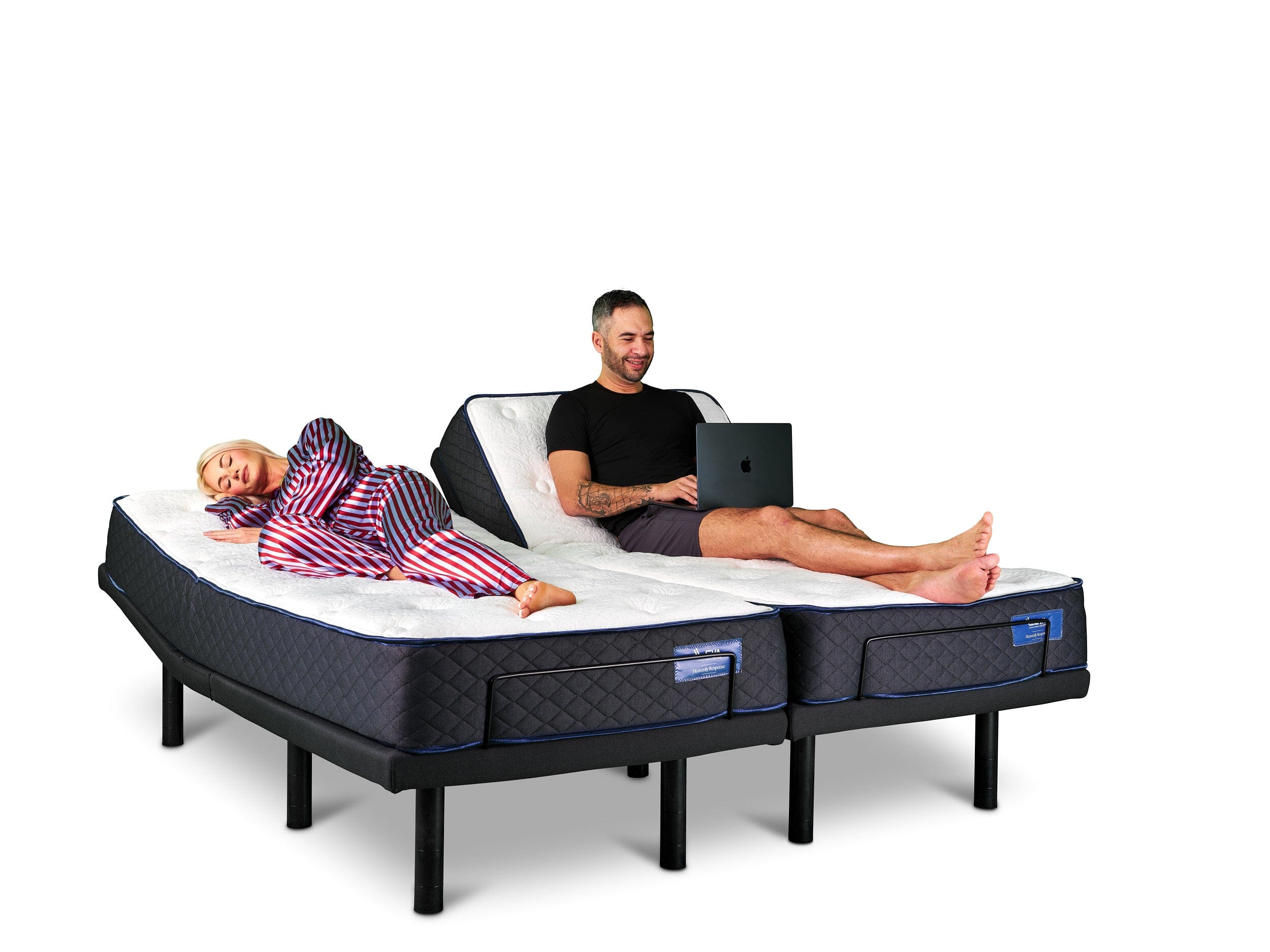
A split adjustable system places two independently controlled bases side by side within a shared bed frame. Each partner adjusts head elevation, foot elevation, lumbar support, and massage settings from a dedicated remote or smartphone app without affecting the other side. A Split King consists of two Twin XL bases totalling 76 by 80 inches, the same footprint as a standard king, while a Split Queen uses two narrower bases within a 60-by-80-inch frame. This configuration makes the Split Queen a practical choice for Canadian condos and older homes where a king requires at least 12 by 12 feet of floor space to allow nightstand and walking clearance.
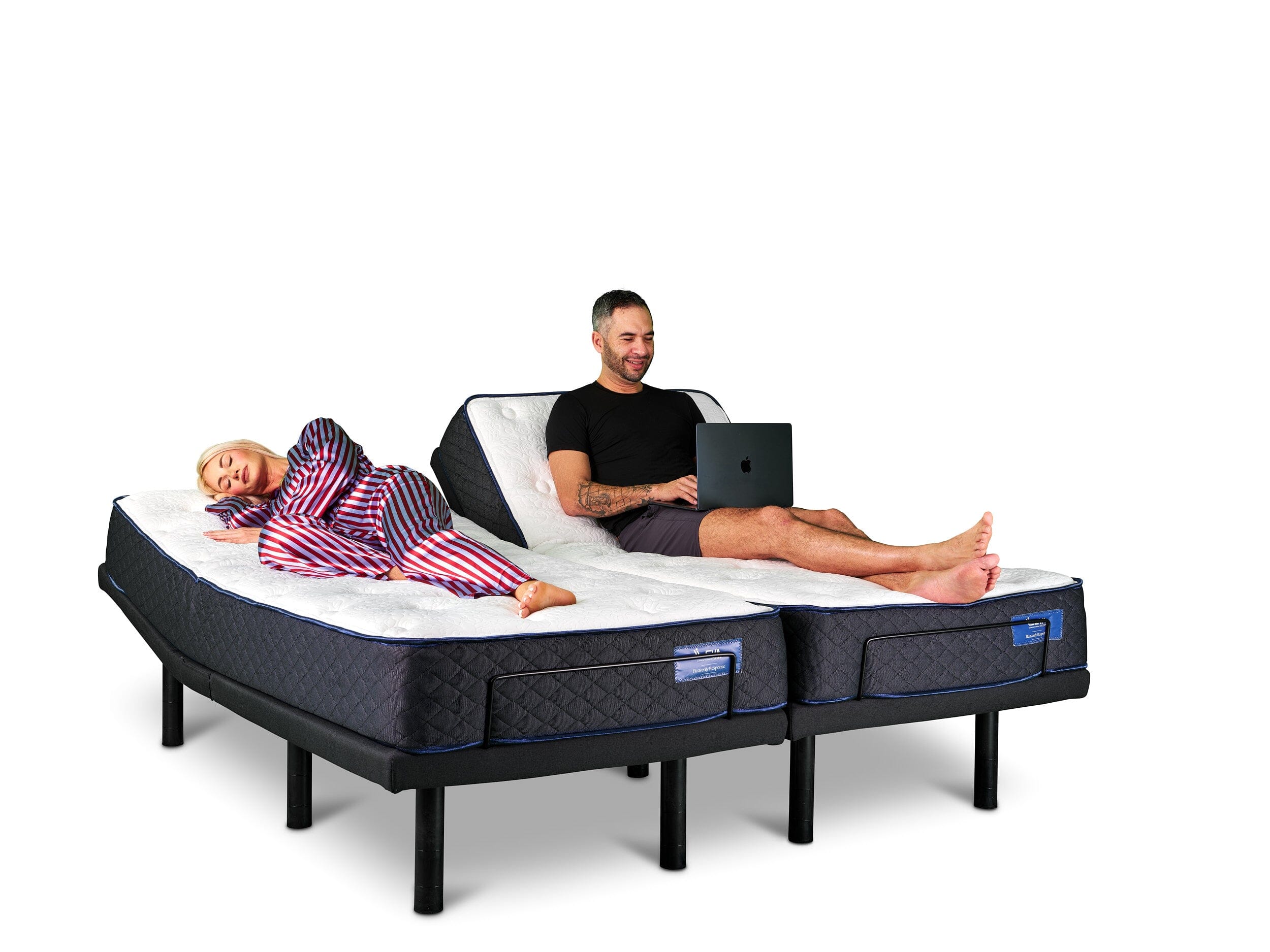
Leva Sleep's whisper-quiet German motors allow mid-night repositioning without waking a partner. The anti-snore mode, available on higher-tier bases, detects snoring acoustically and makes micro-adjustments to the head of the bed to open the airway. These small changes can reduce or eliminate snoring episodes without requiring the snorer to wake. Zero-gravity positioning elevates the head 15–20 degrees with knees raised above heart level, and research published in the journal Sleep reports that zero-gravity positioning reduces spinal disc pressure by roughly 25% compared to lying flat. Semi-reclined positioning can also decrease gastroesophageal reflux episodes and improve oxygen saturation in participants with mild sleep apnea.
Explore Leva's anti-snore automation and zero-gravity presets for Ontario and Alberta delivery.
Evaluation Criteria for Couples Choosing a Split System
Couples should focus on features that directly address snoring disruption, motion transfer, and mismatched preferences when assessing any split adjustable system.
- Independent adjustability: Each side must have its own motor and controls so one partner's position change does not force the other to move. This independence removes the compromise built into single-zone bases.
- Motion isolation: Because movement transmission affects 19–46% of bed-sharing partners, mattresses with individually wrapped pocket coils or high-density foam layers work best. Pocketed coils minimize motion transfer by activating only the coils directly beneath the moving body, which keeps the other partner more stable.
- Motor noise: A repositioning that wakes your partner defeats the purpose of an adjustable base. Request decibel ratings or ask for a live demonstration. Whisper-quiet motors should be effectively inaudible from the opposite side of the bed.
- Mattress compatibility: The mattress must be rated for full articulation across the base's elevation range without voiding the mattress warranty. This protects both comfort and long-term coverage.
- Temperature control: Per-side heating and cooling options allow one partner to sleep cooler while the other stays warmer. Shared single-zone units cannot solve temperature mismatch.
- Bedding fit: Purpose-built fitted sheets with deep pockets and reinforced elastic, along with duvet clips for split configurations, keep bedding in place during frequent adjustments.
- Delivery and setup: White-glove in-home setup, old bed removal, and a product tutorial simplify installation. Professional setup also ensures correct calibration from the first night.
- Long-term support: Warranty length on both the base and mattress, plus a Canadian service network, determines how easily issues can be resolved over time.
Real-World Couple Scenarios and Recommended Features
Snoring partner: choose a split adjustable base with anti-snore automation when:
- One partner snores consistently and the other is losing meaningful sleep.
- The snoring partner is unwilling or unable to use a CPAP device nightly.
- Both partners want to remain in the same bed rather than move to separate rooms.
Hip- or knee-pain sleeper: choose a split system with zero-gravity and lumbar presets when:
- One partner has been advised by a physician to sleep with legs elevated or in a reclined position.
- Morning joint stiffness affects daily function and the current flat mattress provides no positional relief.
- The other partner sleeps flat and would be disturbed by a single-zone base that moves both sides.
Temperature mismatch: choose a split system with per-side heating and cooling when:
- One partner consistently overheats and the other feels cold, so a shared blanket or mattress topper becomes a nightly negotiation.
- Hormonal changes, common in the 45–60 age range, have made temperature regulation a new and disruptive issue.
Comparison: Split Adjustable Systems Available in Canada
The table below compares four major brands available to Canadian buyers across price, split-queen availability, anti-snore features, and trial length. These factors most directly affect whether a system can solve the snoring, motion transfer, and space constraints discussed earlier.
| Brand | Approx. CAD Price Range (Queen Package) | Split Queen Available | Anti-Snore Feature | Trial Length |
|---|---|---|---|---|
| Leva Sleep | $3,000–$6,000 | Yes — specialist offering | Yes — automated detection and micro-adjustment | Contact retailer |
| GhostBed | $4,000–$7,500 | Limited — primarily single-base models | Not confirmed on current Canadian listings | 101 nights |
| Douglas | $1,500–$3,500 | No split base offered | No | 365 nights (mattress only) |
| Tempur-Pedic | $8,000–$15,000+ | Yes — via TEMPUR-Ergo base | Yes — Ergo Smart base with snore detection | 90 nights |
Price ranges are approximate retail estimates for Canadian markets. Verify current pricing directly with each retailer before purchasing.
Compare Leva's transparent CAD pricing against the luxury brands above.
Best Adjustable Bed Setup for Couples in Canada
The best adjustable bed for couples provides fully independent control on each side, uses a mattress engineered for articulation and motion isolation, and operates quietly enough for mid-night adjustments. It should also come from a retailer with genuine expertise in adjustable systems rather than treating the base as an accessory. For Canadian couples in Ontario and Alberta, additional considerations include white-glove delivery capability, CAD pricing without cross-border import uncertainty, and a service network that can address warranty issues locally. A Split Queen is the practical choice for smaller bedrooms, while a Split King provides the personal space advantage described earlier for larger rooms.
What Are the Disadvantages of Adjustable Beds?
Adjustable beds carry several practical trade-offs that buyers should weigh before purchasing.
- Higher upfront cost: A quality split adjustable package costs significantly more than a flat bed and basic frame, though direct-to-consumer specialists reduce this gap.
- Bedding compatibility: Standard fitted sheets and duvets are not designed for articulating bases and will require replacement with purpose-built alternatives.
- Weight and installation complexity: Adjustable bases are heavy and usually require professional setup. Self-installation is impractical for most buyers.
- Not a complete medical solution: Elevation helps manage mild snoring and acid reflux, but for diagnosed obstructive sleep apnea, positional elevation is a complement to, not a replacement for, CPAP therapy.
- Mattress restrictions: Not all mattresses are compatible with full articulation. Memory foam and pocket-coil hybrids generally flex well, while some innerspring designs do not.
How Does Leva Compare with Sleep Number?
Sleep Number's primary differentiator is air-chamber firmness adjustment, which allows each partner to dial a numeric firmness setting. Leva Sleep's approach combines a fixed-firmness mattress selected at purchase, in all-foam or hybrid pocket-coil construction, with independent base elevation, lumbar control, and temperature regulation per side. Sleep Number bases are available in Canada through select retail partners, while Leva Sleep operates a direct-to-consumer model with in-house white-glove delivery in Ontario and Alberta, which removes retail markup.
Sleep Number's proprietary air chambers require ongoing calibration and periodic service. Leva's foam and coil mattresses have no mechanical components within the mattress itself. For couples whose primary concern is elevation-based snoring management, anti-snore automation, and motion isolation rather than post-purchase firmness adjustment, Leva's integrated system addresses those needs at a lower total cost.
Frequently Asked Questions
What size is a Split Queen adjustable bed, and will it fit in a standard Canadian bedroom?
A Split Queen adjustable bed matches the standard queen footprint described earlier, so it fits in any bedroom that currently accommodates a queen bed, generally a room of at least 10 by 10 feet. The split configuration changes only the internal mechanics, not the floor space required. This makes the Split Queen a practical choice for Canadian condos, townhouses, and older homes where a king-sized footprint would be too large. Leva Sleep is one of the few Canadian retailers that offers a Split Queen as a standard product rather than a custom order.
Does Leva Sleep offer white-glove delivery and setup in Ontario and Alberta?
Leva Sleep provides in-home white-glove delivery for a fee in Ontario and Alberta. The service includes delivery to the bedroom, full assembly of the adjustable base and mattress, leg-height adjustment, a product tutorial covering app setup and preset positions, and removal of the old bed, with donation or recycling where available. This service differs from standard mattress delivery that drops the product at the door or removes only packaging. For a complex product like a split adjustable base, professional setup ensures the system is calibrated correctly from the first night.
Can an adjustable bed help with sleep apnea, and does it replace a CPAP machine?
Elevating the head of the bed opens the airway and can reduce the frequency and severity of snoring and mild obstructive sleep apnea episodes. Zero-gravity positioning, with the head raised 15–20 degrees and knees elevated, can reduce apnea episodes through the oxygen-saturation improvement noted earlier. For diagnosed moderate-to-severe obstructive sleep apnea, an adjustable base remains a complement to CPAP therapy, not a replacement. Leva Sleep's anti-snore mode detects snoring acoustically and makes automatic micro-adjustments to the head position, which can reduce disruption for both the snorer and their partner. Customers with a formal sleep apnea diagnosis should consult their physician before modifying their treatment plan.
What warranty does Leva Sleep offer on its adjustable bases and mattresses?
Leva Sleep provides warranty coverage on both its adjustable bases and mattresses, and specific terms vary by model and should be confirmed at the time of purchase. Because Leva designs and assembles its systems in-house and operates a direct-to-consumer model, warranty service is handled without routing through a third-party retailer. Buyers should request the warranty document for their specific base model and mattress separately, as the coverage periods and conditions for mechanical components and foam or coil materials differ. Leva's 8-year operating history and 25,000-plus customers provide a track record for evaluating long-term support reliability.
Conclusion: Choosing the Right System for Better Sleep Together
Sleep divorce driven by snoring, motion transfer, and mismatched firmness does not have to be an inevitable consequence of sharing a bed. Split adjustable systems address each of these problems through independent elevation control, motion-isolating mattress construction, and per-side temperature regulation, while allowing partners to stay in the same room.
For Ontario and Alberta couples who want every one of those criteria met, Leva Sleep acts as a focused specialist. With over 8 years of adjustable bed expertise, $50M in lifetime sales, 25,000-plus customers, and a direct-to-consumer model that prices Split Queen and Split King packages 30–50% below comparable luxury competitors, Leva Sleep offers a complete system. The package includes base, mattress, bedding, anti-snore automation, and white-glove setup, without the compromises that come from buying an adjustable base as an afterthought at a general furniture retailer.