
Written by: Matthew Timmins, Founder and Managing Director, Leva Sleep
Key Takeaways for Canadian Couples
- A split king adjustable bed gives each partner independent control over head, foot, and lumbar positioning within a standard king footprint, which removes nightly compromise on firmness or elevation.
- Traditional flat beds and single-unit adjustable bases cannot address snoring, motion transfer, or differing medical needs, and only true split systems with separate motors solve these issues.
- Key evaluation criteria include whisper-quiet German-engineered motors, mattresses with verified flex-angle tolerance, deep-pocket bedding, and white-glove delivery that includes full assembly and old-bed removal.
- Canadian couples in Ontario and Alberta benefit from local stock, in-house delivery, and pricing that is 30–50% lower than luxury competitors while still offering advanced anti-snore and temperature features.
- Couples ready to upgrade can browse Leva Sleep’s adjustable bed packages built for Canadian bedrooms.
The Problem: Sleep Divorce and Differing Comfort Needs
Sleep divorce, where partners move to separate rooms, often starts with snoring, motion transfer, incompatible firmness preferences, and medical conditions such as sleep apnea, acid reflux, and hip or knee pain. When one partner’s snoring repeatedly wakes the other, or when a firmer mattress aggravates one partner’s pressure points while a softer one fails to support the other’s lower back, the shared bed becomes a source of nightly conflict instead of rest.
Canadian couples researching this topic on forums consistently raise the same pain points verbatim:
- “The motor on our base sounds like a lawnmower every time one of us adjusts.”
- “The fitted sheets pop off every single night, we’ve tried three different brands.”
- “Delivery was a nightmare. They left the box at the door and we had to figure out assembly ourselves.”
- “We bought separate bases but the gap in the middle is uncomfortable and the sheets won’t stay.”
While these complaints may sound like minor frustrations, they reflect a deeper problem. Chronic sleep disruption is linked to cardiovascular strain, cognitive decline, and relationship deterioration. For couples managing sleep apnea or post-surgical recovery, the inability to sleep in a medically recommended elevated position on a flat bed compounds the health risk.
Why Traditional Approaches Fall Short
The table below compares three common approaches couples try before investing in a split adjustable system and shows why each fails to solve independent control and medical positioning needs.
| Approach | Independent Control | Medical Positioning | Delivery/Setup | Typical Limitation |
|---|---|---|---|---|
| Traditional flat bed | None | Not possible | Standard drop-off | Zero adjustability, forces compromise on firmness and position |
| Basic adjustable base (single unit) | None, one position for both partners | Limited head/foot elevation | Often curbside or box delivery | Noisy motors, jerky movement, no split control |
| Separate rooms | Full individual control | Possible with any bed | N/A | Eliminates shared sleep entirely, relationship and intimacy costs |
Basic adjustable bases sold as add-ons at general furniture retailers typically offer three to five models, limited app integration, and motors that generate audible noise during adjustment. They are designed for broad compatibility rather than for couples with specific medical or comfort needs.
The Split Adjustable Solution for Shared Beds
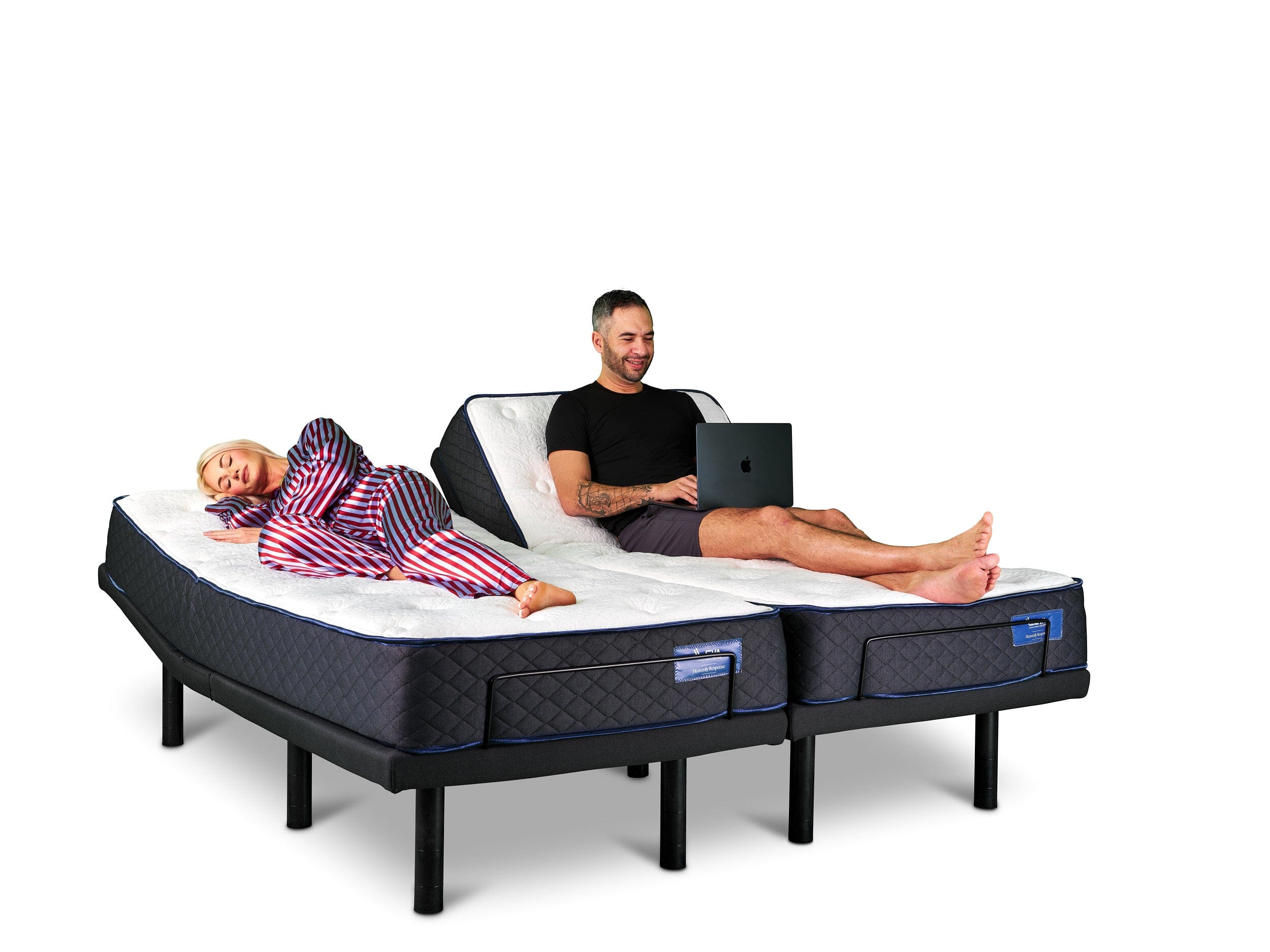
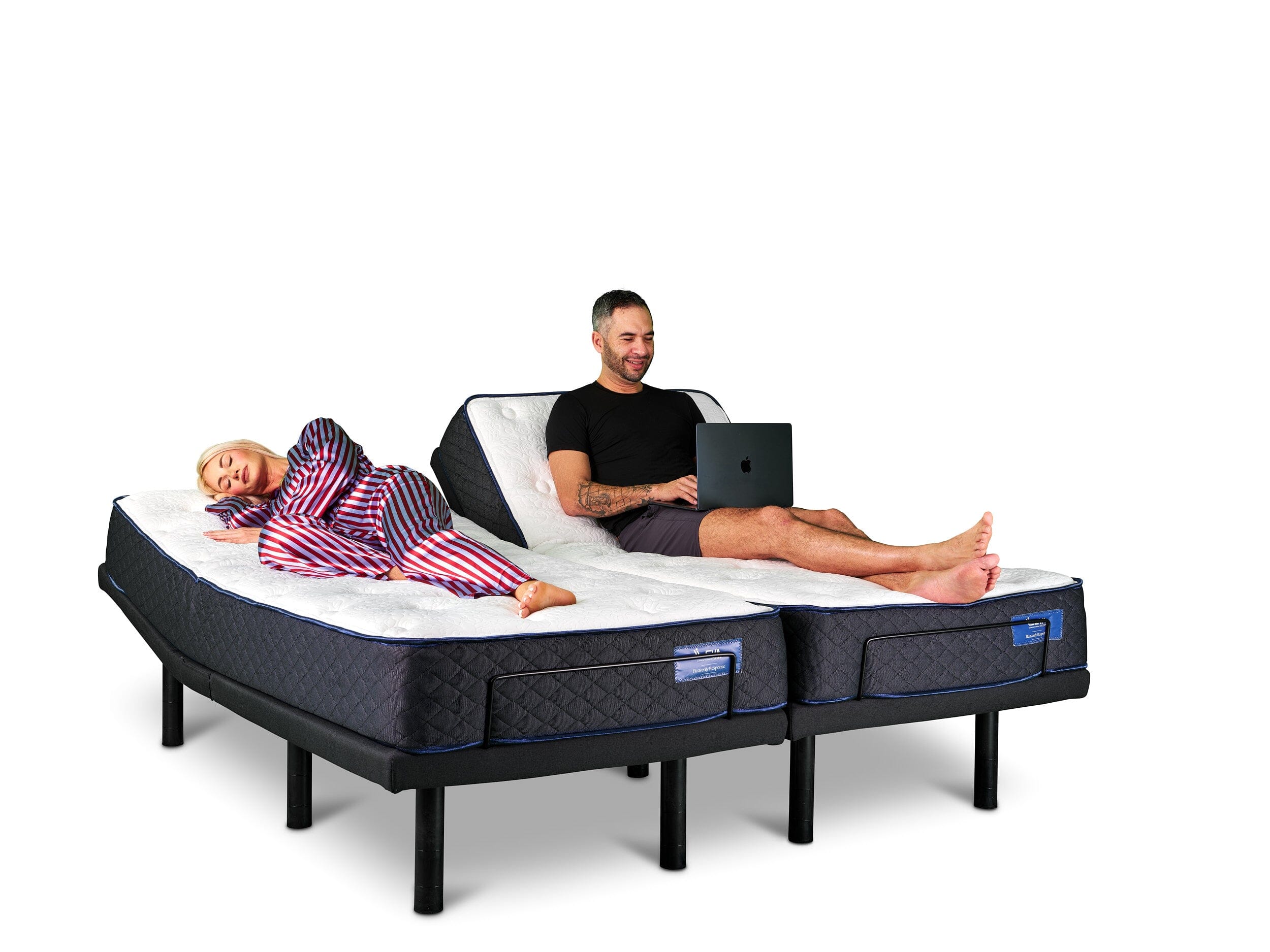
A split adjustable sleep system solves the core problem by giving each partner a fully independent base. Head elevation, foot elevation, lumbar support, massage intensity, and temperature regulation are all controlled separately, usually through a smartphone app or wireless remote, with no mechanical connection between the two sides.
The two mattresses sit within a shared frame or on a shared platform, so the bed still looks and functions like one unit while delivering two different sleep environments. This configuration directly addresses snoring by allowing the affected partner’s head to be elevated to open the airway. It reduces motion transfer by mechanically isolating each side and resolves firmness incompatibility by pairing each base with a mattress chosen for that individual.
Explore Leva Sleep’s split king and split queen adjustable systems for Canadian couples.
Key Components to Evaluate in a Split System
Independent Adjustability on Each Side
Each side of the base must operate on a completely separate motor and control system. Some entry-level “split” bases share a single controller with zone presets, which does not provide true independent control.
Look for bases where one partner can raise the head to 60 degrees while the other remains flat at the same time without any mechanical interference.
Whisper-Quiet Motor Performance
Motor noise is the most frequently cited complaint in Canadian adjustable bed forums. When you evaluate a base, ask the retailer to demonstrate a full head-raise cycle in a quiet room.
German-engineered linear actuators, such as those used in Leva Sleep’s bases, operate at noise levels comparable to a refrigerator hum rather than a mechanical grind. Jerky, incremental movement signals lower-quality actuators that usually worsen over time.
Mattress Flexibility and Compatibility
Not every mattress bends safely with an adjustable base. Innerspring mattresses with rigid border rods can crack or delaminate under repeated flexion.
Focus on mattresses specifically designed for adjustable bases, such as all-foam constructions or hybrid models using individually wrapped pocket coils without a rigid perimeter. Ask for the manufacturer’s stated flex-angle tolerance before purchasing.
Side-Specific Temperature Regulation
Couples with mismatched thermal preferences benefit from integrated heating and cooling pads that operate independently on each side. This approach removes the need for separate electric blankets, which can bunch and slip on an adjustable surface.
Bedding That Stays Put
Standard fitted sheets are not designed for the repeated flexion of an adjustable base. Choose sheets with deep pockets of at least 18 inches and reinforced elastic on all four sides to keep the fitted sheet from popping off when the base moves.
Beyond the fitted sheet, split configurations also require duvet management. Duvet clips that anchor each partner’s duvet independently prevent the covers from migrating to one side when positions diverge.
Anti-Snore Positioning Features
Anti-snore functionality ranges from a simple preset head-elevation angle to active detection systems that sense snoring vibration and make automatic micro-adjustments. When you evaluate this feature, ask whether detection is passive, meaning manual trigger, or active, meaning sensor-driven.
Also confirm that adjustments are gradual enough to avoid waking the snoring partner.
Delivery and Setup Realities in Ontario and Alberta
A split king system involves two bases, two mattresses, a shared frame, and multiple accessories. Curbside or threshold delivery rarely works for most Ontario and Alberta homes.
Check whether the retailer offers in-house white-glove delivery that includes bedroom placement, full assembly, leg-height adjustment, app setup, a product tutorial, and removal of the existing bed.
Benefits and Practical Outcomes for Real Couples
Consider a couple in Oakville, Ontario. One partner has mild sleep apnea and has been advised to sleep with the head elevated, while the other is a side sleeper who needs a softer mattress and runs warm at night. On a flat bed, neither partner’s needs are met.
On a split king adjustable system, the first partner elevates the head to the prescribed angle and uses a firmer foam mattress. The second remains flat on a softer hybrid with an active cooling pad. Both sleep through the night in the same bed.
Now picture a couple in Calgary, Alberta, where one partner’s snoring has pushed the other to the guest room for six months. An anti-snore mode that gently raises the snoring partner’s head by a few degrees, without waking them, can restore shared sleep and end the nightly negotiation over who sleeps where.
Explore anti-snore bundles designed for couples like this Calgary pair.
Comparison and Decision Support for Common Setups
The following table breaks down four common configurations by use case, approximate total investment, and the primary trade-off each involves. Use it to narrow your shortlist based on bedroom size, budget, and whether pressure relief or temperature regulation matters more.
| Configuration | Best For | Approx. CAD Total (Base + Mattresses + Accessories) | Key Trade-off |
|---|---|---|---|
| Split Queen (Leva) | Couples in smaller master bedrooms, budget-conscious buyers | Contact Leva for current pricing | Narrower individual sleeping surface than split king |
| Split King, All-Foam Bundle | Pressure relief, silent movement, lighter weight per mattress | Contact Leva for current pricing | Retains more body heat than hybrid without cooling pad |
| Split King, Hybrid Bundle | Couples wanting bounce, edge support, and airflow | Contact Leva for current pricing | Heavier, requires confirmed flex-angle compatibility |
| Luxury competitor (e.g., Tempur-Pedic split king) | Pressure relief as primary concern | Typically 30–50% higher than Leva equivalent | Sold through generalist retailers with limited adjustable base expertise |
Leva Sleep offers 15–20 adjustable base models, compared to the three to five typically found at a general mattress retailer, and assembles its systems locally in Ontario and Alberta. An in-house anti-snore mode with active detection is scheduled for release in spring 2026. White-glove delivery is available for a fee across both provinces.
Frequently Asked Questions
What are the main disadvantages of a split king adjustable bed?
The primary disadvantages are the centre gap between the two twin XL mattresses, the higher total cost compared to a standard king, and the bedding complexity. The gap can be addressed with a mattress bridge pad, and purpose-built split king sheets with reinforced elastic reduce the sheet-slippage issue.
Total cost is higher than a flat bed but, with a direct-to-consumer specialist like Leva Sleep, it remains significantly lower than luxury retail alternatives.
Who should avoid a split king adjustable bed?
Couples who share a bedroom smaller than approximately 12 by 12 feet may find a split king impractical because of the full king footprint plus clearance needed for base articulation. In those cases, a split queen is a more space-conscious alternative.
Individuals with certain spinal conditions should consult a physician before using any adjustable base, because specific elevation angles may be contraindicated.
How long does delivery and setup typically take in Ontario or Alberta?
With in-house white-glove delivery, a split king system that includes two bases, two mattresses, a shared frame, leg-height adjustment, app pairing, and old-bed removal requires professional handling. Scheduling lead times vary by region and season.
Contacting the retailer directly for current availability in your postal code provides the most accurate timing.
What maintenance does a split king adjustable base require?
Adjustable bases require minimal routine maintenance. Periodically check that all cable connections remain secure, particularly after moving the bed for cleaning.
Lubrication of the actuator mechanisms is not typically required for sealed motor units. Mattresses should be rotated head-to-foot, not flipped, every three to six months to distribute wear evenly, following the manufacturer’s specific guidance.
Can existing mattresses be used with a new adjustable base?
Existing mattresses work only if the manufacturer confirms compatibility with adjustable bases. Traditional innerspring mattresses with rigid border rods are not compatible and will sustain structural damage.
All-foam and pocket-coil hybrid mattresses without rigid perimeters are generally compatible, but the specific flex-angle tolerance should be verified before purchase. Using an incompatible mattress will void most base warranties.
Conclusion: Matching a Split System to Your Relationship
The decision between a split queen and split king, all-foam and hybrid, and entry-level and premium bundles depends on bedroom dimensions, individual health needs, and total budget. The evaluation criteria that matter most are true independent control, verified motor noise levels, mattress flex compatibility, and a delivery model that includes professional setup.
Couples in Ontario and Alberta have access to a local specialist with over eight years of adjustable bed expertise, 25,000 customers, and a direct-to-consumer model that delivers a comparable luxury experience at 30–50% below the price of top-tier retail competitors.
See how Leva’s local expertise and direct pricing apply to your bedroom.