Written by: Matthew Timmins, Founder and Managing Director, Leva Sleep | Last updated: July 5, 2026
Key Takeaways for Canadian Buyers
- Premium adjustable bases need heavy-gauge steel frames and motors rated at 850 lb or more per side for long-term durability.
- Independent lumbar and pillow-tilt functions require separate actuators. Combined mechanisms force both zones to move together and reduce control.
- Written confirmation of 15–20-year parts availability and clear full-coverage warranty terms protects your investment over time.
- Split Queen configurations provide independent adjustability in smaller Canadian bedrooms where Split King setups do not fit comfortably.
- Explore Leva Sleep’s adjustable bed packages to compare Split Queen and Split King options designed for Canadian homes.
How Premium Adjustable Bases Differ in Canada
Modern adjustable bases now go far beyond simple head and foot elevation. The premium tier adds independent lumbar zones, dedicated pillow-tilt motors, app-controlled positioning, and anti-snore detection. Canadian buyers also need to consider delivery logistics and local service networks, which many U.S.-focused reviews ignore.
The market divides into three clear tiers. Entry-level bases use a single actuator and offer no lumbar function. Mid-range bases add lumbar support but often link it to the head section through one motor. Premium bases provide fully independent zones, quiet motors, and documented long-term parts programmes. Couples aged 45–65 managing back pain, obstructive sleep apnea (which affects an estimated 3–6% of Canadian adults), or GERD (estimated at 10–20% of Canadian adults) most often choose this premium tier.
Compare Leva Sleep's Split Queen and Split King adjustable bases to see how each configuration fits Canadian room sizes and service expectations.
How Independent Lumbar and Pillow Tilt Actually Work
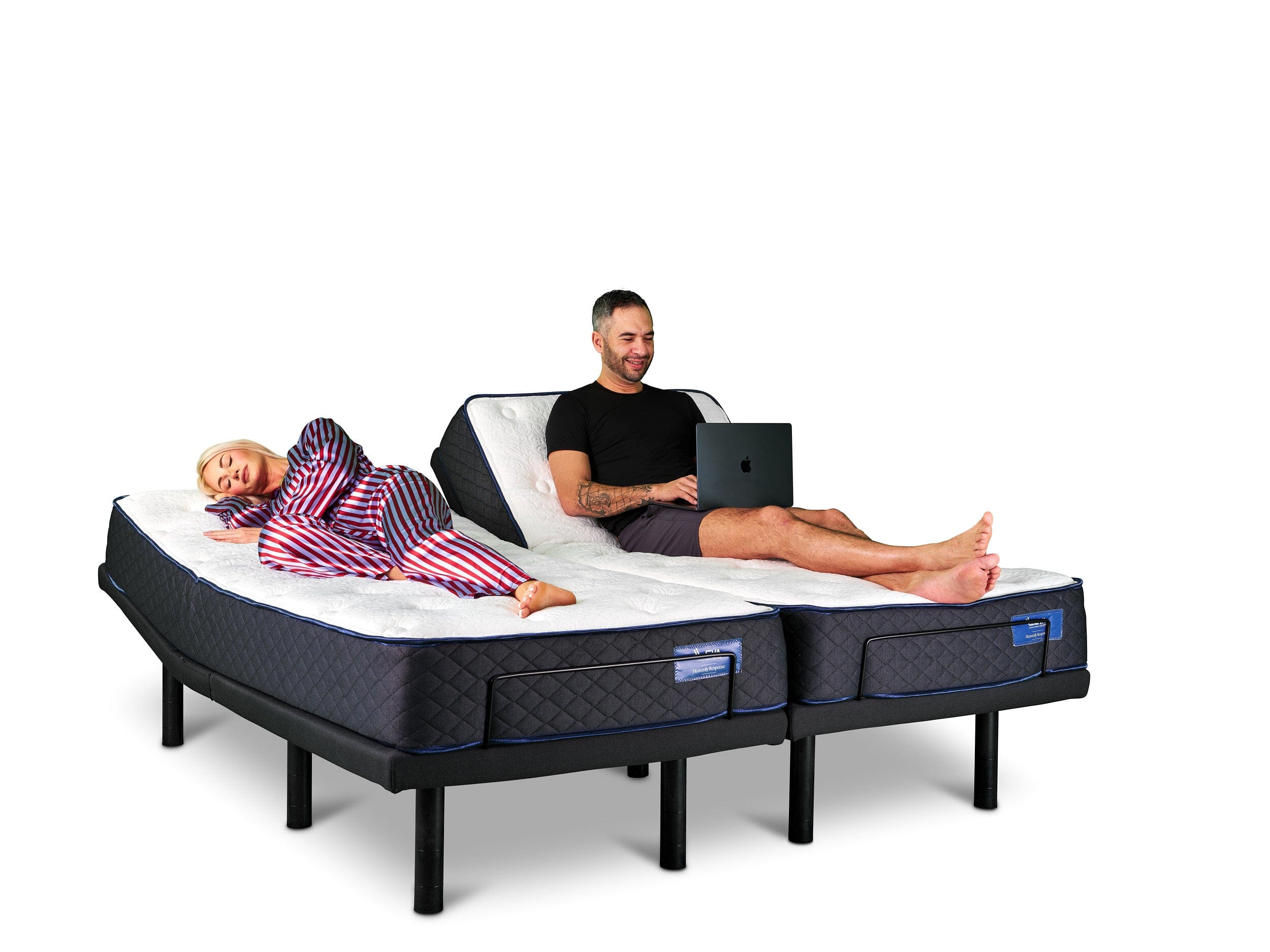
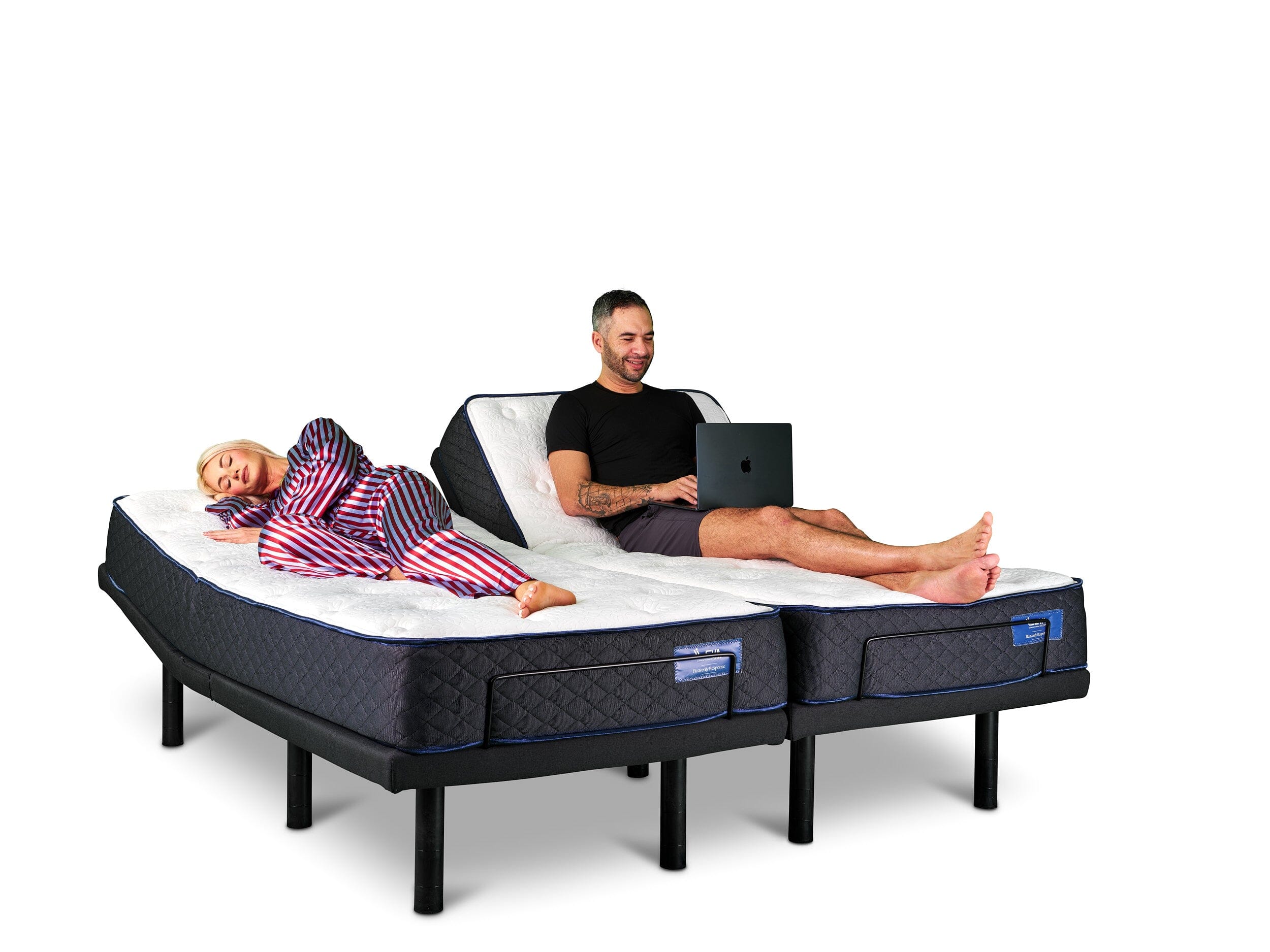
Independent lumbar support relies on a dedicated actuator positioned in the lower-back zone of the base. This actuator inflates, extends, or articulates separately from the head and foot sections. That separation allows targeted contouring that fills gaps between the body and mattress and enables full muscle relaxation during sleep.
Pillow tilt uses a second short-travel actuator at the very top of the head section. This motor changes the angle of the pillow zone without lifting the entire head section. Users who need cervical support without raising the whole torso benefit most from this feature.
Combined mechanisms link lumbar and head movement through a single motor. Any change to one zone forces a change in the other, which limits fine-tuning. Fully independent systems use two separate motors for these zones alone, so motor count becomes a practical proxy for feature independence when you compare spec sheets.
Leva Sleep's spring 2026 anti-snore AI mode and app-controlled micro-adjustments will appear only in this premium segment of the product line. These features support real-time positional corrections while both partners stay asleep.
Who Benefits Most from Independent Lumbar and Pillow Tilt
Head elevation can reduce the apnea-hypopnea index in patients with positional OSA, so pillow tilt becomes a clinically relevant feature rather than a luxury add-on. Head elevation improves esophageal acid clearance time by 67% (without changing reflux frequency) in GERD patients, which supports symptom control at night.
Elevating the knees 15–30 degrees relaxes the hamstrings and relieves pressure on the sciatic nerve. In addition, zero-gravity positioning reduces spinal shearing forces and decompresses the lower back. Couples where one partner has a medical need and the other does not benefit strongly from a Split Queen or Split King. Each side adjusts independently, which removes the sleep compromise that often leads to a "sleep divorce."
Key Durability Criteria for a 15-Year Adjustable Base
Use the following criteria as a step-by-step checklist before you purchase any adjustable base.
- Motor lift capacity: As noted in the key takeaways, 850 lb per side is the minimum threshold for couples. Lower ratings indicate undersized actuators that cycle harder and fail sooner under real-world loads.
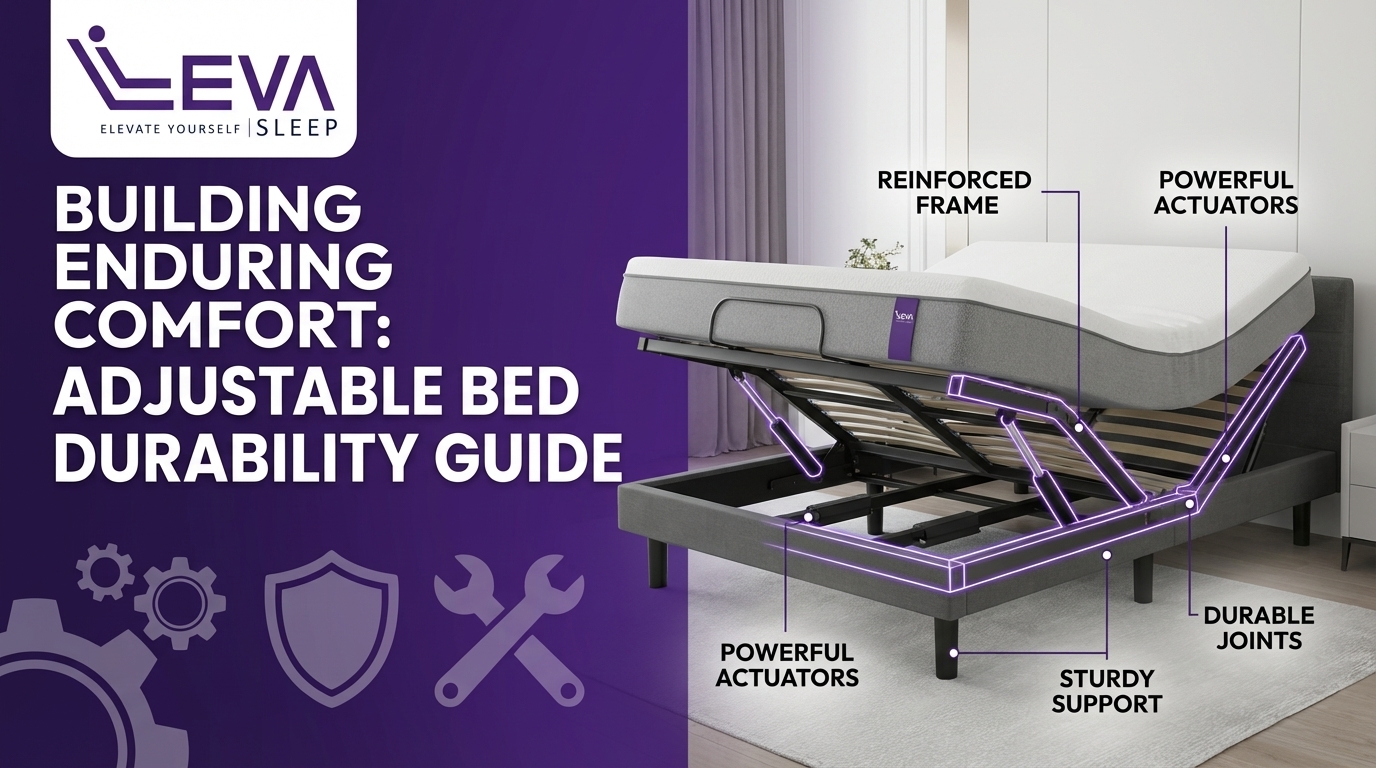
- Frame material and gauge: Once you confirm adequate lift capacity, check that the frame can support it. Strong, lightweight metals with powder-coat finishes resist repeated movement and strain over years of use. Ask for gauge specifications in writing so you can compare brands fairly.
- Motor origin and replaceability: After capacity and frame strength, verify long-term serviceability. German-engineered linear actuators with documented replacement programmes outperform generic motors. A properly selected and maintained motor should last 15–20+ years under normal operating conditions.
- Parts availability commitment: Confirm in writing that the manufacturer stocks replacement actuators, controllers, and remotes for at least 15 years after your purchase date. This commitment keeps a single failed component from forcing a full replacement.
- Warranty language: Read beyond the headline number. Distinguish between full-coverage years and prorated years. A 25-year warranty with only 3 years of full parts and labour differs materially from a 15-year full-coverage warranty for most buyers.
- Noise rating: Quiet operation matters in shared bedrooms. Whisper-quiet motors, typically under 45 dB at load, have measurable specifications. Ask for decibel ratings or request an in-store demonstration so you can hear the base under weight.
| Brand / Model | Motor Lift Capacity | Independent Lumbar | Pillow Tilt | Warranty (Full Coverage) | Canadian Pricing (Queen, approx.) |
|---|---|---|---|---|---|
| Ergomotion (flagship) | Varies by model, confirm with retailer | Select models only | Select models only | Varies, confirm warranty terms directly with Ergomotion | Confirm with Canadian retailer |
| Leggett & Platt (Prodigy series) | Varies by model, confirm with retailer | Select models only | Select models only | Varies, confirm warranty terms directly with L&P | Confirm with Canadian retailer |
| Tempur-Pedic Ergo Power Base | 700 lb | Yes | Confirm with Tempur-Pedic | 25-year limited, 3 years full parts & labour | Premium tier, 30–50% above Leva pricing |
| Leva Sleep (Split Queen / King) | 650 lb per side | Yes | Yes | Confirm current terms at levasleep.com | 30–50% below comparable competitors, confirm at levasleep.com |
Note: Ergomotion and Leggett & Platt sell through multiple retail channels with varying model configurations. Contact a Canadian authorised dealer for current specifications and pricing. Tempur-Pedic data comes from published U.S. specifications, so Canadian pricing may differ.
Trade-offs and Limitations of High-Feature Bases
Independent lumbar and pillow-tilt motors increase mechanical complexity. More actuators create more potential failure points, which makes parts availability and warranty depth even more important. Bases with five or more independent motors also need a controller board that can manage simultaneous zone commands. Confirm that this controller is a replaceable component, not a disposable part.
Adjustable bases deliver value primarily for ongoing symptom management rather than permanent structural correction of spinal conditions. Buyers with acute injuries should consult a physician before choosing a specific positioning protocol.
Split configurations depend on compatible mattresses. Standard queen mattresses do not suit split bases and will bridge the gap, which removes independent movement. Leva Sleep designs its mattresses specifically for split adjustable bases to avoid this issue.
Setup, Ownership, and Room Planning
A Split Queen base needs enough room width to allow full articulation clearance on both sides. A Split King requires even more space. Measure from wall to wall and include nightstands and door swing before you select a configuration.
White-glove delivery functions as a requirement for complex adjustable bases, not a luxury add-on. Bases with independent lumbar and pillow-tilt zones need calibration after assembly, and leg-height changes affect comfort and under-bed storage clearance. Leva Sleep's in-house white-glove delivery includes bedroom-level setup, leg-height adjustment, a product tutorial, and removal of the existing bed. The team confirms that the system operates correctly before leaving.
Confirm that your delivery provider works directly for the brand rather than a third-party logistics contractor. Direct employment improves accountability for setup quality and follow-up service.
Review Leva Sleep's Split Queen and Split King dimensions and delivery options before you schedule your installation.
Common Mistakes to Avoid When Comparing Bases
- Evaluating warranty length without reading coverage tiers: A 25-year warranty with 3 years of full coverage often provides less real protection than a 15-year full-coverage warranty. This surface-level reading of numbers can mislead buyers.
- Assuming lumbar support is independent: The same pattern appears with feature claims. Motor count or "lumbar" labels do not guarantee independence. Ask whether the lumbar actuator operates without moving the head section, because many mid-range bases couple these functions.
- Purchasing a split base without a compatible mattress: Even a correctly specified base with truly independent zones fails to deliver if paired with the wrong mattress. Standard mattresses bridge the split and block independent movement entirely.
- Ignoring parts availability timelines: A base purchased in 2026 should have confirmed parts availability through at least 2041. Request this commitment in writing so you are not forced into an early replacement.
- Selecting a base by motor count alone: Motor lift capacity per side, at an 850 lb minimum, and motor origin with replaceable, documented components matter more than the raw number of motors on a spec sheet.
- Overlooking noise ratings: Bearing failure accounts for approximately 50% of all motor failures and often causes the loudest operational noise in aging bases. Ask about bearing specifications, replacement intervals, and decibel ratings under load.
FAQ
What lift capacity should I require for a couples' adjustable base?
Buyers should look for at least 850 lb per side on a couples' split base. This rating covers combined mattress and occupant weight while leaving enough motor headroom to avoid continuous high-load cycling, which accelerates actuator wear. Bases rated below 750 lb per side are undersized for most adult couples using a premium mattress.
How do I verify 15–20-year parts availability before purchasing?
Request a written statement from the manufacturer, not the retailer, confirming that replacement actuators, controller boards, and remote handsets will be stocked for a defined period after purchase. Then review the warranty document for language that separates "limited" and "full" coverage years. Brands with vertically integrated manufacturing and local assembly, such as Leva Sleep, usually maintain shorter supply chains and tighter control over parts stocking than brands that outsource production entirely.
Is a Split Queen worth the investment over a Split King for smaller bedrooms?
A Split Queen often makes more sense in rooms where a Split King creates clearance or circulation problems. A Split Queen still provides fully independent adjustability, including separate head, foot, lumbar, and pillow-tilt control per side. The footprint is approximately 16 inches narrower than a Split King, which fits standard Canadian bedrooms more easily. Leva Sleep is one of the few Canadian providers offering a Split Queen configuration built to this specification, which suits many Ontario and Alberta couples.
Can an adjustable base with pillow tilt replace CPAP therapy for sleep apnea?
An adjustable base does not replace physician-prescribed CPAP therapy for moderate to severe obstructive sleep apnea. As discussed earlier, adjustable bases can reduce the apnea-hypopnea index in positional OSA and support better positioning, but this benefit remains complementary. Any decision to modify or delay CPAP use should occur under direct physician supervision.
Conclusion: Applying a Durable-First Evaluation Framework
Durable adjustable bases with lumbar support and pillow tilt succeed when they meet clear, verifiable criteria rather than marketing claims. Motor lift capacity, frame strength, actuator independence, long-term parts availability, precise warranty language, and professional in-room setup all contribute to a realistic 15-year ownership plan. Price alone does not reliably predict performance on any of these points.
Canadian couples in Ontario and Alberta also need to factor in local service networks, Split Queen availability, and delivery accountability. U.S.-focused reviews rarely address these regional issues. Leva Sleep's vertically integrated model, local assembly, and in-house delivery programme target this specific context while maintaining pricing that sits roughly 30–50% below comparable competitors.
Compare Split Queen and Split King configurations, review current specifications, and confirm parts availability commitments directly on the Leva Sleep collection page. Find the Leva Sleep adjustable base that fits your room, health needs, and 15-plus-year durability goals.