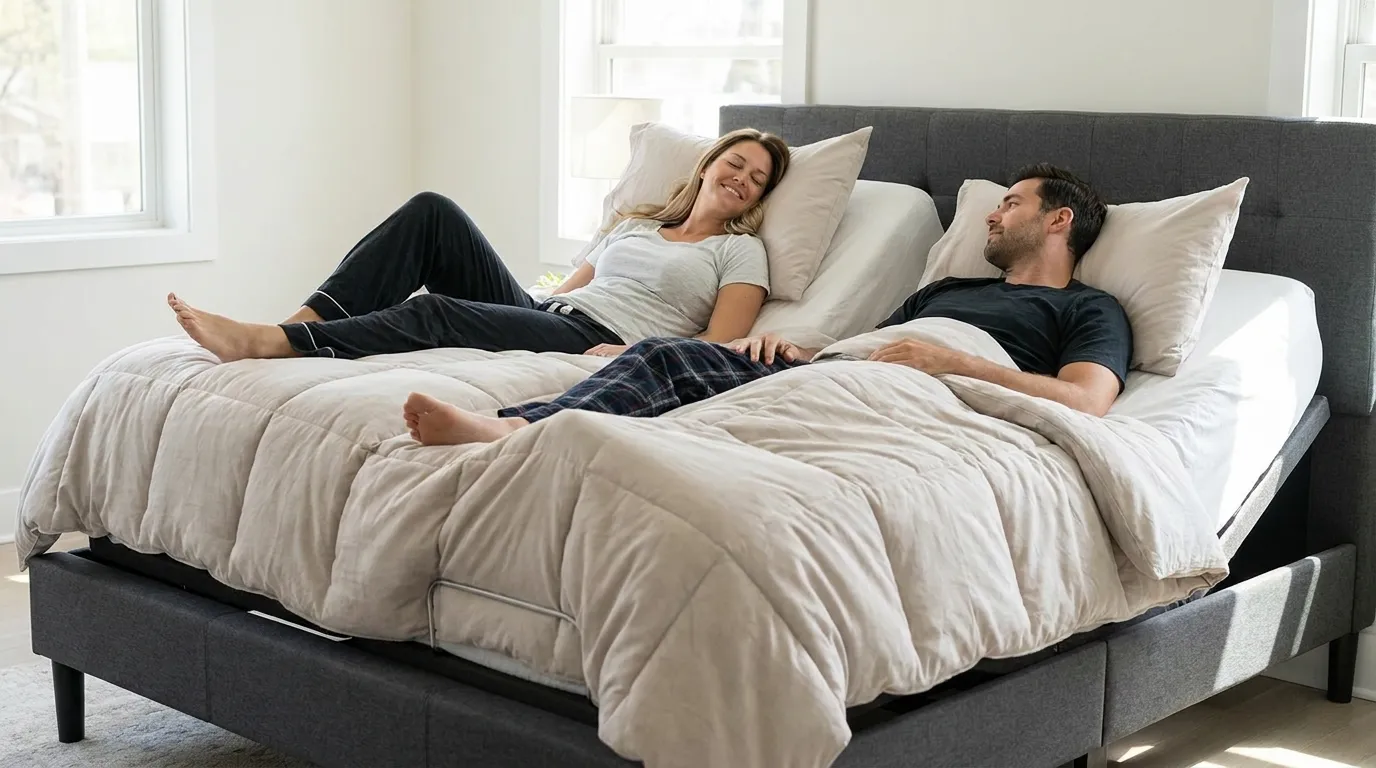
Written by: Matthew Timmins, Founder and Managing Director, Leva Sleep
Key Takeaways
- Adjustable bases can reduce chronic back pain by elevating the upper body and knees into a Zero-Gravity position that decompresses the lumbar spine and lowers disc pressure.
- Independent head, foot, and lumbar controls help you maintain a neutral spinal position that a flat bed cannot provide for chronic pain.
- Medium-firm mattresses paired with adjustable bases deliver strong spinal alignment and pain relief outcomes according to clinical research.
- Split queen and split king configurations let each partner keep their own therapeutic settings without compromise.
- Leva Sleep offers a feature-rich adjustable base solution for chronic back pain in Canada, with independent adjustability, lumbar control, and quiet motors.
The Problem: How Flat Beds Can Worsen Chronic Back Pain
A flat bed locks the lumbar spine into a fixed position for seven to eight hours. For back sleepers, the hip flexors pull the pelvis into anterior tilt, extending the lower back and loading the posterior disc. For side sleepers without knee support, the top leg rolls forward and rotates the pelvis, holding the lumbar spine in a sustained side-bend. Sustained lumbar flexion loads the front of the disc and drives nuclear material toward already-irritated posterior structures, while sustained extension narrows the spinal canal and increases nerve compression in stenosis patients.
The result often feels predictable. Many people wake with stiffness and pain that peaks in the first twenty to thirty minutes after rising. Poor sleep then amplifies pain sensitivity the following day. Research published in the Journal of Clinical Sleep Medicine found that patients with chronic pain who improved sleep hygiene reported 20–30% reductions in pain severity independent of any direct pain treatment. For an already-irritated spine, a flat bed actively contributes to the pain cycle rather than providing neutral support.
Because a flat bed locks the spine into harmful positions, the right adjustable base needs specific features that counteract those forces and support a neutral posture.
Key Features For Chronic Back Pain Relief
When evaluating an adjustable base for chronic back pain, prioritize the following features:
- Zero-Gravity Preset: A one-touch position that elevates head and knees simultaneously, distributing body weight evenly and reducing lumbar disc pressure.
- Independent Head And Foot Articulation: Separate motor control for the head and foot sections, allowing precise angle adjustment for different pain patterns.
- Adjustable Lumbar Support: A dedicated horizontal bar in the midsection that raises independently to fill the gap behind the lower back without pushing the spine into extension.
- Pillow Tilt: A secondary head-section motor that adjusts the top few inches of the base, reducing neck strain at higher head elevations.
- Split Queen Or Split King Configuration: Two fully independent bases so the pain sufferer’s therapeutic settings do not dictate the partner’s sleep position.
- Whisper-Quiet DC Motors: Smooth-start drive systems transition gradually, which matters because sudden jarring movements can trigger involuntary muscle spasms in acute pain sufferers.
- App Control: Lets you save custom therapeutic positions and make micro-adjustments without disturbing a sleeping partner.
How Clinicians View Adjustable Beds For Chronic Back Pain
Clinical guidance supports elevated sleeping for disc-related pain, sciatica, spinal stenosis, acid reflux, and post-surgical recovery. The 2017 American College of Physicians guideline recommends nonpharmacologic treatments as first-line care for chronic low back pain, and positional modification, including elevated sleeping, falls within that category. The evidence is strongest for reflux and positional snoring, moderate for disc-related pain and sciatica, and weaker for non-specific chronic low back pain without a clear positional component.
Chiropractor Dr. Jason Young notes that discogenic sciatica responds better to neutral or mildly extended positions, while stenotic sciatica responds better to flexion-biased positions such as semi-reclined at 20–30 degrees of trunk flexion. An adjustable base holds either position consistently through the night, which is difficult to achieve with pillows alone.
Explore Clinically-Informed Adjustable Beds
Best Adjustable Bed Settings For Chronic Lower Back Pain
The right setting depends on the underlying pain pattern. The following protocol draws from clinically grounded positioning guidance:
- Sciatica And Herniated Discs: A 15–25 degree head angle and 20–30 degree foot angle decompresses lumbar discs and reduces sciatic nerve stretching.
- General Lower Back Pain: A 30–45 degree head angle and 15–20 degree foot angle reduces spinal compression and relaxes major back muscle groups.
- Spinal Stenosis: A 30–40 degree head elevation widens the spinal canal, with the foot section flat to 10 degrees. Raising the head section beyond 45 degrees can pull the cervical spine forward and create new compression points in the neck.
- Building Tolerance (Days 1–3): Start with a 10–15 degree head elevation and 10 degree foot elevation, then increase articulation by 5 degrees every two nights until reaching the therapeutic zone.
- Duration In Zero-Gravity: The supine 90-90 position maximally opens the lumbar neural foramina but can cause hip stiffness if maintained more than 2–3 hours. Return to a gentle neutral position after 2–3 hours in Zero-Gravity to avoid hip flexor tightness and upper-back strain.
- First 48 Hours: Mild core or lower back stiffness during the first 48 hours of incline sleeping is standard muscle lengthening as the pelvis shifts to a neutral position. Reduce the angle and extend the adaptation timeline if acute pain spikes.
Get The Base That Supports Your Protocol
Why Your Adjustable Base Might Be Hurting Your Back
An adjustable base can worsen chronic back pain when used incorrectly. These are the most common failure modes and the practical fix for each:
- Too Much Head Elevation: A steep head angle with a flat foot section forces the lower spine to flatten excessively, straining the lumbar ligaments. Pairing head elevation with slight knee elevation keeps the pelvis neutral and prevents lumbar ligament strain. Reduce head angle to 15–25 degrees and add knee elevation if lower back pain increases.
- Sleeping In Zero-Gravity All Night: Treat Zero-Gravity as a strong starting point and adjust if you feel hip flexor tightness or upper-back strain. Use Zero-Gravity for 2–3 hours, then return to a gentle neutral position.
- Wrong Mattress Pairing: A mattress that is too rigid will bridge and lift off the frame when the motors operate, leaving the spine unsupported. A mattress that is too soft allows the hips to sink regardless of the angle. In both cases, the base cannot compensate for a mattress that is wrong for your back, so the mattress must provide the right foundation for the base to work.
- Wrong Lumbar Height: Lumbar support set too high pushes the spine into extension. Set too low, it provides no benefit. Adjust the lumbar bar to fill the gap behind the lower back without creating a forward arch.
- Jerky Or Cheap Motor Bases: Smooth-start drive systems with certified DC motors transition gradually, and sudden jarring movements can cause involuntary muscle spasms in acute pain sufferers. If a base lurches into position rather than gliding, it is not appropriate for acute or chronic pain management.
Understanding these failure modes helps you evaluate bases more critically and avoid settings that aggravate symptoms.
Choose A Base That Avoids These Pitfalls
The Best Adjustable Bases For Chronic Back Pain In Canada
The following shortlist is an editorial ranking based on named features, approximate Canadian pricing, and stated trade-offs relevant to chronic back pain. No proprietary scoring system or in-house testing was used. The table below compares these models at a glance, highlighting chronic-pain-specific features and the type of sleeper each base best serves.
| Model | Price Band (CAD) | Chronic-Pain-Specific Features | Best For |
|---|---|---|---|
| Leva Sleep | Mid to Premium | Split queen/king independent bases, lumbar control, pillow tilt, whisper-quiet German motors, app control | Couples where one partner has chronic back pain and needs independent adjustability |
| Tempur-Pedic Ergo ProSmart | Premium (from ~$2,600 to ~$5,200) | Zero-Gravity preset, quiet motors, Tempur-Pedic ecosystem | Sleepers who want premium brand and mattress integration |
| Quest 2.5 | Mid (~$1,999 CAD at LBAL; ~$1,699 USD direct) | Independent head/foot articulation, Zero-Gravity preset | Chronic pain sufferers who want core adjustability without premium features |
| Ergomotion emPremium 2.0 | Budget (~$900, discounted from ~$1,300) | Basic head/foot articulation | Budget-conscious trial of adjustable base before investing in a premium model |
Leva Sleep stands out for split queen and split king configurations with two fully independent bases, adjustable lumbar support, pillow tilt, whisper-quiet German motors, and app control. Anti-snore mode is coming spring 2026. With 8 years in business, $50M+ in lifetime sales, 25,000+ customers, and 15–20 adjustable bed models versus the 3–5 found at a standard retailer, Leva Sleep operates as a specialist adjustable bed authority.
Tempur-Pedic Ergo Smart And Ergo ProSmart sit in the premium tier. The TEMPUR-Ergo Smart adjustable base is priced at approximately $2,199 for a Queen size, with sale prices often around $1,999–$2,099, while the TEMPUR-Ergo ProSmart Base is priced from $2,599.98 (Twin XL) up to approximately $5,199.98 (Split California King). Both offer Zero-Gravity presets and quiet motors. The premium suits sleepers who value the Tempur-Pedic brand ecosystem and pressure-relief mattress pairing.
Quest 2.5 occupies the mid-range. The Quest 2.5 adjustable base is priced at $1,999.00 CAD at the Canadian retailer LBAL, while Ergomotion’s official store lists it at a regular price of $1,699.00 USD. It offers independent head and foot articulation and a Zero-Gravity preset, which covers core adjustability for many chronic pain sufferers.
Budget-focused options such as Ergomotion emPremium 2.0 and the National Mattress NM Series provide basic head and foot articulation. The Ergomotion emPremium 2.0 Lifestyle Adjustable Power Base is priced at $899.93 at Canadian Bedding, discounted from a regular price of $1,299.99. These models work as trial entries but lack lumbar support, pillow tilt, and advanced quiet-motor engineering that chronic pain sufferers often need.
Adjustable Base And Mattress Pairing For Chronic Back Pain
Medium-firm is the anchor firmness for chronic back pain. A 2003 randomized controlled trial by Kovacs et al., published in The Lancet, studied 313 adults with chronic low back pain. It found that medium-firm mattresses produced significantly better outcomes than firm mattresses at 90 days, including less pain in bed, less pain on rising, and less daytime disability. A too-soft mattress defeats the base because the hips sink regardless of the angle set by the motors, and the spine loses the neutral alignment the base is designed to create.
An adjustable base does not inherently make a mattress wear out faster if the mattress is specifically rated for adjustable-base use. Memory foam, latex, and pocket-coil hybrid mattresses flex readily and are designed for repeated articulation. Traditional bonded innerspring mattresses resist bending, damage the drive motors, and cause uneven support planes. Always verify mattress compatibility with the manufacturer before pairing it with an adjustable base. Mattresses thicker than approximately 14 inches may resist bending regardless of construction type.
Split King Vs. Split Queen For Couples Managing Chronic Pain
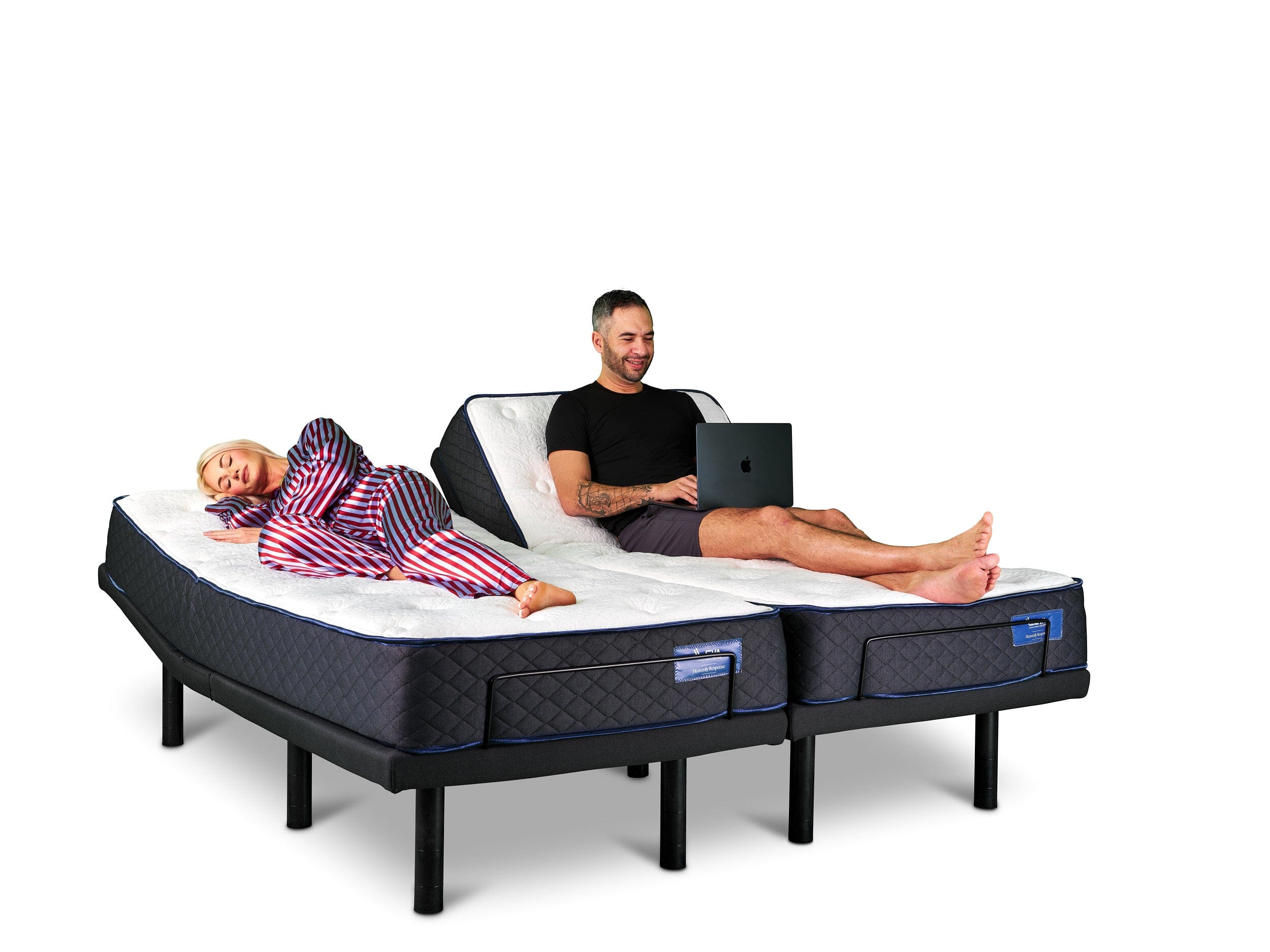
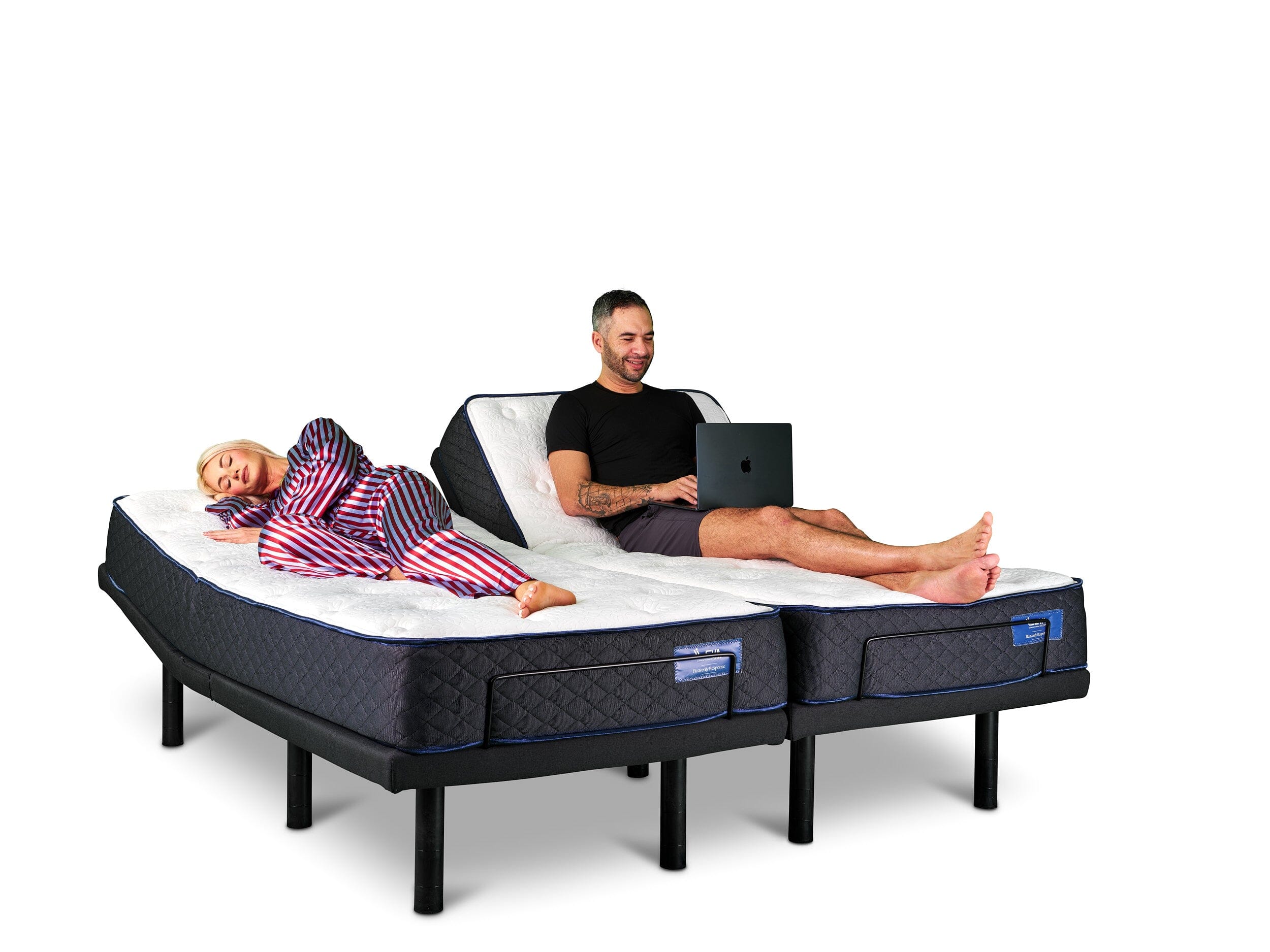
When one partner has chronic back pain, their therapeutic settings, such as elevated head, elevated knees, and specific lumbar height, should not dictate the other partner’s sleep position. A split configuration solves this directly. Leva Sleep’s split queen always means two fully independent bases with head and foot articulation on each side, giving each partner complete control over their own elevation, lumbar support, and massage settings.
This configuration is distinct and uncommon in Canada. Most retailers do not offer a true split queen at all. Leva Sleep provides split queen adjustable beds in Canada, built to customer specifications, and delivers the benefits of full independent adjustability in a more space-conscious size than a split king.
Shop Split Queen Adjustable Beds
Frequently Asked Questions
Can An Adjustable Base Help With Back Pain?
For many chronic back pain sufferers, an adjustable base can help. Elevating the upper body and knees together in a Zero-Gravity position decompresses the spine and distributes body weight more evenly. Supine lying with knees bent has been shown to reduce L4-L5 disc pressure to approximately 25% of standing pressure. Clinical guidance supports elevated sleeping for disc-related pain, sciatica, acid reflux, and post-surgical recovery. As noted earlier, the 2017 American College of Physicians guideline supports nonpharmacologic treatments, and the evidence strength varies by condition.
An adjustable base holds a therapeutic position consistently through the night. Wedge pillows or stacked pillows compress, shift, and lose shape, so they rarely provide the same stability.
What Are The Downsides Of Using Adjustable Beds?
The most common downsides relate to user-error failure modes rather than inherent product flaws. The main issues include incorrect head elevation, all-night Zero-Gravity use, mattress incompatibility, wrong lumbar height, and jerky motors, all covered in detail above. The key caveat is simple. An adjustable base cannot compensate for a mattress that is wrong for your back, because a worn or incompatible mattress on an adjustable base still behaves like a worn or incompatible mattress.
What Is The Lifespan Of An Adjustable Bed Frame?
Quality adjustable bases from established brands last 10–15 years, with the motor the component most likely to fail. The base will likely outlast two mattresses, which makes it a long-term investment rather than a recurring expense. Most brands offer 5–10 year warranties covering motor and frame defects. Warranty structures are typically multi-tiered. The steel chassis often carries a longer warranty of 10–20 years, while linear actuators, control boxes, and massage motors usually carry a shorter 2–5 year full replacement threshold. When evaluating warranty coverage, look beyond the frame warranty to the electronics and motor coverage, since those components fail first.
Does An Adjustable Base Wear Out A Mattress Faster?
An adjustable base does not inherently shorten a mattress’s lifespan if the mattress is specifically rated for adjustable-base use. Mattresses designed to flex, such as memory foam, latex, and pocket-coil hybrids, are built for repeated articulation and will not be damaged by normal use on a compatible base. Using an adjustable base with an incompatible mattress, such as a traditional bonded innerspring, can cause broken coil connections, deformed foam rails, and permanent creasing at bend points. Mattresses thicker than approximately 14 inches may also resist bending regardless of construction type. Always confirm compatibility with the mattress manufacturer before pairing.
Conclusion
A flat bed forces the lumbar spine into sustained positions that load an already-irritated lower back for eight hours a night. An adjustable base with the right settings and the right mattress pairing can decompress the lumbar spine, support a neutral position, and interrupt the cycle in which poor sleep amplifies pain and pain disrupts sleep.
For chronic back pain in Canada, the best adjustable base delivers independent adjustability, lumbar control, quiet motors, and a compatible mattress pairing. Leva Sleep provides those features with specialist depth across 15–20 adjustable bed models, in-house white-glove delivery in Ontario and Alberta, and 8 years of established expertise, at the same pricing advantage noted earlier.