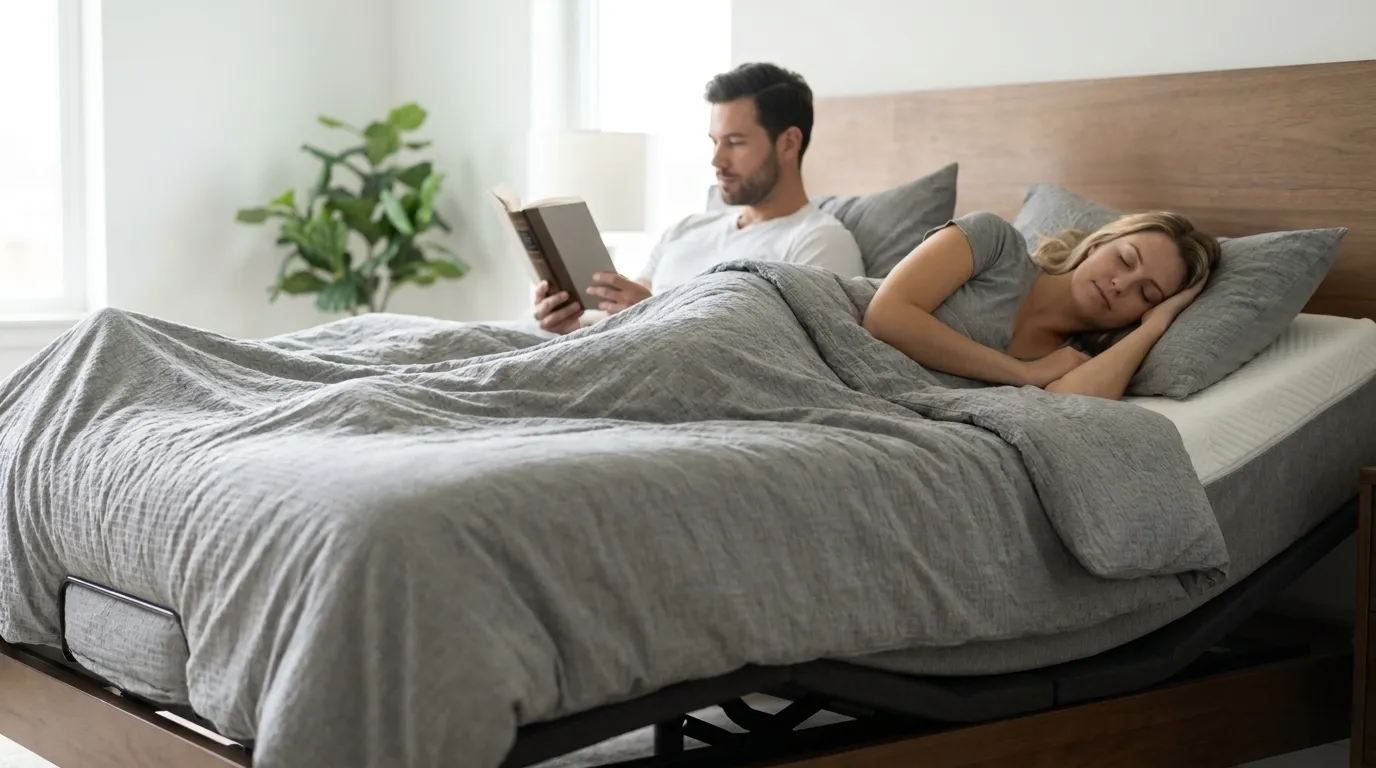
Written by: Matthew Timmins, Founder and Managing Director, Leva Sleep
Key Takeaways
- Start with configuration (split king, split queen, or one-piece) before choosing any mattress brand, because the base controls compatibility and daily usability.
- Memory foam needs high density (4+ lb/ft³), open-cell or gel-infused construction, and an adjustable-base-safe warranty to resist hinge-point sagging and edge collapse.
- Split king delivers full independent head-and-foot control and uses standard king top bedding, but carries a clear cost premium and leaves a centre gap that can disrupt sleep.
- Split queen offers the same independent adjustability in a 60-inch footprint, which suits Canadian bedrooms that cannot comfortably fit a split king.
- Leva Sleep designs complete adjustable-bed packages (base, mattress, and bedding) specifically for couples who want reliable performance and long-term comfort on an adjustable base.
Compare split king and split queen packages
Quick-Read Overview: What You Are Actually Buying
A memory foam adjustable bed system for couples has three parts: a memory foam mattress (all-foam or hybrid), an adjustable base that raises the head and foot, and bedding that stays put when elevated. The decision framework follows a simple order.
- Choose your configuration (split king, split queen, or one-piece).
- Confirm your foam construction flexes without failing.
- Address couple-specific comfort: motion isolation, cooling, and independent controls.
Leva Sleep is Canada's adjustable-base specialist that sells the complete system (base, mattress, and bedding) rather than a mattress brand adding a base as an accessory. It offers 15–20 adjustable bed models and packages ranging from $1,299 to $8,999+, including its unique Split Queen, with a 180-night comfort guarantee and whisper-quiet German motors.
Find your split queen or split king package
Configuration Choices For Canadian Couples
The configuration decision shapes cost, bedding, and how independently each partner can sleep. Here is what each option means in daily use.
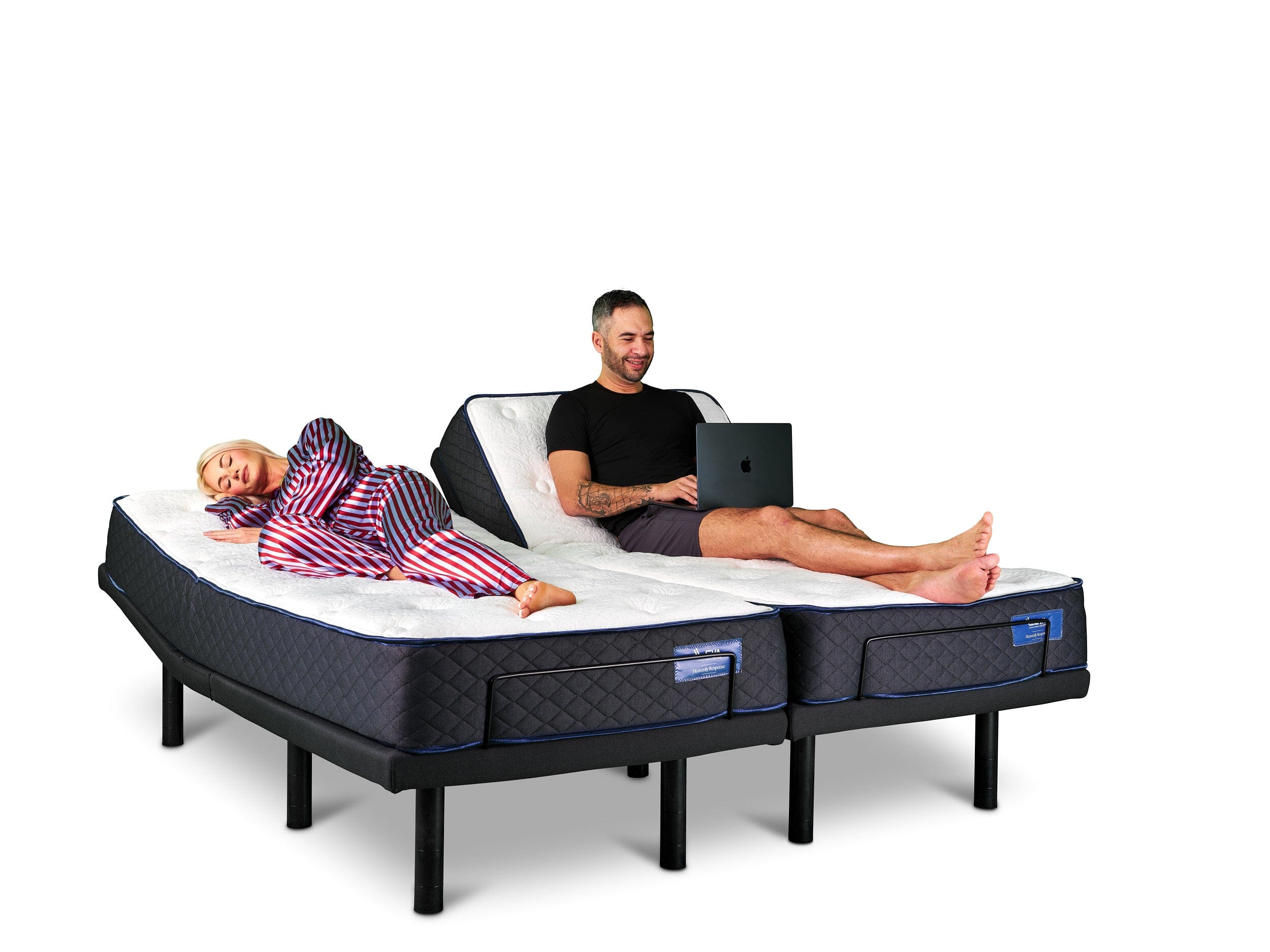
- Split King: Two Twin XL mattresses (each 38" × 80") sit side by side on two independent bases, totalling 76" × 80", the same footprint as a standard king. Each partner controls head and foot elevation on their own side. This configuration is the most widely available couple-focused option in Canada.
- Split Queen (Leva Sleep's Unique Offering): Two fully independent bases with head and foot articulation on each side sit in a 60-inch footprint, about 16 inches narrower than a split king. Leva Sleep offers the largest selection of Split Queen adjustable beds in North America, with five packages starting at $1,399. This configuration differs from a "split head queen," which uses a single mattress with only the head section split. Leva's Split Queen uses two fully independent bases, so each side adjusts head and foot separately in a more space-conscious size. It suits couples who want full independent adjustability with a smaller footprint and lower total cost than a split king.
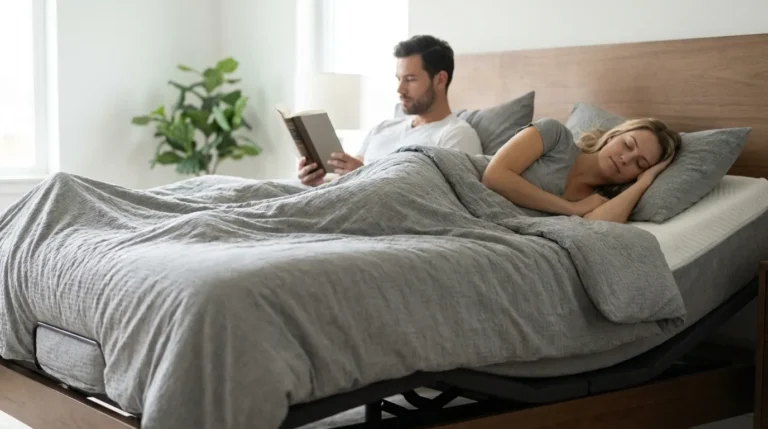
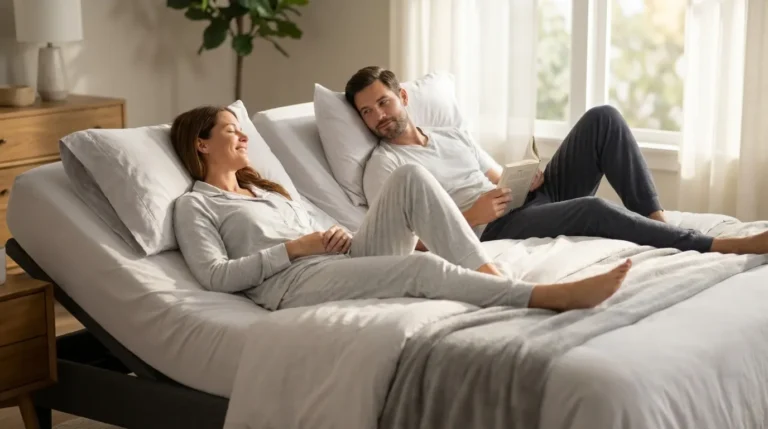
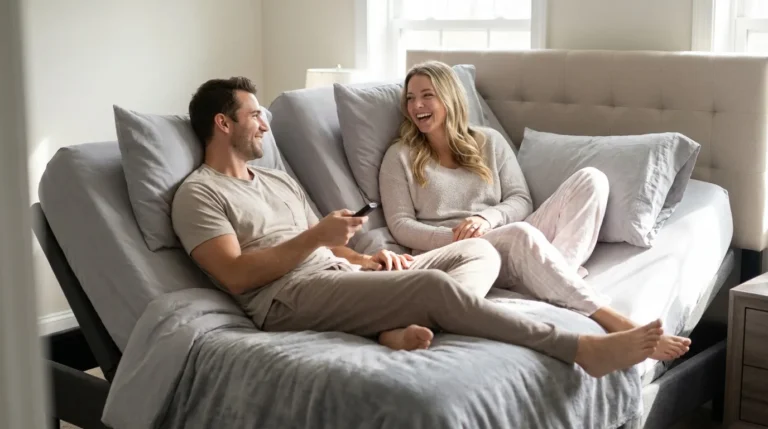
- One-Piece Queen On A Single Adjustable Base: One mattress, one base, and one set of controls keep both partners moving together. This setup works when sleep positions are similar and independent adjustment does not matter.
The table below compares these three configurations on the factors that matter most for couples: independent adjustment, bedding requirements, and the centre gap.
| Configuration | Independent Adjustment | Bedding Requirement | Centre Gap |
|---|---|---|---|
| Split King | Full head and foot per side | Two Twin XL fitted sheets; king top sheet and comforter can be shared | Typically 1–3 inches even with retention bars |
| Split Queen (Leva Sleep) | Full head and foot per side | Two split-queen fitted sheets; shared top layer possible | Present; narrower overall footprint than split king |
| One-Piece Queen | Shared controls only | Standard queen fitted sheet | None |
Will Your Memory Foam Survive An Adjustable Base?
Memory foam flexes with an adjustable base, but foam constructions handle that flex very differently over time. The consequences of a mismatch often appear after months of nightly use.
Flex fatigue and hinge sagging: Memory foam and polyfoam are the most sag-prone constructions because foam softens with heat and repeated compression, with most sagging developing in the transition layer beneath the comfort layer. On an adjustable base, the hinge point, where the head section meets the flat section, concentrates that compression every night. As the Key Takeaways note, higher-density foam (4+ lb per cubic foot) resists sagging significantly better than lower-density foam, and budget foam often sags within 2–3 years.
Edge support collapse at elevation: Edge support matters more on adjustable bases because when the head section elevates, the mattress flexes at the hinge point, which places different stress on the mattress than flat-surface sitting. Coil-based mattresses generally handle this flex better than all-foam designs, which can develop creasing or structural damage at the flex zone over time.
Warranty implications: Most mattress warranties require that the mattress sits on an approved foundation, and sagging caused by an unapproved base usually falls outside coverage. Verify that the warranty explicitly permits adjustable-base use before you buy.
What to look for: Open-cell foam, gel-infused layers, and hybrid constructions with individually pocketed coils flex more reliably than dense closed-cell all-foam. If you are considering a mid-market Canadian foam mattress like Douglas or Endy, confirm that the warranty terms allow adjustable-base use. Leva Sleep takes a different approach and designs its own all-foam and hybrid pocket-coil mattresses specifically for adjustable bases, and its bedding, including fitted sheets with extra elastic, duvet clips, and remote pockets, is engineered to stay put at elevation.
Shop adjustable-base-ready mattresses
Motion Isolation And Cooling For Two Sleepers
On a shared adjustable base, motion isolation and heat retention become more noticeable. When one partner adjusts their side, the mechanical movement stays on their base, but the mattress can still transmit vibration if the foam density is too low. Open-cell foam and cooling gel infusion can help reduce motion transfer and surface temperature.
Heat retention relates directly to foam density, because denser foam traps more body heat. Gel infusion and open-cell construction improve airflow, yet they rarely offset the warmth of two bodies sharing a confined surface. Hybrid constructions with pocket coils create air channels that all-foam mattresses cannot match. When you test a mattress, press your hand into the surface and watch how quickly it returns to shape. Slow-recovery foam tends to retain heat longer. Ask the retailer for the foam density specification, because anything below 3 lb/ft³ creates a durability and heat-retention risk for nightly adjustable-base use.
The Split King Reality Check: What Nobody Tells You
Split king setups have genuine advantages for couples with different sleep needs, yet the honest downsides rarely receive a clear explanation in Canadian search results. The three most common complaints, higher cost, awkward bedding, and the centre gap, often reinforce each other, which makes them worth reviewing together.
Split king setups cost noticeably more than a standard king, require two Twin XL fitted sheets, which are harder to find and pricier than standard king sheets, and mattress protectors must be purchased in two Twin XL sizes. The centre gap between the two Twin XL mattresses typically measures a few inches even when mattress retention bars are used, which creates a space where pillows can fall through and reduces usable sleeping surface. Split king adjustable bases also carry a clear price premium over non-split king adjustable bases.
The split queen offers an under-discussed alternative. At 60 inches wide versus 76 inches for a split king, it fits more Canadian bedrooms, costs less overall, and still delivers full independent head and foot adjustment on each side. Leva Sleep offers both Split King and Split Queen configurations with independent app-controlled adjustment, whisper-quiet German-made Okin motors, and bedding designed for adjustable bases, and it markets itself as the only brand offering Split Queen with advanced app features.
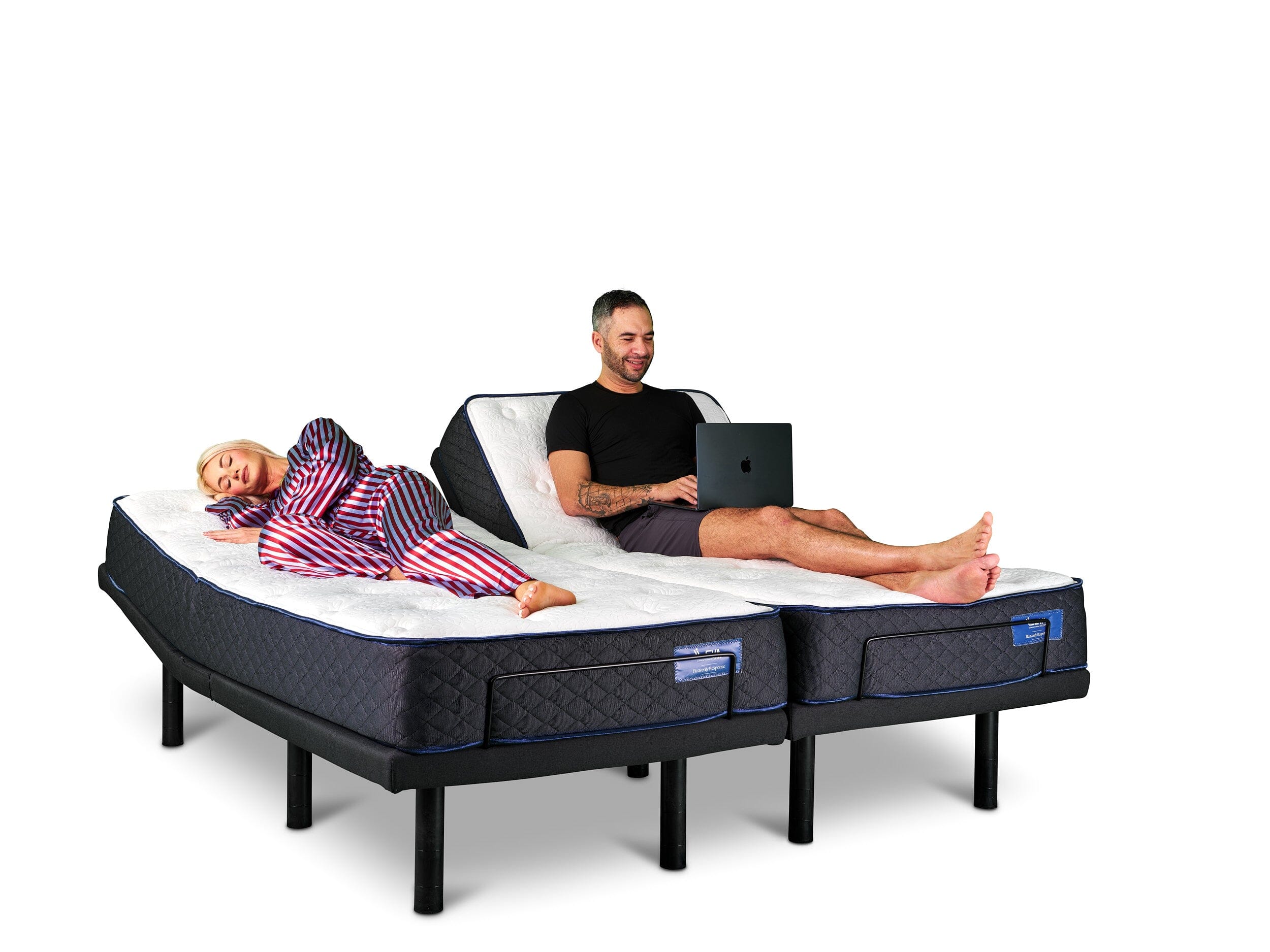
For many couples, configuration is only part of the story. A specific health concern often drives the final decision, which is where clinical guidance on positioning becomes useful.
What Doctors And Chiropractors Say About Adjustable Beds
Named conditions drive most adjustable bed purchases among Canadian couples aged 35–70, and professional guidance on positioning is specific.
Sleep apnea and snoring: The American Academy of Sleep Medicine (2024) states that elevating the head of the bed 30–45 degrees can reduce snoring and sleep apnea symptoms. A 2017 study found that tilting the bed by 7.5 degrees reduced obstructive sleep apnea severity by about 31.8% and improved minimum oxygen levels during sleep.
Acid reflux and GERD: The Mayo Clinic recommends elevating the head of the bed by about 6 to 9 inches to ease nighttime heartburn and notes that stacking extra pillows usually does not work well. The American Gastroenterological Association's 2008 GERD statement gives head-of-bed elevation a Grade B recommendation for people with recumbent heartburn or regurgitation, and the 2022 ACG Clinical Guideline also lists elevation alongside other lifestyle strategies. A 2023 systematic review in the World Journal of Clinical Cases found that left-side sleeping significantly reduced acid exposure time compared with right-side or back sleeping.
Post-surgery recovery and joint pain: Research published in the Journal of Arthroplasty (Halawi et al., 2019) found that sleep quality directly affects post-surgical outcomes in joint replacement patients, with poor sleep increasing pain perception, slowing tissue healing, and reducing participation in rehabilitation exercises. The National Institute on Aging (2024) notes that supportive sleep surfaces are a key component of healthy aging, particularly for adults managing chronic pain or mobility limitations.
These conditions change the mattress selection criteria. Head elevation requires foam that holds its shape at the hinge, and lumbar support plus pillow tilt become functional requirements rather than extras. Leva Sleep's bases include adjustable lumbar support and pillow tilt as standard on higher-tier models, and an anti-snore mode (coming spring 2026) that detects snoring and makes micro-adjustments to the head of the bed.
Upfront cost only tells part of the story. The real cost of ownership depends on how long the base and mattress last and what tends to fail first.
What A Complete Setup Actually Costs In Canada
Canadian bundle pricing varies widely by configuration and brand. These reference points from named retailers give a realistic range.
- Douglas offers an adjustable bed and mattress bundle starting at CAD $1,668, with bundles spanning roughly CAD $1,848–$4,845.
- The Nectar Classic Memory Foam split king is listed at approximately CAD $1,549 for the mattress alone.
- Tempur-Pedic's Canadian queen mattress lineup runs CAD $2,500–$8,000+, with an estimated 30–50% of the retail price covering brand-related costs rather than materials.
Leva Sleep packages run from $1,299 to $8,999+, with Split Queen packages starting at $1,399. That price advantage comes from vertical integration, because Leva designs and assembles its systems locally and removes the middleman. White-glove delivery, including old bed removal, assembly, product tutorial, and real-time height adjustment, is available in Ontario and Alberta for a fee. Leva has been in business for 8 years, with $50M+ in lifetime sales and 25,000+ customers across Canada.
Once you understand pricing, lifespan becomes the next factor in the total value of an adjustable system.
Adjustable Bed Lifespan And Common Problems
An adjustable bed base typically lasts about 8–15 years overall, with the steel frame lasting 15–20+ years, motors and electronics around 10 years, and the mattress on top lasting 7–10 years, which is slightly shorter than on a flat foundation due to flexing. Most dead-bed calls come from simple power issues, because unplugged cords and switched-off power strips occur more often than true motor failure. When you evaluate a base, ask whether replacement motors and control boxes are stocked as spare parts. A base without available parts carries a hidden expiry date. Leva Sleep's whisper-quiet German motors and app control via Bluetooth set a useful benchmark. Confirm motor warranty length, since frame and motor often have different terms, and check whether the manufacturer stocks spares for the Canadian market.
Frequently Asked Questions (FAQ)
These are the questions Canadian couples ask most often once they have worked through configuration, foam, and cost.
What Is The Best Adjustable Mattress For Couples?
For most couples, a split king or split queen with fully independent head and foot controls on each side offers the strongest starting point, because configuration matters more than brand. Within that framework, choose a high-density memory foam or hybrid pocket-coil mattress that the manufacturer explicitly warrants for adjustable-base use. The 4+ lb/ft³ density mentioned earlier is the key specification to confirm. Leva Sleep's Split King and Split Queen packages are purpose-built for this use case.
Are Memory Foam Mattresses Good For Adjustable Beds?
Memory foam works well with adjustable bases when density and construction support repeated flexing. Higher-density open-cell or gel-infused foam resists hinge-point sagging better than budget low-density foam. Always confirm that the mattress warranty explicitly covers adjustable-base use, because some warranties exclude bases that the brand has not approved, even when the foam bends without any immediate issue.
What Are The Downsides Of A Split King Adjustable Bed?
A split king requires two Twin XL fitted sheets instead of one king sheet and uses two separate mattress protectors, which complicates bedding and increases cost. The cost premium mentioned earlier over a standard king is the main trade-off, along with the centre gap discussed above that no accessory fully removes. Couples who share the middle of the bed or feel the seam should consider a split queen instead.
Is A Split King Just Two Twin XL Mattresses?
Yes. A split king consists of two Twin XL mattresses (each 38" × 80") placed side by side on two independent adjustable bases, totalling 76" × 80", which matches the footprint of a standard king. Each mattress and base operates independently, which creates the configuration's main benefit of independent adjustment and its main drawback of a centre seam and two sets of fitted sheets.
Conclusion: Configuration First, Then Foam, Then Comfort
The decision framework stays simple: choose your configuration (split king, split queen, or one-piece), confirm that your foam construction will survive nightly flexing, then fine-tune motion isolation and cooling for two sleepers. Leva Sleep is the Canadian adjustable-base specialist that sells the complete system (base, mattress, and bedding) with the Split King and the unique Split Queen, and whisper-quiet German motors.
Build your complete adjustable bed system