Visit One Of Our 6 Showrooms Located Across Canada!
No Payments, No Interest Until 2027
Free Delivery & In-Home Set Up
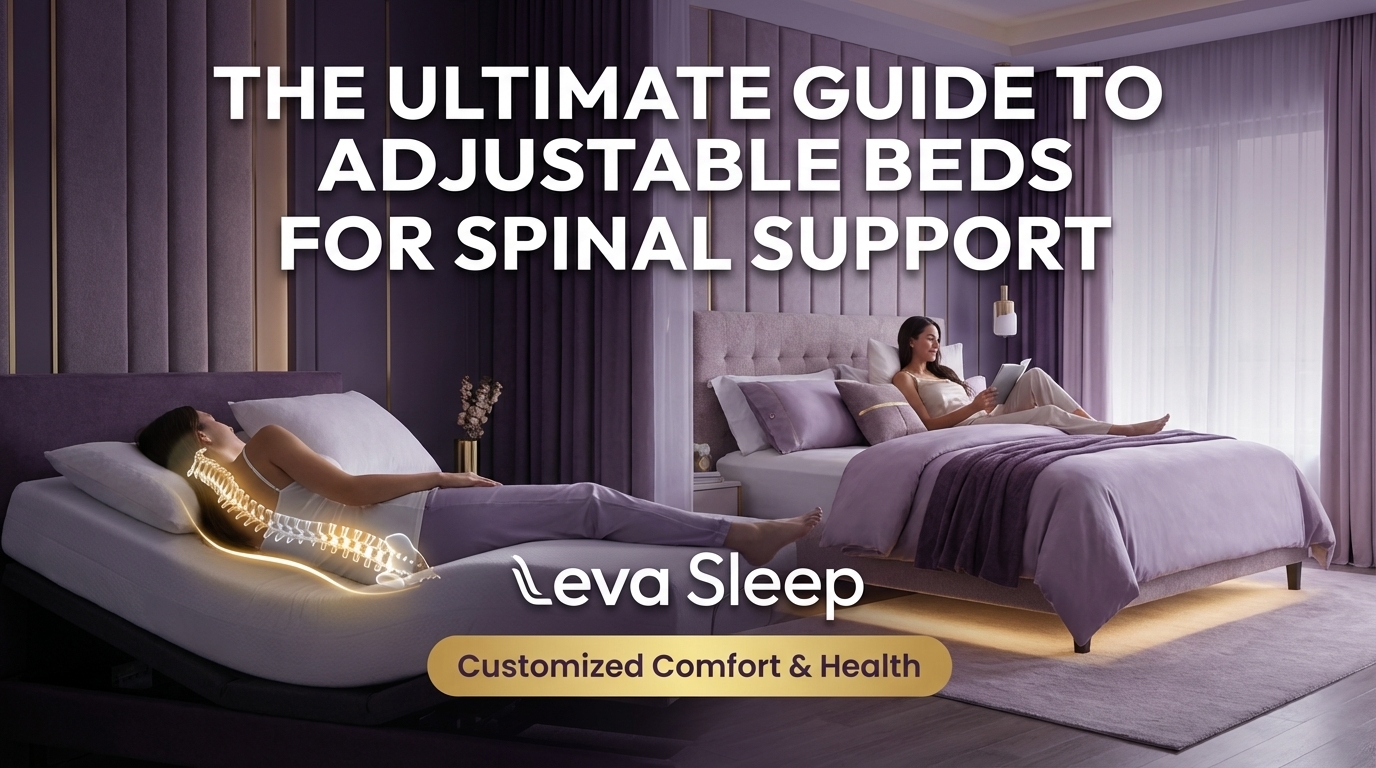
How to Choose a Bed That Supports Spine Alignment & Sleep
Content
Written by: Matthew Timmins, Founder and Managing Director, Leva Sleep | Last updated: June 18, 2026
Key Takeaways for Canadian Couples
Spine misalignment during sleep is a primary cause of morning stiffness and soreness, so neutral curves must be maintained all night.
Couples often need different firmness levels and sleep positions, so a single static mattress rarely works for both partners.
A zoned mattress paired with an adjustable base provides targeted lumbar support and pressure relief tailored to each sleeper.
A quick visual spine-alignment self-test helps reveal whether your current mattress or base contributes to discomfort.
Leva Sleep offers split adjustable bed packages with independent controls, quiet motors, and Canadian white-glove delivery, so shop Leva Sleep’s adjustable beds to find the right configuration for you.
Phase 1: Match Sleep Position and Body Weight to Firmness
Firmness requirements follow directly from how body mass rests on the mattress surface during sleep. Different positions load different areas of the spine and joints. The following table summarises position-specific firmness guidance alongside the benefit of adding an adjustable base.
Prevents torso sinkage that causes lower back and neck strain
Slight head elevation can ease neck rotation, and a firmer mattress with minimal elevation is typically preferred
Heavier sleepers generally need a firmer surface to prevent excessive sinkage regardless of position. Lighter sleepers may find that a medium-firm mattress feels too rigid and does not contour enough. Individual experimentation is required to find what works, because no single surface suits every body.
Phase 2: Use Firmness and Zoning to Support Neutral Spine Curves
Zoned mattress construction divides the sleep surface into distinct firmness regions, typically softer at the shoulders and firmer beneath the lumbar area and hips. This design allows a single mattress to address multiple pressure points at the same time. For couples with similar sleep positions but different body weights, a zoned hybrid mattress with foam comfort layers over individually wrapped pocket coils often provides a strong balance of contouring and support.
When pairing a zoned mattress with an adjustable base, confirm that the mattress is engineered to flex repeatedly with the base. Leva Sleep offers both all-foam and hybrid pocket-coil mattresses designed specifically for this purpose. Standard mattresses from general retailers are not always built to bend repeatedly without degrading their internal structure, so verify this detail before purchase.
Phase 3: Run a Five-Minute Spine-Alignment Self-Test
A simple observational method can reveal whether your current mattress supports neutral alignment. Lie in your typical sleep position and ask a partner to observe your spine from the side, or use a full-length mirror positioned at mattress height.
Signs of misalignment to look for:
Lower back pain that improves throughout the day, common for back sleepers on too-soft mattresses
Hip or shoulder pain upon waking, typical for side sleepers on overly firm surfaces
Neck stiffness or morning headaches that suggest the cervical spine lacks support
Visible sagging or indentations where you typically sleep
Consistently better sleep in hotel beds, which often use medium-firm surfaces with fresh support layers
If two or more of these signs appear, the mattress firmness, the base configuration, or both are likely contributing to the problem.
Phase 4: Decide Whether an Adjustable Base Adds Needed Support
A quality adjustable base allows independent elevation of the head and foot sections. These changes alter the angle of the lumbar spine and redistribute pressure away from the sacrum and lower discs. This configuration often helps back sleepers with chronic lower back pain, people managing mild sleep apnea, and those recovering from hip or knee surgery.
Common mistakes to avoid when evaluating adjustable bases:
Too-soft mattress with elevation: Elevating the head on a mattress that is too soft causes the torso to fold instead of support, which worsens lumbar strain.
Pillow height when elevating: Raising the head section reduces the need for thick pillows. Using the same pillow height as on a flat bed often pushes the chin toward the chest and strains the cervical spine.
Noisy motors: Basic adjustable bases with loud or jerky motors disrupt sleep during adjustments. Leva Sleep uses whisper-quiet German motors to reduce this disturbance.
Leva Sleep bases include adjustable lumbar control and pillow tilt motors, which allow precise positioning that a flat base cannot match. The Leva Sleep app controls all adjustments via Bluetooth and includes preset positions.
Phase 5: Choose Between Split and Non-Split Bases for Couples
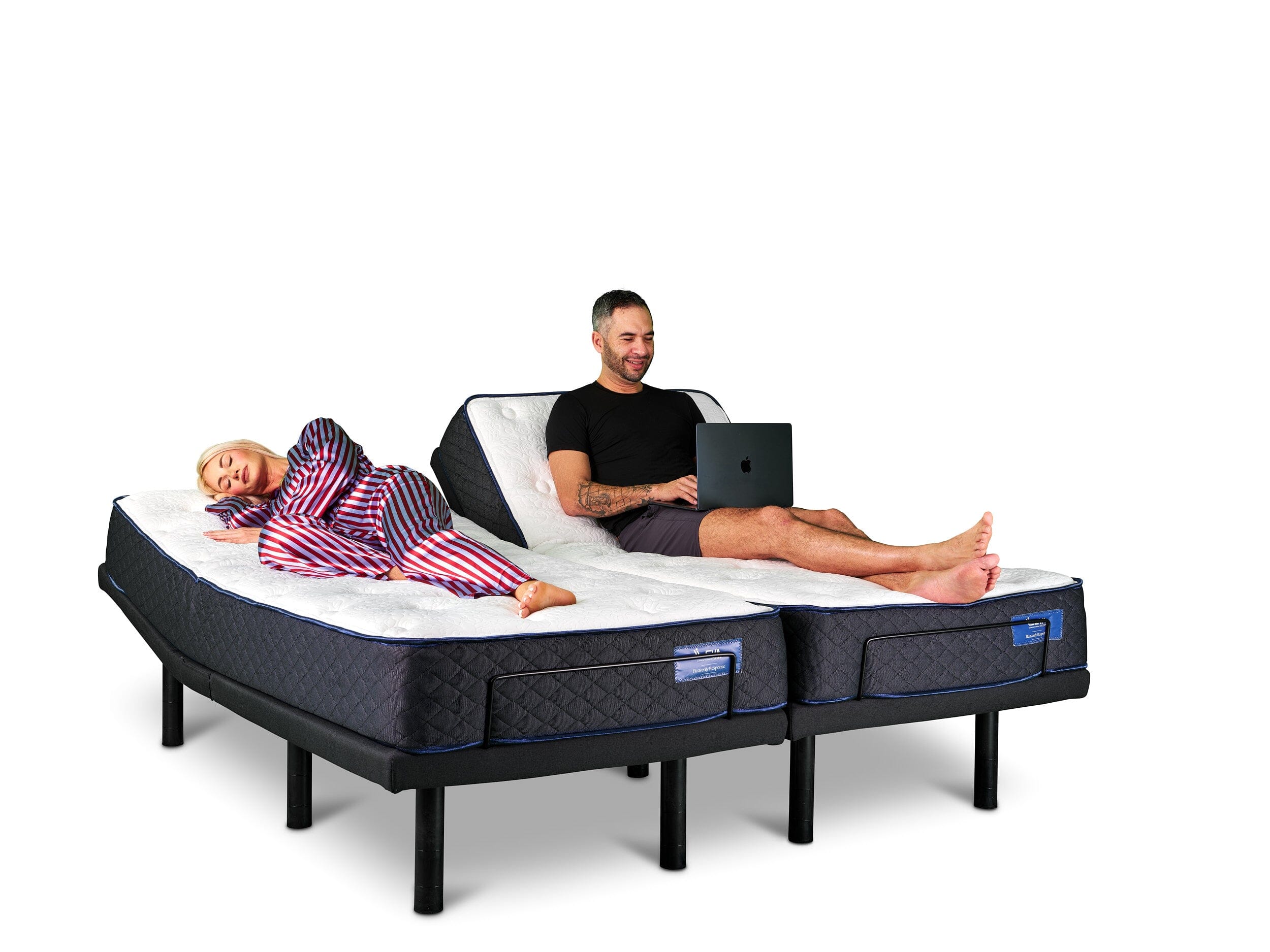
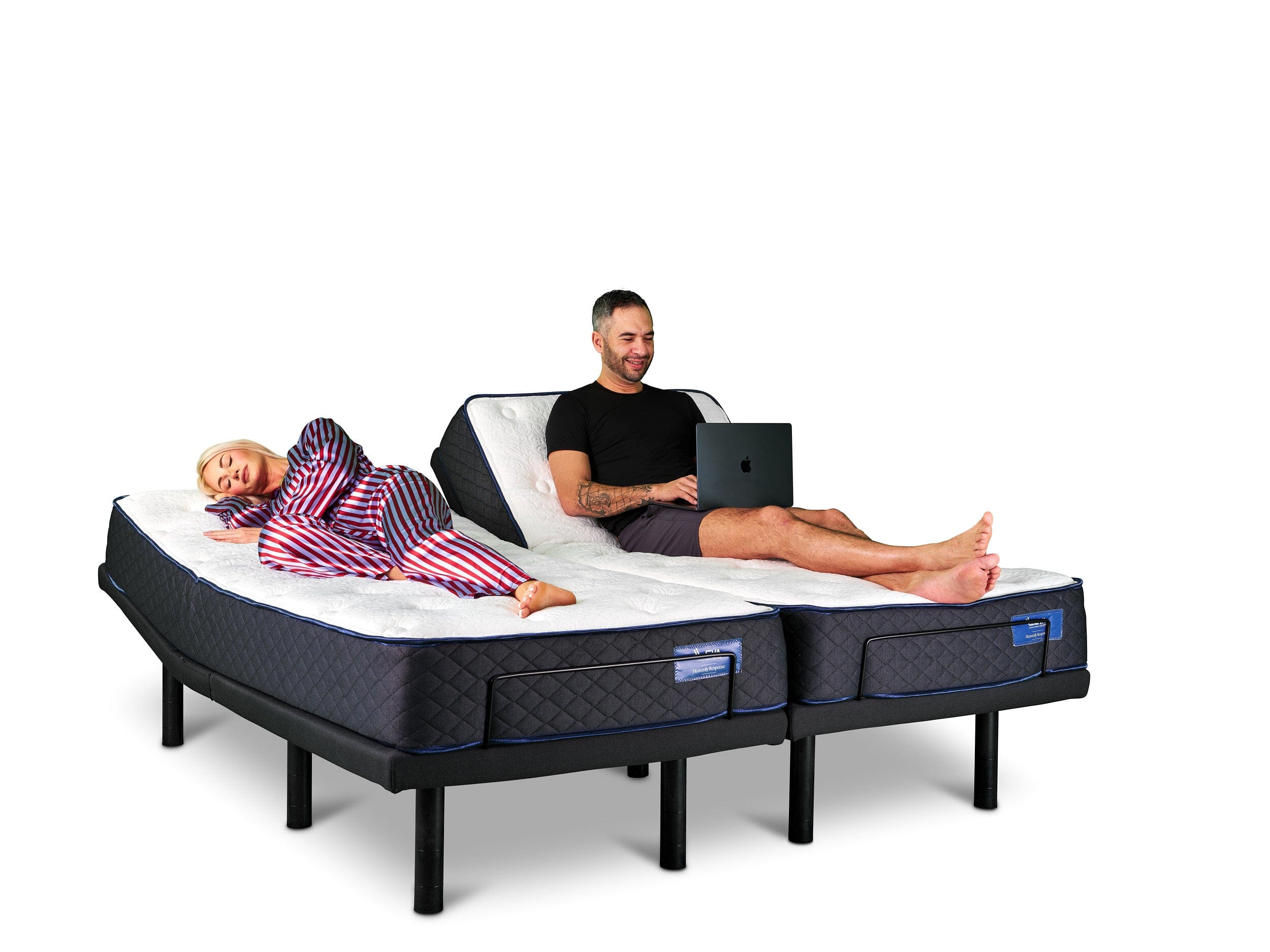
A non-split adjustable base moves both sides of the bed at the same time. This setup works for couples who share identical sleep preferences, which is uncommon. A split configuration places two independent bases side by side within a shared frame, so each partner controls their own elevation, firmness feel, and massage settings without affecting the other side.
Leva Sleep offers both split king and split queen configurations. The split queen delivers the same independent control in a more space-conscious format than the split king, which requires a larger room footprint. For couples in standard-sized bedrooms, this approach provides the same benefits in a smaller space.
Phase 6: Use a Canadian Buying Checklist Before You Order
Before finalising a purchase, confirm the following details.
Trial period: Verify the length of the in-home trial and the return or exchange policy in writing.
Provincial delivery: Leva Sleep delivers to Ontario and Alberta with scheduled appointments, not drop-ship windows.
White-glove setup: Confirm that delivery includes in-bedroom assembly, leg-height adjustment, old bed removal, and a product tutorial, all included in Leva Sleep’s white-glove service for a fee.
Mattress compatibility: Confirm the mattress warranty explicitly covers use with adjustable bases, and see Phase 2 for why this matters.
Bedding compatibility: Standard fitted sheets often pull off adjustable bases during elevation. Leva Sleep fitted sheets include deep pockets and extra elastic designed specifically for this purpose.
Motor noise rating: Ask for a demonstration or video of the motor in operation before purchasing any base.
Expert tip: When scheduling white-glove delivery, book a morning slot so you have the evening to test your saved positions before your first full night. Bring your usual pillow to the setup appointment so the technician can adjust the pillow tilt motor with your actual pillow in place.
What Success Looks Like on a Split Adjustable System
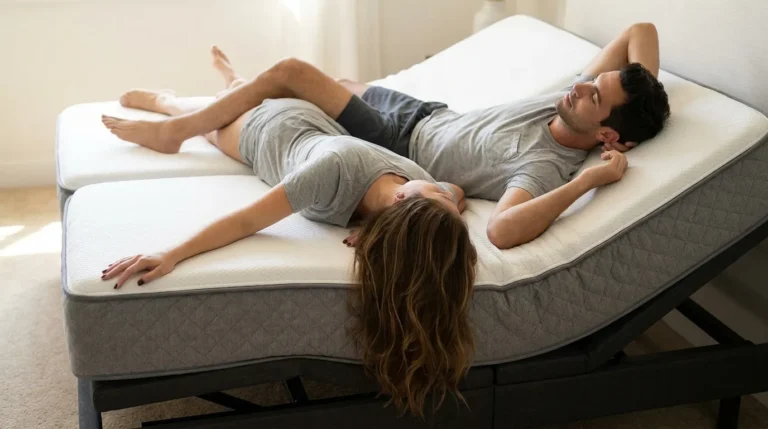
Within two to four weeks on a properly matched split adjustable system, many couples notice clear changes. Morning lower back or hip stiffness that previously eased throughout the day often fades or disappears. Both partners usually remain in the same bed rather than moving to a sofa or spare room. Each partner can fine-tune their elevation independently after a snoring episode or positional discomfort without waking the other.
Advanced Features That Support Long-Term Spine Health
Sleep needs change with age, weight fluctuation, and medical events, so flexibility matters. A split adjustable system future-proofs the sleep environment because each side can be reconfigured independently as needs evolve. One partner recovering from surgery can elevate their side without altering the other person’s settings.
Leva Sleep’s heating and cooling pad accessory adds individual temperature regulation to each side, which helps when one partner sleeps hot and the other cold. AI-powered sleep tracking, available on higher-end Leva bases, enables real-time micro-adjustments through the night based on movement and position data.
Frequently Asked Questions
How long is the trial period for a Leva Sleep adjustable bed?
Leva Sleep offers an in-home trial period that lets you assess the system in your own bedroom under real sleep conditions. Trial length and exchange terms vary by package, so confirm the specific duration and any conditions, such as mattress protector requirements, before purchase. Adjustable sleep systems typically require at least 30 nights for the body to adapt to new support and elevation settings, so a trial of that length or longer is worth prioritising when comparing options.
Does Leva Sleep deliver to both Ontario and Alberta?
Yes. Leva Sleep white-glove delivery operates in Ontario and Alberta. Delivery is scheduled by appointment rather than a drop-ship window, which helps ensure you are available to walk through the initial calibration described in Phase 6. This service offers a more guided setup than bed-in-a-box brands that leave assembly to the customer.
Will standard sheets fit a split adjustable bed?
Standard fitted sheets are not designed for the repeated flexing and elevation of an adjustable base and will typically pull off the corners during use. Leva Sleep designs its own fitted sheets with deep pockets and reinforced extra elastic specifically for adjustable bases. Duvet clips are also available to keep bedding separated when each side sits at a different elevation angle. Using Leva Sleep purpose-built bedding is the most reliable way to prevent this common frustration.
How quiet are Leva Sleep’s motors during adjustment?
The German motors in Leva bases operate quietly enough that one partner can adjust position during the night without waking the other, which solves a common complaint with entry-level models. Motor noise remains one of the most frequent issues with basic adjustable beds, especially for light sleepers. If you are comparing bases, ask for a live or video demonstration of the motor at various speeds before committing to a purchase.
How do I verify that my spine is in neutral alignment after setting up the adjustable base?
After your white-glove setup, lie in your typical sleep position and ask your partner to observe your spine from the side. Your ear, shoulder, hip, and ankle should form a roughly straight line for back sleepers, or a gently curved line that mirrors your natural standing posture for side sleepers. If your lower back arches away from the mattress as a back sleeper, increase the lumbar support setting in small steps. If your hips feel compressed as a side sleeper, reduce firmness or adjust the head elevation slightly. Leva Sleep delivery technicians walk through initial position calibration during setup, and the app allows you to save preferred positions for future reference.
Conclusion: A Six-Step Path to Better Sleep for Two
Choosing a bed that supports spine alignment and sleep quality involves six sequential decisions. These include identifying sleep positions and weight range, matching firmness to neutral spine requirements, self-testing for misalignment signs, evaluating whether an adjustable base addresses lumbar and elevation needs, comparing split versus non-split configurations for independent couple comfort, and applying a Canadian buying checklist that covers trial periods, delivery, setup, and bedding compatibility.
Static mattresses cannot satisfy two people with different positions, firmness preferences, or medical needs at the same time. Split adjustable systems with independent controls solve this by letting each partner configure their side independently. Among Canadian specialists, Leva Sleep distinguishes itself by offering both split queen and split king configurations with whisper-quiet German motors, locally assembled systems, purpose-built bedding, and in-house white-glove delivery in Ontario and Alberta, delivering the same independent customisation as luxury brands at 30–50% less.
Shop Leva Sleep’s adjustable beds and find the split configuration that lets both partners sleep on their own terms in the same bed.