Written by: Matthew Timmins, Founder and Managing Director, Leva Sleep | Last updated: June 30, 2026
Key Takeaways for Canadian Couples
-
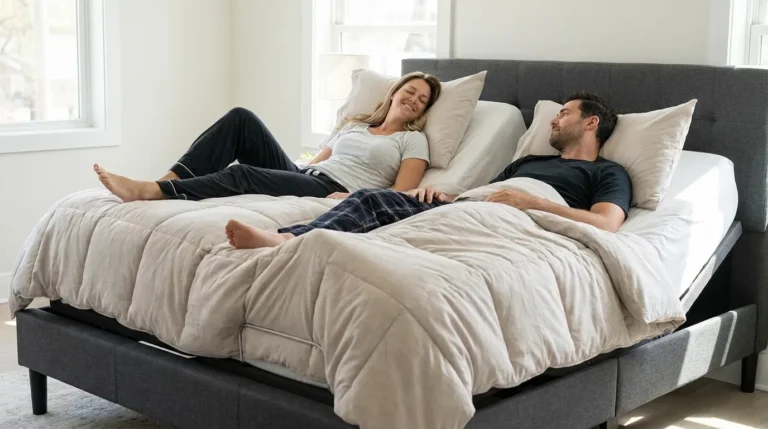
Traditional flat beds rarely suit two partners with different needs, so snoring, reflux, and pain often push couples toward sleep divorce.
-
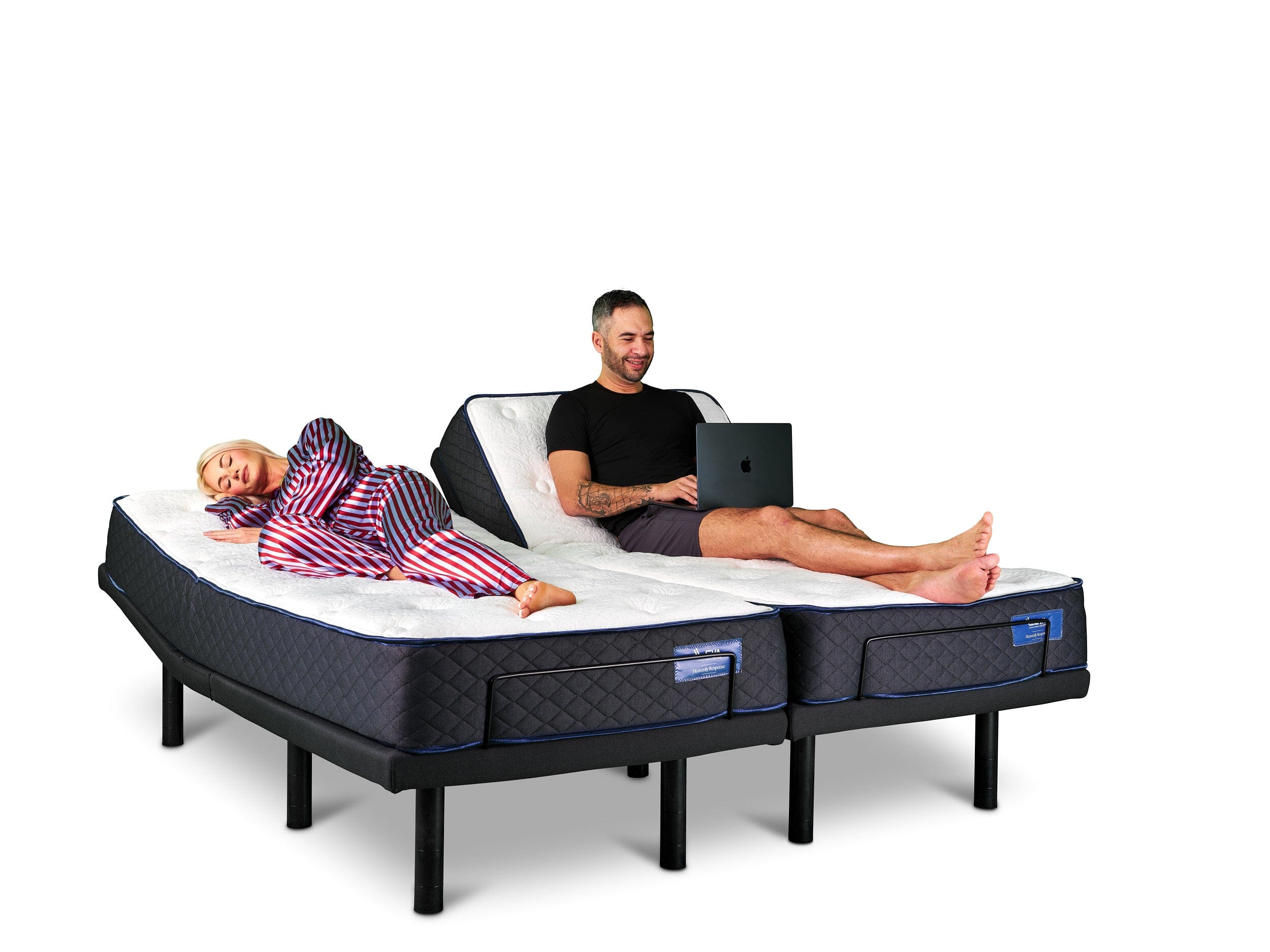
Adjustable bases with compatible mattresses allow independent head and foot elevation, which clinical research links to fewer reflux episodes, less snoring, and fewer pain-related awakenings.
-
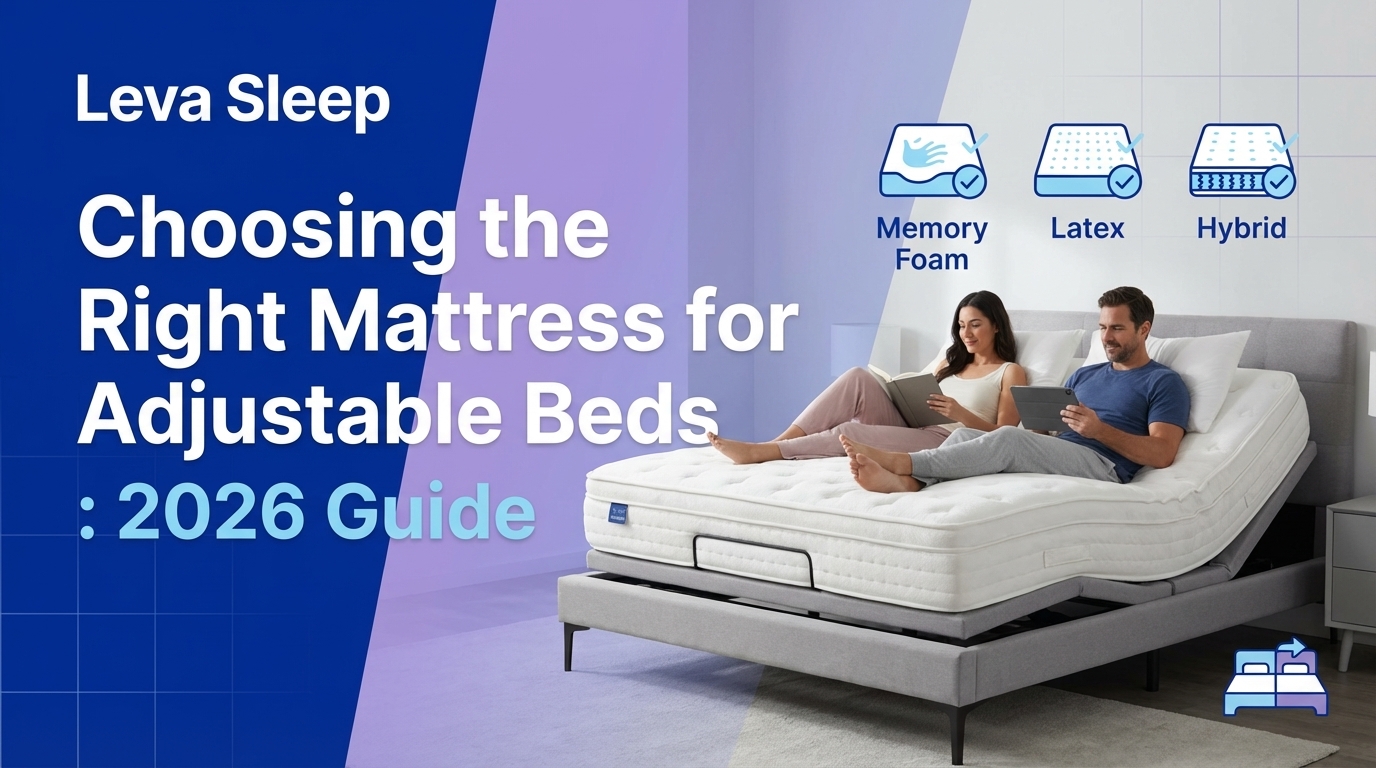
All-foam and hybrid pocket-coil mattresses work best on adjustable bases, while traditional innerspring mattresses usually perform poorly and wear out faster.
-
Leva Sleep offers split configurations with independent controls, whisper-quiet motors, and deep-pocket sheets that solve common issues Canadian couples face.
-
Explore Leva Sleep’s adjustable bed packages designed for Canadian couples to find a complete system that improves sleep quality together.
The Solution: Clinical Evidence and Mattress Compatibility
Adjustable bases reduce sleep disruption by allowing the head and foot of the bed to elevate independently, which changes how the body relates to gravity. Oxford Academic’s sleep research literature shows that positional changes during sleep can meaningfully reduce reflux episodes, snoring events, and pain-related arousals. Separately, the National Council on Ageing reports that adults who address underlying sleep disruptors, including positional factors, gain measurable total sleep time, with some studies citing about 21 extra minutes per night once positional symptoms are managed.
Mattress type determines whether those gains actually show up in real life. An adjustable base can only move through its full range if the mattress bends with it. A mattress that resists flexing, or that breaks down after repeated bending, cancels out the mechanical benefit of the base. The mattress and the base must be evaluated as a single system, not as separate purchases. To understand which mattress types work best with adjustable bases, we need to look at how different constructions respond to repeated articulation.
Explore Leva Sleep’s complete adjustable bed systems, where mattress and base are engineered together for reliable compatibility.
How Common Mattress Types Perform on Adjustable Bases
The table below summarizes how four common mattress constructions perform when paired with an adjustable base. These descriptions reflect general material properties and published guidance on adjustable base compatibility.
|
Mattress Type |
Flexibility on Adjustable Base |
Support at Elevation |
Durability Notes |
|---|---|---|---|
|
All-Foam |
Excellent, conforms readily to most articulation angles |
Good, maintains pressure relief at head and foot elevation |
High, no coils to fatigue and foam layers tolerate repeated flexion well |
|
Hybrid Pocket-Coil |
Good, individually wrapped coils flex independently without the rigidity of connected coil systems |
Very Good, coil layer preserves edge support and spinal alignment at elevation |
Good, pocket coils handle articulation better than Bonnell or offset coils and foam comfort layers add resilience |
|
Natural Latex |
Moderate, latex is elastic but heavier and slower to conform, and thick cores may resist sharp angles |
Good, latex provides consistent pressure distribution, with performance shaped by ILD rating and thickness |
Very High, latex resists compression fatigue, although its weight can stress base motors over time |
|
Traditional Innerspring (Bonnell/Offset) |
Poor, interconnected coil systems resist bending and may creak or deform with repeated articulation |
Poor at elevation, coil geometry is tuned for flat use and support drops significantly when inclined |
Low on adjustable bases, repeated flexion speeds up coil fatigue and border wire failure, so this type is not recommended |
Leva Sleep designs its own all-foam and hybrid pocket-coil mattresses specifically for adjustable bases, which removes the guesswork that comes with pairing a random mattress to an articulating frame.
How Adjustable Beds Support Specific Health Concerns
Acid Reflux Relief with Head Elevation
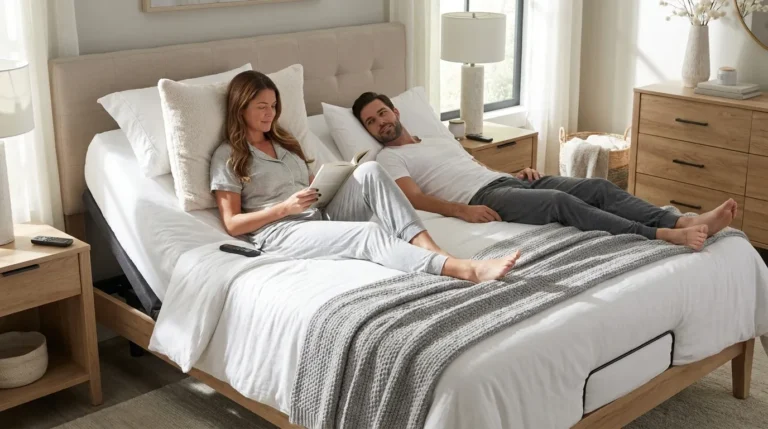
Head elevation between 15 and 30 degrees uses gravity to reduce how often gastric acid moves into the oesophagus during sleep. Oxford Academic’s gastroenterology and sleep intersection literature identifies head-of-bed elevation as a first-line positional strategy for nocturnal reflux. Wedge pillows can mimic this effect but often shift during the night, while a motorized adjustable base holds the angle consistently. Couples where only one partner has reflux benefit from a split configuration, because that partner can elevate their side without disturbing the other.
Find split-configuration bases with independent head elevation at Leva Sleep.
Snoring and Mild Sleep Apnea Support
Snoring often worsens in certain positions. When the head is elevated, the tongue and soft palate are less likely to collapse into the airway, which reduces the vibration that creates snoring sounds. For mild obstructive sleep apnea, positional therapy that includes head elevation is recognized as a complementary option alongside, or sometimes instead of, CPAP for positional-dependent patients. Leva Sleep’s anti-snore mode, available on select bases, detects snoring acoustically and makes small head adjustments to improve airway openness without waking either partner. Individuals with diagnosed moderate-to-severe sleep apnea should work with a physician before replacing prescribed CPAP therapy with positional approaches.
Hip and Knee Pain Pressure Reduction
Foot elevation reduces pressure on the hip joints by allowing slight knee flexion, which decompresses the hip capsule. As noted earlier, pain-related sleep disruption is a primary contributor to fragmented sleep in older adults, and easing joint pressure can help consolidate rest. Adjustable lumbar support, available on Leva Sleep’s higher-tier bases, adds targeted contouring to the lower back independent of head and foot elevation.
Limitations for Seniors and Individuals with COPD
Adjustable beds do not suit every senior or every health profile. Seniors with significant mobility limitations may find getting in and out of bed harder when the base is elevated, especially if the overall bed height has not been set correctly. This accessibility concern also affects individuals with COPD, who may benefit from head elevation to reduce respiratory effort during sleep, yet need a carefully chosen angle that a respiratory therapist helps define. Beyond positioning, mechanical limits matter as well, because heavier latex mattresses can strain motors on entry-level bases and shorten their lifespan. Leva Sleep’s whisper-quiet German motors provide reliable performance, and pairing them with an appropriately weighted mattress supports long-term durability.
Real-World Trade-offs Adjustable Bed Owners Report
Owners of adjustable beds commonly mention three friction points: motor noise during adjustment, fitted sheets slipping when the base moves, and higher upfront cost compared with a standard frame. Motor noise appears most often in reviews of entry-level and older bases, so Leva Sleep uses German-engineered whisper-quiet motors that keep sound levels low during position changes. Sheet slippage shows up with most standard bedding on adjustable bases, so Leva Sleep designs fitted sheets with deep pockets and reinforced elastic to stay in place through full articulation. Cost remains a real factor, and the next section explains how Canadian buyers can weigh price against long-term value.
Cost-Value Framework for 2026 Canadian Buyers
Adjustable bed systems from many luxury brands carry price points that place them beyond reach for a large share of Canadian households. Leva Sleep’s vertical integration model, which covers design, assembly, and delivery without wholesale intermediaries, creates a 30–50% price advantage over comparable luxury competitors. For couples considering a Split Queen configuration, which offers two independently controlled twin XL-equivalent surfaces within a queen footprint, Leva Sleep is one of the only Canadian providers that builds this format to order.
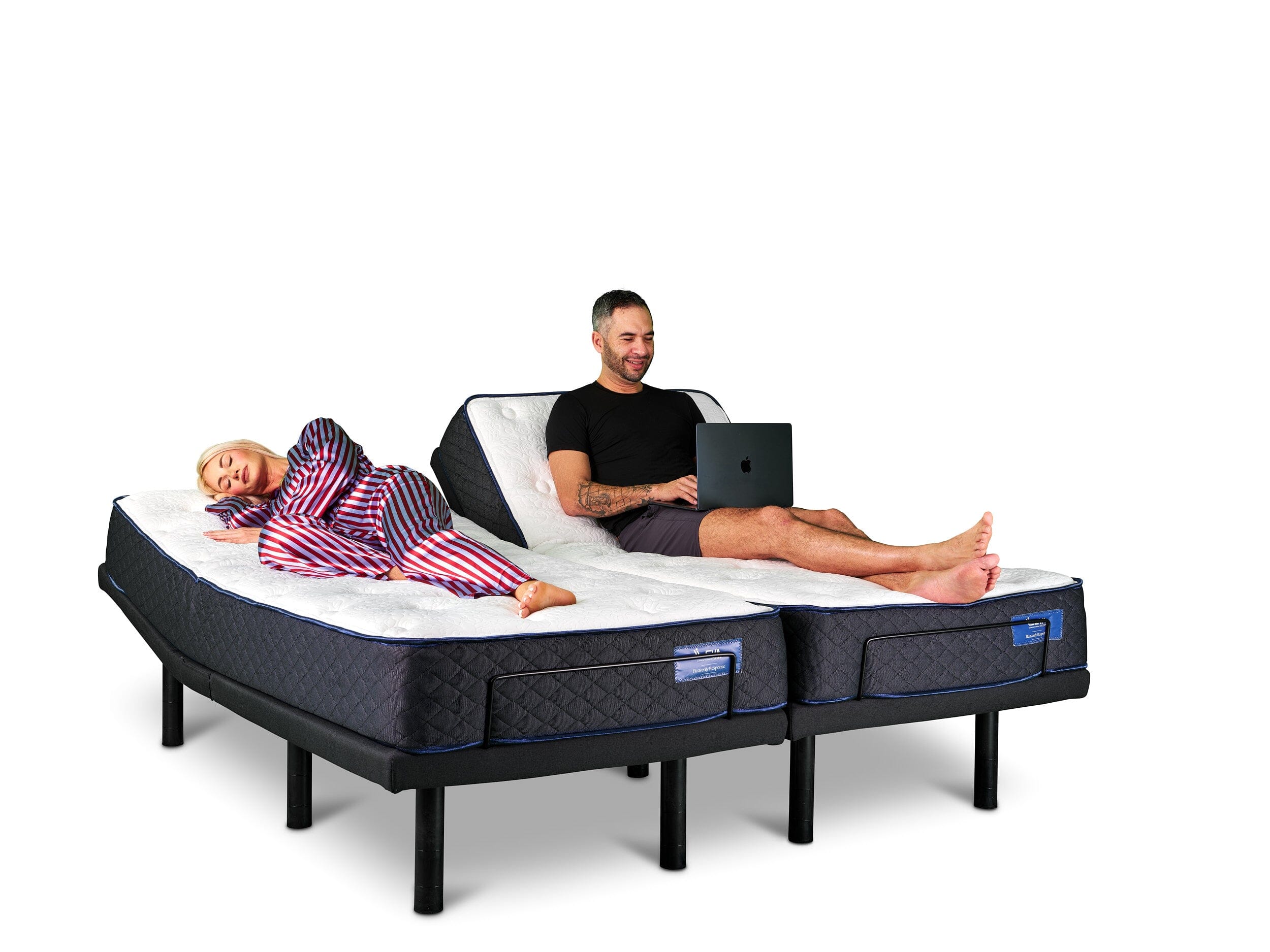
White-glove delivery, available for a fee, includes bedroom-level setup, leg height adjustment, a product tutorial, and removal of the existing bed. For a product that depends on precise assembly and calibration, this service reduces the risk of incorrect setup that could affect both performance and warranty coverage. Over an 8 to 10 year product lifespan, the per-night cost gap between a Leva Sleep system and a traditional flat bed narrows significantly once sleep quality improvements enter the calculation.
Decision Checklist: Matching an Adjustable Bed to Your Needs
-
Medical consultation completed: If either partner has diagnosed sleep apnea, COPD, or post-surgical recovery needs, confirm with a physician that positional therapy is appropriate before buying.
-
Mattress flexibility verified: Confirm that the mattress under consideration is rated for adjustable base use. All-foam and hybrid pocket-coil designs are the most reliable choices, while traditional innerspring is not recommended.
-
Split configuration assessed: If partners have clearly different elevation or firmness needs, a Split Queen or Split King base with independent controls fits better than a single-zone adjustable base.
-
Motor noise tolerance considered: If either partner is a light sleeper, review the base’s motor specifications before purchase. Whisper-quiet motors can make a noticeable difference.
-
Bedding compatibility planned: Budget for fitted sheets and accessories designed for adjustable bases to avoid the common frustration of standard bedding slipping during the night.
-
Delivery and setup requirements confirmed: Adjustable bases are heavy and require accurate assembly. White-glove delivery deserves serious consideration, especially for upper floors or complex bedroom layouts.
-
Long-term usability assessed: Evaluate ease of getting in and out of bed at the planned height, particularly for seniors or anyone with mobility concerns.
Browse Leva Sleep’s Split Queen and Split King systems, built for Canadian couples and available with white-glove delivery across Ontario and Alberta.
Frequently Asked Questions
Will an adjustable bed actually help with snoring, or is it just marketing?
Head elevation has a clear physiological basis for reducing snoring. When the upper body inclines, gravity helps keep the tongue and soft palate from collapsing into the airway, which is the main mechanical cause of snoring sounds. This works best for positional snorers, whose snoring worsens when lying flat. It does not guarantee a cure, and individuals with diagnosed obstructive sleep apnea should work with a physician to decide whether positional therapy is enough or whether CPAP remains necessary. Leva Sleep’s anti-snore mode adds automation by detecting snoring acoustically and making subtle head adjustments without waking either partner, which solves the practical challenge of manual repositioning during the night.
Can any mattress be used on an adjustable base, or does it have to be a specific type?
Not every mattress works well on an adjustable base. Traditional innerspring mattresses with Bonnell or offset coil systems are not designed for repeated flexing and tend to degrade quickly on an articulating frame. All-foam mattresses are the most universally compatible option because foam bends easily without structural fatigue. Hybrid mattresses with individually wrapped pocket coils also perform well because each coil moves independently, which lets the mattress follow elevation angles without the stiffness of a connected coil system. Natural latex can work but is heavier and may resist sharper angles, depending on thickness. The safest approach is to purchase a mattress and base from the same specialist, and Leva Sleep designs its mattresses specifically for use with its adjustable bases.
What makes a Split Queen different from a Split King, and which is right for our bedroom?
A Split King uses two twin XL mattresses placed side by side on two independently controlled bases to create a king-sized sleeping surface. A Split Queen uses two narrower mattresses to create a queen-sized footprint with the same independent control features. The Split Queen suits couples who want independent adjustment but have a bedroom that cannot fit a king-sized bed, or who prefer a closer sleeping arrangement. Leva Sleep is one of the only Canadian providers that builds Split Queen configurations to order, which makes it a practical option for couples in standard-sized Canadian bedrooms where a Split King would feel too wide.
Are adjustable beds suitable for seniors with mobility issues?
Adjustable beds can help seniors manage acid reflux, reduce hip and knee pressure, and move more easily from lying to sitting by raising the head of the bed. However, genuine limitations exist. As discussed in the limitations section, bed height optimization is critical for seniors with mobility challenges, because an elevated base can complicate getting in and out of bed if the overall height sits too high. Some seniors with COPD benefit from head elevation to ease breathing, but the ideal angle varies and should be set with guidance from a respiratory therapist. Key evaluation criteria include bed height adjustability, ease of remote or app control, and whether motor noise will disturb a light sleeper. Leva Sleep’s white-glove delivery service includes leg height adjustment at setup, which directly supports seniors who need easier access.
How long does an adjustable base typically last, and is the investment worth it for a couple?
A well-built adjustable base with quality motors and a compatible mattress is generally designed for 8 to 10 years of regular use. Durability depends heavily on motor quality, the weight of the mattress, and how often the base changes position. Entry-level bases with weaker motors paired with heavy latex mattresses will usually wear out faster than a properly matched system. For couples, the value calculation should include the cost of sleep disruption in both health and relationship terms. Couples who resolve snoring, reflux, or pain-related sleep disruption with an adjustable system often report that better sleep and the ability to stay in the same bed justify the investment. The price advantage discussed earlier makes the entry point more accessible without sacrificing the motor quality or feature set that supports long-term performance.