Written by: Matthew Timmins, Founder and Managing Director, Leva Sleep | Last updated: June 18, 2026
Key Takeaways for Couples Sharing an Adjustable Bed
- Adjustable beds let couples choose independent positions, such as 10–30° anti-snore head elevation or zero-gravity, so each partner can address snoring or pain without compromise.
- Zero-gravity positioning, with head and feet raised together, distributes weight evenly, decompresses the spine, and eases lower-back tension for both partners.
- Split Queen and Split King bases give each sleeper separate controls, so no one is forced to share a single incline or wake up when the other adjusts.
- Features like lumbar control, pillow tilt, and gradual angle changes improve comfort and long-term spinal alignment for side sleepers and people with back pain.
- Explore Leva Sleep’s adjustable bed packages, including Split Queen and Split King options with white-glove delivery across Ontario and Alberta, at Leva Sleep.
Best Adjustable Bed Position to Stop Snoring
Snoring often starts when soft tissues in the throat relax and partially block the airway during sleep. Elevating the head and torso 10–30° uses gravity to keep those tissues from collapsing inward and narrowing the airway. The presets below move from lightest to most aggressive intervention.
Preset 1 — Light snoring (10–15° head elevation): A 10–15° head elevation, roughly 4–6 inches of lift, often helps lighter snoring. Because this angle is gentle, you can keep the foot section flat without sliding down the mattress. To open the airway further, activate pillow tilt to 3–5°, which slightly extends the neck and improves airflow. Keep lumbar control at a neutral setting, since this shallow angle does not create a large gap at the lower back.
Preset 2 — Moderate snoring (20–25° head elevation): A 20–30° incline is the practical sweet spot for moderate to heavier snoring. At this steeper angle, raise the foot section 5–10° to reduce sliding and keep the body anchored. Set pillow tilt to about 5° to maintain neck extension without strain. Engage lumbar control at a low-to-medium level so the lower back stays supported as the torso rises.
Preset 3 — Zero-gravity anti-snore (head 15–20°, feet above heart level): The zero-gravity position elevates both the head and legs at the same time, which opens the airway and reduces spinal pressure. This preset works well for partners who snore and also carry lower-back tension, since it combines airway support with decompression for the spine.
Neck positioning, especially slight head extension, can reduce sleep-disordered breathing in people with mild-to-moderate obstructive sleep apnea. Pillow tilt on higher-end Leva Sleep bases recreates this extension mechanically, so couples can avoid stacking pillows that shift or collapse during the night.
Best Adjustable Bed Position for Lower Back Pain
Lower back pain during sleep often comes from excess tension on the psoas muscles and lumbar discs when the spine lies fully flat. Adjustable bases reduce this strain by creating a gentle hip pocket that unloads those structures and supports a more neutral curve.
Preset 1 — Mild lumbar relief (head 10–15°, foot 15–20°): Raising the foot section 15–20° and the head section 10–15° creates a small pocket for the hips that eases tension on the psoas muscles and lumbar discs. Turn lumbar control to a low setting so it fills the gap between the mattress and the lower back at this angle.
Preset 2 — Zero-gravity for back pain (head 15–30°, feet elevated above heart): Zero-gravity is widely considered a leading position for back pain relief, with the head raised about 30–45° and the knees slightly elevated. This setup distributes body weight more evenly and takes pressure off the vertebrae. It also decompresses the lumbar spine, reduces pressure on the tailbone, and opens space in the lower vertebrae, which can ease nerve compression for people with sciatica.
Adaptation guidance: Starting with a 5–10° lift and gradually increasing the angle over several nights allows back muscles and ligaments to adapt to the new neutral spinal alignment. Leva Sleep’s app-controlled bases let partners save incremental presets and increase angles by about 5° every two to three nights.
Best Adjustable Bed Position for Side Sleepers with Hip Pain
Side sleepers with hip pain often feel concentrated pressure on the lower hip while the upper hip rotates forward and strains the sacroiliac joint. Elevation adjustments reduce this load and rotation while still allowing a familiar side-sleeping posture.
Preset 1 — Slight head elevation with leg support (head 10–15°, foot 10–15°): Leg elevation alone on an adjustable bed can ease lower-back tension by tilting the pelvis and softening the spine’s natural curve, which also reduces rotational stress on the hip joint. Matching that with a 10–15° head elevation keeps the spine closer to a neutral lateral line.
Preset 2 — Pillow tilt for neck-hip alignment (head 10°, pillow tilt 5°, foot 10°): Setting the main head panel at 10° and adding a 5° pillow tilt prevents the neck from dropping toward the mattress. That drop would create a side bend that travels down the spine and increases hip tension. A low-to-medium lumbar setting fills the waist gap common in side sleepers and helps keep the pelvis level.
Mattress pairing note: Hip pain relief from elevation works best when the mattress also provides pressure relief at the shoulder and hip contact zones. Leva Sleep’s all-foam and hybrid pocket-coil mattresses are built for adjustable bases and maintain their contouring properties through repeated articulation cycles.
How Split Queen and Split King Bases Help Couples Sleep Differently
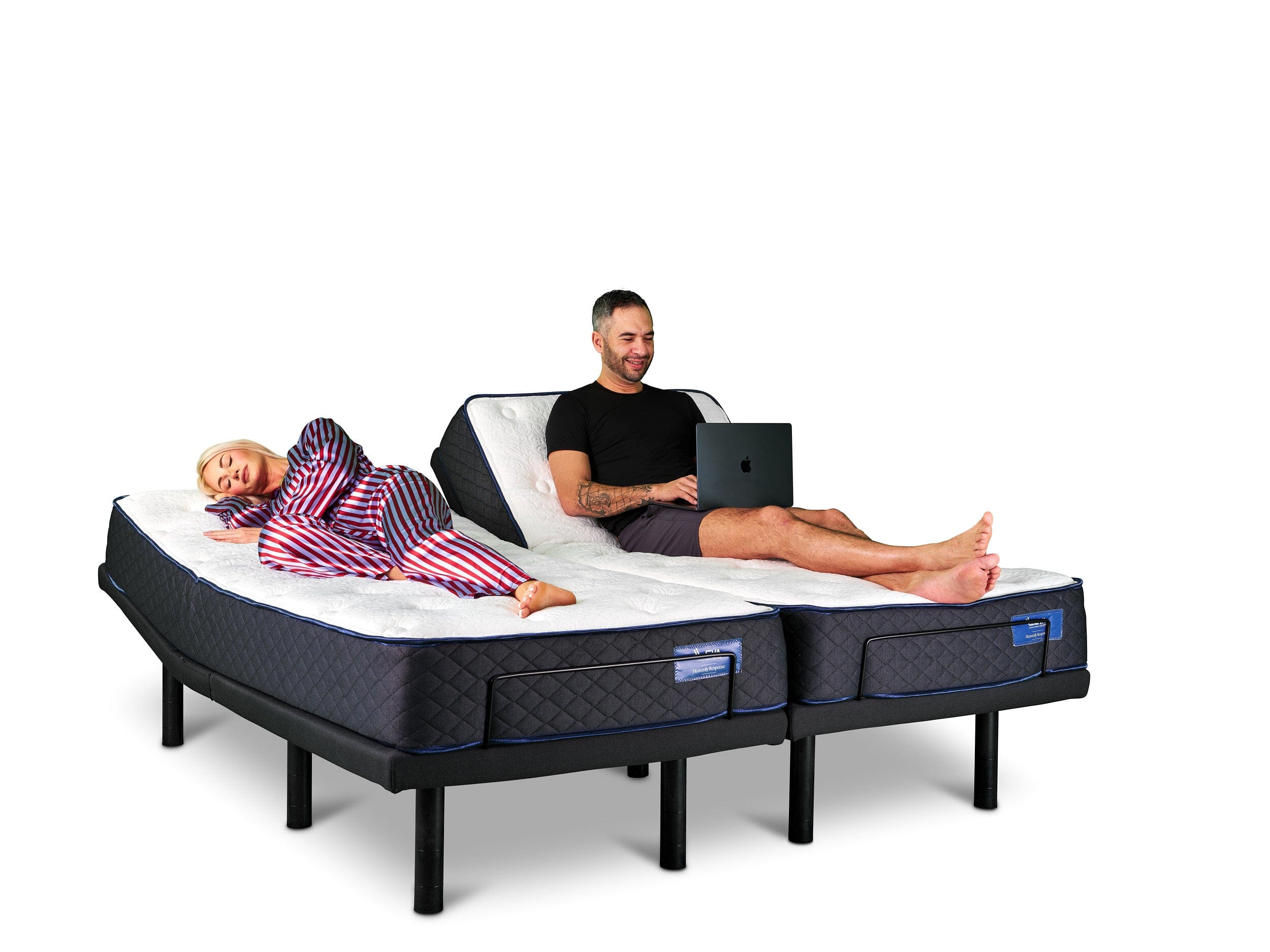
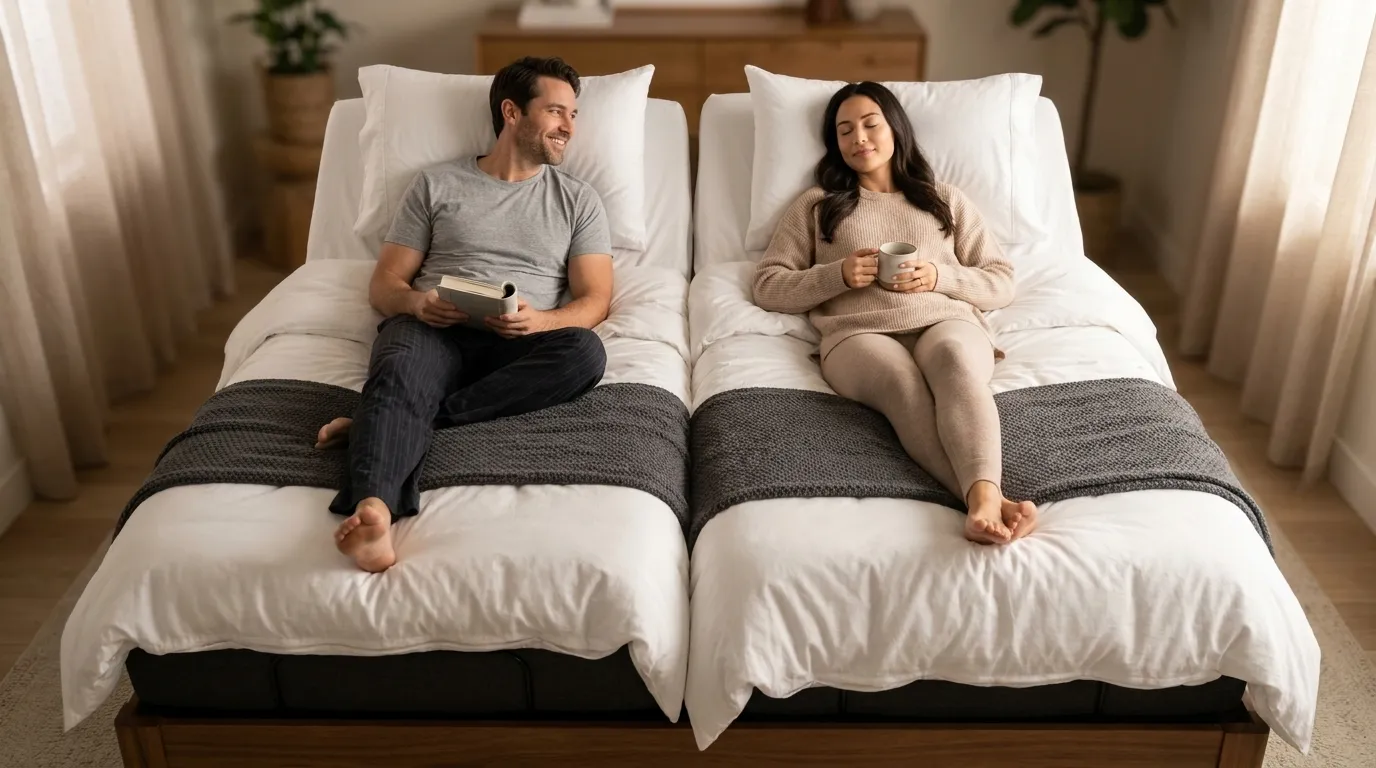
A standard king adjustable bed forces both partners to share the same incline, while a split configuration lets one partner use a 20° anti-snore angle and the other stay flat or choose a different position such as zero-gravity for pain relief. The table below illustrates a typical couple scenario using Leva Sleep’s independent dual-control system.
| Setting | Partner A (Snoring) | Partner B (Lower Back Pain) | Shared Outcome |
|---|---|---|---|
| Head elevation | 20–25° | 15–30° (zero-gravity) | Each side independent |
| Foot elevation | 5–10° | Knees above heart level | Each side independent |
| Lumbar control | Neutral | Low-to-medium engaged | No cross-side interference |
| Pillow tilt | 5° (airway extension) | Flat or 3° | Each side independent |
A split king uses two Twin XL mattresses on independent adjustable bases, so each partner can customize their side without disturbing the other, while also gaining motion isolation between mattresses. For Ontario couples in condos or Alberta couples in suburban homes where a full split king footprint of 76″ × 80″ feels too large, Leva Sleep’s Split Queen at 60″ × 80″ offers the same independent-control function in a more compact size that most general mattress retailers do not stock.
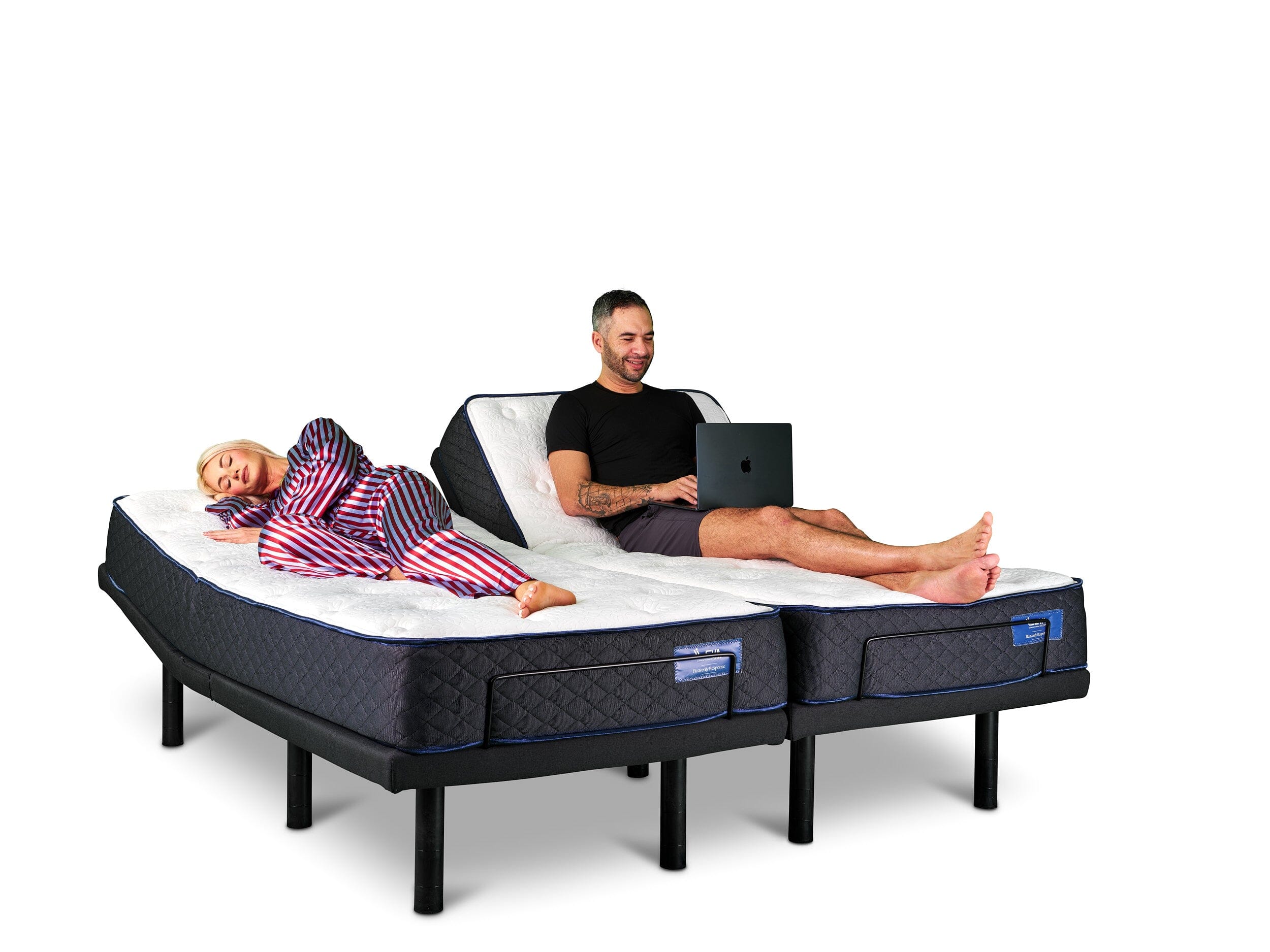
Explore Leva Sleep’s Split Queen and Split King adjustable bases with independent app control for each partner.
What to Expect from Anti-Snore Mode in 2026
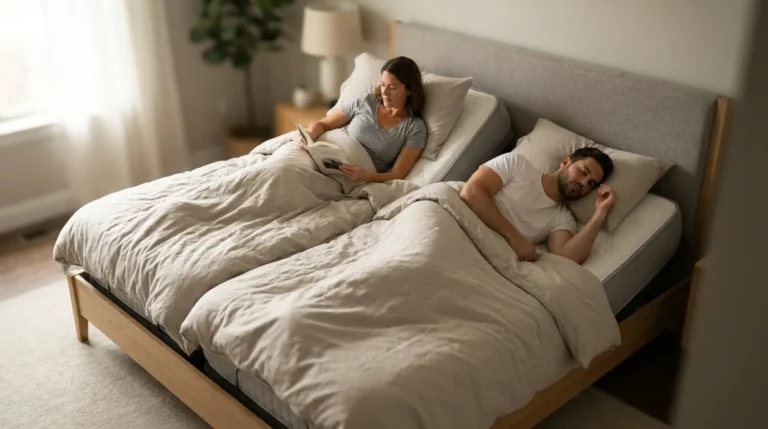
Leva Sleep plans to introduce an anti-snore mode in 2026 that uses onboard detection to identify snoring events and trigger small adjustments to the head section on the snoring partner’s side. Because Leva Sleep’s split bases adjust each side independently, only the snoring partner’s position changes while the other partner remains undisturbed.
The feature will integrate with the Leva Sleep app, which will log each adjustment and show which elevation changes correlate with quieter breathing. Over time, this data can shape a personalized default preset that reflects real-world sleep patterns. The anti-snore mode will roll out across select models within Leva Sleep’s 15–20 adjustable base range, which is three to four times broader than the three to five models most general mattress retailers in Canada carry.
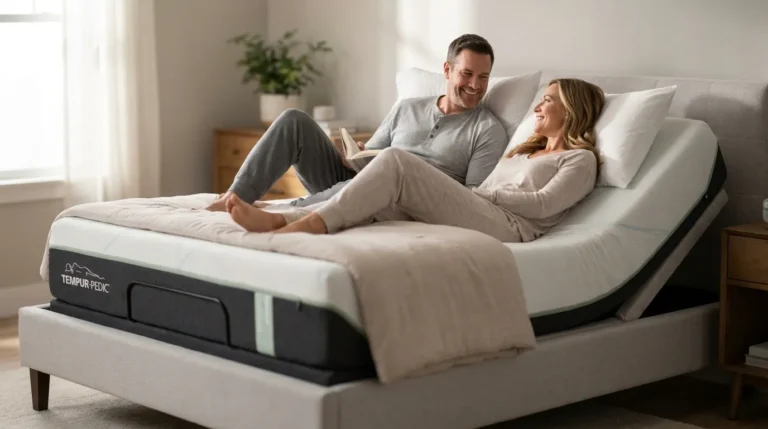
Leva Sleep’s direct-to-consumer model, with local design, in-house assembly, and no retail markup, prices these advanced bases about 30–50% below comparable luxury competitors. Couples who previously felt priced out of brands like Tempur-Pedic gain access to similar technology at a lower cost.
White-Glove Delivery and Common Adjustable Bed Mistakes
Leva Sleep’s white-glove delivery service, available across Ontario and Alberta for a fee, covers transport to the bedroom, full assembly, on-site leg-height adjustment, a tutorial on app pairing and preset programming, and removal of the old bed through donation or recycling. This end-to-end service removes the assembly burden common with bed-in-a-box purchases and ensures the base is level and calibrated before the first night.
Common mistakes couples make when purchasing adjustable bases:
Buying a single non-split base: A single-unit adjustable base, no matter how advanced, cannot provide independent elevation for two partners with different needs. Couples who choose a single base often discover that one partner’s ideal angle becomes the other partner’s discomfort zone.
Using standard bedding: Conventional fitted sheets are not built for repeated articulation and often pull free at elevated angles. Leva Sleep’s fitted sheets use deep pockets and reinforced elastic designed for adjustable bases. Standard duvets also bunch at the fold when one side elevates, while Leva’s duvet clips keep the two sides separated.
Ignoring motor noise: Basic adjustable bases rely on motors that are clearly audible during movement and can wake a light sleeper. Leva Sleep’s whisper-quiet German motors reduce disruption, which matters for couples where one partner wakes easily.
Skipping gradual adaptation: Starting with a 5–10° lift and gradually increasing the angle over several nights allows back muscles and ligaments to adapt to the new neutral spinal alignment. Jumping straight to a 30–45° zero-gravity preset can cause temporary muscle soreness during the first week.
Schedule white-glove delivery and setup for a Leva Sleep adjustable base across Ontario and Alberta, including old-bed removal and on-site configuration.
Frequently Asked Questions
What is the best head elevation angle to stop snoring on an adjustable bed?
Many sleep specialists recommend a head elevation between 10 and 30 degrees for snoring relief. Lighter snorers often improve at 10–15 degrees, while moderate to heavy snorers usually need 20–30 degrees to keep the airway open. The zero-gravity preset, which raises both the head and feet, also helps by reducing overall spinal pressure while maintaining an open airway. Pillow tilt on higher-end bases adds a secondary neck-extension angle that further reduces airway restriction without requiring a much steeper incline.
Can one partner use zero-gravity for back pain while the other uses an anti-snore incline on the same bed?
Yes, but only on a split-base configuration, which places two independent adjustable bases side by side with separate controls. One partner can hold a 20–25° anti-snore head elevation with a slight foot raise, while the other uses a full zero-gravity preset with knees above heart level. The two bases operate independently, so adjustments on one side do not affect the other. A single non-split base cannot match this flexibility because both partners share one articulating surface.
Is a Split Queen adjustable bed a practical size for a condo bedroom in Toronto or Calgary?
A Split Queen measures 60 inches wide by 80 inches long, the same footprint as a standard Queen, so it fits most condo master bedrooms in Toronto, Ottawa, Calgary, and Edmonton. The split runs down the centre of the base, so external dimensions stay the same. The main requirement is enough clearance on both sides for the head section to rise without hitting a wall or headboard. Leva Sleep’s white-glove delivery team checks clearance on arrival and adjusts leg heights to suit the room layout.
Will my existing mattress work with a Leva Sleep adjustable base?
Most all-foam and hybrid pocket-coil mattresses work with adjustable bases if the foam and coils are flexible enough to bend without damage. Innerspring mattresses with a rigid border wire usually are not compatible. Leva Sleep designs its all-foam and hybrid mattresses specifically for adjustable bases, so the materials maintain pressure relief and support through repeated articulation. If you plan to use an existing mattress, the delivery team can assess compatibility during the white-glove setup visit.
How does Leva Sleep’s anti-snore mode differ from simply setting a fixed elevated angle?
A fixed elevated angle requires the snoring partner to choose and maintain a preset every night. Leva Sleep’s anti-snore mode, arriving spring 2026, detects snoring in real time and makes automatic micro-adjustments to the head section only when snoring occurs. If the partner sleeps quietly, the base stays at the chosen position, including flat. This approach avoids locking the partner into a high angle all night, which can improve comfort and reduce sliding. Because the feature uses the split base’s independent controls, it activates only on the snoring partner’s side.
Conclusion: Choosing the Right Adjustable Setup for Two Sleepers
The positions and degree presets in this guide, including 10–30° anti-snore inclines, 15–20° foot elevation for lumbar relief, zero-gravity with head at 15–45° and feet above heart level, and combined pillow-tilt settings for side sleepers, cover the clinically referenced range where most couples see meaningful improvement. The best starting point depends on each partner’s condition, preferred sleep position, and comfort with elevated angles during the first few weeks.
Couples in Ontario and Alberta who want to move from a single flat surface to an independent split system can review Leva Sleep’s full range of 15–20 adjustable base models. Options include Split Queen and Split King configurations with whisper-quiet motors, lumbar control, pillow tilt, and the upcoming 2026 anti-snore auto-adjust feature. Compare Leva Sleep’s adjustable base models, configurations, and pricing, with white-glove delivery and old-bed removal available across Ontario and Alberta.