Written by: Matthew Timmins, Founder and Managing Director, Leva Sleep | Last updated: July 10, 2026
Key Takeaways for Canadian Couples
- Split adjustable beds give each partner independent control over firmness, elevation, massage, and temperature. This independence directly addresses the mismatch issues that often cause arguments and sleep divorce in Canadian couples.
- Traditional flat mattresses cannot support differing medical needs such as sleep apnea, acid reflux, or back pain. Split systems let one side stay flat while the other elevates, so both partners get what they need.
- Leva Sleep’s 2026 anti-snore automation will detect snoring and adjust head position automatically. This proactive approach improves on competitor systems that still rely on manual remote input.
- Key buying factors include room size (Split King vs Split Queen), motor noise, mattress and bedding compatibility, warranty coverage, and white-glove delivery availability in Ontario and Alberta.
- Couples ready to upgrade can explore Leva Sleep’s full range of Split Queen and Split King adjustable bed packages at Leva Sleep’s adjustable beds.
Quick-Read Overview: Why Flat Mattresses Fail Many Canadian Couples
A flat mattress forces both partners to accept a single firmness, a single sleeping angle, and a single temperature environment. A Saatva survey found that 35% of couples have argued specifically about mattress firmness preferences. A Naturepedic survey reported that many people sharing a bed experience sleep issues serious enough to make them question their relationship. These problems go beyond basic discomfort. About 29% of Americans choose to sleep in a separate bed or another room to accommodate a partner, a pattern Canadian sleep specialists increasingly call “sleep divorce.”
Motion transfer often makes things worse. Adults experience frequent microarousals each night, and these brief awakenings increase with age. A partner’s movement on a shared mattress can shift the brain from deep sleep into lighter stages. Split adjustable systems avoid this shared motion because each side rests on a physically separate base.
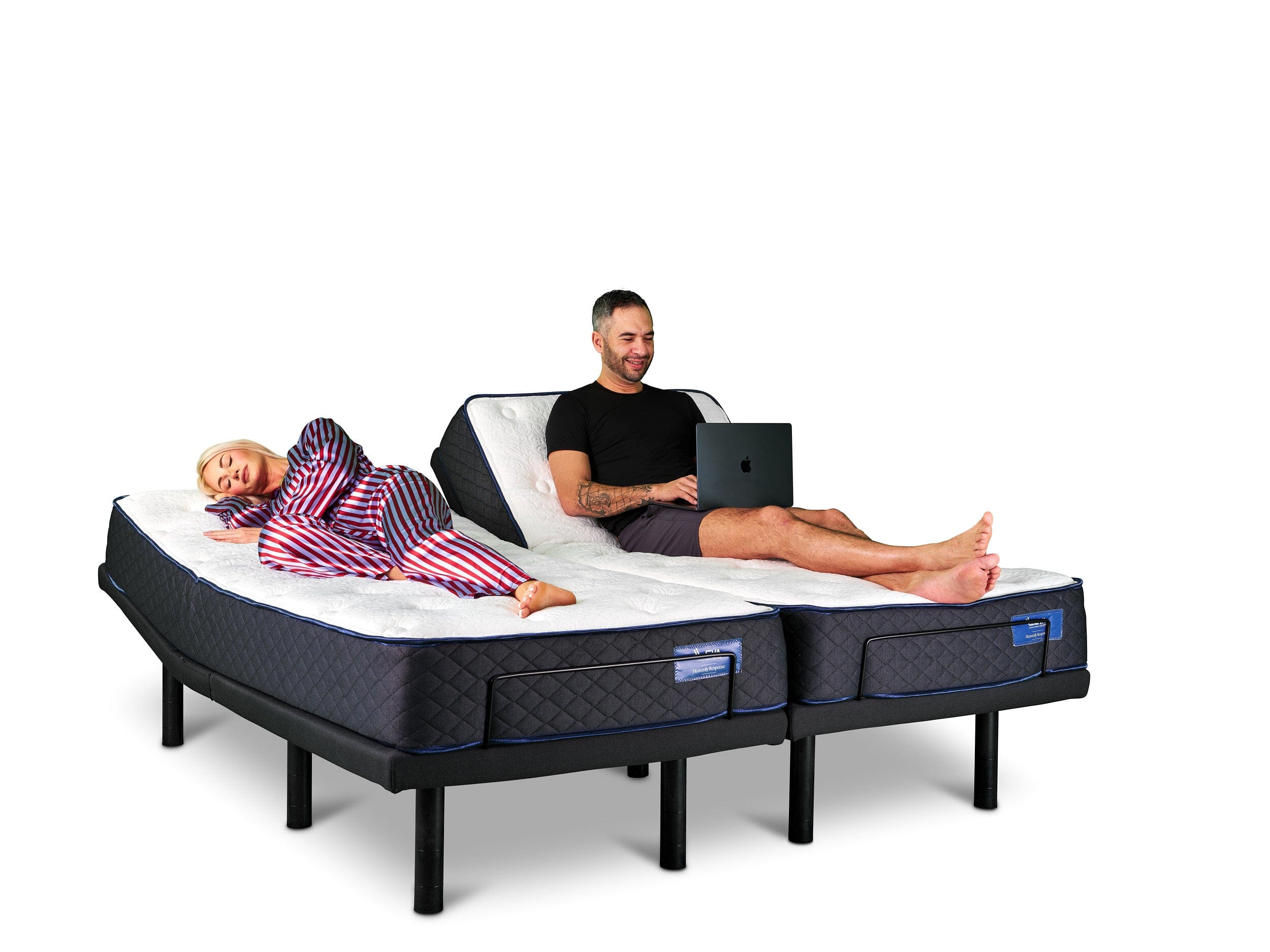
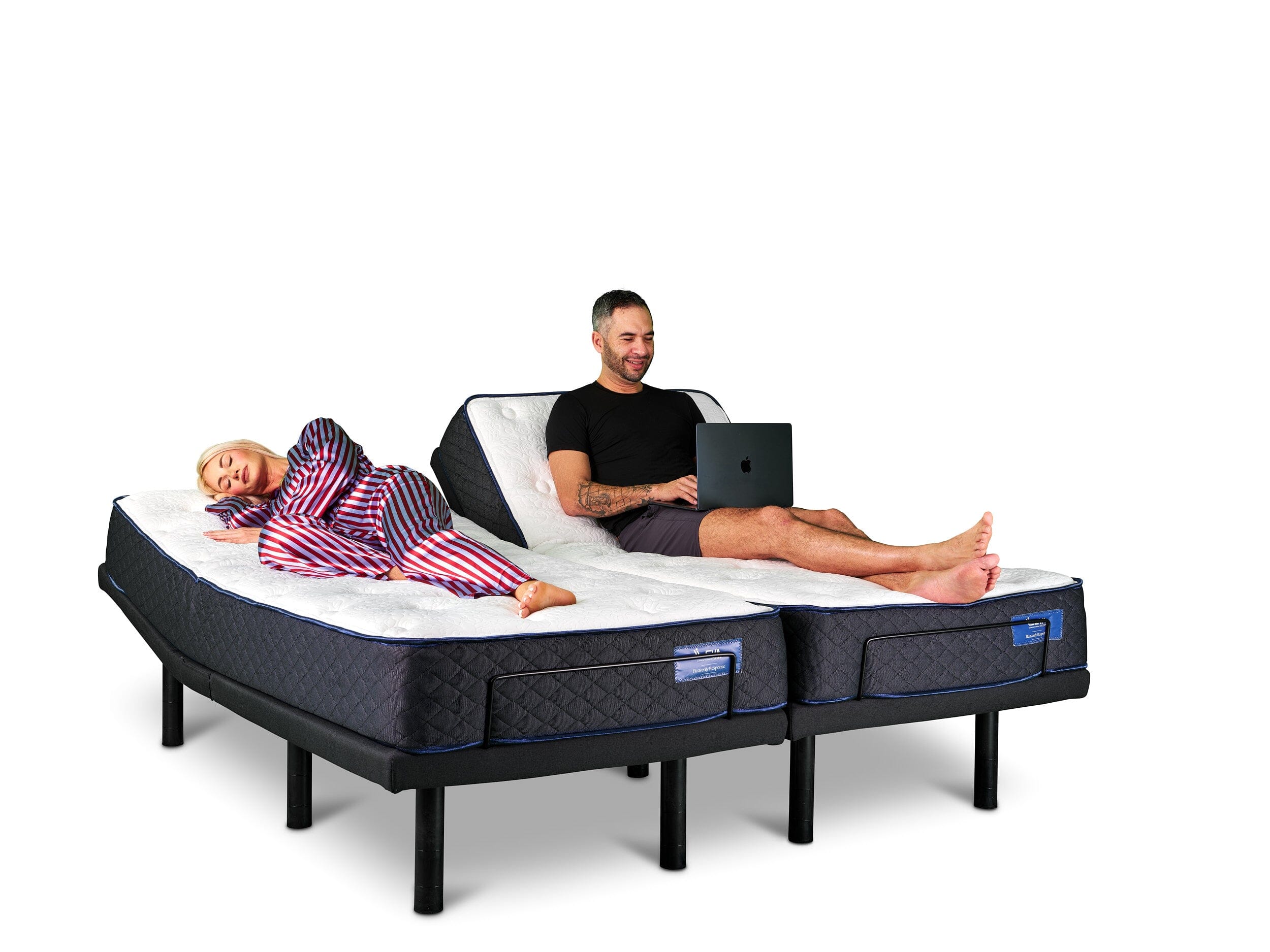
Beyond motion isolation, split systems also address medical needs that a flat mattress cannot. Doctors often recommend elevated sleeping positions for sleep apnea, acid reflux, and post-surgical recovery. These conditions are difficult to manage on a fixed surface. Leva Sleep’s adjustable bases provide precise head and foot elevation per side. One partner can sleep flat while the other sleeps elevated, and neither has to compromise.
Adjustable Beds in Canada, 2025–2026: Market Context
The mattress market in Canada is anticipated to grow at a CAGR of 7.7% from 2026 to 2033, with premium adjustable, cooling, and smart-bed formats driving much of that growth. Canada’s overall home furniture market is projected to grow at a 7.04% CAGR through 2031, with no data supporting an 11.05% rate for the premium segment. This trend reflects a growing willingness among Canadians to pay for app-enabled adjustability and comfort features. Canada’s 65+ cohort is also expanding rapidly through 2030, which increases demand for accessibility upgrades and bedroom furniture that supports aging in place.
Smart mattresses with sleep tracking, temperature control, and adjustable firmness are moving into the mainstream Canadian market. Most general retailers, however, still carry only three to five adjustable base models and treat them as simple add-ons to mattress sales. Leva Sleep takes a different approach. As a vertically integrated specialist with over eight years of experience, $50M in lifetime sales, and more than 25,000 customers, it carries 15–20 adjustable models and designs every component to work together. The base, mattress, and bedding are engineered as a single system. This specialization, combined with direct-to-consumer pricing, typically places Leva 30–50% below comparable Tempur-Pedic and Ghostbed configurations.
How Leva’s Split Adjustable Systems Operate
Each half of a Leva Sleep split system runs independently using whisper-quiet German motors. The core adjustments available per side include:
- Head elevation, which raises the upper body to open airways, reduce acid reflux, or support reading and lounging
- Foot elevation, which lifts the legs to relieve pressure on hips, knees, and the lower back
- Lumbar control, which raises or lowers a reinforcement zone under the lower spine for targeted back support
- Pillow tilt, which makes fine adjustments to head and neck angle independent of full head elevation
- Massage and vibration, with intensity and zone settings per side
- Heating and cooling pad integration, which provides per-side temperature control so one partner can sleep warm while the other sleeps cool
- App control via Bluetooth, which enables custom saved positions, vibrating alarms, and real-time micro-adjustments from a smartphone
Leva Sleep’s anti-snore mode, detailed in the overview above, will automate head adjustments when it arrives in spring 2026. This automation removes the need for a partner to wake up and trigger changes manually.
Who Benefits Most from Split Adjustable Systems
Split adjustable systems from Leva Sleep work best for couples dealing with one or more of these situations:
- Differing firmness preferences, where a split king gives each partner a completely independent mattress surface with separate firmness and zero motion transfer
- Snoring and sleep apnea, where gentle head elevation opens airways without always requiring a CPAP mask, and the 2026 anti-snore automation manages adjustments during sleep
- Hip, knee, or back pain, where independent foot and lumbar elevation lets the affected partner find a therapeutic position without forcing the other into the same angle
- Temperature mismatch, where per-side heating and cooling pads resolve conflicts between partners who sleep hot and cold
- Schedule differences, where vibrating alarms can wake one partner without disturbing the other
- Sleep divorce risk, where couples already sleeping separately, or considering it, want a path back to sharing a bed
Key Size and Feature Decisions Before You Buy
The two primary size configurations Leva Sleep offers are Split King and Split Queen. A split king consists of two Twin XL mattresses (38″ × 80″ each) placed side by side to form a 76″ × 80″ surface. A Split Queen uses two narrower halves to create a standard queen footprint, which suits bedrooms where a king-sized frame would feel crowded.
Additional factors to review before purchasing include:
- Room dimensions, since measuring the bedroom first helps you decide between a Split King and a Split Queen, with the Split Queen offering full independent control in a smaller footprint
- Motor noise, because not all adjustable bases use the same motor quality, and Leva’s whisper-quiet German motors stand apart from basic models at general retailers
- Mattress compatibility, as foam and hybrid pocket-coil mattresses flex well with adjustable bases, while innerspring mattresses with rigid border wires usually do not
- Bedding compatibility, because standard fitted sheets often pop off adjustable bases during elevation, so Leva designs deep-pocket sheets with extra elastic and duvet clips that keep each side in place
- Warranty coverage, since both the base and mattress warranties should clearly cover use with an adjustable platform
- Delivery logistics, because white-glove delivery is available in Ontario and Alberta, and you should confirm service for your postal code before ordering
Trade-offs and Limitations of Split Systems
Split adjustable systems cost more than a basic flat bed or a single non-split adjustable base. Split king total setup costs, which include two mattresses and two adjustable bases, typically range from about $1,400 to $6,000 at full market pricing. Leva Sleep’s direct-to-consumer model lowers that range by about 30–50% compared to Tempur-Pedic and Ghostbed equivalents. Even with that discount, the investment remains higher than a conventional mattress.
Several other trade-offs deserve attention, because they influence day-to-day satisfaction:
- The centre gap, since about 60% of couples find the 2–4 inch gap between two Twin XL mattresses challenging for physical closeness, and a connector strap reduces but does not fully remove this separation
- White-glove delivery fee, because in-home setup, old-bed removal, and product tutorials are available but add an extra charge to the purchase
- App learning curve, as the Leva Sleep app offers extensive customization and requires some initial time to set up saved positions and preferences
- Laundry volume, since split kings use two specialized Twin XL sheet sets, which doubles laundry compared with a single king setup
Setup, Ownership, and Long-Term Planning
Leva Sleep’s in-house white-glove delivery service operates in Ontario and Alberta. Trained delivery professionals bring the system directly to the bedroom, assemble the base and mattress, adjust leg heights to the customer’s preferred bed height, connect and configure the app, provide a full product tutorial, and remove the old bed. The team donates or recycles removed beds where possible. This approach contrasts with “bed in a box” brands that drop components at the front door and leave all assembly to the customer.
For long-term ownership, Leva’s split configuration offers a practical advantage. Split kings allow replacement of only one Twin XL mattress if one side wears faster because of weight differences or usage patterns. This flexibility can extend the effective lifespan of the overall sleep system, since you do not need to replace both sides at the same time.
Common Buying Mistakes to Avoid
- Choosing on price alone, because a lower-cost base with a loud motor or limited elevation range rarely solves the sleep incompatibility issues that drove the purchase
- Ignoring split configurations, since buying a single adjustable base for partners with very different needs usually leaves the core problem unsolved
- Overlooking bedding compatibility, because standard sheets and duvets are not designed for elevated positions, and purpose-built bedding functions as a requirement rather than an upsell
- Assuming all motors are equally quiet, even though motor quality varies widely across brands, so you should ask about decibel ratings or motor origin before buying
- Skipping the size assessment, because ordering a split king for a room that cannot accommodate it comfortably often creates a worse outcome than choosing a well-fitted split queen
2026 Product and Technology Updates
The most significant update on Leva Sleep’s 2026 roadmap is the automated anti-snore mode, scheduled for spring 2026. The system uses sensors embedded in the base to detect snoring and then triggers micro-adjustments to head elevation on the snoring partner’s side. These changes happen automatically during sleep, without requiring either partner to wake up and intervene. This shift moves anti-snore functionality from a reactive feature to a proactive one.
The broader Canadian market supports this direction. Smart mattresses with built-in sensors that monitor heart rate and breathing patterns, plus smartphone apps that analyze sleep, are entering the mainstream. Smart furniture integration and connected home technology adoption are also identified as long-term growth drivers in the Canadian home furniture sector through 2031. Leva Sleep’s 2026 anti-snore automation places it ahead of that curve within the adjustable bed category.
Frequently Asked Questions
What is the difference between a Split King and a Split Queen adjustable bed?
A Split King uses the two-Twin-XL configuration described earlier, creating a total surface of 76″ × 80″ with two independent adjustable bases inside a shared king-sized frame. A Split Queen uses two narrower halves to form a standard queen footprint, which suits bedrooms where a full king-sized frame would not fit comfortably. Both configurations provide fully independent elevation, firmness, massage, and temperature control per side. The Split Queen remains relatively rare in Canada, and Leva Sleep is one of the few specialists that builds it to customer specifications.
Can a split adjustable bed help with snoring and sleep apnea?
Elevating the head of the bed gently opens the airway, which can reduce or eliminate snoring and ease mild obstructive sleep apnea symptoms without always requiring a CPAP mask. On a split adjustable system, only the snoring partner’s side needs elevation, so the other partner can stay flat. Leva Sleep’s anti-snore mode, arriving in spring 2026, adds automation by using sensors to detect snoring and trigger micro-adjustments to head elevation on the affected side during sleep. These changes occur without waking either partner. For diagnosed sleep apnea, consult a physician, as some sleep clinics refer patients to Leva Sleep as a complementary or alternative solution for mild cases.
Is a split adjustable bed worth the cost compared to a regular mattress?
Value depends on how severe the sleep incompatibility has become. When one or both partners experience snoring, pain that requires elevated positioning, very different firmness preferences, or temperature conflicts, a flat mattress cannot resolve the underlying problem, no matter its quality. The ongoing cost of disrupted sleep in health, relationship quality, and productivity often exceeds the price premium of a split system over time. Leva Sleep’s direct-to-consumer model reduces that premium by about 30–50% compared to Tempur-Pedic and Ghostbed equivalents. A Split Queen configuration lowers the entry cost further for couples who do not need a full king footprint.
What bedding works with a split adjustable bed?
Standard fitted sheets are not built for the range of motion an adjustable base creates and usually pull off the corners during elevation. Leva Sleep designs fitted sheets with deep pockets and reinforced elastic specifically for adjustable bases. For couples using different elevation settings at the same time, Leva also offers duvet clips that keep separate duvets in place and prevent sliding when the two sides sit at different angles. Purpose-built bedding functions as a requirement for a split adjustable system. Standard bedding tends to degrade the experience regardless of base quality.
Does Leva Sleep deliver and set up adjustable beds in Ontario and Alberta?
Yes. The white-glove delivery service described in the Setup section is available in Ontario and Alberta for a fee. Unlike third-party services used by some competitors, Leva’s delivery team trains specifically on its own products, so setup and configuration follow the system’s technical requirements.
Conclusion: Choosing a Split Adjustable System with Confidence
For Canadian couples in Ontario and Alberta dealing with snoring, pain, differing firmness preferences, temperature conflicts, or the risk of sleep divorce, a split adjustable system addresses structural problems that a flat mattress cannot. Split King configurations offer the largest independent sleep surface. Split Queen systems deliver the same independent-control functionality in a more space-conscious footprint. Leva Sleep’s whisper-quiet German motors, per-side heating and cooling, app integration, purpose-built bedding, and upcoming 2026 anti-snore automation combine into a complete sleep system rather than a simple base. The direct-to-consumer model keeps pricing about 30–50% below comparable luxury competitors, and in-house white-glove delivery covers everything from assembly to old-bed removal.
Couples comparing options can review Leva Sleep’s full range of Split Queen and Split King adjustable bed packages, including current pricing and available configurations, at the link below.