Written by: Matthew Timmins, Founder and Managing Director, Leva Sleep | Last updated: July 12, 2026
Key Takeaways for Couples Using Sleep Trackers
- Modern sleep trackers measure total sleep time within about 30 minutes of clinical standards and detect sleep versus wake with over 90% sensitivity, but they only reach 50–86% accuracy for sleep stage classification.
- Partner movement and snoring in shared beds interfere with biometric signals, which causes trackers to misclassify sleep stages and inflate restlessness scores for both individuals.
- No consumer sleep tracker is validated for shared-bed use, so accuracy figures apply only to single-occupancy conditions, and under-mattress sensors also lose reliability when two people share the same surface.
- Split adjustable bases with independent elevation and anti-snore modes physically reduce motion transfer and snoring, which improves both sleep quality and the reliability of tracker data.
- Leva Sleep’s Split Queen and Split King adjustable bases address the root causes of partner-induced sleep disruption at 30–50% below comparable luxury competitors. Shop Leva Sleep’s adjustable beds to turn your tracker data into better rest.
The Core Problem: Sleep Tracking Accuracy in Shared Beds
Consumer sleep trackers infer sleep stages from accelerometer movement and optical heart-rate signals instead of brain-wave measurement. Many consumer devices show high accuracy for sleep duration but lower accuracy for sleep stages, and that ceiling drops further in shared beds. A 2024 State of the Science review by de Zambotti et al. (Sleep, 2024) highlights limitations in wearable accuracy metrics, with validation studies conducted almost exclusively on single-occupancy users.
How a Bed Partner Changes Your Tracker Readings
Sleeping with a partner measurably degrades tracker accuracy. Partner movement and snoring interfere with biometric signals including HRV, movement, and breathing rate, which can distort individual sleep phase determination. In practical terms, a partner’s toss at 2 a.m. can register as the other person’s movement event, inflate restlessness scores, and misclassify light sleep as wakefulness or the reverse. Dual tracking in couples often shows one partner’s restlessness scores rising in step with the other partner’s movements, which points to motion transfer issues in shared mattresses.
Couples Action:
- Track simultaneously for at least two weeks and compare restlessness timestamps. Correlated spikes indicate motion transfer rather than individual sleep disorders.
- Once tracking confirms motion transfer as the main issue, independent elevation on a split adjustable base physically isolates each side of the bed, which reduces the motion transfer that corrupts tracker data. Shop Leva Sleep’s adjustable beds to address the disturbances your tracker can only flag.
The Device Question: Comparing Sleep Tracker Types
As established earlier, no consumer device is validated for shared-bed use. Accuracy varies by sensor type, and the figures below apply to single-occupancy conditions unless otherwise noted. Use these benchmarks as a reference before purchasing.
| Tracker Type | Sleep/Wake Accuracy | Sleep Stage Accuracy | Shared-Bed Limitation |
|---|---|---|---|
| Wrist wearable (e.g., Oura Ring Gen 3) | Oura Ring Gen 3 with OSSA 2.0 achieves 64% four-stage PSG agreement | 50–86% depending on stage | Partner movement distorts HRV and movement signals, and the device is not validated for shared-bed use |
| Under-mattress sensor | Reported sleep-wake accuracy in a 2025 validation study | Person-specific staging unreliable when partners have different movement patterns (see prose below) | Operates best in single-occupancy beds, and partner presence causes data interference |
Under-mattress sensors can have lower specificity for wake detection, which may cause overestimation of total sleep time. These sensors enable passive whole-bed trend monitoring without wearables, but person-specific staging becomes less reliable when partners have different movement patterns or sleep schedules. Software cannot fully solve this gap when two bodies share the same sleep surface.
Couples Action:
- When evaluating a tracker, prioritize total-sleep-time accuracy over sleep-stage scores, because stage data is the least reliable metric in a shared bed.
- Use tracker data to spot patterns such as chronic low sleep efficiency or frequent movement spikes, rather than treating individual stage percentages as clinical fact.
The Practical Fix: Split Adjustable Bases That Respond to Data
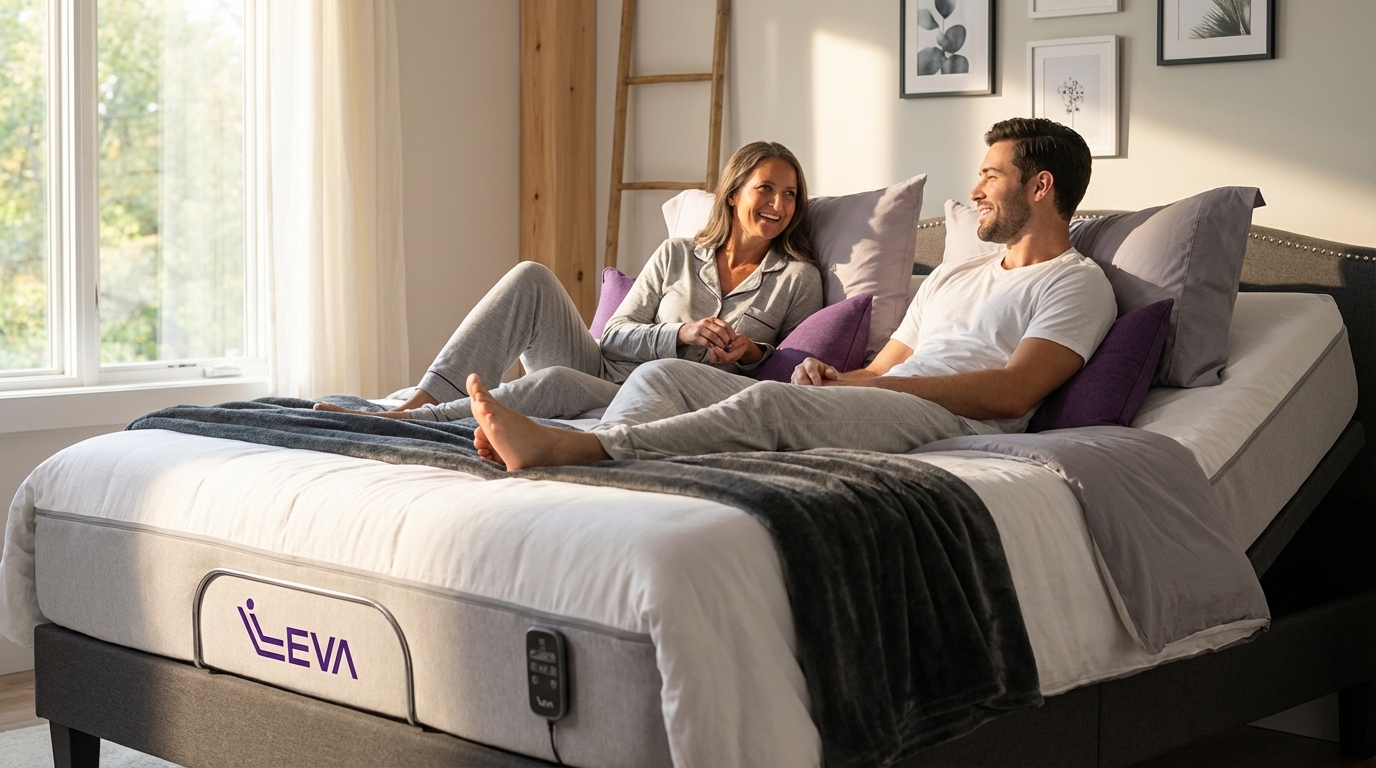
Trackers highlight problems, and adjustable bases help resolve them. Leva Sleep’s Split Queen and Split King bases give each partner independent control over head and foot elevation, which addresses two common sources of partner-induced tracker distortion: motion transfer and snoring.
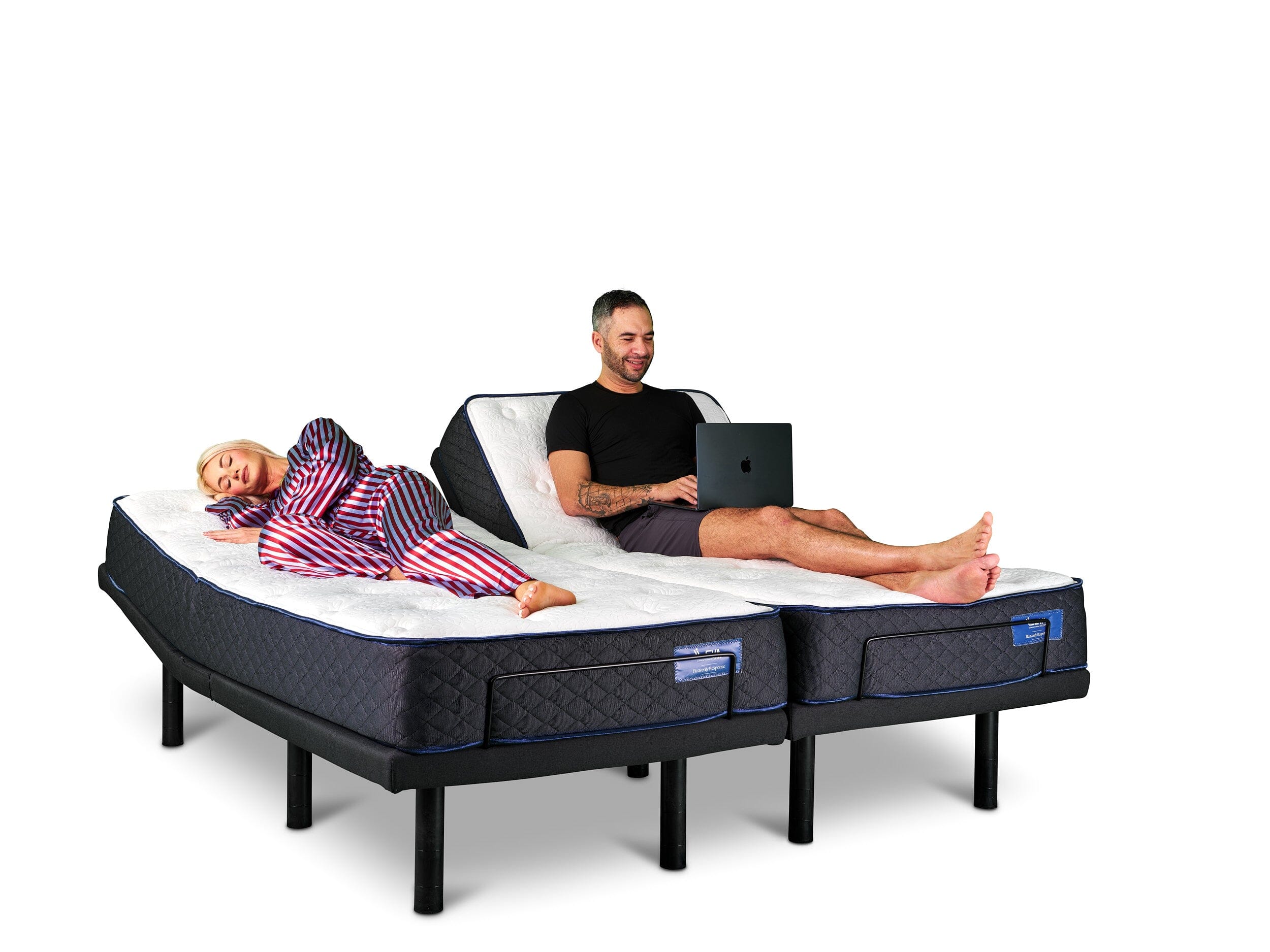
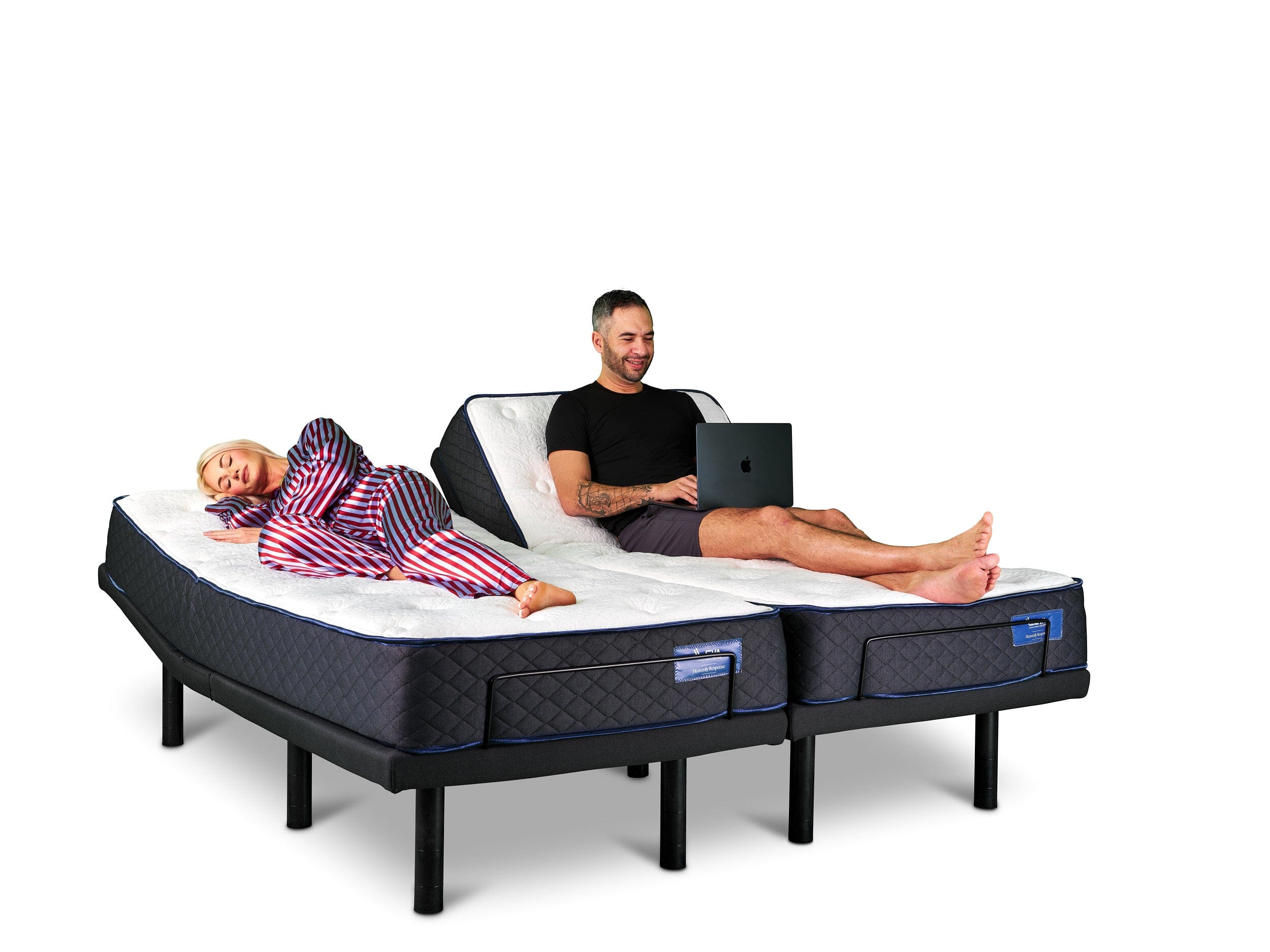
Independent Elevation. When one partner elevates their head to reduce acid reflux or open airways, the other side stays flat, which mechanically isolates motion from position changes. This isolation directly reduces the cross-contamination of movement signals that causes trackers to misattribute restlessness, as noted earlier. Because Leva’s bases use whisper-quiet German motors, adjustments during the night avoid the mechanical noise that can wake a partner and create a second disturbance event in tracker data.
Couples Action:
- If tracker data shows one partner with consistently high restlessness scores and the other with normal scores, independent elevation becomes the targeted intervention, not a new wearable.
- Shop Leva Sleep’s adjustable beds and compare Split Queen and Split King configurations for your room size.
Anti-Snore Mode. Leva Sleep’s anti-snore mode detects snoring and makes micro-adjustments to the head of the bed to reduce airway obstruction by slightly opening the airway. Some consumer sleep trackers detect snoring and allow users to compare snoring event timing against the bed partner’s restlessness scores to quantify disturbance impact, but they cannot act on that data. A split adjustable base closes that loop by responding to the disturbance instead of only recording it.
Couples Action:
- Cross-reference snoring timestamps from a tracker with the non-snoring partner’s restlessness spikes. When correlation is high, anti-snore elevation becomes the evidence-based next step.
Decision Guide: Matching Tracker Type and Bed Setup to Your Complaint
This framework helps couples weigh options based on their primary sleep complaint rather than device marketing claims.
- Primary complaint: inaccurate total sleep time. Many consumer sleep trackers measure total sleep time with reasonable accuracy compared to polysomnography, so a flat bed usually is not the limiting factor.
- Primary complaint: one partner’s movement waking the other. Tracker type becomes secondary. A split adjustable base with independent elevation removes the mechanical cause, and tracker data can then confirm improvement after purchase.
- Primary complaint: snoring disrupting the non-snoring partner’s sleep stages. A wearable on the non-snoring partner combined with a split base featuring anti-snore mode provides both measurement and a direct intervention.
- Primary complaint: differing firmness or temperature preferences inflating restlessness scores. An under-mattress sensor cannot solve this, while independent comfort zones on a split base can. Leva Sleep’s system supports individual temperature regulation accessories alongside independent elevation.
- Primary complaint: anxiety over tracker data (orthosomnia). Researchers at Rush University Medical Center and Northwestern University introduced the term orthosomnia in a 2017 case-report paper describing patients whose sleep-tracker data caused anxiety and insomnia. Reducing partner-induced disturbances through a split base can improve actual sleep quality, even when the tracker still shows imperfect numbers.
Shop Leva Sleep’s adjustable beds to find the split configuration that matches your complaint profile.
Cost-Benefit for Couples: Trackers vs Split Adjustable Bases
Couples often compare the cost of a new tracker with the cost of a new bed system. A tracker upgrade improves measurement precision, but it does not change the physical causes of partner-induced disruption such as motion transfer and snoring. A split adjustable base takes a different approach by reducing disturbances at their source, which improves both sleep quality and the reliability of tracker data over time.
The 30–50% savings mentioned earlier come from Leva Sleep’s direct-to-consumer model, which uses local design, in-house assembly, and no retail middlemen. White-glove delivery includes bedroom setup, leg-height adjustment, product tutorial, and removal of the existing bed. For couples considering brands like Tempur-Pedic mainly for adjustable base features, Leva Sleep offers equivalent or superior adjustability with deeper specialization, with 15–20 adjustable models compared to the 3–5 typically found at general mattress retailers.
Frequently Asked Questions
Can a sleep tracker accurately tell which partner is causing sleep disruptions in a shared bed?
Not reliably. Consumer sleep trackers infer sleep stages from movement and heart rate, and in a shared bed those signals are contaminated by the other partner’s movements. When both partners track simultaneously, correlated restlessness spikes can suggest motion transfer, but the tracker cannot isolate which body generated the original movement. Dual tracking over two or more weeks provides the clearest picture, and couples should treat the data as directional rather than diagnostic.
Is a Split Queen or Split King adjustable base suitable for couples with very different sleep schedules?
Yes. Independent controls allow one partner to adjust elevation, activate massage, or set a vibrating alarm without affecting the other side. Leva Sleep’s app-based controls let each partner save custom sleep positions and make adjustments from their side of the bed. Whisper-quiet German motors help avoid waking a sleeping partner during adjustments, which matters when schedules differ by an hour or more.
Should couples with suspected sleep apnea rely on a consumer tracker for diagnosis?
No. Consumer trackers do not function as diagnostic tools for sleep apnea. The Apple Watch sleep apnea screening feature, for example, demonstrated 98.5% specificity but only 66.3% sensitivity in clinical trials, which means it misses a meaningful proportion of cases. A formal sleep study or polysomnography referral from a physician remains the appropriate diagnostic pathway. Leva Sleep’s adjustable bases, which gently elevate the head to help open airways, are used by customers referred by sleep apnea clinics as a complementary comfort measure, not a medical replacement for CPAP therapy.
Will an adjustable base interfere with an under-mattress sleep tracker?
It depends on the sensor and its placement. Under-mattress sensors that rely on ballistocardiography to detect heart rate and breathing can be affected by the mechanical components of an adjustable base frame. Couples should confirm compatibility with the tracker manufacturer before purchasing. Wrist-worn wearables are unaffected by the base type. Leva Sleep’s team can advise on compatible mattress and accessory configurations during the consultation and setup process.
What mattress types work with Leva Sleep’s split adjustable bases?
Leva Sleep designs and sells mattresses engineered to flex with adjustable bases, available in all-foam and hybrid pocket-coil configurations. The company also partners with brands including Tempur-Pedic, Simmons, Beautyrest, Serta, and Kingsdown. Mattresses must be flexible enough to accommodate head and foot elevation without damaging internal components, so standard innerspring mattresses with rigid borders are generally not compatible. Leva’s specialists can confirm compatibility during the purchase process.
Conclusion: Turning Shared-Bed Data into Better Sleep
Modern sleep trackers deliver reliable total-sleep-time data and useful trend information, but their accuracy for individual sleep stage classification in shared beds remains limited by a core problem. They cannot fully separate one partner’s biometric signals from the other’s. Partner movement, snoring, and differing sleep schedules corrupt the very metrics couples most want to understand. The 2025 World Sleep Society Sleep Tracker Task Force and multiple 2024 validation studies confirm that shared-bed scenarios remain an unaddressed gap in consumer tracker validation.
The practical response usually is not a more expensive tracker. A better approach is a sleep environment that reduces the physical disturbances trackers can only measure. Leva Sleep’s Split Queen and Split King adjustable bases provide independent elevation, anti-snore micro-adjustments, and individual comfort controls that address the root causes of partner-induced sleep disruption at 30–50% below comparable luxury competitors, with white-glove delivery and setup included.
Shop Leva Sleep’s adjustable beds and configure the split base that turns your tracker data into genuinely better sleep.