Written by: Matthew Timmins, Founder and Managing Director, Leva Sleep | Last updated: July 6, 2026
Key Takeaways
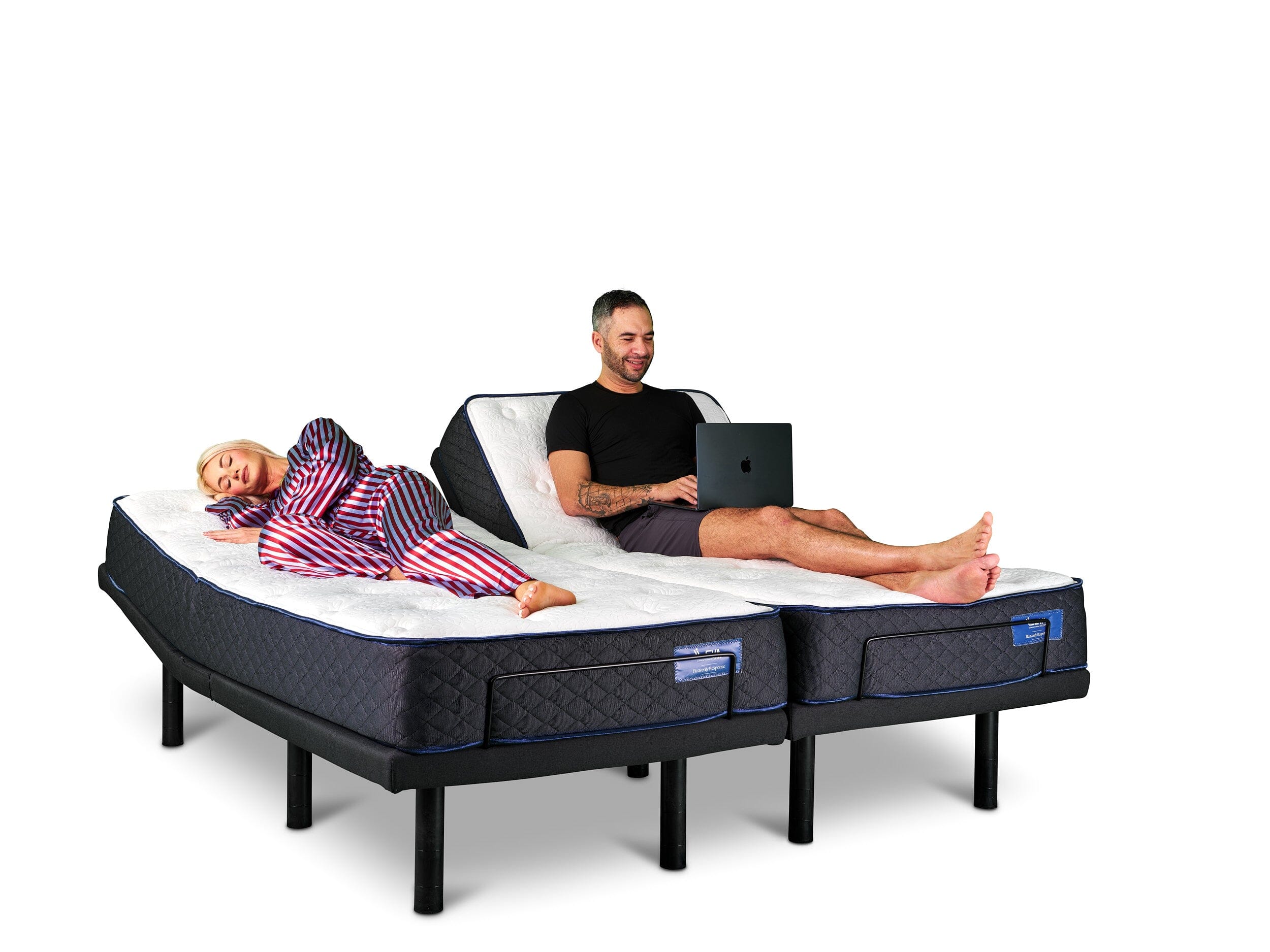
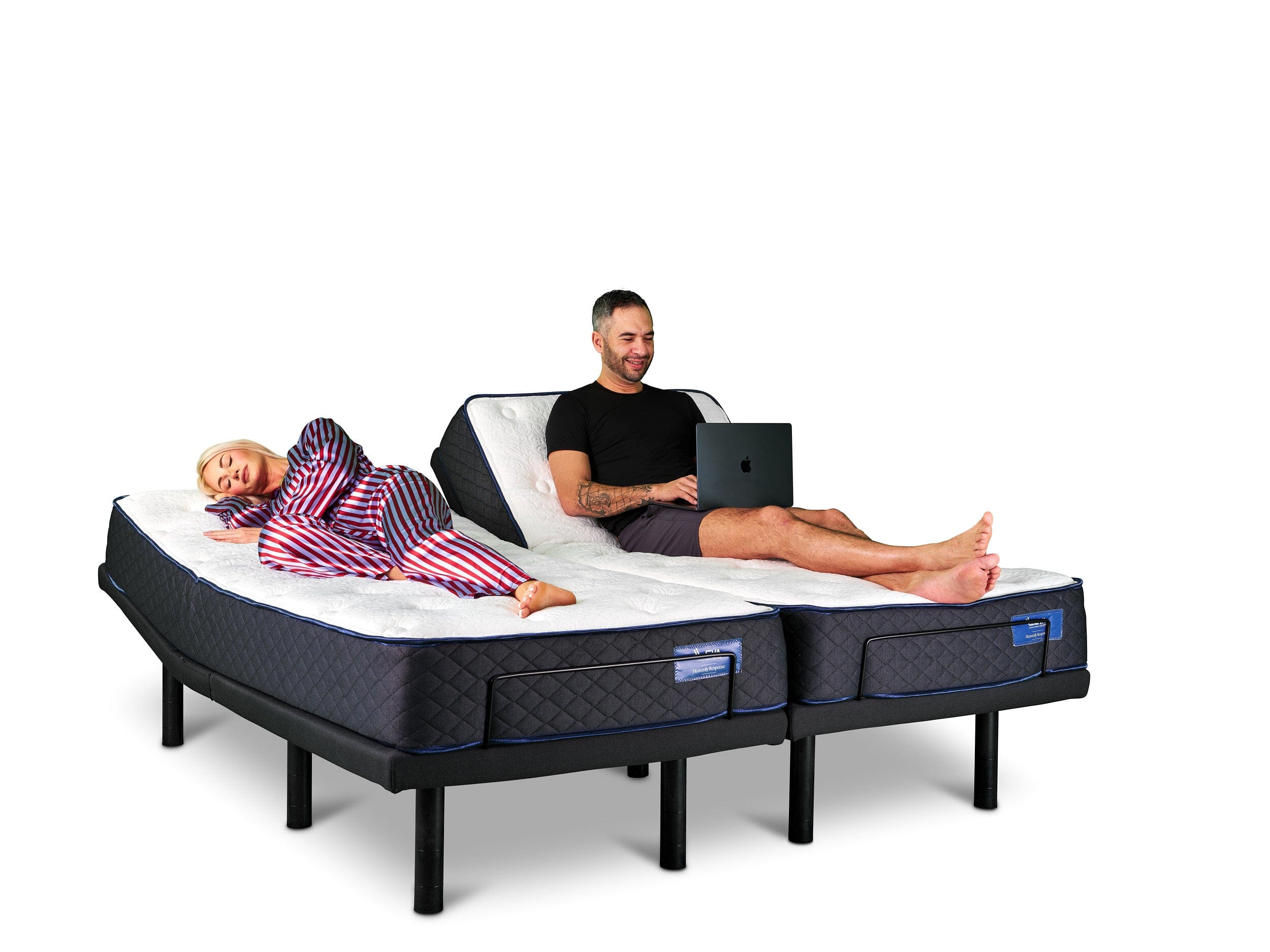
- Independent controls on split adjustable bases let each partner adjust head and foot elevation separately, so no one has to compromise on sleep position.
- Quiet motors rated below 45 dB help one partner reposition without waking the other, which makes motor noise a critical factor for couples.
- Anti-snore and zero-gravity presets, when programmable per side, give targeted relief for snoring and spinal pressure while the other partner stays comfortable.
- Foam, latex, and pocketed-coil hybrid mattresses flex properly on adjustable bases, and a 600 lb or higher weight capacity per base protects motor life for couples.
- Leva Sleep offers purpose-built Split Queen and Split King packages with quiet motors, independent controls, and compatible mattresses—explore Leva’s complete split base packages for Ontario and Alberta delivery.
Quick-Read Feature Checklist for Couples
- Independent controls: Each partner adjusts head and foot elevation without moving the other side. Confirm the base offers fully separate app or remote operation per side, not just a shared preset system.
- Quiet motors: Quality adjustable bases operate at 35–50 dB during adjustment, quieter than normal conversation, so one partner repositioning does not wake the other. Ask for the rated decibel range before purchasing.
- Anti-snore and zero-gravity positions: Head elevation of 10–20 degrees reduces snoring. Zero-gravity raises the head 30–45 degrees with knees above heart level to relieve spinal pressure. Verify both presets are programmable per side.
- Mattress compatibility and weight capacity: Foam, latex, and pocketed-coil hybrid mattresses flex properly on adjustable bases. Confirm the base is rated for 600 lb or more for couples.
- Specialized bedding accessories: Split bases work best with fitted sheets that have deep pockets and extra elastic, duvet clips, and remote pockets. Ask whether the retailer designs these accessories specifically for adjustable bases or relies on generic alternatives.
Split King vs Split Queen in Canadian Bedrooms
A Split King uses two Twin XL bases and mattresses placed side by side, creating the same 76″ × 80″ footprint as a standard King. Each Twin XL unit moves independently, and Split King adjustable bed halves can shift apart during normal use unless secured by a containing bed frame, connector straps, or similar stabilizers. A Split Queen at 60″ × 80″ offers the same independent-control benefit in a narrower footprint. This size works well in Ontario and Alberta bedrooms where a King frame cannot fit through standard doorways or around tight stairwell corners.
Each half of a Split King measures roughly half a standard King, which simplifies delivery through narrow hallways, an advantage in older Toronto or Edmonton homes. A Split Queen provides similar delivery ease with a smaller overall width. Leva Sleep specializes in Split Queen adjustable bases, a configuration that general mattress retailers rarely stock.

| Configuration | Dimensions | Typical 2026 Canadian Price Range (bases only) | Delivery Considerations (Ontario & Alberta) |
|---|---|---|---|
| Split Queen (2 × bases) | 60″ × 80″ combined | $1,200–$2,200 CAD total | Narrower profile, fits most standard doorways, white-glove available from specialists |
| Split King (2 × Twin XL bases) | 76″ × 80″ combined | $1,400–$2,400 CAD total | Wider footprint, each half still navigates doorways independently, white-glove recommended for setup |
Mattress costs sit on top of base pricing. Total Split King ownership, including two mattresses and two bases, ranges from $2,000 to $6,000 CAD depending on mattress tier. Evaluate total cost of ownership, not base price alone, before choosing a configuration.
Compare Split Queen and Split King options at Leva Sleep — with in-house white-glove delivery across Ontario and Alberta.
Independent Controls and Custom Presets for Each Partner
Independent controls remove the usual couples’ compromise, so one partner can sit upright to read while the other lies flat. In 2026, app-based control adds precise adjustments that older wired remotes cannot match. Leva Sleep’s app lets each partner save custom elevation presets, set vibrating alarms that do not disturb the other side, and access anti-snore micro-adjustment modes.
Snore-response technology that automatically detects snoring and gently raises the head now appears on premium bases, and Leva Sleep’s anti-snore mode offers comparable functionality. When evaluating a base, confirm that app control operates each side independently and that preset positions save to individual user profiles rather than sharing across both sides.
Quiet Motors and Wall-Hugger Comfort
Independent controls only feel truly useful when one partner can adjust without waking the other, so motor noise becomes a key comfort factor. Motor noise is the most consistent factor affecting long-term satisfaction with adjustable bases for couples. Modern DC motors in adjustable bases produce approximately 30–45 dB during movement, comparable to a quiet conversation, and the sound lasts only a few seconds while the bed repositions.
By contrast, budget bases can reach 50–60 dB, and motor noise tends to increase as components wear. Leva Sleep uses whisper-quiet German motors from Okin and Richmat, which industry experts identify as a benchmark for quiet operation and longevity.
Wall-hugger technology slides the mattress forward as the head raises, keeping the sleeping surface close to the nightstand instead of pulling away. For Ontario and Alberta bedrooms where nightstands sit flush against the bed, this mechanism preserves access to water, glasses, and phones without moving furniture. When evaluating a base, ask whether the wall-hugger mechanism comes standard or appears only on an upgrade tier, and request a live demonstration of the slide distance at maximum head elevation.
Anti-Snore and Zero-Gravity Relief
ResMed’s fifth annual Global Sleep Survey (2025) of 30,026 people across 13 markets found that 18% of couples reported sleeping in separate rooms due to snoring and restlessness. Sleeping flat on the back causes throat tissue to relax and block the airway, while elevating the head four inches or more encourages the tongue and jaw forward and opens the airway.
A pilot study found snoring stopped in 22% of interventions at 10 degrees of head elevation and in 67% at 20 degrees, with no reduction in subjective sleep quality. A separate study of 52 patients found that 7.5 degrees of head-of-bed elevation reduced the apnea-hypopnea index by 31.8%. Zero-gravity position, with the head at 30–45 degrees and knees elevated above heart level, further reduces spinal pressure and improves circulation.
On a split base, the snoring partner can use anti-snore elevation while the other remains flat, and neither side needs to be disturbed. Confirm that both anti-snore and zero-gravity presets are programmable independently per side before purchasing.
Mattress Compatibility and Weight Capacity for Couples
Mattress construction determines whether it can flex safely on an adjustable base. Foam, latex, and pocketed-coil hybrid mattresses are compatible with adjustable bases in Canada, while traditional innerspring mattresses with interconnected coils cannot flex repeatedly without damage. Leva Sleep designs its all-foam and hybrid pocket-coil mattresses specifically for use with its adjustable bases, which removes compatibility guesswork.
Weight capacity needs careful calculation. A base’s rated capacity must cover the combined weight of both sleepers, the mattress, which a queen hybrid typically weighs at 80–120 lbs, and 15–25 lbs of bedding. Motors in adjustable bases can last 8–15 years with normal use, though lifespan varies based on load and how close to capacity they operate. Motor replacement costs $300–$600 and is typically not covered under warranty if the stated weight capacity was exceeded.
For couples, a base rated at 600–850 lbs usually falls in the right range. Ask for the per-base weight rating on split configurations, not just the combined figure.
View Leva’s couples-rated bases and compatible mattresses — with transparent weight capacity specifications.
Specialized Bedding Accessories for Split Bases
Sheet slippage ranks among the most common frustrations on Canadian sleep forums for split adjustable base owners. Standard fitted sheets are not designed for the range of motion an adjustable base produces, so they often pull free at the corners during elevation. Split King configurations require sheet sets that include two Twin XL fitted sheets plus one King-sized flat sheet to accommodate independent movement of each side.
Leva Sleep designs fitted sheets with deep pockets and extra elastic, duvet clips that maintain separation when bed positions differ, and remote pockets integrated into the bedding. When evaluating a retailer, ask whether their bedding accessories are designed specifically for adjustable bases or adapted from standard sets. This difference shows up clearly in how long sheets stay in place at full elevation.
Canadian Pricing and Delivery for Adjustable Bases
Adjustable base pricing in Canada depends on motor system, frame construction, control system, and extra features. For couples who want independent controls, quiet motors, and anti-snore presets, the realistic 2026 range is $800–$2,000+ CAD per base, and split configurations require two units. Premium bases often use higher-quality motors, which provide quieter operation and better durability.
Leva Sleep’s direct-to-consumer model delivers comparable premium features at 30–50% less than top-tier competitors by removing retail markup. White-glove delivery, which includes bedroom delivery, full assembly, leg-height adjustment, a product tutorial, and old-bed removal, is available from Leva Sleep for Ontario and Alberta customers for a fee. This service deserves a place in total cost comparisons against brands that offer curbside or self-assembly delivery only.
Common Mistakes to Avoid with Split Adjustable Bases
Underestimating motor noise: Audible noise during every position adjustment causes couples to underuse the base and disturbs partners. To avoid this outcome, request the rated dB figure and read verified reviews that mention motor noise before purchasing.
Ignoring sheet slippage: Buying a split base without purpose-built bedding accessories often leads to sheets pulling free every night. Budget for compatible fitted sheets, duvet clips, and remote pockets as part of the initial purchase, not as an afterthought.
Underestimating total ownership cost: The base price represents only one component. Add two compatible mattresses, split-configuration bedding, white-glove delivery, and a realistic assessment of motor longevity under actual load. Quality adjustable bases typically last 8–15 years with normal use, which changes the true cost-per-year calculation in a meaningful way.
FAQ
What is the best bed setup for couples with different sleep preferences in Canada?
A split adjustable base, either Split Queen or Split King, with fully independent controls per side works best for couples with differing preferences. Each partner controls their own head and foot elevation, firmness when paired with compatible mattresses, and preset positions such as zero-gravity or anti-snore. In Canada, Split Queen configurations suit smaller bedrooms and are a specialty offering from retailers like Leva Sleep, while Split King configurations suit standard king-sized rooms. Both setups require compatible foam or pocketed-coil hybrid mattresses and purpose-built split bedding accessories.
What are the downsides of adjustable beds for couples?
The main downsides involve cost, bedding complexity, and motor noise on lower-quality bases. Split configurations require two bases and two mattresses, which raises total ownership cost compared to a single flat bed. Standard bedding does not fit properly on adjustable bases, so purpose-built sheets with extra elastic and duvet clips become necessary. Budget bases can produce 50–60 dB of motor noise during adjustment, which can disturb a light sleeper.
These downsides are largely reduced by choosing a base with German-engineered motors rated below 45 dB, purchasing bedding designed specifically for adjustable bases, and calculating total ownership cost, including mattresses and delivery, before comparing price points.
Does head elevation on an adjustable base actually reduce snoring?
Clinical evidence supports head elevation as an effective positional intervention for snoring and mild obstructive sleep apnea. As noted earlier, a study of 52 patients recorded a 31.8% reduction in the apnea-hypopnea index at just 7.5 degrees of head-of-bed elevation. A separate pilot study found snoring stopped in 67% of interventions at 20 degrees of elevation.
Most people find relief at 10–15 degrees, with 12 degrees often recommended as a balance between effectiveness and all-night comfort. Head elevation does not replace CPAP therapy in moderate to severe sleep apnea cases, but for positional snoring it offers a clinically supported, non-invasive option that a split adjustable base provides without disturbing the non-snoring partner.
Are adjustable bed bases covered by health insurance in Canada?
Adjustable bed bases are generally not covered by provincial health insurance plans in Ontario or Alberta for standard residential use. Some extended health benefit plans or medical expense tax credits may apply if a base is prescribed for a documented medical condition such as sleep apnea, severe acid reflux, or post-surgical recovery, but coverage varies by plan and requires documentation from a physician or specialist. Consulting a benefits administrator or tax professional is advisable before assuming coverage. Leva Sleep’s team can provide product specifications that may support a medical necessity claim where applicable.
How do I know if my current mattress is compatible with an adjustable base?
Mattress compatibility depends on construction type. Foam mattresses, including memory foam and latex, are the most flexible and work well across the full elevation range of adjustable bases. Hybrid mattresses with individually pocketed coils are compatible but may not reach the same maximum incline as all-foam models. Traditional innerspring mattresses with interconnected coil systems are not compatible and will be damaged by repeated flexing.
Mattress height also matters. Most adjustable bases accommodate mattresses up to 14 inches tall, though this varies by model. If you plan to purchase a new mattress alongside a base, choosing one designed specifically for adjustable bases, as Leva Sleep’s mattresses are, removes compatibility risk entirely.
Conclusion: Choosing a Split Adjustable Base in Canada
Canadian couples evaluating adjustable bed bases in 2026 can follow a clear decision framework. Prioritize independent controls with app-based presets, confirm motors are rated below 45 dB, verify that anti-snore and zero-gravity positions are programmable per side, calculate total weight capacity against actual load, and budget for purpose-built split bedding from the start. Compare Split Queen and Split King configurations against your bedroom dimensions and total ownership budget, not base price alone.
Before finalizing any purchase, review local delivery policies, white-glove setup availability, and warranty terms across Ontario and Alberta retailers. Find your ideal split base package at Leva Sleep — Split Queen and Split King options with quiet German motors, anti-snore technology, compatible mattresses, and in-house white-glove delivery across Ontario and Alberta.