Written by: Matthew Timmins, Founder and Managing Director, Leva Sleep | Last updated: June 16, 2026
Key Takeaways for Couples Dealing With Snoring
- Split adjustable beds let each partner choose a different head-elevation angle, which reduces snoring without disturbing the other sleeper.
- Independent Okin motors and low-noise technology keep adjustments quiet so position changes do not wake your partner.
- Anti-snore presets and automatic detection gently raise the head 10–30 degrees to help keep airways open while you sleep.
- White-glove delivery, mattress compatibility, and Canadian pricing make split systems realistic for couples across Ontario and Alberta.
- Explore Leva Sleep’s full range of adjustable bed packages designed specifically for Canadian couples who share a bed.
The Problem: Snoring, Sleep Disorders, and Strain on Canadian Couples
Snoring rarely affects only one person. When one partner snores, the other loses sleep, and over months or years that lost sleep compounds into fatigue, irritability, and relationship strain. Many couples in their 40s and 50s reach a tipping point where one person relocates to a spare room. This pattern, commonly called sleep divorce, resolves the immediate noise problem but introduces new ones such as reduced intimacy, disrupted routines, and the unmet medical need of the person who snores.
Physicians frequently recommend head elevation for obstructive sleep apnea, acid reflux, and post-surgical recovery. A flat mattress cannot support that recommendation in a consistent way. A standard pillow stack shifts the neck forward rather than raising the entire upper body, which can worsen airway restriction rather than relieve it. Couples navigating these realities need a structural solution, not a temporary workaround.
Why Common Sleep Setups Fail Snoring Couples
Before looking at split adjustable systems, it helps to see why couples usually try other options first and then give up on them. Each common solution addresses part of the problem while leaving a significant gap.
| Solution Type | Snoring Relief | Independent Partner Control | Key Limitation |
|---|---|---|---|
| Flat bed | None | No | No elevation possible, no adjustability |
| Single adjustable base | Partial | No | Forces both partners into the same head-elevation angle, unsuitable when only one person requires anti-snore positioning |
| CPAP machine | High (when tolerated) | N/A | Mask discomfort, noise, and low long-term adherence, does not address partner’s sleep quality |
| Bed-in-a-box | None | No | Flat foam construction, no elevation, self-assembly, no white-glove setup |
Beyond these fundamental limitations, motor noise creates a separate concern with older or entry-level adjustable bases. Sounds as low as 40 decibels can cause sleep disturbances in sensitive individuals, while 50–60 dB from an adjustable base during nighttime adjustments can pull a sleeping partner from deep sleep into lighter stages. A base that reduces snoring but wakes the non-snoring partner with motor noise simply trades one disruption for another.
The Split Adjustable Solution for Shared Beds
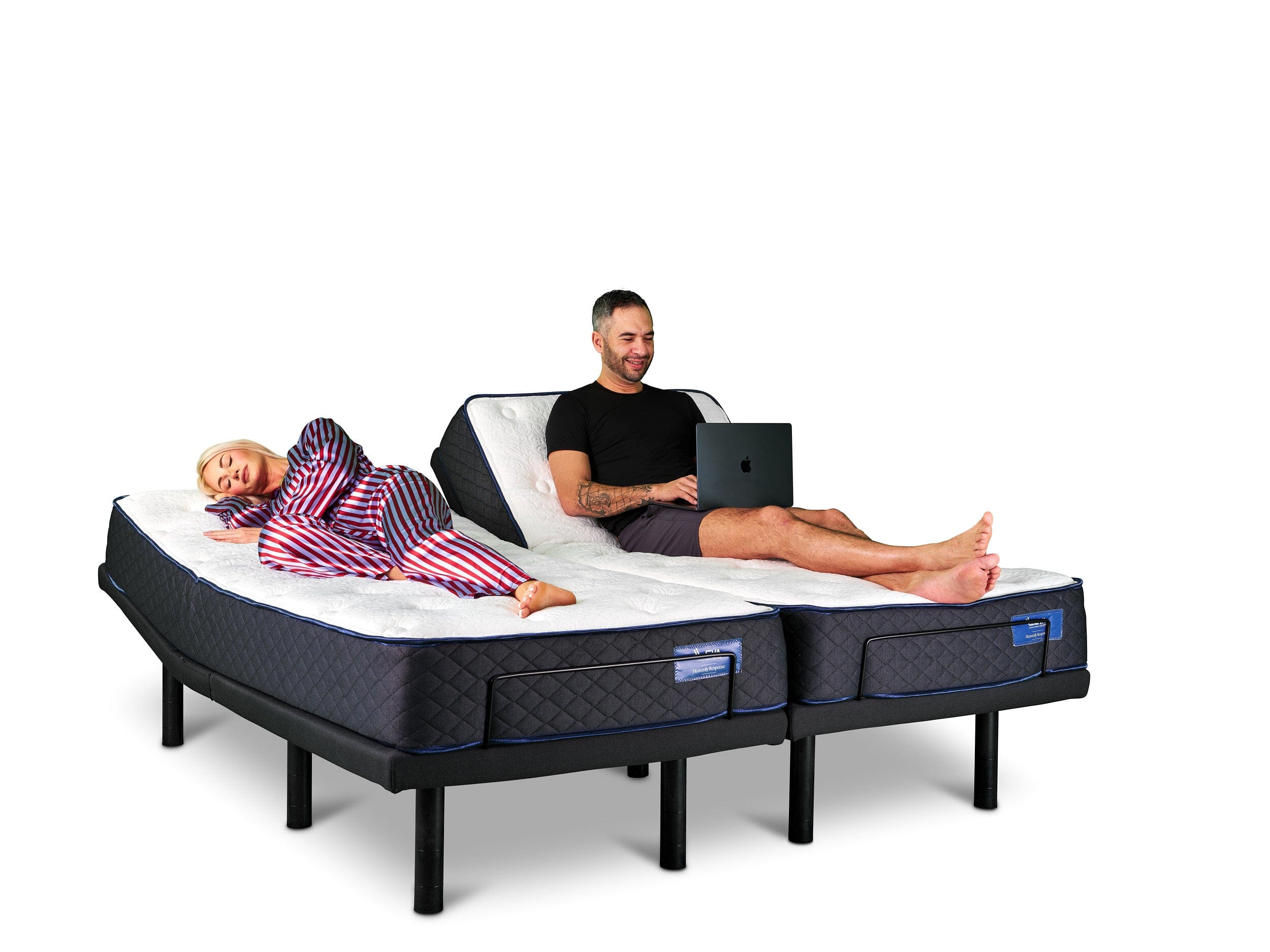
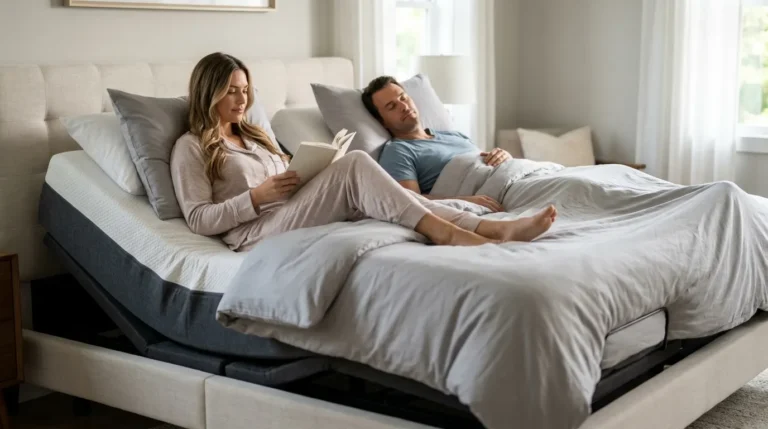
A split adjustable sleep system places two independent bases side by side under one shared bed frame. Each side has its own motor, its own remote or app control, and its own elevation range. One partner can set a 20–30 degree anti-snore incline while the other sleeps flat or at a different angle without affecting their partner. Each person keeps full control of their own comfort.
Leva Sleep’s Split King and Split Queen systems use whisper-quiet German-made Okin motors. Brushless DC motors eliminate buzzing and grinding by using electronic commutation instead of physical brushes, resulting in smoother operation with less vibration transferred to the bed frame. That noise floor sits below the level at which most adults experience sleep disruption.
Independent massage, lumbar support, and pillow tilt controls follow the same logic. One partner can adjust their settings at 2 a.m. without moving, vibrating, or waking the other side of the bed.
How to Choose a Split Adjustable Bed for Snoring
A clear set of criteria makes it easier to compare split adjustable bases for a shared bedroom. Each point below connects to the core goal of reducing snoring while keeping both partners comfortable.
- Independent adjustability: Each side must operate entirely separately so one partner’s elevation does not affect the other. Dual configurations that use two separate mattress platforms allow each person to select their own sleep position and mattress type without affecting the other sleeper’s comfort or alignment.
- Motor noise level: Quiet motors protect sleep when positions change during the night. Brushed DC motors can increase in noise over time as carbon brushes wear, typically after 3–5 years, while brushless DC motors maintain consistent noise levels longer.
- Mattress compatibility: The mattress must flex at the joints without cracking or losing support. All-foam and hybrid pocket-coil mattresses designed for adjustable bases perform better than standard innerspring models with rigid edges.
- Temperature regulation: Couples often have different thermal preferences, so individual heating and cooling pads help each person stay comfortable without blanket tug-of-war.
- Anti-snore presets and detection mode: A dedicated anti-snore elevation preset and automatic snore detection allow the base to trigger micro-adjustments without requiring the snoring partner to wake up.
- White-glove delivery: Adjustable bases are heavy, multi-component systems, so in-house white-glove delivery that includes bedroom setup, leg-height adjustment, and a product tutorial removes the assembly burden.
- Total cost of ownership: Comparing base price, mattress cost, delivery fees, and accessory needs across brands shows the real investment. Canadian-assembled systems from a direct-to-consumer specialist typically carry a 30–50% price advantage over U.S. luxury imports.
Snore Detection Features in Modern Adjustable Beds
Snore detection in adjustable beds works by sensing vibration or sound through the mattress platform and then triggering a gradual head elevation to reopen the airway. Leva Sleep’s anti-snore detection mode detects snoring and makes subtle, automatic micro-adjustments to the head of the bed, without requiring the snoring partner to wake up or press a button.
The clinical basis for this approach is well established. Elevating the head of the bed by 10% to 30% may reduce airway obstruction associated with snoring. More specifically, raising the head approximately 4 to 6 inches produces the 10–30 degree incline that reduces snoring by preventing airway collapse, with 10–15 degrees suitable for light snoring and 20–30 degrees as the target range for moderate to heavy snoring.
Anti-snore technology that gently raises the upper body via button or automatic control opens airways while avoiding the slippage or neck-forward positioning issues common with stacked pillows. A dedicated anti-snore preset automates this independent elevation, so the system responds to snoring events in real time.
Real-World Results Couples Notice After Switching
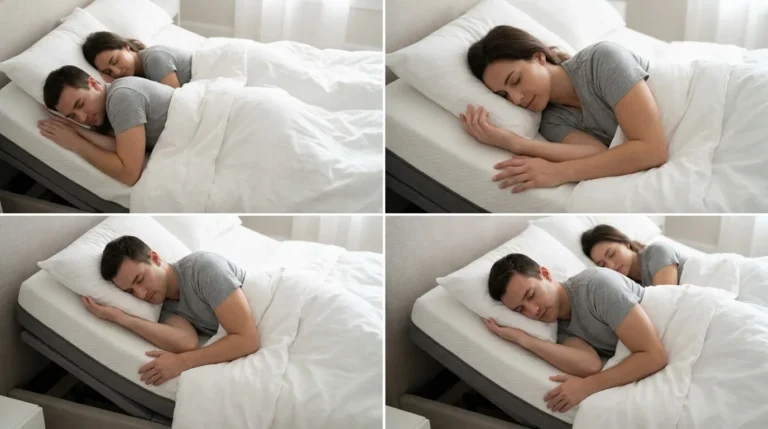
Couples who move from a flat bed or single adjustable base to a split system consistently report four interconnected improvements. The most immediate change is uninterrupted sleep, because when the snoring partner’s airway stays open through elevation, the non-snoring partner stops being woken by noise. This improvement in sleep quality builds alongside reduced physical pain, as independent lumbar support and foot elevation address hip, knee, and lower back discomfort that often worsens on flat surfaces overnight.
These changes work together to remove the need for sleep divorce. Couples stay in the same bed not by tolerating disruption but because the underlying causes have been resolved. App-controlled positions, vibrating alarms, and pre-set profiles then simplify morning routines, so both partners can wake gradually and comfortably without disturbing each other.
Leva Sleep’s customer base includes couples referred directly by sleep apnea clinics, which reflects the degree to which positional therapy via adjustable elevation is recognized as a legitimate clinical complement to other treatments.
Deciding Between Split and Single Bases and Choosing the Right Size
A single adjustable base suits one person or a couple with identical sleep needs. For couples with any difference in preferred elevation, firmness, or temperature, a split configuration fits better because each partner can personalize their side. Once you decide on a split system, the remaining choice is size.
A Split King uses two Twin XL mattresses side by side, totalling 76 inches wide, which matches a standard King footprint and suits larger master bedrooms. A Split Queen uses two narrower mattresses totalling 60 inches wide, matching a standard Queen footprint. Split Queen adjustable beds are rare in Canada, and Leva Sleep builds them to customer specifications, which makes this configuration accessible to couples in homes where a King footprint is impractical.
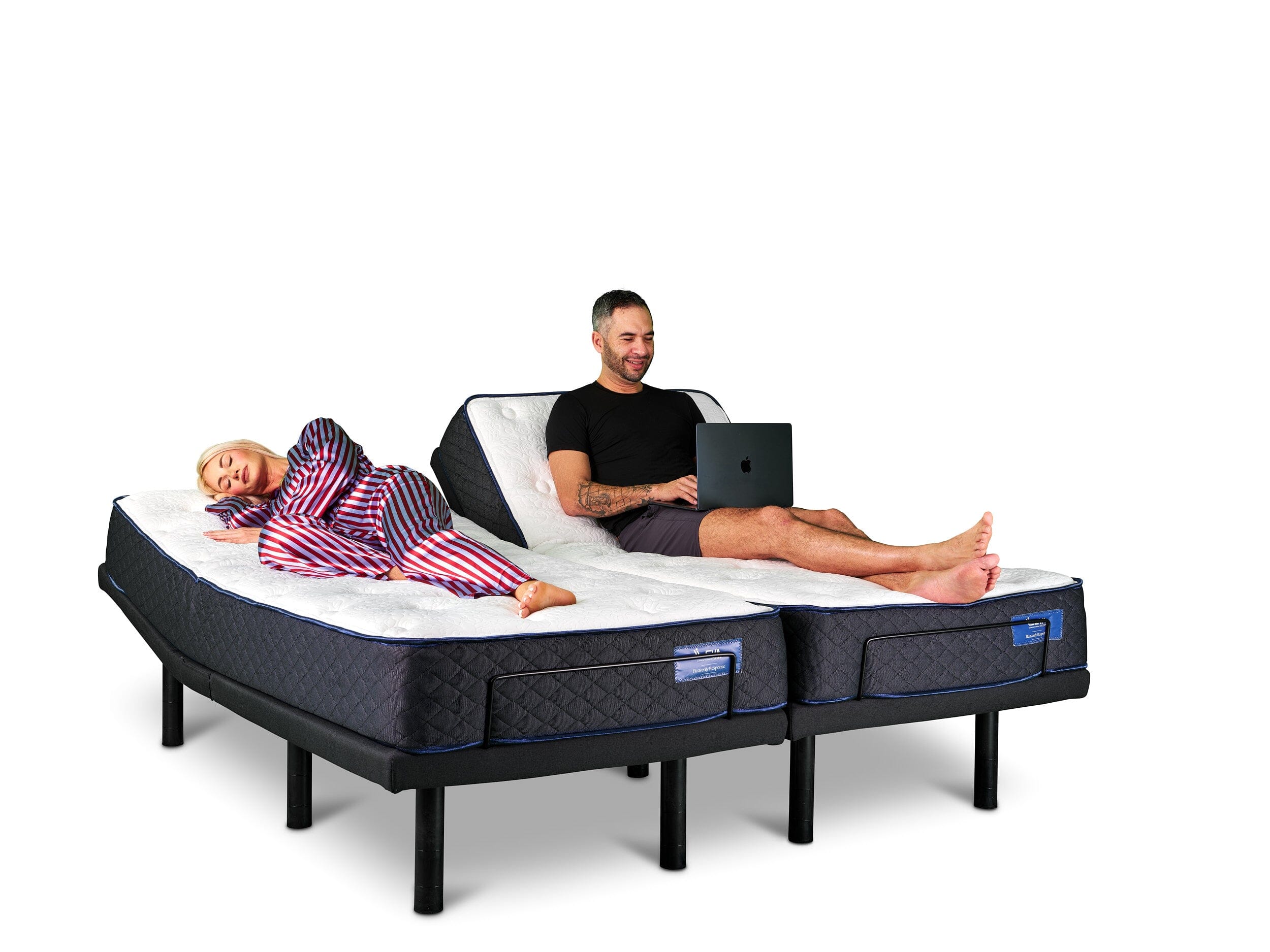
On cost, Leva Sleep’s direct-to-consumer, vertically integrated model, with local Ontario and Alberta assembly and in-house white-glove delivery, produces a 30–50% price advantage over comparable U.S. luxury brands such as Tempur-Pedic and GhostBed. That gap widens further when you factor in cross-border shipping, duty, and the absence of local setup support from those brands.
Frequently Asked Questions
Do adjustable beds really stop snoring?
Adjustable beds reduce snoring by elevating the head to prevent the airway collapse that causes the sound, using the elevation range discussed earlier. Results vary by individual and snoring severity. For couples where only one partner snores, a split adjustable base is the most practical configuration because it allows the snoring partner to elevate without forcing the other into the same position. Leva Sleep’s 2026 anti-snore detection mode automates this adjustment, making it passive rather than requiring the snoring partner to wake and reposition.
Can I use a CPAP machine with a Leva Sleep adjustable bed?
Yes. Leva Sleep’s adjustable bases are compatible with CPAP use. The head elevation available on the base can complement CPAP therapy by reducing the pressure required to keep the airway open, though any changes to CPAP settings should be discussed with a physician. The independent controls on a split base mean the CPAP user’s side can be elevated to a comfortable angle while the other partner sleeps flat.
What mattress works best with a split adjustable base?
Mattresses designed specifically for adjustable bases, either all-foam or hybrid pocket-coil construction, flex without cracking or losing structural integrity at elevation. Standard innerspring mattresses with rigid border wires are not compatible with adjustable bases. Leva Sleep designs its mattresses in-house to work with its adjustable bases, and also pairs bases with compatible models from Tempur-Pedic, Simmons, Beautyrest, Serta, and Kingsdown.
Who benefits most from a split adjustable bed?
Couples where one or both partners snore, have obstructive sleep apnea, experience acid reflux, or are recovering from hip, knee, or back surgery benefit most. Couples with differing firmness or temperature preferences also benefit significantly from independent controls. The split configuration is particularly valuable when medical advice requires one partner to sleep elevated and the other has no such need.
Is white-glove delivery available across Canada?
Leva Sleep currently offers in-house white-glove delivery in Ontario and Alberta. This service includes delivery to the bedroom, full assembly, leg-height adjustment, a product tutorial, and removal of the old bed. Customers outside these provinces should contact Leva Sleep directly to discuss delivery options.
Conclusion: Next Steps for Choosing a Split Adjustable Bed
For Canadian couples managing snoring, sleep apnea, or differing comfort needs, a split adjustable base is the only bed category that resolves the underlying problem without requiring one partner to compromise or relocate. The clinical case for head elevation in snoring relief is well established, and 2026 anti-snore detection technology now makes that elevation automatic rather than manual.
Leva Sleep’s Split King and Split Queen packages deliver quiet operation, independent app controls, specialized mattresses, and Canadian-specific service that general mattress retailers and U.S. imports cannot match. With over 25,000 customers, $50M in lifetime sales, and eight years of adjustable bed specialization, Leva Sleep offers the experience and configurations that align with how Canadian couples actually sleep.
View Leva Sleep’s full range of Canadian-built adjustable beds