Written by: Matthew Timmins, Founder and Managing Director, Leva Sleep
Key Decisions For Canadian Couples
- Canadian couples can solve snoring, temperature differences, and tight bedroom layouts with a well-matched latex mattress on a split adjustable base.
- Latex works well on adjustable bases because it isolates motion, stays cooler than memory foam, and flexes reliably between 8–12 inches of thickness.
- Split queen delivers full per-side independence in a 60-inch footprint that fits most Canadian master bedrooms, making it more practical than split king for many couples.
- ILD firmness matching around 25–32 for average-weight sleepers, plus a stretch knit cover, supports long-term comfort and smooth articulation.
- Leva Sleep offers complete adjustable bed packages with true split queen options, white-glove delivery in Ontario and Alberta, and mattresses built for independent control on each side.
Quick-Read Overview: The Five Decisions That Matter
Latex comes in several forms, and those differences affect how it behaves on an adjustable base. Natural latex is derived from rubber tree sap and processed via either the Dunlop or Talalay method. GOLS-certified organic latex goes further by confirming the rubber trees were farmed without synthetic pesticides, which is a separate claim from simply “natural.” Synthetic latex is petrochemical-based and degrades faster, while latex hybrids layer latex over pocketed coils for added airflow and edge support.
Latex suits adjustable bases because its open-cell structure flexes without permanent deformation, isolates motion between partners, and sleeps cooler than memory foam through continuous airflow in its air channels. These traits make latex a strong material choice for a couples’ adjustable sleep system when the five decisions below align.
The decision framework, in order:
- Material: natural latex, GOLS-certified organic, synthetic blend, or latex hybrid
- Thickness: total mattress height relative to the base’s articulation limits
- Configuration: split queen, split king, or two Twin XLs
- Firmness matching: ILD selection per side based on weight and sleep position
- Canadian availability: provincial delivery, CAD pricing, and certification verification
Why Latex Suits Adjustable Bases And Couples
Latex’s open-cell structure lets it compress and rebound quickly, so it follows the articulating sections of an adjustable base without bunching or creating pressure ridges at the hinge. Its natural breathability keeps surface temperatures lower than memory foam, which helps the partner who sleeps hot. Because latex returns to baseline after compression, quality latex resists body impressions and soft spots over many years of use, although long-term data under nightly articulation remains limited.
Very thick latex resists bending, so density becomes both the source of durability and the source of hinge resistance when the base elevates the head or foot.
Latex Thickness And Adjustable-Base Compatibility
Thickness often decides whether a latex mattress works smoothly on an adjustable base. The specific ranges matter:
- 6–8 Inches (Low-Profile): Thinner profiles articulate more easily because there is less material to bend, which suits bases with aggressive angles or strict motor weight limits. The trade-off is less pressure relief for heavier or side-sleeping adults.
- 8–12 Inches (Standard Range): Mattress Advice recommends 12 inches or less for adjustable bases, since thicker mattresses cannot bend properly and may strain the motor. Most quality latex mattresses fall in this range. Avocado’s mattress height guide identifies 10–12 inches as the standard range for most adults, which works well on adjustable bases without raising bed height excessively.
- Above 12–14 Inches (Caution Zone): Mattresses above 14 inches fight the adjustable base mechanism, may void the mattress warranty, and can strain the base motor. Very thick latex layers also become harder to articulate because the same density that improves durability resists bending at the hinge.
Because latex is dense and supportive, a well-made 9-inch latex mattress can outperform a thicker low-density foam mattress in durability and material quality. The evidence does not yet focus on articulation performance, so thickness still needs careful matching to the base.
Cover construction also affects articulation comfort. Tight woven covers restrict foam movement and create pressure points when the bed bends, while stretch knit covers let the latex expand and contract freely. When evaluating a latex mattress for an adjustable base, confirm that the cover uses a stretch knit construction.
Split Queen Vs. Split King Vs. Two Twin XLs: The Core Decision
Configuration determines whether the system fits the bedroom, the budget, and each partner’s independence needs. The table below compares the three options on footprint, articulation independence, and bedding requirements, which are the factors that usually decide the choice.
| Configuration | Footprint | Independent Articulation | Bedding Requirement |
|---|---|---|---|
| Split Queen | 60 inches wide × 80 inches long | Two fully independent bases, head and foot articulation on each side | Two 30″ × 80″ split queen fitted sheets; standard queen flat sheet fits over both |
| Split King | 76 inches wide × 80 inches long | Two independent Twin XL bases on an adjustable frame | Two Twin XL fitted sheets; each side moves independently |
| Two Twin XLs | 76 inches wide × 80 inches long (same King footprint) | Two independent bases; each partner can choose a different mattress entirely | Two Twin XL fitted sheets |
Each configuration fits a different bedroom reality:
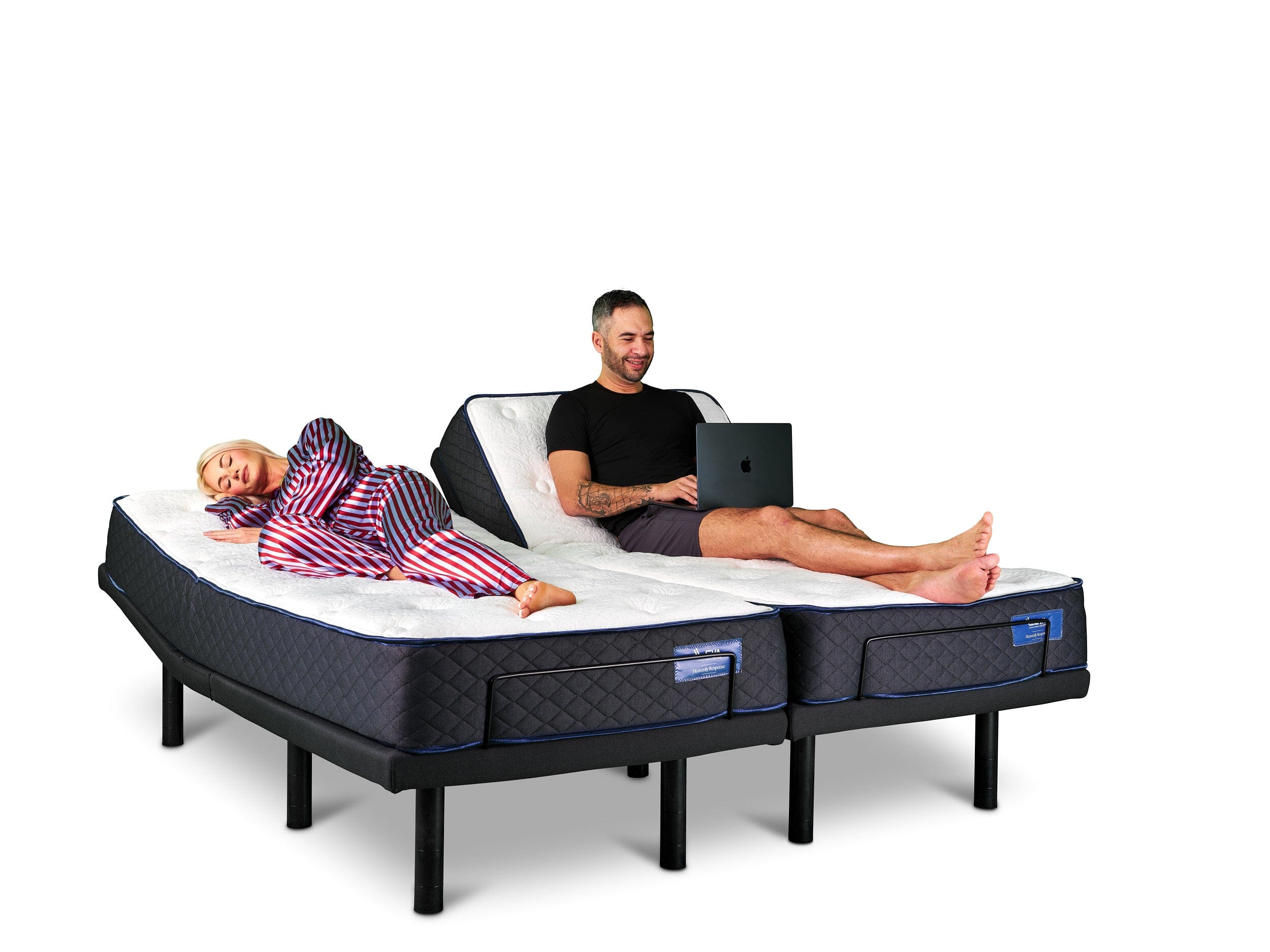
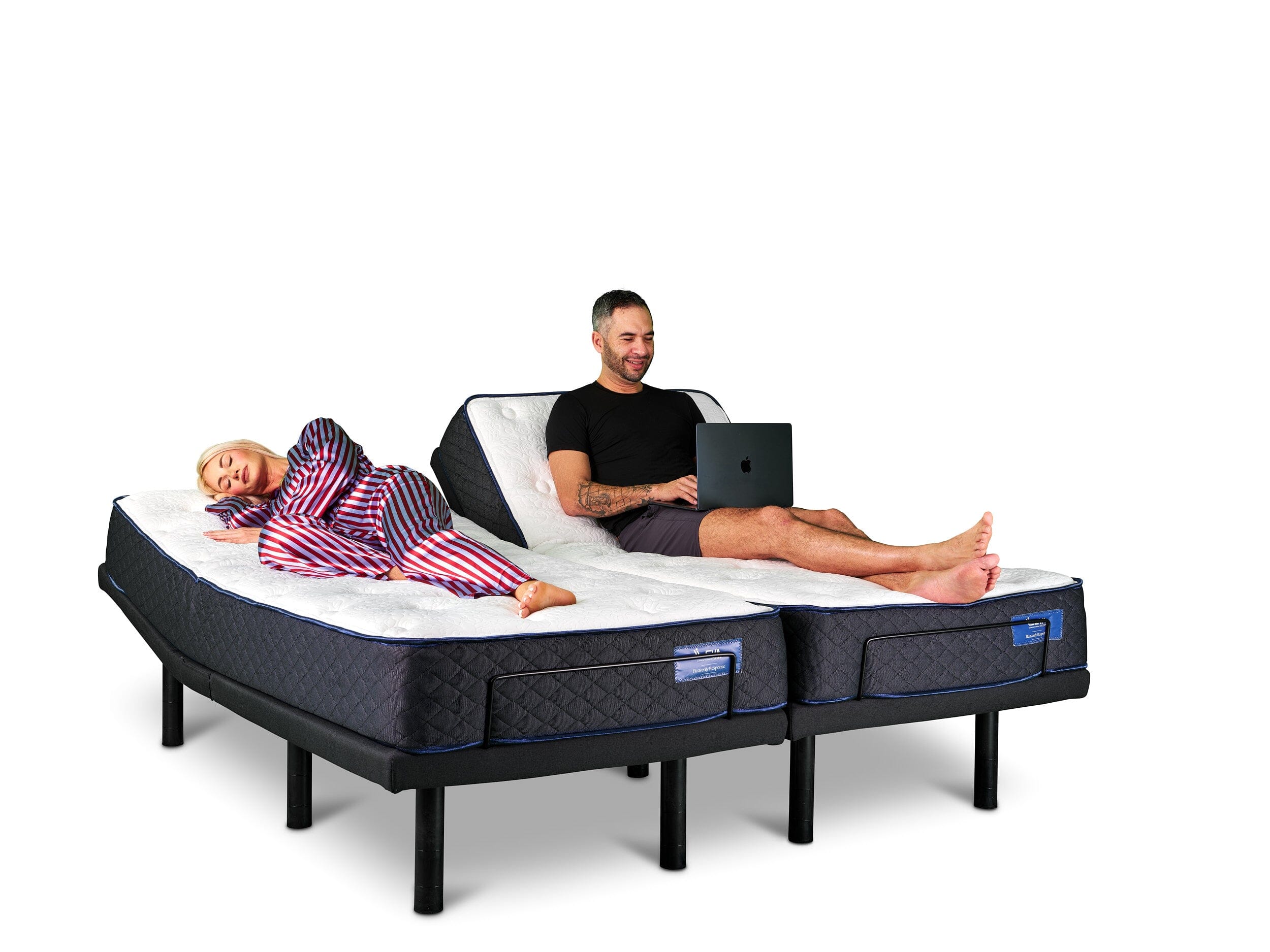
- Split Queen: Leva Sleep’s split queen uses two fully independent bases with head and foot articulation on each side. At 60 inches wide, it fits a standard Canadian master bedroom without a room expansion. A queen requires a minimum room size of 10 × 12 feet, compared to 12 × 12 feet for a king. Split queen remains rare in Canada, and Leva Sleep builds these to customer specifications.
- Split King: Two Twin XL mattresses on two independent bases create a 76 × 80 inch footprint. Each partner gets about 38 inches of personal width. A minimum room size of 12 × 12 feet is recommended. This is the widest split option and the most common at Canadian retailers.
- Two Twin XLs: This setup matches a split king in footprint and bedding needs but lets partners choose entirely different mattress constructions, such as one latex and one hybrid. It requires the same room dimensions as a split king.
For Canadian couples in a standard master bedroom who want full per-side independence without upsizing the room, split queen usually fits best. Availability is the main obstacle. Leva Sleep offers one of the largest selections of split queen adjustable beds in North America, with five packages starting at $1,399, each including two fully independent bases with head and foot articulation on each side.
Matching Firmness For Two Sleepers
ILD, or Indentation Load Deflection, provides the measurable number behind mattress firmness labels. ILD quantifies the force in pounds required to compress a standard 4-inch foam sample by 25% of its thickness using a 50-square-inch circular indenter. A higher number means firmer foam. The ranges that matter for latex selection:
- 14–19 ILD: Soft, ideal for light side sleepers under 130 lbs
- 20–24 ILD: Medium-soft for side sleepers needing pressure relief
- 25–32 ILD: Medium to medium-firm for most combination sleepers and a strong starting point for average-weight couples
- 33–40 ILD: Firm for back and stomach sleepers
- 41–44 ILD: Extra-firm for heavier individuals needing maximum support
For couples whose preferences differ by more than one ILD step, splitting the bed is the recommended approach, using one cover over two firmness profiles. A split configuration lets each partner’s side match their weight, sleep position, and ILD preference independently.
Two additional variables shape how ILD feels in practice. First, Dunlop latex feels firmer and more substantial than Talalay at the same ILD rating because heavier particles settle during production and create a denser bottom section. A 30 ILD Dunlop resists compression differently than a 30 ILD Talalay. Second, ILD values are not cross-brand comparable, since processing methods, additives, and layer thickness all affect feel. Use ILD as a directional guide within one brand’s lineup rather than a strict cross-brand comparison.
The Real Downsides Of A Latex Mattress
Latex brings real trade-offs that matter when you pair it with an adjustable base. Canadian couples should weigh these before committing:
- Weight: A queen-size latex mattress typically weighs between 80 and 150 lbs, which makes solo moving or rotating difficult. On an adjustable base, you move the mattress less often, yet setup and any future repositioning usually require professional help or at least two people.
- Upfront Cost: A real 100% natural latex mattress starts around $1,200 USD, with a quality range between $1,500 and $3,500 USD for a queen. In Canada, natural latex queen mattresses often start around $1,200–$2,000 CAD, while premium GOLS-certified organic models run $2,000–$3,500 CAD. Any “latex” mattress below $1,000 CAD deserves close review of its actual natural content.
- Limited Plushness Range: Some sleepers experience solid latex as bouncy or rigid, without the deep body-hugging contour of memory foam. Latex cushions pressure points with a buoyant feel. Shoppers who expect memory foam’s slow sink should adjust expectations.
- Bending Limits At High Thickness: Latex above 12–14 inches total height resists articulation and can strain the base motor. This behaviour reflects a structural constraint of thick, dense foam layers.
- Off-Gassing: Natural latex has minimal VOC output, and releases only a faint sweet scent that fades within a few days. Synthetic blends vary, and some produce stronger odors. Off-gassing concerns appear more often with blended or synthetic latex models. GOLS-certified natural latex usually offers the lowest risk for chemically sensitive sleepers.
- Bedding Fit: Latex mattresses on adjustable bases work best with stretch knit covers and deep-pocket fitted sheets. Standard sheets often pop off when the bed articulates. Adjustable-base-specific bedding with extra elastic and side remote pockets keeps the system stable and easier to use.
Canadian Availability And Pricing
Canadian couples shopping for latex on an adjustable base face a narrower market than many US-focused guides suggest. Several US-only brands rank well in search results but do not deliver to Ontario or Alberta, or they price in USD without Canadian distribution.
Certification checks help confirm material claims. The key public databases are global-standard.org for GOLS and GOTS and oeko-tex.com for OEKO-TEX Standard 100. GOLS certifies the latex material itself, not the entire mattress. A mattress marketed as GOLS-certified usually has a latex core that meets the standard, while the cover, fire barrier, and adhesives rely on separate certifications such as GOTS or OEKO-TEX. Canada has no domestic mattress chemical safety certification equivalent to these international standards, so third-party labels provide the main trust signals.
Costco Canada sells mattresses and some adjustable base packages and appears often in Canadian search queries. Costco’s adjustable bed offerings include Queen, King, Split King, and Split California King, with white-glove delivery on some models. Costco Canada carries some latex or latex-hybrid mattresses, such as the NSC Medical Hybrid Pressure Balance Latex Mattress, but selection varies by location and season, and split queen configurations are absent from the standard lineup while split king options appear more often. Couples who need a specific split configuration, per-side firmness matching, and coordinated professional setup often need a more specialized provider.
Leva Sleep delivers to Ontario and Alberta with in-house white-glove service. Packages range from $1,299 to $8,999+ CAD, covering 15–20 adjustable base models, compared to the 3–5 options common at many Canadian retailers. Leva also manufactures its own 30″ × 80″ mattresses for split queen setups and offers matching split queen bedding.
What To Avoid
Availability and price only help when the mattress actually works on an adjustable base. Several common constructions do not, so ruling them out early simplifies the decision:
- Traditional Innerspring With Bonnell Coils: Interconnected coil designs fight the bending mechanism and can crack at the hinge point within weeks. Bonnell coil mattresses do not suit articulating bases.
- All-Latex Mattresses Above 14 Inches: Very thick all-latex builds exceed the mechanical limits of most bases. Above 14 inches, the mattress resists the base, may void the mattress warranty, and can strain the motor.
- Non-Flexible Hybrids: Hybrids with rigid perimeter coil systems or non-pocketed coil cores do not bend cleanly. Pocketed coil hybrids compress independently and usually work, while Bonnell or offset coil hybrids do not.
- Low-Density Synthetic Latex: Synthetic latex loses shape and support faster than natural latex, and often lasts only 7–12 years versus 15–25 years for natural latex. On an adjustable base that cycles nightly, low-density synthetic comfort layers usually wear out before the base.
- “Bed In A Box” Latex Without System Support: Compressed-and-rolled latex often uses thinner, lower-density foam that ships safely but may not pair with stretch knit covers, deep-pocket sheets, or duvet clips designed for articulation. The mattress alone might be acceptable, yet the overall system often feels incomplete.
- Mattresses With Tight Woven Covers: Tight woven covers restrict foam movement and create pressure points when the bed bends. Confirm stretch knit construction before choosing any latex mattress for an adjustable base.
How To Test And Buy
Latex is heavy and adjustable bases include moving parts, so buying a complete system deserves more planning than a standard mattress purchase.
Return policies and trials should allow enough time for latex to settle. Look for at least a 90-night trial, since latex softens slightly during a 2–4 week break-in period, and a 30-night trial rarely captures that change. Confirm whether the trial includes comfort exchanges, such as swapping a latex layer for a different ILD, or only full returns, and check for any return fees.
Professional delivery usually pays off with latex. That earlier 80–150 lb weight range explains why setup and repositioning feel challenging for one person. Leva Sleep offers in-house white-glove delivery for a fee, including old bed removal, full assembly, bed height adjustment, a product walkthrough, and real-time comfort tweaks. For systems with two independent bases, a split mattress, and adjustable-base-specific bedding, professional setup often determines how smoothly the system works from day one.
Showroom and online evaluations should include a few specific questions. Ask for the ILD and density (PCF) of each latex layer, the total mattress height, and the cover construction type. A salesperson at a reputable store should be able to pull this from the manufacturer spec sheet, and refusal or inability to share it signals a problem.
Frequently Asked Questions
What Is The Best Adjustable Mattress For Couples?
Most Canadian couples do well with a natural latex mattress between 9 and 12 inches thick on a split adjustable base. Latex offers motion isolation, cooling, and durable flex over motorized joints, while a split configuration gives each partner independent head and foot control. A medium-firm starting point around 25–32 ILD suits many average-weight combination sleepers, with per-side adjustments available on split setups.
Does Latex Work On A Split Adjustable Base?
Latex works effectively on a split adjustable base when thickness and cover construction match the base’s limits. Latex between 8 and 12 inches total height usually flexes well over articulated head and foot sections. Key requirements include a stretch knit cover, a total mattress height under 14 inches, and a design that avoids a single rigid block thicker than about 6 inches. Leva Sleep’s split queen adjustable base uses two fully independent bases and pairs with mattresses built to flex without damage.
How Thick Can A Latex Mattress Be For An Adjustable Bed?
The practical ceiling for most setups is 12–14 inches of total mattress height. Mattresses in the 8–12 inch range flex well and usually suit adjustable bases. Mattresses above 14 inches tend to resist articulation, strain the motor, and risk warranty issues. Thinner profiles at 6–8 inches articulate most easily but offer less pressure relief for heavier or side-sleeping adults. Because latex is dense and supportive, a 9-inch natural latex mattress can outperform a thicker low-density foam model in durability and material quality, even though current evidence focuses more on longevity than on articulation.
Does Costco Sell Latex Mattresses In Canada?
Costco Canada carries mattresses and some adjustable base packages and occasionally stocks latex or latex-hybrid models, depending on season and location. Costco’s adjustable bed lineup includes Queen, King, Split King, and Split California King, with white-glove delivery available on some models. Latex and latex-hybrid options appear periodically, but split queen configurations remain outside Costco Canada’s standard range while split king options appear more often. Couples who need a specific split layout, detailed firmness matching, and coordinated installation often require a more specialized retailer.
What Is The Downside Of A Latex Mattress?
Key downsides include weight, higher upfront cost, a buoyant rather than deeply contouring feel, and thickness limits on adjustable bases. A queen latex mattress often weighs 80–150 lbs, which makes rotation and repositioning difficult without help. Quality natural latex queen mattresses usually start around $1,200–$2,000 CAD, while premium GOLS-certified organic models reach $2,000–$3,500 CAD. Latex feels responsive and springy instead of deeply enveloping, which suits many sleepers but not those who want memory foam’s slow sink. On an adjustable base, latex above about 14 inches total height tends to resist articulation. GOLS-certified natural latex has minimal off-gassing, while synthetic blends can produce stronger initial odors.
What Mattress Should I Stay Away From On An Adjustable Base?
On an adjustable base, avoid traditional innerspring mattresses with Bonnell or offset coils, since interconnected coil systems fight the bending mechanism and can crack at the hinge. Avoid all-latex mattresses above 14 inches total height, non-flexible hybrids with rigid perimeter coil systems, and any mattress with a tight woven cover instead of a stretch knit cover. For latex specifically, steer clear of low-density synthetic blends that degrade quickly under nightly articulation and bed-in-a-box latex products that lack bedding designed for adjustable bases.
Conclusion: The Final Decision Framework
Choosing a latex adjustable bed mattress for couples in Canada works best as a five-part decision. Material, thickness, configuration, firmness matching, and Canadian availability all interact, and each one needs to align with the others.
A strong overall setup uses natural or GOLS-certified organic latex between 9 and 12 inches, a stretch knit cover, a split adjustable base with per-side ILD matching, and professional delivery in Ontario or Alberta. The challenge lies in finding a Canadian provider that addresses all five pieces in one coordinated system.
Leva Sleep focuses on split queen adjustable beds in Canada, offering two fully independent bases with head and foot articulation on each side in a 60-inch footprint that fits standard Canadian master bedrooms. With whisper-quiet German motors, latex-compatible mattresses and bedding, 15–20 base models, in-house white-glove delivery, and pricing positioned below many luxury competitors, Leva Sleep aligns closely with the couple described in this guide.
The next step is simple: review the available split queen and split king packages, confirm delivery to your Ontario or Alberta address, and share your room dimensions and per-side firmness preferences with Leva Sleep’s team before finalizing a configuration.