Written by: Matthew Timmins, Founder and Managing Director, Leva Sleep | Last updated: June 27, 2026
Key Takeaways
- An adjustable-base compatible mattress must flex repeatedly without cracking, sagging, or losing edge support. Construction type, thickness, and sheet fit are the key details to check in Canada.
- All-foam and pocket-coil hybrid mattresses in the 25–35 cm range usually deliver the most reliable flex performance. Traditional innerspring models should be avoided unless explicitly certified for articulation use.
- Split Queen and Split King configurations let couples adjust independently. Each mattress needs reinforced inner edges and matched heights to prevent gaps and keep sheets fitting properly.
- Deep-pocket sheets with full-perimeter elastic and at least 5 cm extra depth keep bedding secure through repeated elevation cycles on an adjustable base.
- Leva Sleep offers Canadian-assembled adjustable bed packages with mattresses built for continuous articulation. Shop Leva Sleep adjustable beds to find a split or standard configuration that matches how you sleep.
Core Mattress Traits That Matter on an Adjustable Base
Three visible properties show whether a mattress will perform safely on an adjustable base over time: flex tolerance, hinge durability, and edge support.
Flex tolerance describes how freely the mattress bends at the head and foot zones without the internal layers separating or bunching. To check this in a showroom or during a trial period, raise the base to its maximum elevation and press along the bend point. A compatible mattress conforms smoothly. An incompatible one resists, buckles, or creates a visible ridge.
Hinge durability reflects how the mattress holds up after thousands of elevation cycles. Stitched perimeter borders and bonded foam layers usually last longer than glued-only constructions. Ask the retailer whether the mattress is rated for continuous articulation use.
Edge support affects both comfort and sheet retention. A mattress with reinforced foam or coil edges maintains its profile when elevated, which prevents the perimeter from collapsing inward and creating a gap between the mattress edge and the base platform. This gap causes fitted sheets to lose tension and pop off at the corners, which many adjustable-base owners report. When the edge collapses under your weight at full elevation, that same gap-and-slippage problem becomes constant rather than occasional.
Mattress Types Ranked by Flex Performance
The four main mattress constructions available in Canada behave differently on an adjustable base. Use the points below to evaluate any model you are considering.
- All-foam: This type offers the highest flex tolerance. Memory foam and polyfoam bend without much resistance. Check that layers are bonded, not loose-stacked, and that foam density is high enough to resist early body impressions.
- Hybrid (foam + pocket coils): These mattresses can deliver strong flex performance when they use individually wrapped pocket coils. Avoid hybrids with continuous or Bonnell coil systems, which resist bending and can strain the base motor over time.
- Latex: Natural and synthetic latex flex well but weigh more than other options. The extra weight places more load on the motor. Confirm the base weight rating before purchasing a latex mattress.
- Traditional innerspring: This type is usually the least compatible. Interconnected coil systems resist articulation and can void both the mattress and base warranties. Avoid unless certified for articulation.
The table below summarizes the specific flex criteria to verify for each mattress type during showroom testing or trial periods, along with typical thickness ranges and current Canadian availability.
| Mattress Type | Flex Criteria to Check | Typical Thickness Range | Canadian Availability Notes (2026) |
|---|---|---|---|
| All-Foam | Bonded layers, no ridge at bend point | 20–30 cm | Endy, Douglas, Leva Sleep all-foam models |
| Hybrid (pocket coil) | Individually wrapped coils, smooth articulation | 25–35 cm | Silk & Snow Hybrid, Leva Sleep hybrid, Tempur-Pedic (via Leva) |
| Latex | Confirm base weight rating, check for bonded layers | 20–30 cm | Limited Canadian-direct options, verify adjustable-base certification |
| Traditional Innerspring | Avoid unless manufacturer certifies articulation use | 25–35 cm | Widely available but generally incompatible, check warranty terms |
Shop Leva Sleep’s adjustable beds, designed and assembled in Canada with mattresses built specifically for continuous articulation use.
Best Mattress Thickness for Adjustable Bases
Once you identify a compatible mattress construction type, thickness becomes the second critical specification to verify. A thickness of 25 to 35 cm is the practical range for adjustable-base use in Canada. Mattresses below 25 cm often lack sufficient edge-support foam, which causes the perimeter to collapse when elevated and speeds up sheet pop-off. Mattresses above 35 cm are heavier and stiffer, which places excess strain on the motor and reduces the effective articulation angle at the head and foot zones.
To check edge support during a trial, sit on the corner of the mattress while the base is elevated to 45 degrees. The edge should compress only a few centimetres. Significant collapse at this point signals weak perimeter reinforcement.
Heat dissipation also relates to thickness. Thicker all-foam mattresses can trap more heat at the body-contact layer. If temperature regulation matters to you, look for hybrid constructions with airflow channels, or pair any mattress with a heating and cooling pad designed for adjustable bases.
Split Queen and Split King Mattress Tips for Couples
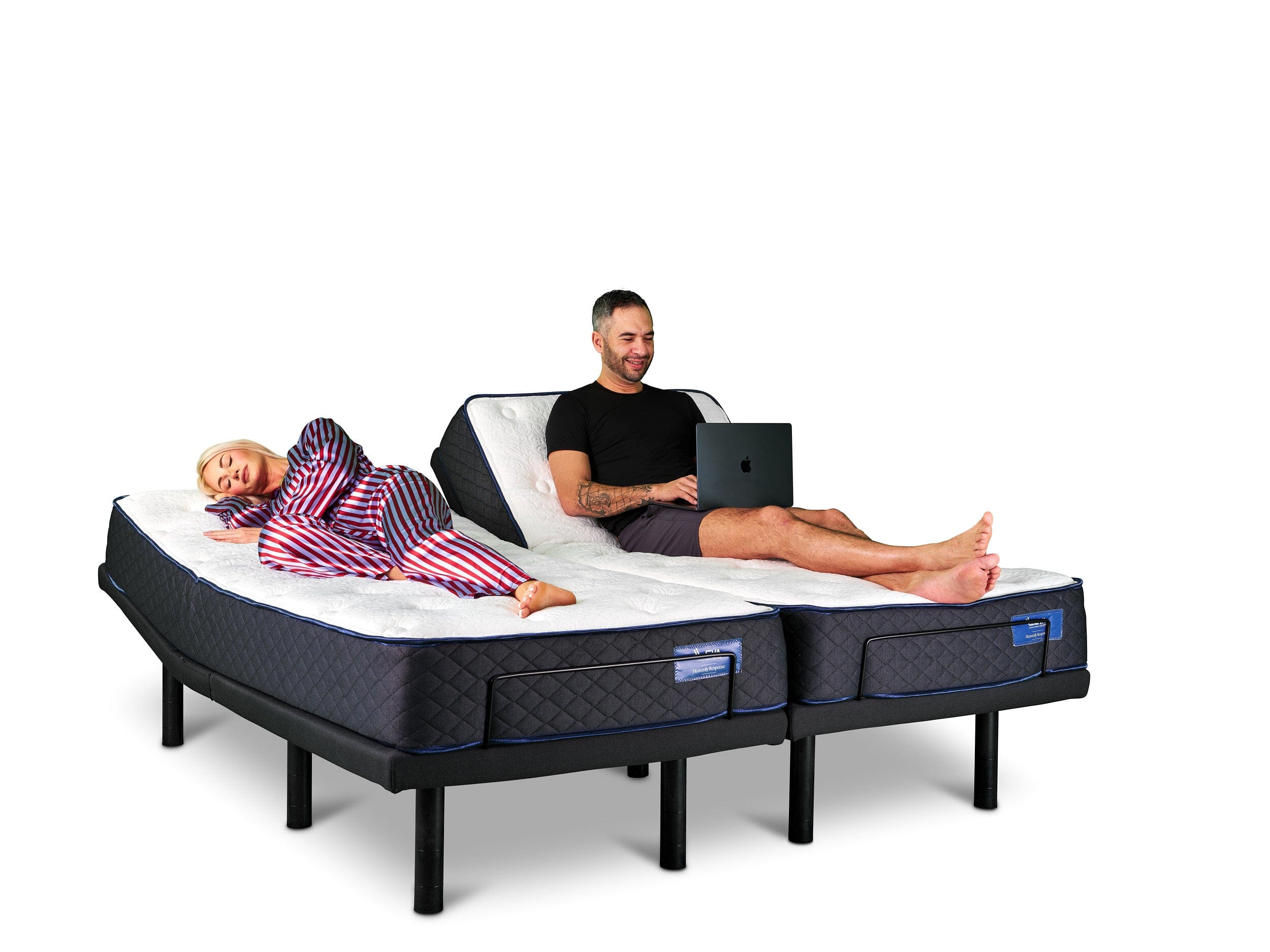
Split configurations, where two separate mattresses sit side by side on independent bases, let each partner adjust elevation, firmness, and massage settings independently. This setup works well for couples with different firmness preferences, snoring, sleep apnea, or hip and knee pain who still want to share one bed.
The main risk with split bases is the gap or sag that can develop between the two mattresses over time. To reduce this, each mattress should have reinforced edges on the split side. Check this by pressing firmly along the inner edge at full elevation. The edge should hold its profile without sinking toward the centre gap.
A Split King uses two Twin XL mattresses, each approximately 97 cm wide, and suits larger master bedrooms. A Split Queen, a less common but space-efficient configuration, uses two narrower mattresses and fits standard Canadian bedroom dimensions. Leva Sleep’s Split Queen adjustable beds are built to customer specifications and represent one of the few dedicated Split Queen offerings available in Canada in 2026.
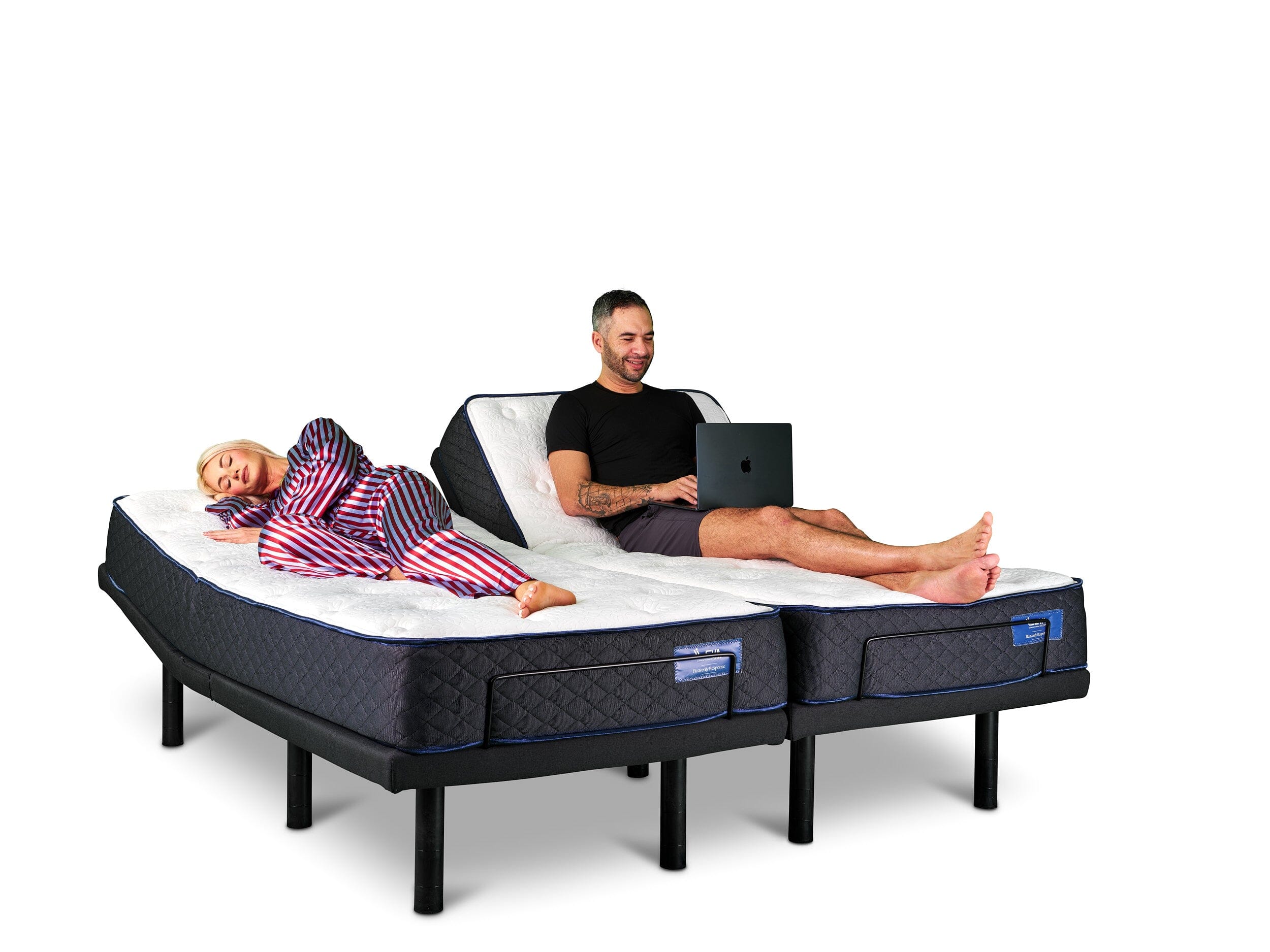
When you select mattresses for a split configuration, both sides should share the same thickness so that bedding sits level. Different firmness levels between sides are fine and often helpful. Different heights create an uneven sleep surface and make sheet fit more difficult.
How to Check Sheet and Accessory Fit on an Adjustable Base
Standard fitted sheets are designed for flat mattresses and often pull free at the corners when a base elevates. Before you purchase bedding, confirm the points below.
- Pocket depth: The sheet’s pocket should be at least 5 cm deeper than the mattress thickness. This extra depth accounts for the mattress compressing against the base platform during elevation.
- Elastic coverage: Full-perimeter elastic, rather than corner-only elastic, distributes tension more evenly and resists pop-off through repeated cycles.
- Split-base sheet strategy: On split configurations, use two separate fitted sheets rather than one shared sheet. A shared sheet restricts independent movement and creates tension that can shift both mattresses.
- Duvet management: A duvet with clip attachments at the foot helps prevent bunching when the foot zone elevates. Test this by raising the foot to maximum elevation and checking whether the duvet slides toward the headboard.
Leva Sleep designs its full bedding suite, including fitted sheets with deep pockets and full-perimeter elastic, duvet clips, and mattress protectors, specifically for adjustable-base use. This approach removes the trial-and-error process of sourcing compatible bedding separately.
Canadian Pricing and Value Comparison (2026)
In the Canadian market in 2026, adjustable-base packages from major brands vary widely in price. Entry-level all-foam mattresses from brands such as Endy and Douglas are priced accessibly but are not always sold with adjustable-base-certified configurations. Mid-range hybrids from Silk & Snow and similar brands sit in a higher tier. Premium brands such as Tempur-Pedic, available through specialist retailers including Leva Sleep, carry the highest price points, supported by pressure-relief engineering.
Leva Sleep’s vertically integrated, direct-to-consumer model removes retail markup at several levels. This structure results in prices that are 30 to 50 percent lower than comparable luxury adjustable-base packages from competing brands. The price advantage applies to both the base and the mattress when purchased as a package.
Motor noise often appears as a concern in Canadian consumer forums. Leva Sleep’s bases use whisper-quiet German motors, which operate without the disruptive sound associated with older or entry-level adjustable bases. White-glove delivery, available for a fee, includes in-room setup, leg-height adjustment, a product tutorial, and removal of the existing bed. This service reduces the setup burden that bed-in-a-box models leave to the customer.
Key Questions to Ask Before You Buy
- Does the mattress manufacturer explicitly certify this model for adjustable-base use, and does that certification cover split configurations?
- What is the trial period, and does it allow returns after the base has been used at full elevation?
- What is the motor noise rating, and can you see or hear a demonstration before purchase?
- Are the fitted sheets and bedding accessories included, or must they be sourced separately?
- Does the retailer offer white-glove delivery, and does that service include old-bed removal and setup adjustment?
- Is the base weight-rated for the mattress you are selecting, particularly if you choose latex?
Shop Leva Sleep’s adjustable beds and review the full range of 2026 split and standard configurations available for delivery across Ontario and Alberta.
Selecting an adjustable-base compatible mattress in Canada means checking construction type, thickness, edge support, and split-line integrity before you commit to a purchase. All-foam and pocket-coil hybrid mattresses in the 25–35 cm range usually offer the most reliable flex performance. Split configurations work best when mattress heights match and inner edges are reinforced to prevent sagging. Sheet fit depends on full-perimeter elastic and pocket depth, not brand. For couples in Ontario and Alberta seeking a specialist with 15 to 20 adjustable models, Canadian assembly, and white-glove delivery at competitive direct-to-consumer pricing, Leva Sleep’s integrated split systems provide a practical starting point for evaluation.
Frequently Asked Questions
Can I use any mattress I already own on an adjustable base?
Not all mattresses are safe to use on an adjustable base. Traditional innerspring mattresses with interconnected or Bonnell coil systems resist bending and can damage the base motor or void the warranty on both products. Memory foam and polyfoam mattresses are generally compatible if their layers are bonded rather than loose-stacked. Hybrid mattresses with individually wrapped pocket coils also perform well. Before you place your existing mattress on an adjustable base, check the manufacturer’s documentation for an explicit adjustable-base certification. If no certification exists, contact the manufacturer directly, because using an uncertified mattress can void your warranty and cause premature sagging.
What is the difference between a Split Queen and a Split King adjustable base?
A Split King uses two Twin XL mattresses placed side by side, each approximately 97 cm wide, for a combined width similar to a standard King. A Split Queen uses two narrower mattresses to create a Queen-width sleeping surface, which suits standard Canadian bedroom dimensions where a full King footprint feels too large. Both configurations allow each partner to control elevation, firmness, and features such as massage or anti-snore mode independently. Split Queen options are significantly less common in Canada, and Leva Sleep is one of the few retailers offering Split Queen adjustable beds built to customer specifications in 2026.
Why do fitted sheets keep popping off my adjustable base, and how do I fix it?
Standard fitted sheets fail because they are designed for flat mattresses and lack the depth and elastic coverage needed for articulation. You need two upgrades. First, switch to deep-pocket sheets that measure at least 5 cm deeper than your mattress and include full-perimeter elastic. Second, on split bases, use two separate fitted sheets instead of one shared sheet so each side can move freely. See the “How to Check Sheet and Accessory Fit on an Adjustable Base” section above for complete specifications.
How does an adjustable base help with snoring and sleep apnea?
Elevating the head of the bed can reduce the soft-tissue collapse that causes snoring and mild obstructive sleep apnea. Many clinicians recommend this positional approach alongside or as an alternative to CPAP therapy for mild cases. Leva Sleep’s adjustable bases include an anti-snore mode that detects snoring through the base and makes subtle head-elevation micro-adjustments automatically, without requiring the sleeper or their partner to intervene. On a split base, only the affected partner’s side adjusts, so the other partner’s position stays unchanged. For medically diagnosed sleep apnea, consult a physician before replacing CPAP therapy with positional adjustment alone.
Is white-glove delivery worth the additional cost for an adjustable base?
Adjustable bases are heavy, multi-component systems that require precise assembly, leg-height calibration, and app pairing to work correctly. A standard drop-off delivery leaves all of this to the customer, which creates a significant burden for a heavy product, especially in a split configuration. White-glove delivery, as offered by Leva Sleep for a fee, includes in-room delivery, full assembly, leg-height adjustment to your preference, a product tutorial covering all features, and removal of the existing bed through donation or recycling. For customers purchasing a split system for the first time, the setup complexity and the value of having trained technicians calibrate the system correctly usually justify the additional cost.