Written by: Matthew Timmins, Founder and Managing Director, Leva Sleep | Last updated: June 30, 2026
Key Takeaways for Cooler Sleep as a Couple
-
Pocket-coil hybrids with natural-latex or open-cell foam layers and moisture-wicking cotton or Tencel covers support strong airflow for couples.
-
Closed-cell and gel-infused foams trap heat quickly, so evaluate the underlying cell structure instead of relying on cooling claims.
-
Percale cotton and Tencel covers move moisture away faster than tight sateen or polyester quilting, which keeps sleep surfaces drier in humid Canadian summers.
-
Mattresses must flex cleanly on adjustable bases, and pocket-coil hybrids usually maintain ventilation channels better than many all-foam models at flex points.
-
Leva Sleep’s adjustable bed packages give Canadian couples breathable hybrid systems built for cooler, more consistent sleep.
The Nightly Heat-and-Moisture Struggle for Canadian Couples
Many couples see the same pattern every night. One partner kicks off the covers while the other pulls them back on. This pattern is especially common in Canadian homes, where air swings from dry winter heat to muggy summer nights in provinces like Ontario and Alberta. The result often includes broken sleep, morning frustration, and, in some cases, a move to separate bedrooms, also called sleep divorce.
Cooling gel layers or a fan on the nightstand rarely solve the root problem. The real solution starts inside the mattress. Airflow through the core, moisture movement away from the body, and how well the mattress flexes on an adjustable base without crushing airflow channels all matter. The six steps below give couples a clear, practical framework to evaluate these details before buying.
Step 1: Pinpoint Your Temperature and Moisture Issues
Start by naming the exact problem before comparing materials. Decide whether one or both partners experience night sweats, and how often this happens. Factor in your regional climate. Coastal British Columbia brings steady humidity, while prairie winters in Alberta create dry indoor air that still traps body heat under dense foam. Clarify whether the main issue is heat retention, moisture buildup, or both, because that answer shapes which material properties matter most in later steps.
If only one partner overheats, a split-base configuration becomes especially useful in Step 5. If both partners run warm, the core material choice in Step 2 becomes the top priority.
Step 2: Compare Core Materials by Breathability
Three core constructions dominate the breathable end of the mattress spectrum. The table below outlines the key evaluation criteria for each. Use these points to guide your in-store or in-home assessment.
|
Material |
Airflow Path |
Moisture Dissipation |
Density Consideration |
|---|---|---|---|
|
Pocket Coils |
Open steel coil structure creates continuous vertical and lateral air channels throughout the core |
Air movement through the coil layer carries moisture vapour away from the comfort layer above |
Coil gauge and count affect support without closing airflow channels, and higher coil counts generally maintain structure without adding foam density |
|
Natural Latex |
Pin-core holes punched through the latex layer during manufacturing create deliberate ventilation paths |
Natural latex is inherently less moisture-retentive than synthetic foam, and its open-cell structure allows vapour transfer |
Dunlop latex is denser and slower to ventilate than Talalay, while Talalay’s more uniform cell structure improves airflow at equivalent ILD ratings |
|
Open-Cell Foam |
Interconnected cell walls allow air to move through the foam rather than being trapped in sealed pockets |
Moisture vapour can migrate through open cells toward the cover fabric, and dissipation depends heavily on cover breathability |
Higher-density open-cell foams can restrict airflow, so evaluate density (kg/m³) alongside cell structure when assessing a specific product |
Common mistake: Gel-infused memory foam is widely marketed as a cooling solution, but the gel beads or swirls sit inside a closed-cell foam matrix. That matrix still restricts airflow. Gel absorbs heat at first and then reaches equilibrium quickly, after which it provides no ongoing ventilation benefit. Evaluate the underlying foam cell structure, not the gel additive.
Step 3: Assess Cover Fabrics and Quilting for Moisture Control
Once you have identified a breathable core material, turn to the cover and quilting layers. The cover fabric is the first surface that body heat and moisture touch. Fibre type, weave openness, and quilting density all influence how quickly moisture moves away from the skin and into the core below.
Cotton with a percale or other open weave allows air to pass through more freely than a tight sateen weave. Tencel (lyocell) fibres come from wood pulp and have a natural moisture-wicking structure at the fibre level, which suits humid Canadian summers. Wool quilting layers add moisture-buffering capacity, because wool can absorb a meaningful percentage of its weight in moisture before feeling damp, although wool also adds insulating mass that may not suit partners who run very warm.
Avoid covers with thick polyester quilting panels placed directly against the sleep surface. Polyester traps heat and resists moisture transfer. During a showroom visit, press your palm flat against the cover for 30 seconds and then notice how quickly warmth fades. A breathable cover feels noticeably cooler to the touch than a polyester-heavy one.
Step 4: Account for How Adjustable Elevation Changes Airflow
Head elevation changes how body heat spreads across the sleep surface. In a flat position, heat builds most around the torso and hips. At a 15 to 30 degree head elevation, convective airflow along the body surface increases. Many people feel less heat buildup at the core of the mattress in this position.
For this benefit to hold, the mattress must flex without compressing its internal airflow channels. Pocket-coil hybrids are engineered to bend at the head and foot zones while the coils maintain their structure. Foam behavior depends on density and cell structure. Open-cell foams with a flexible base layer can articulate cleanly, while high-density foams may resist bending and create a pressure ridge at the flex point that disrupts both support and airflow.
Expert tip: Ask the retailer to show the mattress bending on an adjustable base before you buy. Watch the cover fabric at the flex zone. Bunching or deep creasing suggests the construction is not designed for articulation and will likely reduce both comfort and airflow over time.
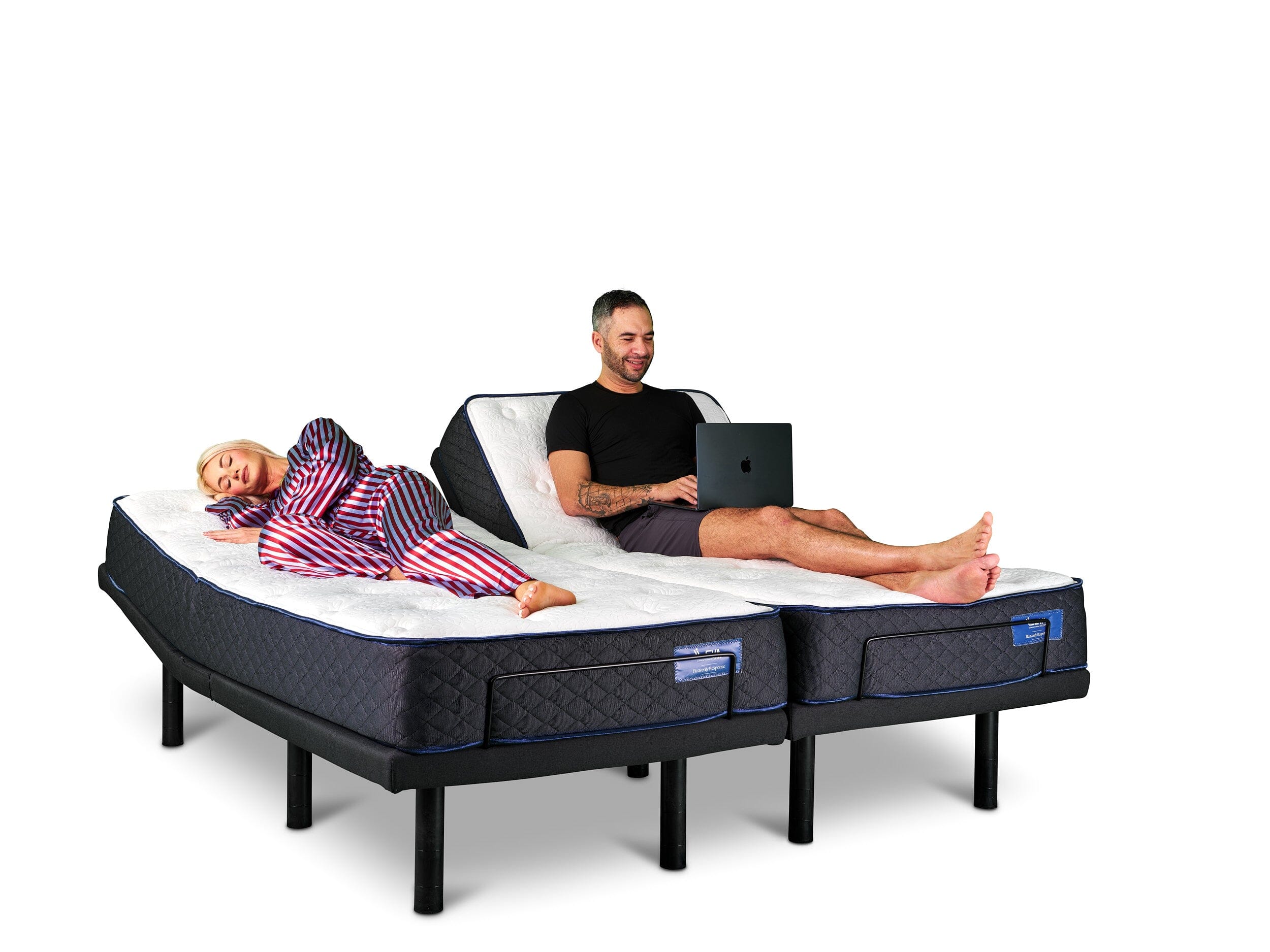
Step 5: Match Bedding to Split Adjustable Bases
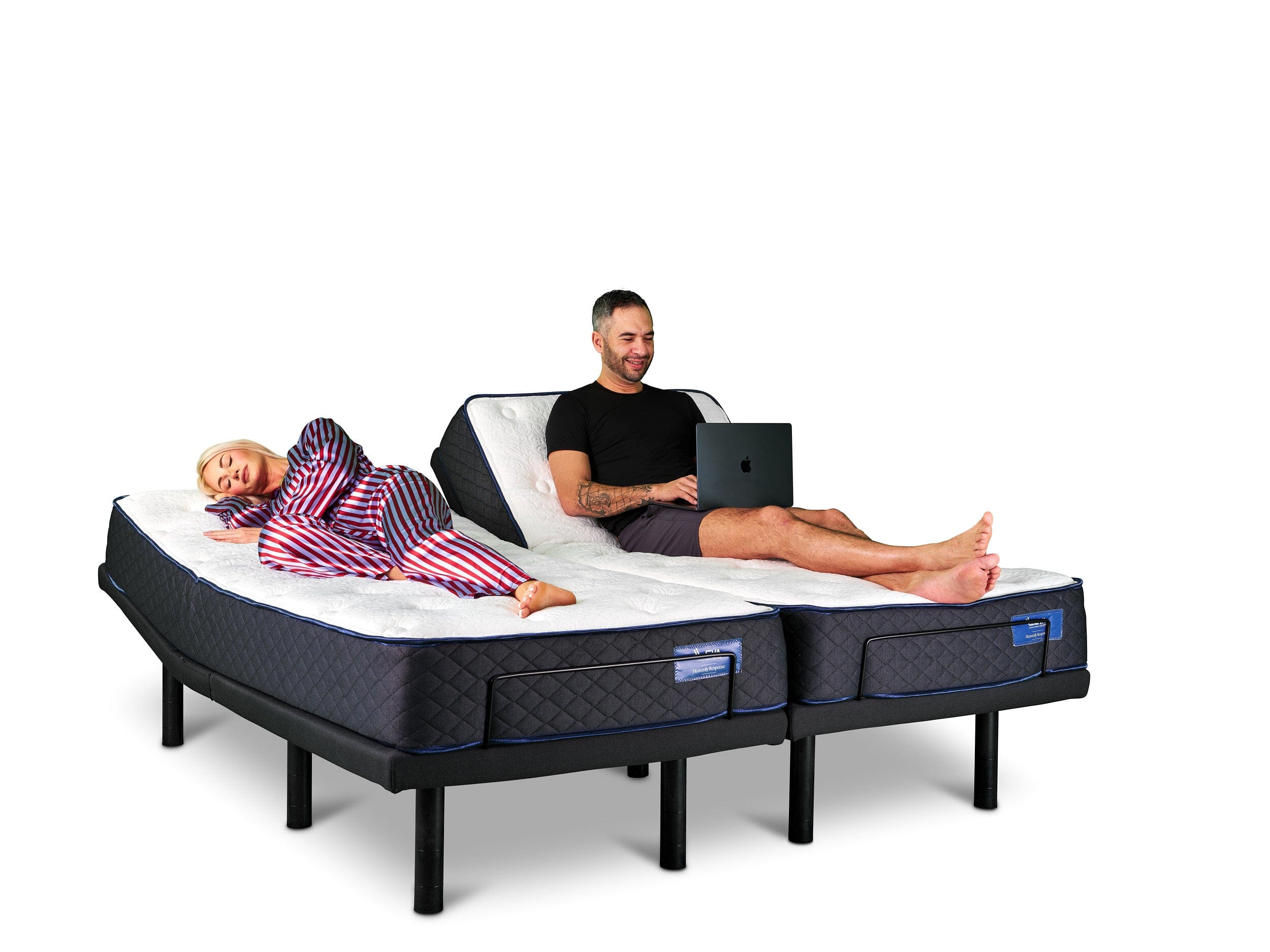
A split adjustable base uses two independent mattress units side by side. Standard fitted sheets are not designed for this layout. They often lack the pocket depth for a mattress on a raised base and have no way to stay anchored when one side elevates while the other remains flat.
When you evaluate bedding for a split base, look for fitted sheets with a pocket depth of at least 40 cm and reinforced elastic that runs around the full perimeter instead of only at the corners. Duvet clips that attach the duvet to each mattress independently keep the cover from drifting to one side when partners adjust positions on their own. Remote pockets sewn into the side of the fitted sheet keep controllers accessible instead of sliding between the mattresses.
Sheet slippage note: The most common complaint from split-base owners is fitted sheets popping off during the night. This issue comes from bedding design, not the mattress. Confirm that any sheet set is clearly rated for adjustable bases before you purchase.
Explore Leva’s split queen and king packages with purpose-built bedding accessories designed to stay in place through every elevation setting.
Step 6: Use a Canadian-Specific Buying Checklist
After you understand the material and bedding criteria, apply a practical Canadian buying checklist before you commit to a purchase.
Delivery realities: Adjustable bases are heavy, multi-component systems that need careful handling. Because of their weight and complexity, many retailers only deliver to your door, which leaves you to manage stairs and assembly on your own. White-glove delivery that includes assembly, leg-height adjustment, and a product walkthrough reduces the risk of incorrect setup that could void a warranty or damage the base.
Certifications: Once delivery is sorted out, confirm that the materials meet Canadian safety expectations. Look for CertiPUR-US certification on foam components, which confirms the foam has been tested for harmful emissions and durability. OEKO-TEX certification on cover fabrics confirms the absence of harmful chemicals in the textile.
Warranty scope: Check whether the warranty covers both the mattress and the base independently, and whether adjustable-base use affects coverage. Some mattress warranties explicitly exclude use on an adjustable base or limit coverage beyond certain angles.
In-store testing: Lie on the mattress in your usual sleep position for at least 10 minutes. Ask the showroom to elevate the base to your typical sleeping angle. Notice whether the mattress surface temperature changes as the base articulates and whether any pressure ridge appears at the bend.
Leva Sleep uses a vertically integrated model with local design, regional assembly, and in-house white-glove delivery. Multiple adjustable models give Canadian couples several paths to match this checklist to their own bedroom and climate.
Browse Leva’s hybrid pocket-coil systems and explore the full range with whisper-quiet motors and flexible split configurations.
What Better Sleep Looks Like for Two People
When the right materials, cover fabrics, and base configuration come together, the results feel clear and measurable. Couples see fewer mid-night wake-ups from overheating, drier sleep surfaces during humid summer months, and both partners stay in the same bed without compromise. Many couples who relied on separate duvets or separate rooms find that a split adjustable base with a breathable hybrid mattress addresses the temperature conflict at its source instead of working around it.
Advanced Comfort Tweaks and Leva Sleep Accessories
Some couples find that one partner’s temperature needs sit beyond what passive breathability can handle. In these cases, active temperature-regulation pads placed between the mattress and the fitted sheet can provide zone-specific heating or cooling. Leva Sleep’s integrated heating and cooling pad works with the adjustable base, maintaining contact with the sleep surface through elevation changes.
App-controlled elevation lets partners save preferred positions and return to them without disturbing the other side. Leva’s Bluetooth app supports custom position memory, vibrating alarms, and an anti-snore mode that detects snoring and makes small head-elevation adjustments automatically. Local assembly in Ontario and Alberta means the system arrives configured for the room dimensions and bed-height preferences confirmed at delivery.
Frequently Asked Questions
Is a breathable hybrid mattress suitable for someone with sleep apnea?
A breathable hybrid pocket-coil mattress works well with the elevated head positions often recommended for mild sleep apnea management. The pocket-coil core flexes cleanly at the head zone of an adjustable base and maintains support without creating a pressure ridge at the bend point. Elevation helps open the airway by shifting the tongue and soft palate forward, which can reduce obstruction. Leva Sleep’s adjustable bases are designed for this use case, and sleep apnea clinics have referred patients to Leva for this reason. Anyone managing diagnosed sleep apnea should confirm their treatment plan with their physician before changing CPAP or positional therapy.
What is a Split Queen adjustable bed and who is it for?
A Split Queen adjustable bed uses two narrow twin-equivalent mattresses placed side by side within a queen-sized frame, each on its own adjustable base. This layout suits couples who share a queen-sized bedroom but need independent elevation, firmness, or temperature settings. Leva Sleep is one of the few Canadian providers offering Split Queen configurations built to customer specifications, which makes it a strong option for couples in smaller bedrooms who want split adjustability without moving to a king-sized footprint.
How does mattress material choice affect the warranty?
Mattress warranties vary widely by manufacturer. Some warranties become void if the mattress is used on an adjustable base, especially if the base articulates beyond a listed angle. Hybrid pocket-coil mattresses designed for adjustable bases usually state this use case clearly in the warranty terms. All-foam mattresses from general retailers may not. Before you purchase, confirm in writing that the warranty covers use on an articulating adjustable base at the elevation angles you plan to use. Leva Sleep designs its mattresses specifically for use with its adjustable bases, so the warranty covers the full system as an integrated unit.
How can I test breathability in-store?
Several simple tests help you judge breathability in a showroom. Press your palm flat against the mattress cover for 30 seconds and then notice how quickly warmth fades. A breathable cover feels cooler than a polyester-heavy one. Ask the sales associate to elevate the base to your usual sleeping angle and lie in position for at least 10 minutes to gauge heat buildup at the torso and hips. For the core material, ask whether the mattress uses open-cell or closed-cell foam and whether the coil system is individually pocketed or continuous wire. Pocketed coils maintain independent airflow channels that continuous wire systems do not. If the showroom cannot answer these questions clearly, request the product specification sheet before you buy.
Conclusion: Putting the Six-Step Framework into Action
Choosing breathable mattress materials for better couple sleep comes down to six linked decisions. Identify your specific temperature and moisture pain points. Rank core materials by their structural airflow properties. Evaluate cover fabrics for fibre type and weave openness. Confirm that the mattress can articulate on an adjustable base without compressing its ventilation channels. Verify that bedding is engineered for split-base use. Apply a Canadian buying checklist that covers delivery, certifications, warranty, and in-store testing.
Gel-infused foam and broad cooling claims cannot replace structural breathability. A pocket-coil hybrid with a natural latex or open-cell foam comfort layer, topped by a Tencel or open-weave cotton cover, tackles airflow at the construction level. On a split adjustable base, each partner can fine-tune elevation independently without disturbing the other side.
View Leva’s complete adjustable bed packages to explore the full range of hybrid systems discussed in this guide, including the split configurations, motor quality, and delivery service outlined in Step 6.