Visit One Of Our 6 Showrooms Located Across Canada!
No Payments, No Interest Until 2027
Free Delivery & In-Home Set Up
How Secure Are Smart Adjustable Beds for Sleep Data?
Content
Written by: Matthew Timmins, Founder and Managing Director, Leva Sleep | Last updated: July 2, 2026
Key Takeaways for Canadian Couples
Smart adjustable beds collect sensitive biometric data such as heart rate, breathing patterns, and sleep stages that qualify as personal health information under PIPEDA.
Canadian couples need to check data-storage location, third-party sharing policies, and firmware-update practices before buying any connected bed.
Local Bluetooth-only operation keeps more data in the bedroom and reduces exposure compared with continuous cloud syncing of sleep metrics.
Following a five-step protection checklist with guest network isolation, limited cloud features, privacy-policy review, and two-factor authentication helps safeguard personal data.
Leva Sleep offers Bluetooth-first adjustable beds designed for minimal data exposure; shop Leva Sleep’s adjustable bed packages to find a privacy-conscious solution for your bedroom.
Phase 1: Map the Sleep Data Your Smart Bed Can Capture
Smart adjustable beds now act like quiet health monitors under your mattress. In 2026, high-end systems commonly collect the following categories of data:
Movement and restlessness: Accelerometers and pressure sensors log how often each sleeper shifts position throughout the night.
Heart rate and heart-rate variability: Ballistocardiographic sensors embedded in the mattress or base detect cardiac vibrations without requiring a wearable.
Breathing rate and respiratory irregularities: The same sensors can flag pauses or irregularities consistent with sleep-disordered breathing.
Sleep-stage estimates: Algorithms combine movement and cardiac data to infer light, deep, and REM sleep cycles.
Skin or ambient temperature: Beds with active heating and cooling pads record thermal preferences and adjustments made during the night.
App interaction logs: Every manual adjustment made through a companion app, such as position changes, massage intensity, or alarm settings, is typically logged with a timestamp.
Each data point may seem harmless on its own. Over months, the combined record can reveal chronic health conditions, medication effects, relationship patterns, and lifestyle habits. That aggregation risk makes the storage and sharing policies of a smart-bed brand worth close review before purchase. To evaluate that risk in a structured way, move to the next phase and assess how each brand handles security and privacy in practice.
Phase 2: Compare Privacy and Hacking Risk Across Brands
Smart beds do not all carry the same privacy or hacking risk. Four criteria most directly shape a brand’s data-security posture: firmware-update frequency, data-storage location, third-party sharing practices, and the level of control inside the app. Use the table below as a framework for your own evaluation. Confirm each point in the brand’s current privacy policy and app store listing before purchase, because policies change.
Evaluation Criterion
Higher-Risk Profile
Lower-Risk Profile
Leva Sleep Approach
Firmware update frequency
Infrequent or manual-only updates, so known vulnerabilities persist
Automatic over-the-air updates with published changelogs
Updates delivered through the Leva Sleep app; customers should confirm current cadence at point of sale
Data-storage location
Servers located exclusively outside Canada with no data-residency option
Canadian or user-selectable data residency, with a local Bluetooth-only mode available
Local Bluetooth control is the primary operating mode, which reduces reliance on cloud servers
Third-party data sharing
Data sold or licensed to health insurers, advertisers, or research partners without explicit opt-in
No third-party sharing without explicit, revocable consent and no data monetisation
Leva Sleep prioritizes local control; customers should review the current privacy policy for details on data sharing practices
App permission granularity
All-or-nothing permissions with no ability to disable cloud sync while retaining local features
Granular toggles for each data category so cloud sync can be disabled independently
Bluetooth-first architecture means core functions operate without cloud connectivity
Common misconception: Many people assume that cloud-connected always equals high risk. Cloud connectivity introduces serious risk only when data-residency controls, encryption standards, and third-party sharing policies are weak. A bed that uses the cloud solely to push firmware updates and stores no biometric data remotely carries a very different risk profile than one that continuously streams sleep metrics to an advertising-linked platform. Focus on the specific data flows, not on the presence of Wi-Fi alone.
Phase 3: Understand PIPEDA Rules for Sleep Data in 2026
PIPEDA applies to any private-sector organisation that collects, uses, or discloses personal information in the course of commercial activity in Canada. Biometric sleep data such as heart rate and breathing patterns can qualify as personal information under PIPEDA, especially when used to infer health conditions. That sensitivity usually raises the standard of care required from brands.
Three PIPEDA principles matter most when you buy a smart bed:
Meaningful consent:The Office of the Privacy Commissioner of Canada’s consent guidelines state that consent must be informed, meaningful, and not buried in lengthy terms of service. A brand that relies on a pre-ticked box during app setup likely falls short of this standard for sensitive health data.
Accountability for cross-border transfers: When a Canadian consumer’s sleep data is processed on servers in the United States or elsewhere, the Canadian organisation remains accountable under PIPEDA for ensuring comparable protection. PIPEDA’s transborder data-flow provisions require organisations to use contractual or other means to provide equivalent protection.
Access and correction rights: Consumers can request a record of what data a brand holds about them and ask to correct inaccuracies. Brands that cannot fulfil this request, because data is anonymised in a way that prevents re-identification, must disclose that limitation upfront.
Phase 4: Follow a Five-Step Protection Checklist at Home
Place the bed’s hub on a dedicated guest network. Isolating smart-home devices on a separate Wi-Fi network prevents a compromised bed from becoming a gateway to computers, phones, or financial accounts on the primary network.
Use local Bluetooth-only control where possible. As noted earlier, beds like Leva Sleep’s operate primarily via Bluetooth. Confirm in the app settings that cloud sync is off and that position memory, massage, and anti-snore features still function locally.
Disable cloud features you do not use. Review the app’s settings menu and turn off any data-upload or remote-access features that are not essential to your sleep routine. Firmware updates sometimes reset privacy settings to default values. Keep a short record of which features you have disabled so you can quickly verify them after each update.
Review the privacy policy before signing the purchase agreement. Ask the retailer for the current privacy policy URL and check specifically for data-retention periods, third-party sharing clauses, and the process for requesting data deletion. Leva Sleep’s direct-to-consumer model lets you ask these questions of a specialist rather than a generalist sales associate.
Enable two-factor authentication on the companion app account. Most smart-bed apps tie position memory and health data to a user account. A compromised account password is the most common path for unauthorised data access. Two-factor authentication adds a second barrier and closes much of that gap.
Troubleshooting tip for cloud features: If turning off cloud sync in the app removes access to sleep-stage reports you rely on, weigh whether those reports justify the extra exposure. One compromise is to enable cloud sync only during a manual review session, then disable it again. Check whether your bed’s firmware supports a scheduled sync window instead of continuous upload.
Phase 5: Choose Between Smart and Non-Smart Adjustable Bases
This decision tree helps you match your privacy comfort level with the right type of adjustable base. Move through each step in order and stop at the first answer that fits your situation.
Medical need for positional adjustment: If you or your partner live with sleep apnea, acid reflux, or chronic hip or knee pain, a smart adjustable base with anti-snore mode and elevation control can deliver measurable health benefits. With privacy controls applied, those benefits often outweigh the data risk. Then move to step 2.
Local Bluetooth-only operation for required features: If the bed can run all the features you care about in Bluetooth-only mode, your data-exposure risk drops significantly. Proceed to purchase with the five-step checklist applied. If not, decide whether the cloud-dependent features feel essential or optional.
Clear privacy policy protections: If the brand’s privacy policy explicitly prohibits third-party data sales and offers a Canadian data-deletion mechanism, you can proceed with more confidence. If not, consider a brand whose policy meets this standard or choose a non-smart base.
Comfort versus analytics: If your main goal is comfort and adjustability rather than sleep analytics, a non-smart adjustable base with manual or basic app-controlled positioning and no biometric sensors removes data risk entirely while preserving the core therapeutic benefit.
Observable success indicators after purchase: Your router’s device list confirms guest-network isolation. The app shows cloud sync as disabled. You have received and reviewed the brand’s written privacy policy. Two-factor authentication is active on your account.
Frequently Asked Questions
Can a Leva Sleep adjustable bed support partners with different medical needs?
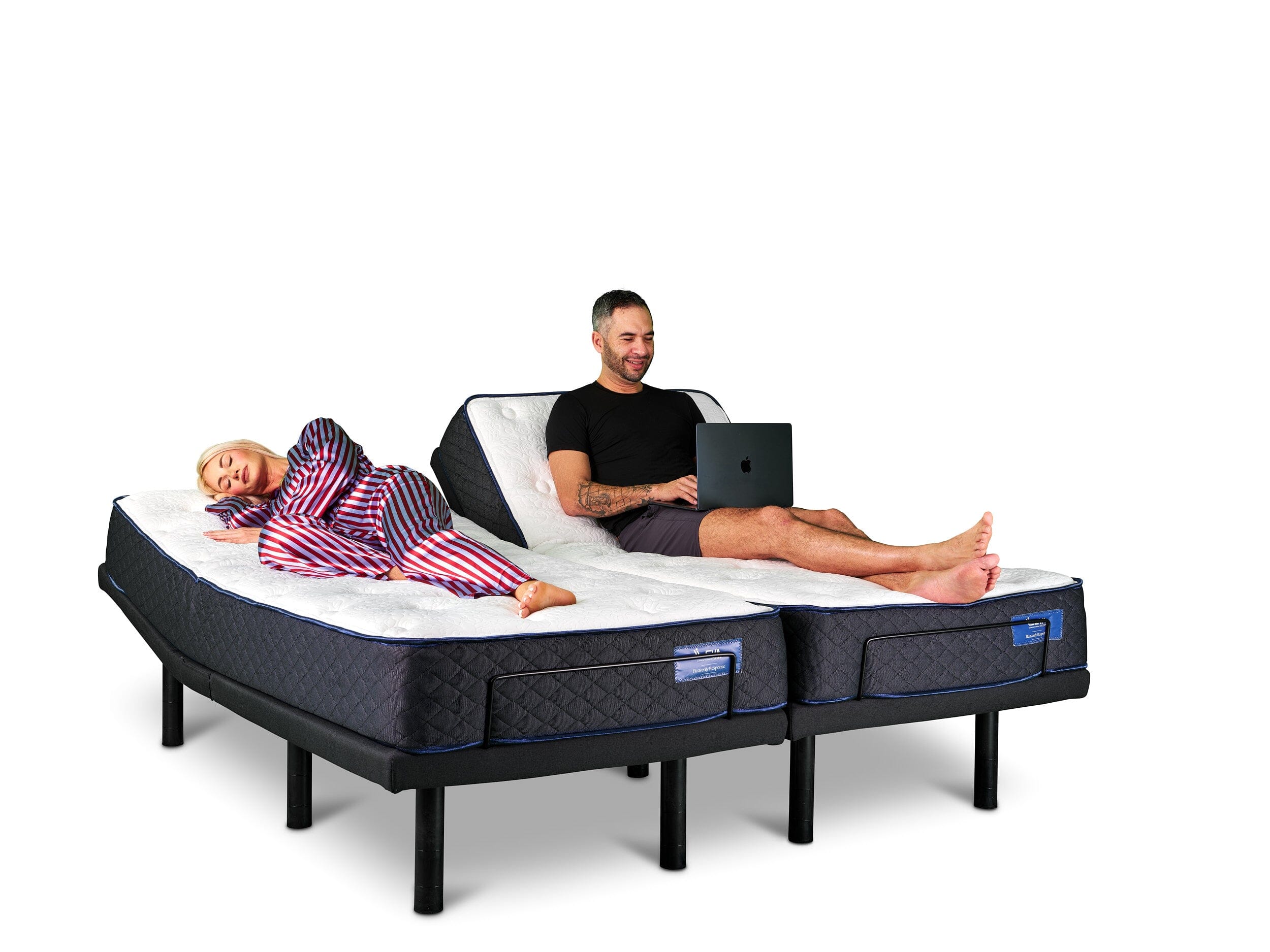
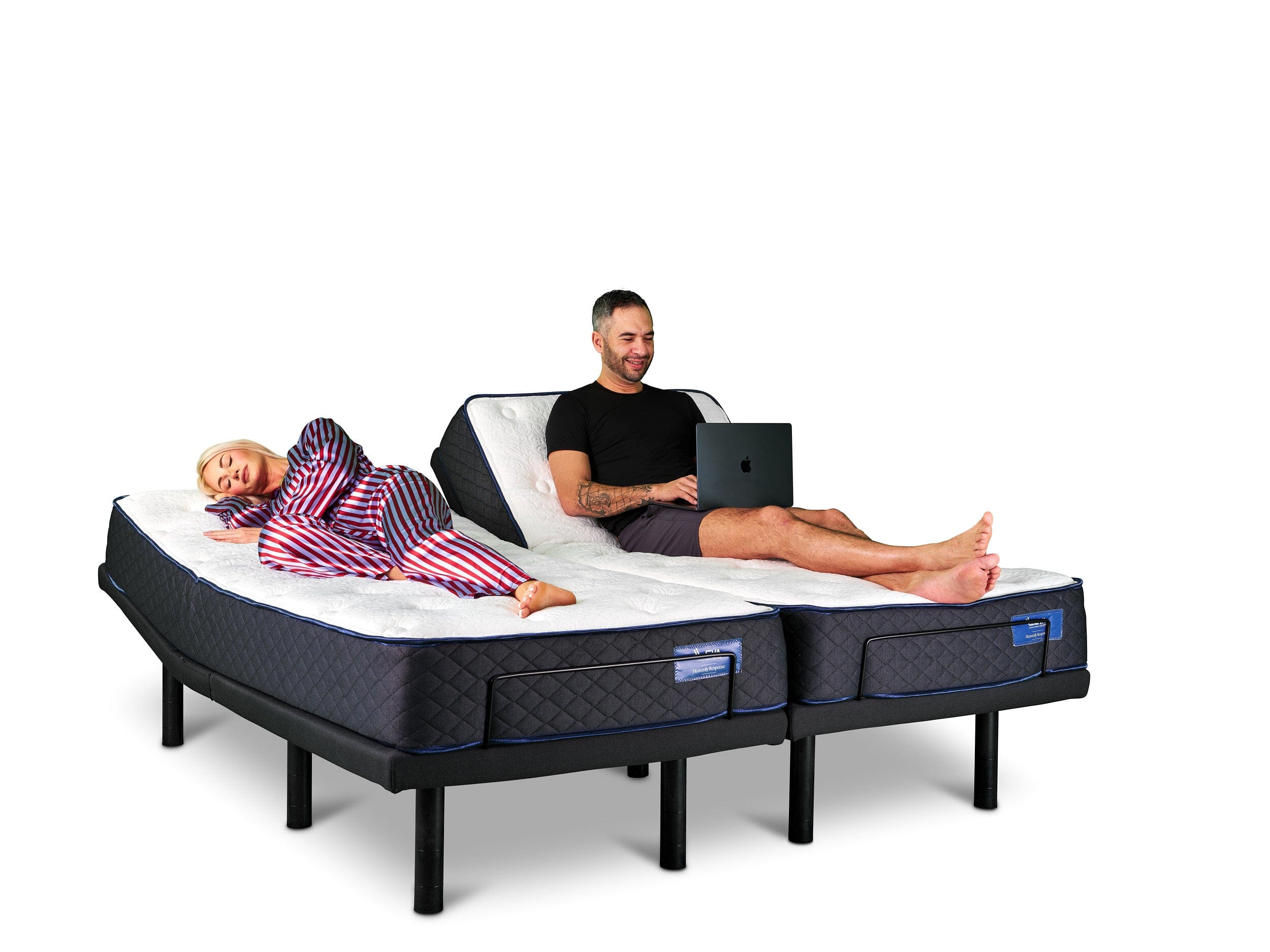
Leva Sleep’s Split King and Split Queen configurations give each partner fully independent control over head elevation, foot elevation, massage intensity, and lumbar support. One partner can sleep flat while the other elevates the head to manage acid reflux or mild sleep apnea. The anti-snore mode, available on higher-end bases, operates per side, so adjustments to one partner’s position do not affect the other. This independence is the main reason Leva Sleep focuses on split configurations rather than single-base systems.
How does a Split Queen adjustable bed help in smaller bedrooms?
A Split Queen uses two narrow twin-long bases placed side by side within a queen-sized frame, and each base has its own motor and controls. It delivers the same independent-adjustment benefits as a Split King but fits in rooms where a king footprint feels too large. Leva Sleep is one of the few Canadian providers that builds Split Queen systems to customer specifications, which makes it a practical option for couples in condominiums or older homes with standard-sized primary bedrooms.
Leva Sleep Split Queen Bed
Does white-glove delivery influence how sleep-data settings are configured?
Leva Sleep’s in-house white-glove delivery team handles physical assembly, leg-height adjustment, and a product tutorial. During that tutorial, customers can ask the delivery team to walk through the app’s privacy settings, confirm that Bluetooth-only mode is active, and verify that cloud-sync features are disabled if that matches the customer’s preference. Because Leva Sleep uses its own trained staff rather than third-party couriers, the setup session becomes a convenient chance to apply the five-step protection checklist with expert guidance present.
Is PIPEDA alone enough protection for smart-bed buyers?
PIPEDA sets a legal floor with meaningful consent, accountability for cross-border transfers, and access rights. It does not guarantee that every smart-bed brand complies in practice. Enforcement is complaint-driven, so a breach may occur before the Office of the Privacy Commissioner investigates. The five-step checklist in Phase 4 adds technical controls that work even if a brand falls short on compliance, giving consumers a layer of protection that does not rely solely on regulatory enforcement.
Conclusion: Balance Sleep Comfort With Data Control
Smart adjustable beds collect meaningful biometric data, and that data carries real privacy implications under Canadian law. The risk varies widely across brands and configurations. A bed that runs mainly over local Bluetooth, avoids monetising sleep data, and offers granular app-permission controls presents a much lower exposure profile than one that streams health metrics to offshore servers around the clock. Applying the five evaluation phases, from mapping collected data through to the buy-or-skip decision tree, gives Canadian couples a clear and calm way to decide without unnecessary alarm.